Key Points
- The Pinal County Planning and Zoning Commission voted 7-1 to recommend rezoning about 1,263 acres south of Eloy for a plant pairing 400 megawatts of solar with 400 megawatts of battery storage.
- The power is contracted to nonprofit cooperative AEPCO, which utility leaders say is needed to replace declining Hoover Dam hydropower.
- Supporters included Eloy’s mayor and a former mayor, the fire district and more than a dozen utilities and public power partners; opponents cited the cumulative loss of rural land.
- Commissioners pressed on crop-damaging heat, wildlife fencing, missing solar zoning rules, property taxes, surrounded neighbors and a still-unwritten decommissioning plan.
- The Board of Supervisors has the final say; construction could start as early as late 2026, with operations as early as December 2027.
The Pinal County Board of Supervisors approved the Eloy Valley Energy Center III rezoning on Sept. 2, 2026, with no opposing votes. Read the coverage of the hearing and vote at Eloy Valley Energy Center III Approved: 400-Megawatt Solar and Battery Project Planned South of Eloy. The two hearings covered different ground: supervisors focused on the power contracts, battery fire safety and where the power will go, while the commission discussion below centered on heat, wildlife fencing, a surrounded home and the county’s lack of solar zoning rules.
ELOY, AZ — About 1,263 acres of farmland south of Eloy moved a step closer to becoming a utility-scale solar and battery plant on July 16. In a pair of 7-1 votes, the Pinal County Planning and Zoning Commission recommended approval of the Eloy Valley Energy Center III rezoning and a companion development overlay. As a result, the NextEra Energy Resources project now heads to the Board of Supervisors for a final decision.
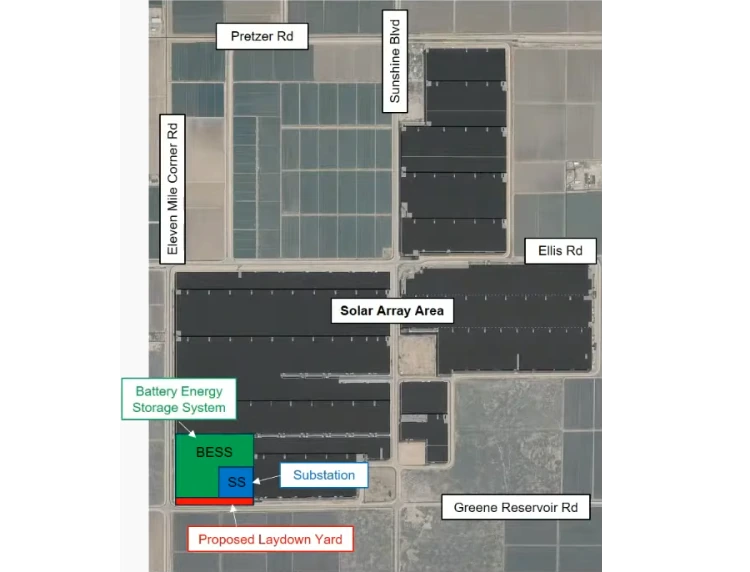
The plan pairs 400 megawatts of solar panels with a 400-megawatt, four-hour battery energy storage system and a new substation.
Its output is fully contracted to Arizona Electric Power Cooperative (AEPCO), a nonprofit wholesaler that supplies rural utilities in Pinal County. Construction could begin as early as late 2026. Operations could start as early as December 2027 if county approvals stay on schedule.
What NextEra Wants to Build South of Eloy
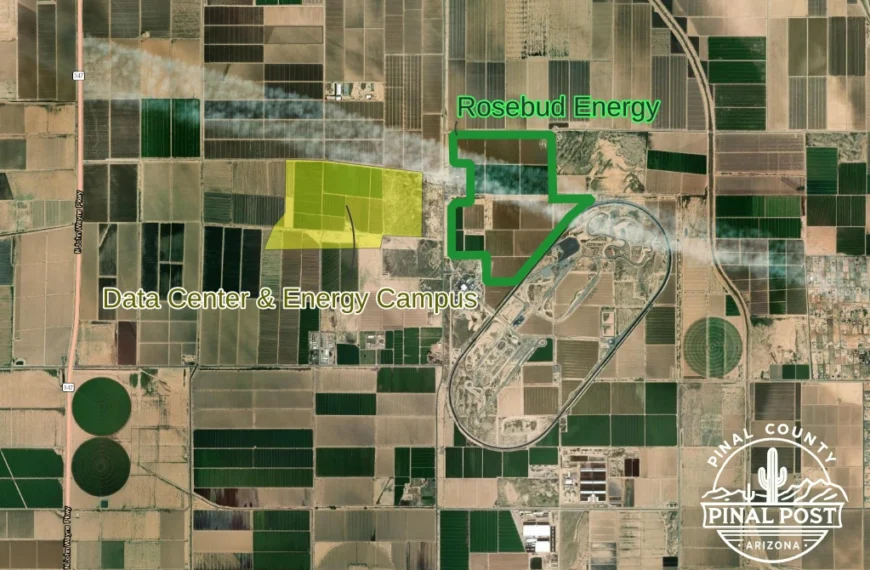
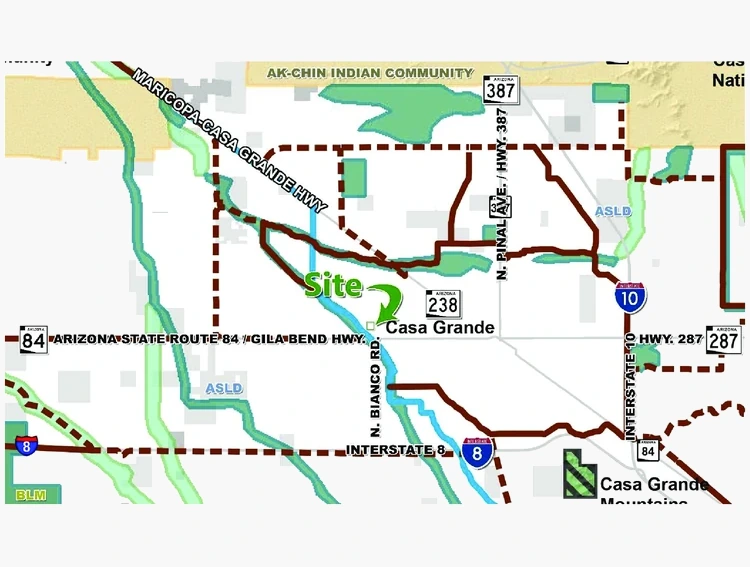
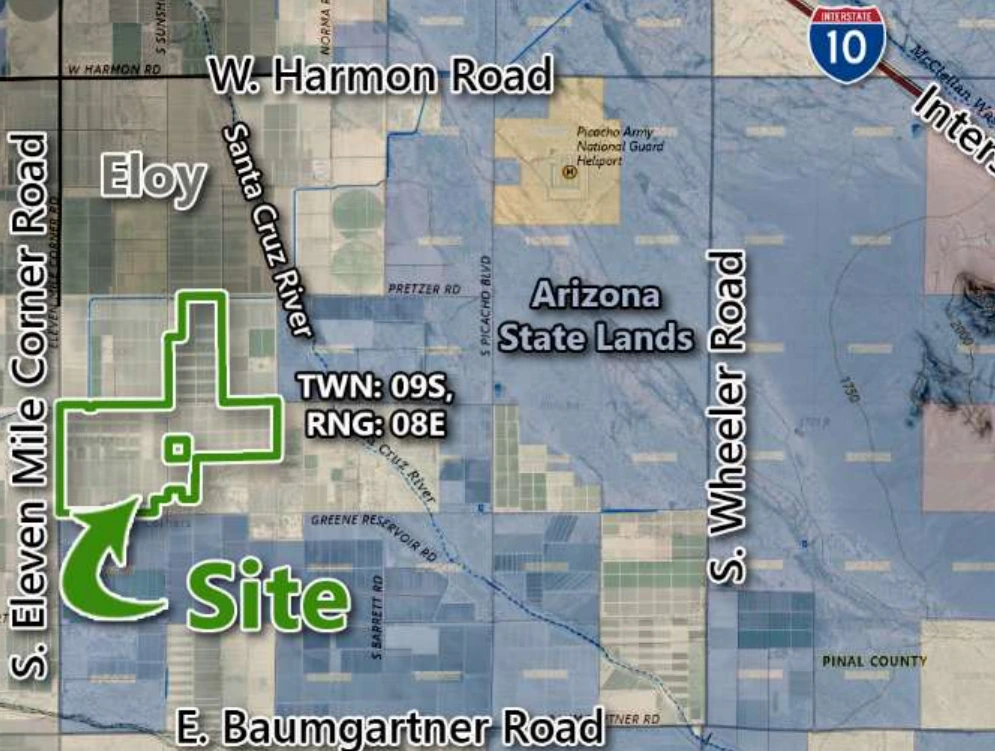
The site sits between East Green Reservoir Road and East Pretzer Road and between South Eleven Mile Corner Road and South La Palma Road in unincorporated Pinal County — the county portion of a larger project whose northern section lies inside Eloy’s city limits.
Today, the land is zoned for rural uses and farmed. The request would rezone it to an industrial district (I-3) while limiting the property to solar, battery storage and related equipment only.
The battery yard would sit behind a required block wall at least eight feet tall. Additionally, a 50-foot buffer — including a 10-foot landscaped strip — would surround the project, with block walls beside homes and chain-link fencing elsewhere.
The facility would use roughly five acre-feet of water per year, according to the applicant’s reports, and needs no potable water or wastewater service. According to the applicant, no new fire stations or personnel would be required, and NextEra has been coordinating with the Eloy Fire District on emergency response. Two family trusts own the parcels, which the project company plans to purchase.
A Warning About Heat, Crops and Dust
Commissioner Tom Scott challenged findings a company representative had presented to the commission about a year earlier, which reported little temperature change near solar panels. He said people living around existing solar farms report far larger increases than that study found, and he tied the heat to crop damage. “When you have an artificial increase in temperature or climate, it has a direct effect on the pollination of plants — cotton, corn, hay,” Scott said. “Plants need to rest at night. They pollinate at night.”
He then described a Pinal County field near another solar site. “Last year there was a farmer, not on this project, in the county that grew silage corn, and corn has to pollinate. The corn that was next to the panels didn’t get very tall,” Scott said, adding that the corn grew closer to normal farther from the panels. “You’re introducing something that’s going to be changing the climate.” Moreover, he warned the effects would cascade: “When you change the climate and you create more temperature, you get high pressure. You get more high pressure, you get more wind. And you get more wind, you get more dust.” Because another solar facility is already approved to the west, he said, the two together would magnify the change. “I am in and around it, and I know this to be true,” said Scott, who lives in Coolidge.
Sean Lake of Pew & Lake, who represents the project, replied that he was “not sure” he agreed. Instead, he said the studies he has read — which he described as measuring temperatures before and after, and at various distances — do not show what Scott described. However, Scott returned to the company’s earlier study, saying the person who conducted it took measurements only after the panels were built, not before.
Declining Hydropower Drives the Case for the Project
Lake told commissioners the project addresses a projected shortfall for local utilities. “With the hydroelectric power that’s going to be lost, we are going to have a 27% decline in electricity by the year 2028,” he said. Support letters attribute that figure to a U.S. Bureau of Reclamation study estimating the decline in hydropower output between April 2025 and May 2028.
Jordy Fuentes, executive director of the Arizona Power Authority, the state agency that receives Arizona’s Hoover hydropower allocation, provided figures on the decline during the public comment period. Hoover’s generating capacity is rated at about 2,100 megawatts but currently sits around 1,350 to 1,370, Fuentes said. Citing water conditions and problems with the dam’s turbines, he warned capacity could fall “as low as about 370 megawatts” by 2027 — “a major, major problem.” He added that the dam historically produces about 4.8 million megawatt-hours of energy a year but is on track for only about 2.6 million this year, of which “about 500,000 megawatt hours comes to Arizona, much of which goes to Pinal County.”
Even so, NextEra’s Kyle Whittier acknowledged the project fills only part of that gap, telling commissioners “there’s more work to be done.”
Where Eloy Valley Energy Center III Power Will Go
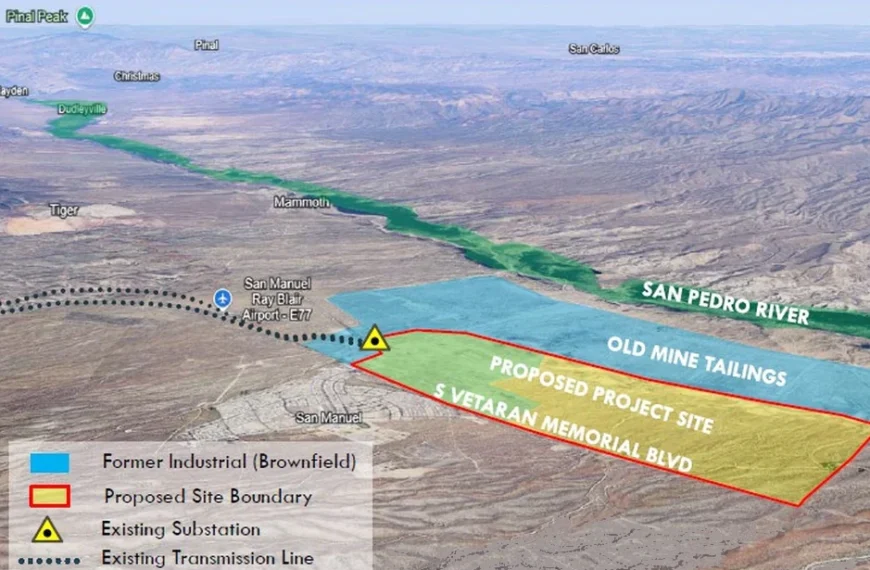
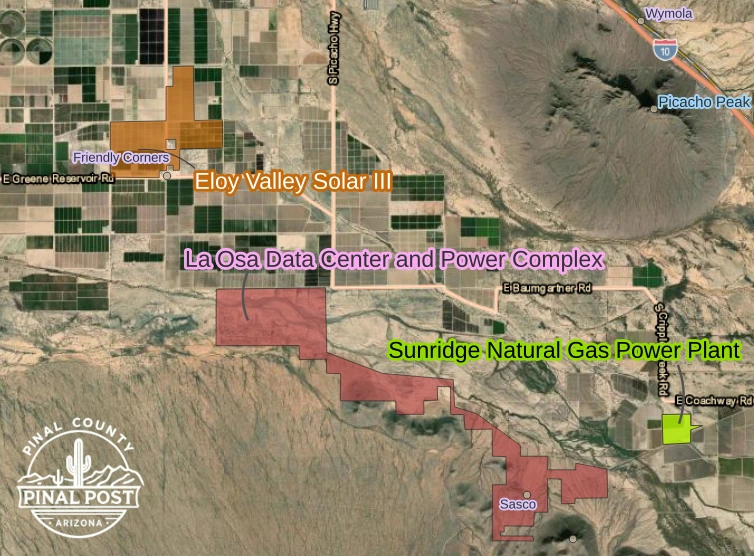
AEPCO has subscribed the output to member utilities including Electrical Districts 2, 3 and 4 and Trico Electric Cooperative. The plant would connect to the grid at a federal Western Area Power Administration substation about 1.7 miles away, next to existing transmission lines, which the applicant cited as a reason for choosing this location.
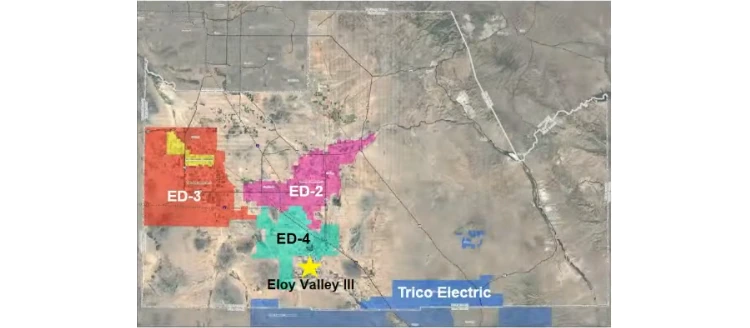
Utility executives spoke in support of the request. Brian Yerges, ED3’s general manager, carried a small flag reading “I support Pinal Solar,” the name the utilities use for the project, and said ED3 subscribed to its share of the project in 2025 and is committed to it for the next 20 years. AEPCO CEO Patrick Ledger added that the cooperative exists to serve rural, lower-income communities the big utilities passed over, so affordability drives its decisions. “We’re not pro-solar, we’re not pro-nuclear, we’re all of the above,” Ledger said.
Commissioners still probed whether the electricity would truly stay local. Chairman Robert Klob noted that developers usually claim they cannot control where power flows, yet this applicant promises local delivery. In response, Whittier explained that the interconnection point limits who can ultimately take the energy, even though individual electrons cannot be traced. When Vice Chairman Karen Mooney asked for “checks and balances” that the power is “staying in this area and not going to Maricopa County, California, New Mexico,” Yerges answered that metering and scheduled deliveries track every sale, with the energy settled and reconciled hourly, daily and monthly. “You can’t say the electron goes here or here. It goes on the system, but it’s done through metering software and financial products,” he said. He added that the output is fully subscribed to AEPCO, its members and its public power partners under signed agreements — “for the benefit of the State of Arizona,” with “a major portion” for Pinal County.
The Eloy Valley Solar Project’s Approvals So Far
Lake framed the rezone as the next step in a process that began in 2021, when the Board of Supervisors designated the site for Green Energy Production. “In 2021, the Pinal County Board of Supervisors approved this site for green energy. Now, the zoning that we’re requesting is the only zoning that we can put into that category, so we’re just taking the next step in accomplishing that,” he said. The team, in his words, is trying “to really implement an approval that has already occurred by Pinal County.”
Afterward, the developer worked with the City of Eloy, which adopted solar siting criteria in 2023 requiring such projects to sit south of Interstate 10, among other requirements. Additionally, the applicant says the project holds two Eloy conditional use permits, and state regulators in March 2026 approved an environmental compatibility certificate for the project’s 1.7-mile transmission tie-in line. “It’s not just one jurisdiction,” Lake said. “It’s Pinal County and Eloy and the Corporation Commission that we’re all working together.” The relationship with Eloy continues, he stressed, citing support letters from Mayor Andy Sutton and former Mayor Micah Powell and an open house held at Eloy City Hall; the meeting report says the February gathering drew about 30 people. The chain-link fencing will follow Eloy’s design standards because the site borders the city, Whittier said.
“We Should Have a Zoning Code for This”
Mooney raised a concern: Pinal County has no zoning category written for solar and battery storage. “If the zoning code had been in place, we would have different requirements, I’m sure,” she said, adding that her frustration was “nothing against the applicant.” Because no solar code exists, the project lands in the same industrial district that covers adult-oriented businesses, airstrips, flammables bulk stations, heliports, and junk and salvage yards. “To throw this solar or others into the same setback requirements gives me severe heartburn,” Mooney said. “So it’s on record, we should have a zoning code for this.”
She pointed to specific gaps in this case. She questioned the required buffer, noting other green-energy projects have provided 100 to 200 feet; similarly, Scott had asked the company to expand its 50-foot setback to about 200 feet, and Whittier answered that 50 feet is the county minimum and any more “reduces what’s possible to be built.” Mooney also questioned a stipulation calling for wildlife-friendly fencing when the plan relies on block walls and chain link, which staff said would be resolved at site plan review.
Support From Mayors and Co-ops, Pushback From Rural Residents
Staff counted 22 letters of support and 12 letters of opposition naming the case, plus two opposition letters that did not cite a case number. Support came from Eloy’s current and former mayors, the Eloy Chamber of Commerce and the Eloy Fire District. The site sits outside the fire district’s boundary, but the district wrote it would most likely be the agency responding to a fire there, and it must send an ambulance to medical calls because the site falls within its state-certified ambulance area. After reviewing the site plans, Fire Marshal Robert Jarvis concluded newer battery designs and chemistries are “much safer than what was experienced in Surprise and Chandler years ago” and wrote he has “no concerns” about this type of development. In addition, more than a dozen AEPCO member utilities and public power partners urged approval, along with the City of Mesa and the Arizona Technology Council, whose representative Cepand Alizadeh told commissioners, “We cannot be saying no to forms of energy.” Most of the utilities that submitted letters are Arizona-based, but AEPCO’s cooperative membership extends into Nevada and New Mexico. Members there, including Boulder City and Columbus Electric Cooperative, wrote that they will “directly benefit from the energy produced” by the project.
Opposition at the hearing centered on the cumulative loss of rural land. Robin Davis, a Hidden Valley resident, said, “Combined with the other energy project rezoning requests from the past and the ones that are coming through the process, we are losing Pinal County.” Therefore, she asked the panel to deny the request: “I urge the denial of recommendation until our laws, codes, and ordinances can catch up to the onslaught of these requests.” By contrast, Tena Dugan, who said she generally opposes solar projects, offered conditional support. “Every project deserves to be evaluated on its own merits, and this proposal’s different,” Dugan said. With the past projects she opposed, she explained, “there was absolutely zero guarantee that that power is coming back to Pinal County. I believe that this project will come back to Pinal County.”
Neighbors drew attention too. One adjacent owner who keeps horses filed an opposition letter; after the company sought him out, it dropped oleanders — a plant toxic to horses — from the landscape plan and committed to a six-foot wall beside his property. However, among the owners whose land would be surrounded, one told the company he did not want to engage either way, and another never responded to its outreach, Whittier said. That “island” worried Klob, who said solar on all sides “really severely lowers their property values” and urged continued outreach.
Donations, Taxes and a Handful of Permanent Jobs
Whittier introduced NextEra as an “American-owned and operated company” with nuclear, gas, renewable and storage assets nationwide, including three wind, six solar and eight battery sites operating in Arizona with more in development. He also pointed to a list of local giving, including 10 scholarships to a first-responders charity, annual sponsorship of the Eloy Glow Festival, a food pantry donation, a boxing gym refurbishment grant, a library after-school program and county fire department training. Those sponsorships continue for the life of the project, he said, alongside a new workforce-development program tied to federal grant funding connected to AEPCO.
Property taxes came up only when Scott asked why the presentation omitted them. Lake said the team was hesitant to bring them up because past applicants “have gotten their hand slapped for even raising it.” Still, he said the project will pay property taxes — primarily benefiting the school district — along with development fees. Scott countered that little of that money returns locally in his experience, and that a farm’s recurring spending on wages, equipment and supplies would be traded for a facility promising only “four or five permanent jobs.” For its part, the rezone narrative projects more than 400 construction jobs and about five to 10 permanent positions.
Herbicides Planned, a Decommissioning Plan Promised
For upkeep, the site will rely on herbicides and a site-specific weed control and vegetative management plan, county staff said. Meanwhile, no decommissioning plan has been submitted yet; a stipulation requires one at site plan review covering removal of all equipment, structures and foundations, restoration of the surface grade and soil, and revegetation. Mooney, who has pushed for such plans “since I first sat on this dais,” called it “sad that it isn’t coming before us.” Whittier explained that the company is combining its plan with the City of Eloy’s requirements, which he called “pretty strict,” after a July 8 meeting with city staff. “We anticipate having it before Board of Supervisors,” he said, adding that the project will fully fund removal and recycle panels, batteries and other materials where possible.
Why Commissioners Voted to Move It Forward
Before the vote, Klob explained what separated this application from the many solar cases the panel has denied. His standard demand, he said, is “show me how it benefits the people I represent in this county.” In the past, he added, “some of these companies have claimed support and we find out later, ‘we haven’t even talked to them before.’” This time, he said, the people benefiting were in the room. “Not only are you claiming the support, but you brought the people to say, ‘No, we’re supporting it. We’re writing the checks.’ So that means a lot to me,” Klob said.
Scott told colleagues, “Pinal County’s not out of power,” pointing to several recently approved gas plants and a Coolidge power plant expansion on top of the tens of thousands of acres of solar he said the county already has. Lake pushed back: “That’s not what I hear when I talk to power companies,” he said, noting the local utilities came to the hearing themselves and said, “This is what we’ve contracted. This is what we need. Please.”
Ultimately, the commission recommended the rezone with one stipulation and the development overlay with 20 stipulations, each on a 7-1 vote. Commissioner Bryan Hartman recused himself from both items, citing a potential conflict of interest.
The Board of Supervisors Holds the Final Say
Eloy Valley Energy Center III now needs approval from the Pinal County Board of Supervisors, which holds final authority over both requests. If it clears that hearing, the project must still complete site plan review, including traffic, drainage, landscaping and decommissioning submittals. Should the schedule hold, the power would arrive in time for summer 2028 — the target ED3 says it is building toward. Asked whether the site would “not just sit for the next 10 years like some of the other projects we’ve seen,” Lake answered, “This is a go, go, go, go, go.”