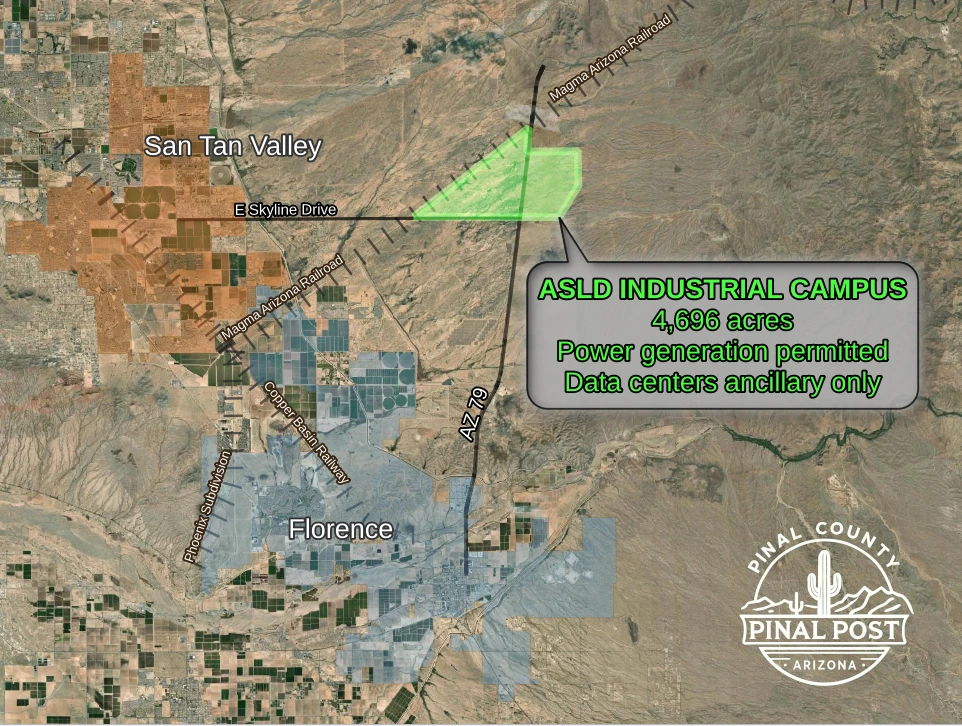
The Pinal County Board of Supervisors approved the SR 79 industrial rezoning of 4,695.89 acres of State Trust land on Sept. 30. The property straddles State Route 79 north of Skyline Drive and north of Florence, with San Tan Valley to the west. The Arizona State Land Department will auction the land for an industrial campus once the approvals are in place, according to its application. A future employer could run its own data center there and generate its own solar power with batteries. However, conditions attached to the approval bar data centers that lease space to outside companies and utility-scale solar that serves users off the site. The state’s attorney said standalone battery storage is barred as well.
Jordan Rose, the Rose Law Group attorney representing the department, told the board the request strikes several uses from the site, including “no standalone data centers, no standalone solar or battery storage.” She told the county’s Planning and Zoning Commission earlier that the state has no buyer in mind. Neither she nor county staff gave an auction date.
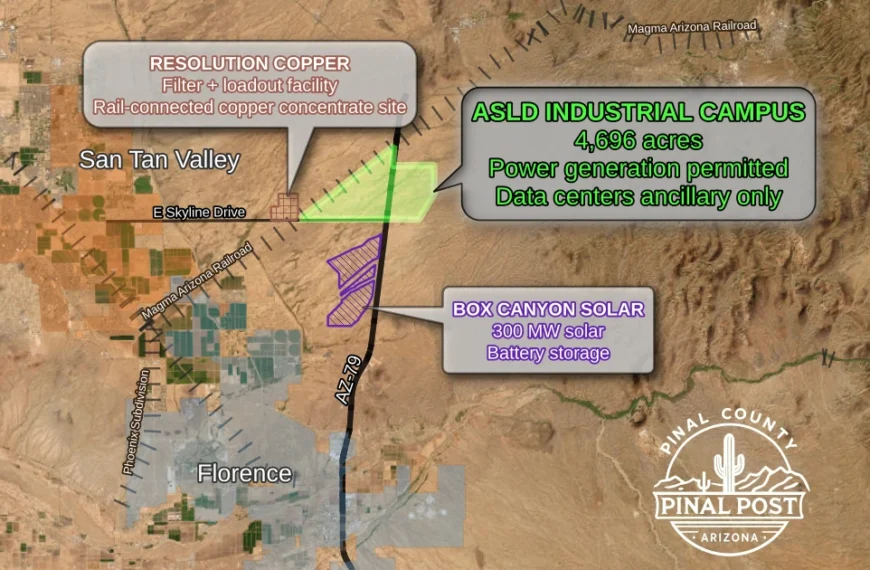
The AZ 79 corridor north of Florence is transforming as industrial and energy projects line the highway. The newly rezoned state land (green) sits among the denied Silver King Energy Center (red), which overlaps its west end; Resolution Copper’s planned copper filter and loadout plant (olive), where the railroad meets Skyline Drive; the site approved for Project Ranger (blue), just south of Skyline; and Box Canyon Solar (yellow), in operation farther south. Boundaries are approximate. Click any shaded area for a description of that project, and switch layers on and off in the legend. Open the map full-screen
What a buyer can and cannot build on the site
The board approved three linked requests: a Comprehensive Plan amendment that changes the land’s designation to “Special District,” a rezone from General Rural to I-3, and a Planned Area Development overlay that sets rules for this property alone. Planning Supervisor Sangeeta Deokar called I-3 the highest level of industrial zoning. The overlay strikes some uses from the I-3 list and adds “research and development.”
The overlay rules out several uses, including landfills, junkyards, prisons and adult businesses. Meanwhile, manufacturing, heavy trucking, power plants and airports are among the industrial uses that remain allowed.
Two of the 19 conditions attached to the overlay set the rules on data centers and solar. The data center condition bars a data center “which hosts and leases servers and networked computer systems for third-party consumers/tenants.” It then allows “a data center as an ancillary use” serving “the primary enterprise functions of the on-site property owner or business entity provided it is not used to lease data storage and processing to third parties.”
Similarly, the solar condition bars a utility-scale solar facility built “to generate power to third party entities outside the rezoned lands.” It adds that “the use of solar facilities to serve any facilities on the rezoned lands will be allowed.” Neither condition sets a numerical size limit, but a data center must remain secondary to the site’s main business.
The conditions do not mention battery storage. Rose said at both hearings that standalone battery projects would not be allowed. The applicant’s written materials address solar paired with battery storage. Its slides for the board say “NO Stand alone Solar with BESS,” or battery energy storage systems. Its narrative says data centers and solar with battery storage “will only be allowed to operate on the Property as ancillary uses to provide support to the primary use.” Only solar carries a condition limiting whom it may serve; power plants, which remain an allowed use, do not.
Vitiello asks for the ancillary data center rule on the record
Supervisor Rich Vitiello said he watched the commission meeting and asked Rose to explain again, for the record, what “ancillary” means for a data center. “We have struck the idea that a user could come in and just do a data center project,” Rose said. “We’re not preventing somebody from having a server farm … just like any business would have.”
“Ancillary means it’s ancillary. It’s not a primary use,” Rose said. “And the same with solar and battery too,” she added, confirming that the limit applies to standalone solar and battery projects. No other supervisor asked a question.
Skyline Drive would extend east to SR 79
The site sits south of the Magma Arizona Railroad. The land is vacant desert under grazing leases, and Deokar said the nearest house is about three miles to the west. Skyline Drive now ends at the railroad, on the site’s west edge. Consequently, the developer must build Skyline east to SR 79 as the site’s legal access. The conditions also require a traffic study and at least two access points to public roads. According to the application, the extension would give residents an alternative east-west route with a connection to SR 79. The remote site has no sewer service, so an employer would treat wastewater on-site with a septic system; the auction winner must extend water and power.
Why State Land sought the SR 79 industrial rezoning
Rose tied the request to the Silver King Energy Center, a solar, battery and natural gas project that overlapped part of this land and that supervisors unanimously denied in February. She said the commission, the board and residents rejected that project and asked that the land be saved for jobs. “The State Land Department listened to that,” she said. According to Rose, the department wants the zoning in place “in order to attract a jobs-producing potential developer there, providing high-paying jobs.”
The “Special District” land use designation exists only for State Trust land. Deokar said it lets the state process a land-use change at any time of year instead of waiting for the county’s once-a-year major amendment cycle. Because the department must sell land at public auction, the staff report says, it secures zoning first to get the maximum value. The applicant’s notice to nearby property owners said the approvals would make the land “more marketable to future industrial developers.” Rose told the commission the sale proceeds fund Arizona’s public schools.
If a buyer later wants a prohibited use, such as a standalone data center or solar farm, it would have to file a new application. Planning Manager Harvey Krauss told the commission that request would go through the same public process as a rezoning.
No public comment; wildlife buffer condition dropped before the commission vote
No one spoke when Board Chairman Jeff McClure opened the public hearing, and staff reported no letters of support or opposition. Likewise, no residents attended the applicant’s Aug. 25 open house in San Tan Valley, and none spoke at the commission hearing.
Commissioners questioned the limits at length at their Sept. 17 hearing before recommending the SR 79 industrial rezoning 7-2 on each item.
The Pinal Post’s coverage of the commission hearing, Employer’s own data center could be part of 4,696-acre industrial site along SR 79, includes:
- How staff defined an “ancillary” data center, and why an office as the primary use with 27 “ancillary” data centers would not qualify
- What on-site solar could look like, and who would enforce the solar limit
- Commissioner Tom Scott calling the request vague because it is unknown whether one employer or several would come, and Commission Chairman Robert Klob’s concern about zoning nearly 4,700 acres without knowing the user, since the industrial zoning, as he put it, “lasts forever, lasts until it gets rezoned”
- Vice Chair Karen Mooney’s worry that banning data centers here signals the county’s I-3 industrial zoning allows them elsewhere, and Krauss telling her, “Yes, you are right,” that a data center could go on land already zoned I-3 without a development plan, and saying the county has no data center ordinance yet
- Commissioner Gary Pranzo arguing that battery storage, charged at night and discharged during the day, would help an industrial area, and Rose responding that batteries are allowed, just not a standalone battery farm
- Pranzo’s objection to excluding data centers from an industrial site
- The dormant Magma Arizona Railroad, Resolution Copper’s planned copper filter and loadout plant and the Project Ranger site next door
The staff report first posted for the commission’s Sept. 17 hearing included a condition that would have required a buffer around the riparian washes that cross the site “to ensure wildlife connectivity as determined by Arizona Game and Fish.” Staff removed it before that hearing, and the board packet contains only the revised report. Krauss said existing county ordinances and policies already address it and the wording “raised some ambiguity,” so it would be worked out at the site plan stage. Staff also removed the county Open Space division’s note about a planned regional trail along the railroad, saying the trail is more appropriate on the north side of the tracks.
The board approved all three requests with no supervisor voting against them, on motions by Supervisor Stephen Miller.
Auction and studies come before any construction
According to the application, development will not begin until the state auctions the land. The staff report says cultural and environmental studies will be completed before the state releases the property, and a buyer must submit a site plan before building. Rose told the commission the department may sell the whole property to one employer or split it into sections. Krauss told commissioners the SR 79 industrial rezone came without a specific development plan, so the industrial zoning alone could have allowed data centers. Staff added the data center limit, he said, “because we don’t have any guidance on how we would deal with those.”
Case numbers: PZ-PA-018-26 (Comprehensive Plan amendment), PZ-024-26 (rezone) and PZ-PD-021-26 (PAD overlay).