Key points
- Supervisors voted 3-2 to delay the State 48 Microschool permit vote to Nov. 18.
- The family opened the school at home about two years ago for their children and their friends, and applied for the permit in November 2025 after a neighbor complaint. The Planning and Zoning Commission recommended denial 7-2 in July. The county is rewriting its zoning code but has not adopted microschool-specific rules.
- County zoning allows a “school” in the rural zone without a special permit, but staff read that to mean public and charter schools. The school argues the word also covers private and micro schools, so it needs no special permit. The county Board of Adjustment, which rules on how the zoning code is interpreted, is expected to hear that question Oct. 22, according to Kemper.
- For future cases, supervisors said the county’s code rewrite must define a microschool; one suggested a 12-student limit for homes, or perhaps 15.
- Neighbors cited noise, traffic, safety, and commercial use; families said their children struggled elsewhere and are thriving there.
SAN TAN VALLEY, AZ — Neighbors and families of the State 48 Microschool, a small nonprofit school run from a home southwest of San Tan Valley, will not see a county vote on its special use permit before Nov. 18. County staff say the school needs that permit to operate in its rural neighborhood, where some neighbors oppose it over noise, traffic, safety, and what they see as a commercial use. On Sept. 16, the Pinal County Board of Supervisors voted 3-2 to continue the public hearing on the State 48 Microschool permit. Karli Kemper, who runs the school, asked for the delay. She has requested a formal ruling on whether the word “school” in the county zoning code already covers private and micro schools. If it does, she told the board, no special use permit would be needed.
Why the State 48 Microschool Permit Vote Waited
Kemper told supervisors she applied for the permit because she was told her home-based microschool “was not otherwise legal because it is somehow not a school.” On Aug. 13, she asked the county Board of Adjustment to decide what “school” means in the zoning code. County staff then offered to postpone the supervisors’ hearing until after the Board of Adjustment hearing, she said.
A representative of the county attorney’s office said the legal arguments had not yet been reviewed and that the office was not stating a position on her request. Meanwhile, because the county had already advertised the public hearing, the board took public comment before voting to continue the case.
Supervisors Call for a Microschool Definition
Supervisor Stephen Miller said he wants to focus on defining a microschool. The topic came up during earlier code revisions, he said, and he assumed the board had not yet reached that section of the code. “I hear the term, but I can’t define it, and I think we need to define that first,” he said. If asked to set parameters himself, Miller said, he would allow no more than 12 students in a residential home, with hours from 7 a.m. to 5 p.m. “After that it needs to go to a commercial site,” he said, though he later said he might accept up to 15 students.
Vice Chairman Jeff Serdy asked staff to prepare an overview of the neighborhood showing who lives where and where the cars come from. “Ten to 12 cars in a neighborhood, that sounds like a lot at any time,” he said. He compared the case to wedding venues opening in neighborhoods in his district that were not built for crowds of guests. Therefore, he told County Manager Leo Lew, the county needs to look at all such uses when it works on the codes. He also cautioned that approving the permit could “encourage more and more of this wildcat neighborhood businesses,” which he said include more than schools.
Supervisor Mike Goodman said public schools in neighborhoods are nothing new, but they must meet requirements such as parking and facilities for students with disabilities. He asked staff to make sure those requirements are checked here. Goodman also observed that the county enforces its rural code only on complaints.
Supervisor Rich Vitiello, whose district includes the property, said he has serious concerns about reports of buildings put up without permits. He also questioned staff’s comparison of the school to homeschooling. “If you’re homeschooling, you’re not charging,” he said. At the July commission hearing, the school said it receives no public funding and that parents pay tuition directly.
How Staff Measured the School Against a Draft Definition
Planning Manager Harvey Krauss said the case began as a code complaint from neighbors. Neither the county code nor state law defines a microschool, he told the board. County code lists “school” among the community uses allowed in the General Rural zone, alongside uses such as churches and libraries. However, staff reads that word to mean public schools, which state law allows in every zoning district, and charter schools receive the same treatment. Because State 48 is neither, Krauss said, it “more closely meets the code definition of a private school.” Unlike some other zoning districts, the General Rural zone does not expressly list private schools. As a result, staff reviewed the request under a catch-all for uses the county “may deem appropriate in the public interest.”
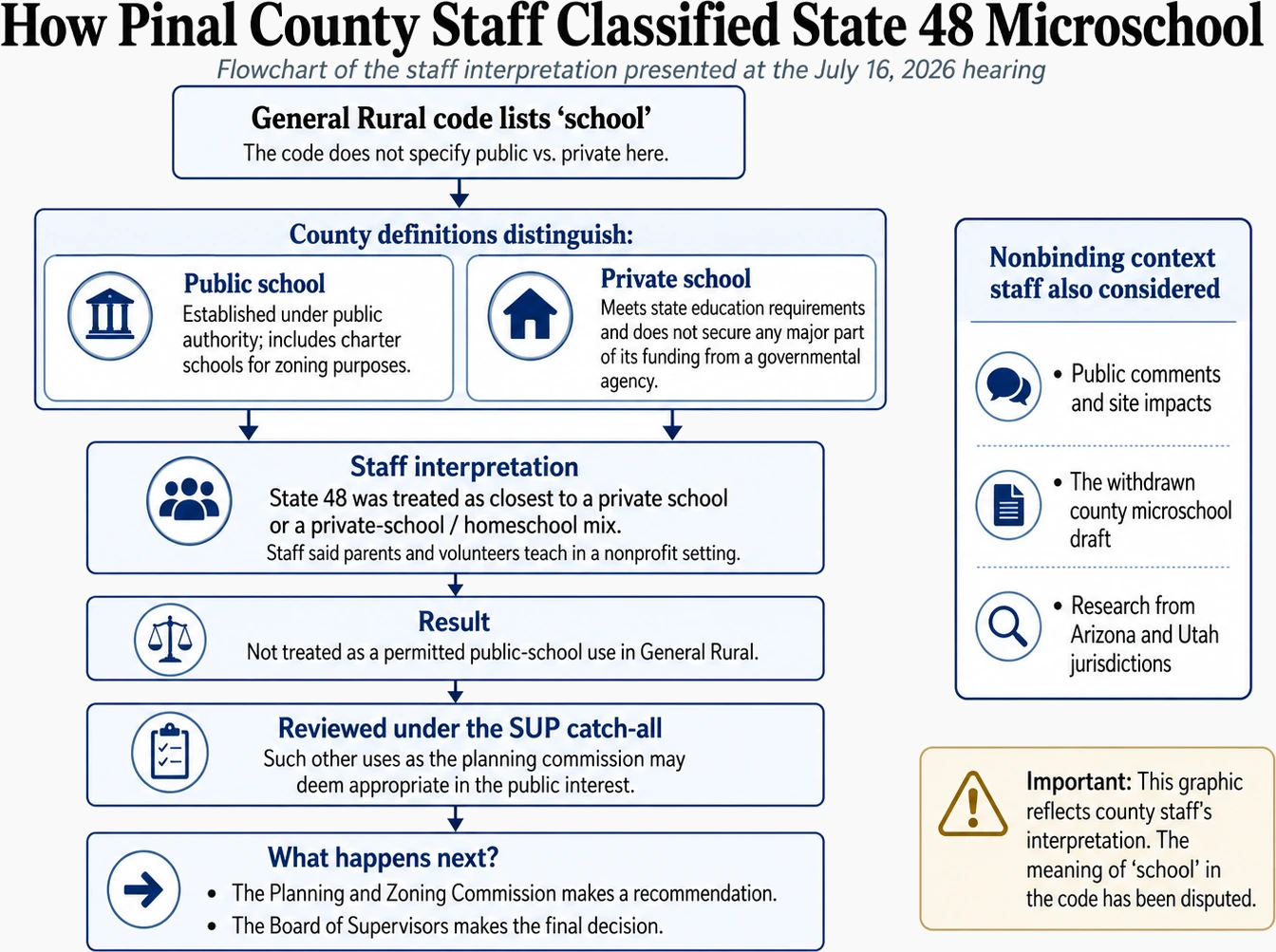
How Pinal County staff classified the State 48 Microschool under the General Rural code, as first presented at the July 16 hearing.
Krauss said staff used the county’s withdrawn draft code, which limited home-based microschools to 15 students, as a reference point along with research from other jurisdictions. That research found a similar pattern: up to 15 students in grades K-8, on at least one acre, from 7 a.m. to 6 p.m. An operation with enrollment in the 30s, he said, would look like “more of a commercial operation.” Krauss described what staff considers workable on a rural lot: a “limited educational use, maybe compatible if low intensity, residential appearance maintained and neighborhood impacts are minimized.”
How the Request Compares With the Draft Definition
The school’s permit request asks for up to 35 students, ages 9 to 18, from 7 a.m. to 6 p.m. Monday through Friday. About 20 students are enrolled now, Krauss said, and the 35-student cap was the Planning and Zoning Commission’s primary concern. The property includes a 2,591-square-foot home, and staff listed a 400-square-foot detached garage and two sheds of 800 and 468 square feet as classroom buildings. Because of the number of students and vehicles, he said, staff judged that the school could affect the neighborhood like a commercial microschool, as other counties and cities classify them. Staff’s evaluation, Krauss said, was that it should be in commercial zoning rather than a residential area.
When Vitiello asked about buildings described as illegal at the commission hearing, Kemper said the family obtained a permit before constructing its classroom building, and the detached garage came with the property. The structure in question, she said, was a temporary haunted house attached to a classroom for an event, and it has since come down. The county’s presentation notes that the property has an open code compliance case, with neighbor complaints about an unpermitted structure. Either way, Krauss said, using the buildings for a school changes how the building code classifies them. Any building where students learn would need upgrades to meet that code, including disability access under the Americans with Disabilities Act (ADA). Staff’s conditions would bar school use of any structure until it has the required permits and fire inspections.
Neighbors Cite Noise, Traffic and Safety
Two nearby residents spoke against the permit. Jennifer Corcoran, who lives next door, said the term microschool is vague but suggests a small group of children. What happens next door “is not small,” she said, with 20 to 30 children on an acre and a half. She and her husband built there for peace and quiet, not commercial businesses, she said. On the Wednesday before the hearing, she counted at least 21 cars entering and leaving the driveway. The noise keeps her from opening windows or doors, and after-school dance, choir, and enrichment activities are nonstop, she said. Her three main concerns are noise, traffic, and safety, including fire safety, she said. She also cited ADA compliance, paid staff on the property, and property values.
Arthur Hargrave, who lives behind the property, said the request would turn a residential parcel into a commercial one. A theater combined with a school and academics is, to him, a commercial operation that does not fit a general rural area. He said a planning commissioner voted against the permit in July for that same reason. Instead, he suggested the school lease, rent, or buy commercial property, where it would have room to expand. Hargrave, 73, said he built his home there for peace and quiet and does not want to have to move. He estimated at least 20 to 25 neighbors would object if asked individually, citing noise, safety, and dust. The neighborhood, he said, is no longer a healthy atmosphere.
Families Say Other Schools Did Not Fit Their Children
Six speakers supported the school, including five parents of current students. They described children with autism, ADHD, auditory processing disorder, and a brain injury who struggled in larger schools. Several said they had tried other options first. Robert Daly of San Tan Valley, for example, said his family tried public, charter, and other private schools. His 8-year-old son “didn’t make it through a year of school at all” until he enrolled at State 48, Daly said. “It was a fight every day to get him to go to school,” he said. He credited the school with teaching his son to read and helping him make friends. Jenny Harris said public school staff cared but “didn’t have enough teachers to give her the individual attention that she needed.” In a short time, she said, the school brought her daughter back to grade level.
Parents also spoke about the setting. Shetawn Baker, whose daughter has attended since the school’s first day, said small classes, individualized attention, and a home-like environment reduce distractions and sensory overload. Her daughter now wants to go to school every day, she said. In her view, the home-like setting is part of how the school teaches, not just a place where classes happen. Meanwhile, Daly said performing arts lessons teach skills such as public speaking and memorization and help students “break out of their shell.” Chuck Green said he spent more than 20 years as a teacher and administrator, including at the nearby Eduprize charter school. He said the school serves “kids who don’t always fit comfortably into a traditional school setting.”
Supporters also described traffic, dust, and noise at the site. Harris said pickup and drop-off happen behind the gates and that drivers follow the speed limit. Heath Medeiros of Johnson Ranch said he sees no more than 10 to 12 cars at a time, with waits of 10 to 12 minutes at most. Daly said gravel keeps dust down and that the Eduprize campus down the road is louder than State 48 Arts and Academics. Baker said no more than 10 to 15 children go outside for recess at once, for up to about 20 minutes a day. Green said “decisions this important should be based on what is actually happening at the property.”
Jennifer Blackford lives nearby on a similar property and enrolled her children this year. She said the site’s fencing gives privacy to both students and neighbors. Her family chose the school partly for its yard, which is equipped like an ordinary backyard. “When you drive past the home, all you see is a beautiful home just like the ones next to it,” she said. Meanwhile, Medeiros said the neighbors’ concerns deserve to be heard and that some may have remedies in time. “Having choices matters, and giving our children the opportunity to thrive matters even more,” he said.
Conditions the County Would Attach to the Permit
The Planning and Zoning Commission voted 7-2 on July 16 to recommend denial. The permit under consideration includes 19 conditions, listed in the county staff presentation. They would hold the school to its requested weekday hours and 35-student cap, or fewer students if building and safety reviews require it. They would also bar evening and weekend activities, keep all drop-off, pickup, and parking on the property, and ban outdoor loudspeakers and amplified music. Violations could lead to the county revoking the permit.
At the July hearing, which followed a June postponement, commissioners debated the enrollment cap against the 15-student limit in the draft zoning code the county withdrew in 2025, along with age limits, hours, and whether the operation is commercial. Neighbors there also cited parking and disclosure to future buyers. In response, the family said it had moved performances off-site, redesigned drop-off, and added privacy screening.
The case comes as the county rewrites its zoning code. Pinal County launched a comprehensive update in early 2025 but withdrew it after public outcry. The update now proceeds section by section, and microschool rules are among the planned topics. Residents can track that work through Pinal Code Watchers or its Facebook group.
Two Dates Now Frame the State 48 Microschool Permit
Kemper said staff told her the Board of Adjustment can hear her request on what “school” means in the zoning code on Oct. 22. The State 48 Microschool permit is scheduled to return to the supervisors on Nov. 18 with a new public hearing, although, when Serdy asked if that was certain, Chairman Jeff McClure said the Board of Adjustment “may solve it, or it may come back to us.” Because the case was continued to a set date, people who came to speak can return then, and the hearing will be publicized again, said Christine Roberts, deputy chief of the county attorney’s civil division.
Case numbers: SUP-024-25 (special use permit) and Resolution No. 2026-SUP-024-25.