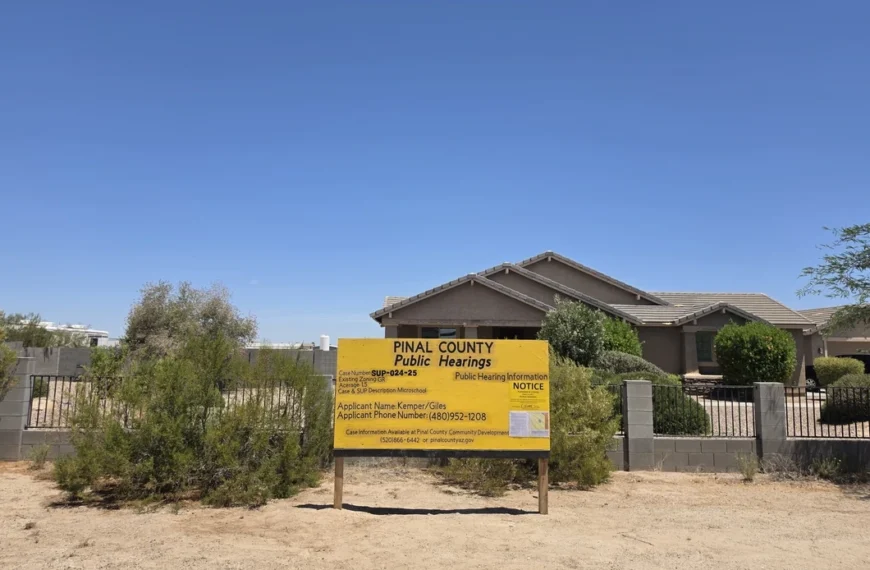
The Pinal County Board of Supervisors voted Sept. 16 to continue the State 48 Microschool permit hearing to Nov. 18. The delay lets the county Board of Adjustment first decide whether the word “school” in the zoning code already covers microschools. Read the full story.
The Pinal County Planning and Zoning Commission voted July 16 to recommend denying the State 48 Microschool’s special use permit. The case now heads to the Board of Supervisors. Read the full story.
SAN TAN VALLEY, AZ — School families and neighbors must wait until at least July 16 for a full hearing on the State 48 microschool permit. State 48 Arts and Academics is a small, family-run school seeking county permission to operate on a rural property. On June 18, the Pinal County Planning and Zoning Commission continued the case. A required newspaper notice had run one day short, so no decision could happen as scheduled.
The commission also declined to require a second neighborhood meeting before the new hearing. The code requires one neighborhood meeting, which the school held in 2025; any repeat is at the commission’s discretion. Commissioners who opposed the requirement doubted another session would accomplish anything. The first meeting had left the school’s family feeling intimidated — commissioners even discussed whether a new one would need hired security or police. They saw the commission’s public hearing, with its moderator, ground rules, and sheriff’s office security, as the better setting for a heated dispute. Instead, residents can bring their concerns straight to the commission next month.
The case also lands in the middle of Pinal County’s effort to rewrite its zoning code. The county launched a comprehensive update in early 2025 but withdrew it after public outcry. It is now proceeding section by section, and microschool rules are among the planned topics. As a result, this dispute previews the questions residents can raise when that section opens for public comment. Those who want to follow the rewrite can join the citizen-run Pinal Code Watchers Facebook group. The chairman kept the public hearing open, so speakers may return on July 16.
Inside the State 48 Microschool Application
Karli Kemper of State 48 Arts and Academics filed the request on behalf of the property’s landowners. The nonprofit wants a special use permit to run a microschool on a roughly 1.49-acre property zoned General Rural. It lies west of the West Allen Road and North Royce Road intersection, southwest of San Tan Valley. The parcel sits within Chandler Heights Ranches in unincorporated Pinal County.
State 48 Arts describes itself as an arts-based microschool that blends academics with the performing arts. Classes take place in a home setting on a rural horse property. Students take core subjects plus choir, dance, drama, and general music, according to the school’s website. Additionally, the school says it follows Arizona state standards and rents a stage in Mesa for its performances. The school also has a Facebook page.
Pinal County’s Microschool Rules Are Still Being Written
Microschools are a new topic for the county’s rulebook, and State 48 Arts is not the first school affected. In 2023, a different founder, Tia Howard, saw plans for her own microschool in Pinal County stall. The code lists a “school” as a permitted rural use but includes no microschool category. County planners told Howard the word “school” did not cover a privately funded school like hers. The Institute for Justice, a national public-interest law firm, took up her case and recounted that position in a filing on her behalf.
That filing flagged a size conflict, too. County code required at least five acres for any private school, but a 2018 state law bars counties from demanding more than one acre. Under that law, the State 48 Arts site, at roughly 1.49 acres, clears the most the county can require.
With no microschool category on the books, the State 48 Arts application runs through a special use permit instead. That permit is the county’s case-by-case tool for allowing uses a zone does not permit outright.
A Family Operation Capped at 35 Students
Kemper, the school’s managing director, said the family opened the program at home for their children and their friends. When they learned a special use permit might be required, she said, they chose to comply with each step voluntarily. Since then, they have spent months working with county staff, revising plans and providing documents on request.
“We care deeply about our community because it is our home,” Kemper told the commission. “We care deeply about the students because they’re like family to us, and we care deeply about doing things the right way.”
Commissioner Daren Schnepf asked whether county code sets a maximum student count for a microschool, and no one cited such a limit. The county has considered one before. A draft code shown to the commission in November 2024 would have limited home-based microschools to 15 students in grades K-8. However, supervisors unanimously canceled the full update in February 2025 after public outcry, particularly over livestock rules and other restrictions on rural life. For now, no adopted rule caps enrollment, so the limit on record is the school’s own policy. Any approved permit could still carry binding conditions. Kemper said State 48 Arts and Academics stays intentionally small, allowing at most 35 students on the property at any time. Six instructors, most of them family members, teach second through 12th grade in age groups.
Chairman Robert Klob did cite one number, from building rules rather than zoning. Once a structure holds more than 50 people, he said, stricter codes apply, including rules for spaces where crowds gather. That count covers staff, students, and everyone else on site — a limit on buildings, not on enrollment.
Parking drew questions as well. In response, Kemper described a controlled drop-off routine on the property. Parents follow a map and specific instructions, pull through a gate into the backyard, and exit without blocking the road. She also presented supportive letters written by school families.
Neighbors Cite Traffic, Noise and Property Values
Two nearby residents spoke against the permit. Gavin Kennealy said he supports educational opportunities but believes the use fits poorly in a quiet residential area. For example, he described vehicles parked along the road, impeded traffic flow, and related safety concerns.
Noise topped his list as well. He cited playground sounds, slamming car doors, and outdoor activities during hours when many residents work remotely. Although his property sits about 600 feet away at its farthest point, he said he cannot open windows or keep the TV at normal volume. In his words, the daily activity “creates a lot of chaos.”
He also raised property values. Buyers expect stability, privacy, and low traffic in residential neighborhoods, he argued, so added congestion and noise could affect resale prices.
Jennifer Corcoran, who lives next door, echoed the traffic and noise concerns. However, she focused on the school’s 2025 neighborhood meeting. Notices went out on July 22, 2025, for a meeting held that Friday evening at 5 p.m., she said. As a result, only about four residents attended, and she recalled having roughly 24 hours’ notice. Corcoran said she believed such letters must go out two weeks ahead, and none have arrived since.
Two Weeks Is Guidance, Not a Rule, County Says
Senior Planner Valentyn Panchenko took up the notice question. He confirmed from the application file that notices went out July 22 and the meeting followed on July 25. However, county code sets no time frame for neighborhood meeting notices, he said. Advance-notice rules of that kind apply to public hearings, not citizen meetings. Still, staff usually advises applicants to give two weeks’ notice, based on commission recommendations.
In fact, that hearing rule caused this delay. According to a staff memo, the school’s notice ran June 4 in the Casa Grande Dispatch. That left 14 calendar days before the hearing instead of the required 15. Otherwise, the case was ready to be heard. Panchenko said staff had finished its report a week earlier, and the advertisement was the only reason to continue.
Deputy County Attorney Daron Garey backed Panchenko’s reading. He noted the commission may still weigh whether the timing gave neighbors effective notice. Additionally, the code lets the commission require another citizen meeting when much time has passed or plans have changed substantially. Any new meeting would push the case to August or September, though, because applicants must file a citizen-input report 30 days before a hearing.
Panchenko added that staff verified the 2025 mailing against the required 1,200-foot notification area. That radius comes straight from the code, which also says a person’s failure to receive notice cannot by itself block county action.
Even so, several commissioners pressed the timing question. Schnepf asked whether letters mailed July 22 could realistically reach every mailbox by July 25. Similarly, Vice Chair Karen Mooney, who lives near the property, said mail in the area can take a week to arrive.
Kemper had addressed the meeting question in her opening remarks. Her family hosted the required session in good faith, she said, but the experience “was not one of constructive dialogue.” Relatives and staff at the session witnessed comments “that made us feel intimidated and unsafe.” As a result, she said, the family has genuine concerns about joining another unsupervised face-to-face meeting. “But that said,” Kemper continued, “we are willing to answer additional questions, provide written responses, or participate in a different process facilitated by county staff if the commission believes that further public outreach would be beneficial.”
Two 5-4 Votes Settle the Meeting Question
Mooney moved to continue the case to August 20 with a required new neighborhood meeting. Her motion recommended a 14-day gap between the mailed notices and that meeting. Schnepf seconded it, saying the 2025 window “wasn’t fair or enough for the community.”
Chairman Klob voiced support too. He said the number of students “takes it outside of that kind of normal realm” of home schooling. Still, Mooney’s motion failed, with four votes in favor and five against.
Commissioner Bryan Hartman had explained his opposition during discussion. He argued a contentious dispute belongs before the commission, where a public body can manage it better than a private gathering. Similarly, Commissioner Gary Pranzo asked Kemper whether a second meeting would accomplish anything. She said she personally did not think so, and Pranzo agreed.
Hartman then moved to continue the case to July 16 without requiring another neighborhood meeting, seconded by Pranzo. During discussion, Panchenko and Schnepf noted that if the commission dropped the meeting requirement, only the newspaper notice needed fixing and the case could go straight to July 16. The revised motion passed 5-4.
What the July 16 Hearing Can Weigh
Under county code, commissioners can weigh factors including traffic conditions, compatibility with neighboring uses, and off-site impacts such as noise and lights. Public input is a factor in its own right: opposition can support denial, and support counts in the applicant’s favor. The county can also attach conditions covering hours, parking, drop-off access, screening, and noise control — and revoke a permit that violates them.
The public portion of the hearing remains open, so neighbors and supporters of the San Tan Valley microschool can return to speak before any vote. Even that vote is only a recommendation; the Board of Supervisors makes the final call.