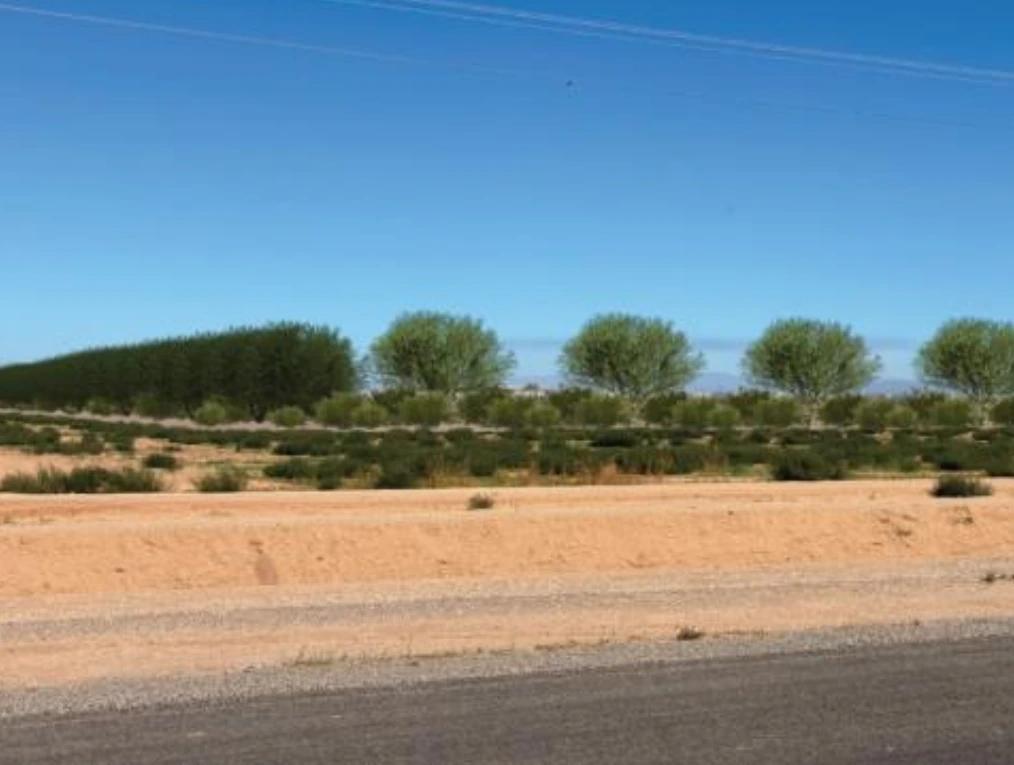
COOLIDGE, AZ — Pinal County supervisors voted 4-0 on July 1 to approve the Valley Farms Energy Center. The vote clears NextEra Energy Resources to pursue a 400-megawatt battery storage facility on 68.77 acres east of Coolidge, at the northwest corner of East Bartlett and North Clemans roads. It also reverses the board’s April 2025 denial of a larger version of the project that included solar panels.
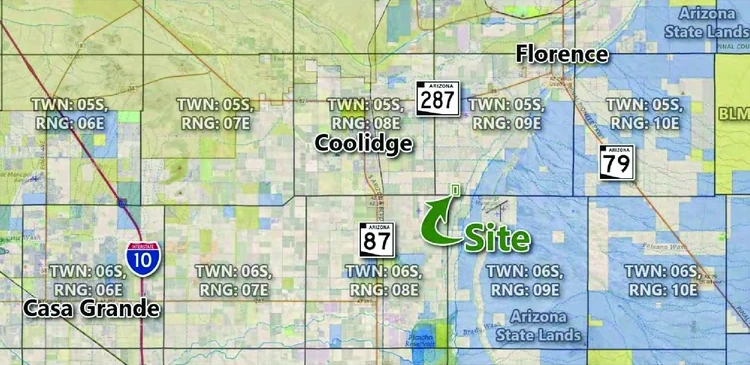
For nearby residents, approval means about 14 months of construction once site plans clear county review. NextEra aims to have the batteries supporting the grid before summer 2028; at the hearing, the company said it hopes to finish construction in 2027. Meanwhile, the project carries a $600,000 community fund with Coolidge projects first in line, and a public power utility serving the Coolidge area has secured the chance to buy into the project.
Chairman Jeff McClure, Vice Chairman Jeff Serdy and Supervisors Mike Goodman and Rich Vitiello voted yes on all three of the project’s requests. Supervisor Stephen Miller was absent.
A smaller Valley Farms Energy Center, and no solar
The hearing covered three requests filed for the Wuertz family trust: a land use change, an industrial rezoning, and a development overlay that, per county staff, permits only power plant uses, which is how the county’s staff report classifies battery storage. The land use change was needed to unwind the 2023 Green Energy Production designation, which the county says covers only solar — the very thing the board had already rejected.
NextEra had been through this parcel once already. Its 2025 proposal — a 160-acre plan pairing solar panels with batteries — died 2-3 at the board after neighbor protests triggered a supermajority requirement it couldn’t clear. NextEra devoted much of its presentation to the changes from that failed 2025 proposal. The company’s own side-by-side comparison, first presented at the May commission hearing, sums them up:
| Valley Farms 1.0 | Valley Farms 2.0 |
|---|---|
| 160 acres | 68.77 acres |
| 80 acres of solar arrays | No solar arrays |
| Project boundary along Malorie Road | Over 500 feet away from Malorie Road |
| 80 acres of battery storage | Approximately 20 acres of battery storage |
| In North/South Corridor area | Outside of North/South Corridor area |
| No boundary wall | 10-foot opaque wall along the north side, wrapping the corners |
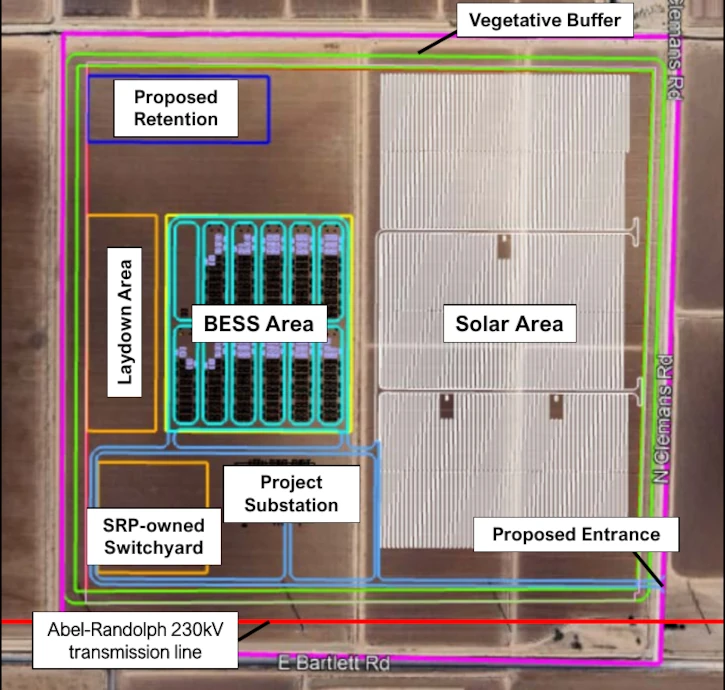
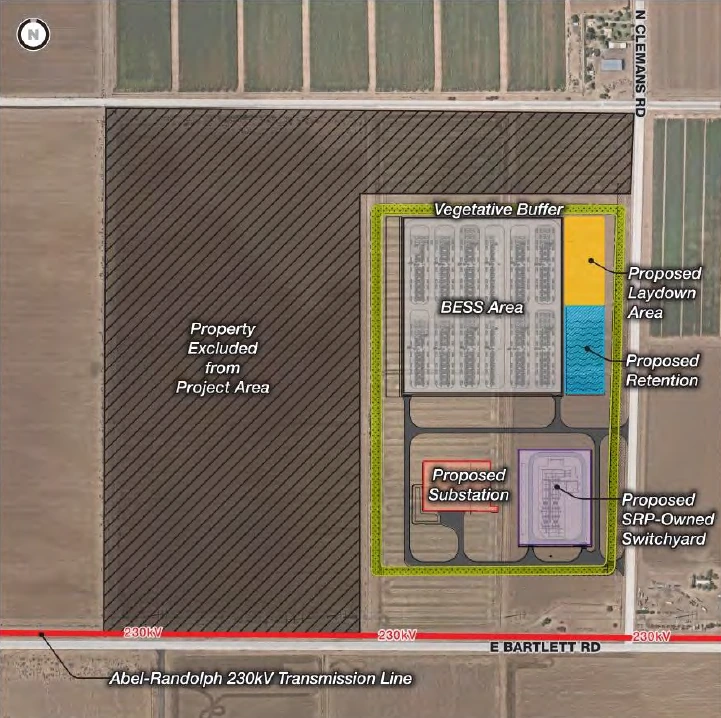
Before the July 1 vote, NextEra also volunteered three new conditions: a 10-foot opaque wall along the northern boundary that wraps the corners, oversized mature trees along that same boundary, and large oleanders on the remaining sides.
Pinal County’s Planning and Zoning Commission recommended denial of all three cases 6-3 on May 21. Commissioner Tom Scott, who made the denial motion, cited Coolidge’s opposition, the planned North-South freeway corridor and the small share of local addresses among the support letters. Detailed coverage of that hearing, including the battery counts, fire testing and construction water discussions, is available in Pinal Post’s report on the commission denial. Background on the original solar version appears in reports on the February 2025 commission rejection and the April 30, 2025 board vote.
SRP’s contract now brings in Coolidge’s own utility
Salt River Project’s Linda Brady said SRP holds a contract to receive the facility’s stored power. Batteries charge when electricity is cheap and discharge when demand peaks, she said, which holds costs down for customers. Brady tied that partnership directly to the 2025 hearings that killed the original solar-plus-battery project. “Even though SRP doesn’t provide electric service in Coolidge, we’ve worked closely with ED2 because we heard the concerns about power availability and possibly missed economic development opportunities in the area,” she said.
She also addressed complaints about how many energy projects have landed near Coolidge in recent years.
“There’s been a concern, and I’ve heard it, about the number of projects in this area. SRP heard the message. When Valley Farms was selected by SRP, it was in 2023. We will not pick any more projects in this area. This is it, Valley Farms.”
— Linda Brady, Salt River Project
Logan Gernet, general manager of Electrical District 2, the public power utility serving the Coolidge area, confirmed the arrangement. He said he had recently signed an agreement with SRP that lets the not-for-profit district take a share of the facility’s stored power at the same wholesale rate SRP negotiated with NextEra. Gernet rarely appears in support of generation projects, he told the board, and made clear he showed up this time because ED2’s customers would directly benefit.
Under questioning from Vitiello, NextEra development director Kyle Whittier detailed the $600,000 community fund required under the SRP contract. So far, Coolidge staff have identified two priorities: a mobile generator for the city’s adult center, which doubles as an emergency space during outages, and unfunded lights at the regional park. Those total about $300,000, and NextEra will work with Coolidge or county staff on the remainder. “The $600,000 is guaranteed by the contract with SRP,” Whittier said.
Local batteries from LG’s new Pinal County plant
Sean Lake, the attorney representing NextEra, tied the request to county growth policy. His presentation quoted Chapter 7 of the Pinal County Comprehensive Plan: “Without ample and reliable energy, Pinal County will not be competitive in attracting business and industry.”
The batteries themselves will come from inside the county. Lake said the facility will use LG batteries manufactured locally, pointing to the groundbreaking of LG Energy Solution’s plant in the county. “We’ll be using local batteries in local storage to support local businesses and local residences,” Lake said. Goodman noted the LG plant sits in his and Serdy’s districts. “Being able to use your own products that are being built here and being used in another location within our county is major,” Goodman said.
NextEra also pointed to demand figures: its slides characterized SRP’s peak load as up roughly 400 megawatts in a single year, the same amount this facility can deliver. On taxes, NextEra’s presentation estimated the project would generate at least $9 million over 20 years for the county, Coolidge Unified School District and the junior college district — roughly $8.7 million more, the presentation said, than farming the same ground.
A farm without water finds a buyer
Greg Wuertz told the board that he and his wife, Loralee, own the property, and that water limits have let him farm no more than a quarter to half of it in any given year. “Being a farmer, I want a farm. I don’t like managing vacant land,” he said. When the family decided to sell, the best offers came from energy companies. He will keep farming the ground directly north and west, he said, and the neighboring farm family to the south and east is in favor of the project. After years of farming around a power plant and batteries, he called them “good neighbors.” He added, “Infrastructure needs to come first as much as possible for a continued orderly growth of Pinal County.”
Other family members also spoke. Thomas Wuertz, a fourth-generation member who left full-time farming two years ago over water, now works at a local John Deere dealership. He lives less than a quarter mile from an existing battery facility. “Housing prices in my neighborhood have not been negatively affected by the battery plant,” he said. Bobby Wuertz, a land advisor, argued that Coolidge already has room for about 17,000 more homes on land with water rights west of the city. What it needs, he said, is jobs to fill them, and “you need labor, you need water, you need power.”
Kirk McCarville, the broker the family hired six years ago, said the county has water for about a quarter of its irrigable acres, and the Wuertzes “haven’t put a seed in the ground in this farm in two years.” Moreover, selling frees their unused water for neighboring farmers. The choice, McCarville said, is between an orderly retreat from farming as water runs out and a wave of bankruptcies. “We can transition logically … or we can transition catastrophically,” McCarville said.
Other voices in support
Several other backers described business relationships with NextEra or stakes in its construction. Cesar Corral of Sheet Metal Workers Local 359 said the project creates about 300 construction jobs and trains apprentices. Similarly, Mark Cardenas of the Western States Carpenters said the project puts Arizona tradespeople to work while strengthening grid reliability.
Amy Sy owns HubXpress, a Coolidge shipping and business services store that counts NextEra among its customers and has been named the Coolidge Chamber of Commerce’s Community Partner of the Year for the past two years. “I grew up under a dictatorship in another country. Rotating blackouts were part of everyday life,” Sy said. She told the board she had researched battery fire safety before forming a view, and concluded that modern utility-scale battery systems use enclosures, temperature controls, detection systems and emergency shutoffs that have improved over time. Pinal County is growing fast, she said, and projects like this help provide reliable electricity and attract investment.
Dillon Lewis, a Florence-based sustainability business owner, disclosed a 12-year working relationship with NextEra at May’s commission hearing. He listed the company’s local footprint: about $350,000 contributed to the community, fleet trucks bought from Garrett Motors, and land purchased in central Coolidge for a facility housing its local employees. “They’re a blue-chip company. I want them in Coolidge,” Lewis said.
Cepand Alizadeh of the Arizona Technology Council, which submitted a support letter, called the project “a piece of the puzzle, the mosaic,” of meeting county energy demand. Meanwhile, fire chief Stephen Kerber, who has worked with NextEra since 2017 and whose Regional Fire and Rescue covers the company’s Pinal Central Energy Center, submitted his own support letter, praised the company’s “transparency and diligence” and said modern batteries disconnect automatically during faults. NextEra’s presentation lists an $80,260 firetruck donation to the South Florence Fire Department in 2022 and two more recent gifts of $20,000 each — in November 2025 and April 2026 — split between his department and the South Florence Volunteer Fire Department.
Richie Kennedy, who farms in Maricopa County and handles vegetation management at NextEra sites, closed the comments on property rights. One family pays the taxes on the land, he said, and the buyer is “coming with a clean record, a good neighbor, good faith. They’ve shown it.” His wife’s family, he said, sold what he thought was about a 40-acre parcel just south of a battery-equipped SRP generating station for six figures an acre, and houses are now going in across the street.
Lake said letters of support also came from organizations including SRP, LG, Pinal County Farm Bureau, Pinal Partnership, the Florence Chamber and the Small Business Owners Hub Alliance.
Coolidge officials and the nearest neighbor remain opposed
Phil Garthright, Coolidge’s senior planner, acknowledged that NextEra and SRP met with the city directly. Even so, the site sits inside Coolidge’s planning boundary, he said, within several square miles the city has designated for business, commerce and neighborhoods, much of it already annexed. “We would not support any major or minor general plan amendment of such to our general plan for proposals like this in this area,” Garthright said.
Misty Brown spoke beside her father, Jim Wallace, who has lived on the adjacent property for more than 50 years. “There is a distinct difference between owning neighboring land and actually living on it,” she said. The family would welcome homes like those being built a mile away, she said, but she questioned how many permanent local jobs the facility creates. “This is a farming and family community, not a solar wasteland, and that is exactly what we are being turned into,” Brown said. She also told supervisors that all eight people who spoke for the project at the commission hearing had financial ties to NextEra or the project: “Not one neutral resident with nothing to gain stood up and said, ‘Yes, build this next to me.'”
Scott, the commissioner behind May’s denial motion, told supervisors he opposes neither solar nor batteries: “they just simply need to be in the right place.” Because NextEra values the site for its access to surplus power on the transmission line, he argued, the location is interchangeable. “They could receive surplus electricity anywhere along the 230 KV line, so their proposed project can be relocated to another place that doesn’t affect people and the City of Coolidge future growth path,” Scott said. He added that Mayor Jon Thompson has repeatedly said he wants no green energy or battery projects north of Bartlett Road. Finally, Scott noted that three supervisors (Miller, McClure and Vitiello) represent Coolidge, and he assumed they would vote no to stay consistent with the city’s repeated objections.
Coolidge Councilmember Tom Bagnall reminded the board that Coolidge already approved the Saint, Storey and Selma energy centers “with very little return to the Coolidge community.” He contrasted the application’s claim of “no potential for smoke, fumes, dust, or glare” with the roughly 45 minutes the commission spent on battery fires. Most support letters come from outside the city, he said. “The City of Coolidge is a big no in regard to this project,” Bagnall said.
Supervisors question water, fire coverage and setbacks
Before the votes, Vitiello said he had read every letter and met with residents and Coolidge officials. He pressed NextEra on its 30-to-50 acre-feet estimate for construction dust control. Whittier responded that engineers expect closer to 30 acre-feet and that the water is needed only during construction. Over the 20-year SRP contract, he said, the project would use about 2.4% of the water rights tied to the property.
Vitiello framed his concern around growth: without more power, he said, no new homes or businesses can come. He also asked who would provide fire service. Project developer Ashley Johnson said NextEra is in discussions with the Florence and regional volunteer fire departments as well as Rural Metro, though no contract exists yet. “We need to make sure that we can construct and operate the project first before we sign a contract,” Johnson said.
Goodman recalled that 85% of his District 2 constituents commuted outside their communities for work when he took office in 2017. A county work-study session with SRP and APS a year ago listed this project among those needed to sustain growth, he said. He also endorsed Kennedy’s closing argument: “I like the gentleman that spoke last, when he talked about property rights. That’s a big thing for myself and for other supervisors on this.” Serdy pointed to the removal of solar: “I’m just thrilled that there’s no solar involved. It’s just batteries, which strengthen the grid.” If solar were included, he added, “I would be against this.”
Board approves all three requests
All three approvals came with conditions attached, including the new wall and landscaping requirements added at the hearing. Each takes effect 30 days after adoption.
The staff report tallied 61 letters of support, all provided by the applicant, and two letters of opposition. Planner Sam Amaya told the board another five support and five opposition letters had arrived before the hearing. Of the initial support letters, just one came from within the 600-foot notification area, he said. All three supervisors who voted against the 2025 version (McClure, Serdy and Vitiello) supported this one. The earlier request failed 2-3.
What stands between approval and summer 2028
Approval does not put shovels in the ground yet. NextEra still needs county sign-off on its site plan and supporting studies, plus a plan for removing the facility at the end of its life. The county requires NextEra to post financial assurances covering the eventual removal of the facility, phased in over time as construction proceeds. The company estimates the total value at $15.71 million. Complete removal is expected to take about a year.
Once permits issue, neighbors can expect roughly 14 months of grading, foundation work and battery deliveries, with water trucks controlling dust. If NextEra holds its schedule, the Valley Farms Energy Center will be charging from the grid, and sending power back, before demand peaks in summer 2028.