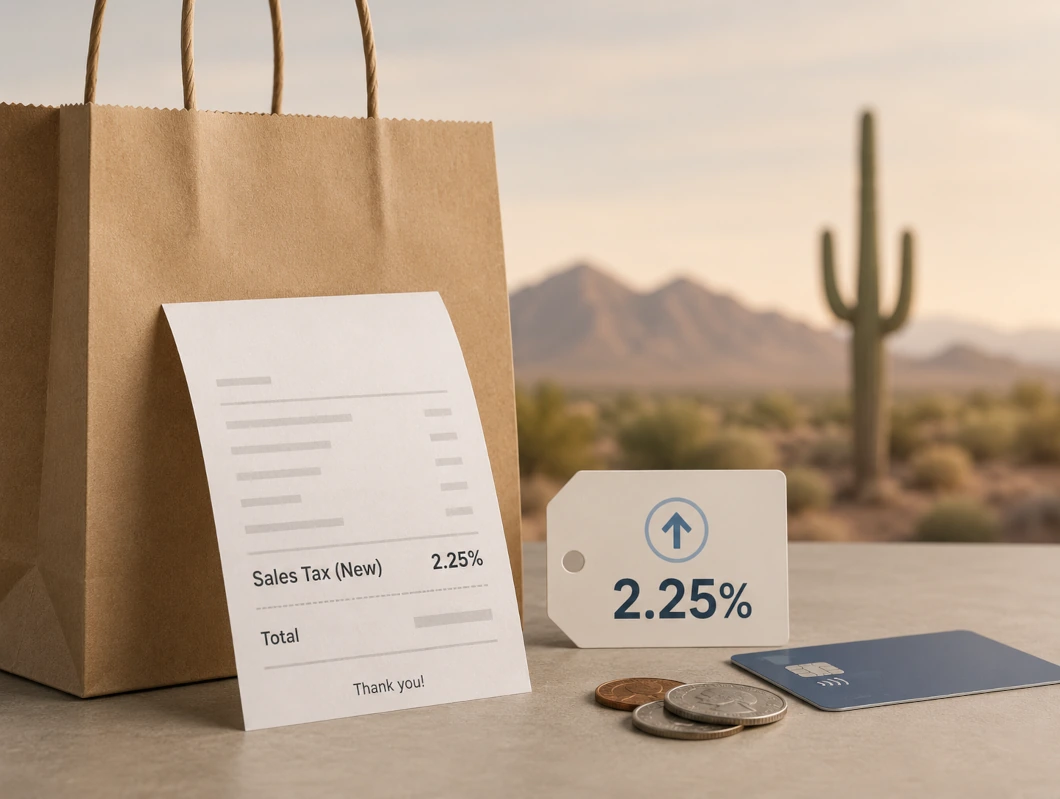
SAN TAN VALLEY, AZ — Shoppers, diners, and residents paying utility and cell phone bills will start seeing the town’s first transaction privilege tax, commonly called a local sales tax, beginning October 1. On Wednesday, July 1, the Town Council set the San Tan Valley sales tax at 2.25% for most purchases. Construction will pay 5%, while hotels and the additional tax on transient lodging were each set at 4.25%. The votes came the same night the town began operating independently from Pinal County.
Groceries are the lone exception to the October start. The grocery tax is scheduled to begin January 1, 2027, giving the town time to respond if a statewide ballot measure this November blocks it.
San Tan Valley sales tax rates at a glance
Until now, the town has charged no transaction privilege tax of its own, Town Manager Brent Billingsley told the council. Transaction privilege tax is Arizona’s version of a sales tax, and the new 2.25% town rate will be added to existing state and county taxes. It covers retail sales, restaurants and bars, utilities, communications, property rentals and more than a dozen business classifications in all.
A handful of categories fall outside that general rate. Construction is taxed at 5% — a rate that applies to prime contractors, speculative builders and owner-builders alike. Short-term lodging carries two town levies: a 4.25% hotel tax plus a separate 4.25% tax on transient lodging. And a 0.10% severance tax applies to metal mining. The town currently has no hotels, Vice Mayor Tyler Hudgins noted, but Councilmember Gia Jenkins said the lodging tax would apply to short-term rentals such as Airbnbs.
“We are not talking property tax,” Mayor Daren Schnepf added, noting that a property tax would require voter approval.
Why builders will pay 5%
Normally, a growing town helps pay for new roads and parks by charging developers a one-time impact fee on each home they build. San Tan Valley’s draft study set that draft fee near $6,200 for a single-family home. But a new state law bars the town from collecting the fee on housing already approved by Pinal County, and because it is the town’s first impact fee, staff say the delay applies to those lots for a full 24 months.
“Due to a change in state law, we’re unable to collect the development impact fees for the next 30 months,” Billingsley told the council. Impact fees aren’t charged when land is platted. They come due later, when a builder pulls a permit to actually construct each home. The new law protects lots that Pinal County had already approved through a final plat or site plan before the town’s fee ordinance takes effect: on those lots, the town cannot charge its new fee for 24 months, even as permits are pulled and homes go up. In San Tan Valley, that covers an estimated 6,000 to 7,000 single-family lots. With the ordinance expected around December, the practical delay runs about 30 months from the July 1 meeting.
Not every platted lot will be built during the freeze. Staff expect about 4,500 of them to be permitted in that window — roughly $22 million in fees the town won’t collect.
Billingsley tied the 5% construction rate directly to the impact fees the town can’t collect. Arizona ties a town’s construction tax and its impact fees together: when the construction rate rises above the general 2.25% rate, the state treats that extra tax as the developer’s contribution toward the same growth infrastructure, and credits it against the impact fee so builders aren’t charged twice. The bigger the gap between the 5% construction rate and the 2.25% general rate, the bigger the credit — and the less the town collects in impact fees. That tradeoff is starkest at 5%. “If you set a rate at 5%, that zeros out development impact fees,” Billingsley said — so during the freeze, the construction tax becomes the revenue the town can collect in place of the fees it can’t. He described the relationship as a “zero sum game” between the two revenue sources — “one can be higher than the other, but the total is still the same.” “If you’re wondering where the 5% came from, that’s an offset for DIF [development impact fees],” he said.
Billingsley also said the council had agreed in February to set aside all construction-tax money for projects such as roads, drainage and parks. “Everything in those one-time funds would be just for infrastructure,” he said, “not operations or purchasing software or putting on events.”
The ordinance grandfathers existing contracts. Certain construction contracts, including home contracts signed before October 1, will not be charged the new construction tax. James Ashley, speaking for the Home Builders Association of Central Arizona, thanked the town for honoring home-buyer contracts signed before the tax takes effect, and the exemption lasts until each contract ends or is renegotiated.
Grocery tax depends on the November ballot
Unlike the other classifications, the food tax won’t start October 1. The town set it to begin January 1, 2027, a deliberate delay tied to a statewide measure on the November ballot. That measure, referred to voters by the Legislature, would bar Arizona cities and towns from creating or raising a grocery tax without voter approval, and would cap any such tax at 2%. San Tan Valley’s food tax is brand new and, at 2.25%, sits above that cap, so passage would block the town from collecting it. “If the bill passes in November, we’ll no longer be able to collect a food tax,” Billingsley said. Other cities are treated differently: those that “already have a food tax get to maintain their food tax,” he said, though the measure would let them raise it only with voter approval, up to the 2% cap. The later start gives the council time to retract the tax before collections begin. “It gives us a good month and a half to react,” he said. “The public will have that opportunity to say yea or nay to the food tax,” Schnepf added.
Food and construction taxes draw objections
Residents Paul Bond and Donna Hallman spoke against the food tax, while Gary Ryan objected to the sales tax more broadly. Ryan called it “a regressive tax,” and Bond, who said he is on Social Security, asked the council “to eliminate food tax.” Hallman said she and the constituents she’d spoken to “feel this is being rushed,” and asked the council to “please consider holding this vote off.” She was, she said, “adamantly opposed to food tax.”
Meanwhile, the town manager’s office received written opposition from the Home Builders Association of Central Arizona, private Arizona landholder El Dorado Holdings and national homebuilder Ashton Woods. In person, James Ashley of the Home Builders Association of Central Arizona opposed the construction rate. “A 5% contracting tax rate, among the top three highest of Arizona’s 92 cities and towns, will harm affordability and economic growth,” he said. He asked for ordinance language stating that “when full impact fee collections begin, the TPT rate will be lowered accordingly.” Councilmember Brian Tyler later asked whether that language could be added to the motion. “As far as making that kind of change at this stage would be challenging,” responded Allen Quist, an attorney for the town. He said the ordinance and resolution had been drafted over about two weeks with input from the League of Arizona Cities and Towns, and that “a lot of moving parts with DIF [development impact fees]” remained, including “potential difficulties in the on-ramping of DIF even after the 24-month period.” Billingsley suggested Tyler could state the intent verbally rather than put it in the ordinance.
Council weighs retail rate before keeping it at 2.25%
Council members disagreed over the general rate before voting. Councilmember Gia Jenkins urged the higher posted rates, arguing they are harder to raise later than to lower: “With so many unknowns at this point in time, I feel like we should go with the higher rates.” Councilmember Bryan Hunt agreed that 2.5% would be a more appropriate start for a town with a limited budget. “We could always come down if we chose to,” he said.
Hudgins disagreed. “My only concern with going up to 2.5 on the general sales tax is it would put us above Queen Creek,” he said, urging the town to stay comparable to its neighbors while trying to attract commercial development. Schnepf sided with him, and 2.25%, the same rate Queen Creek charges, stayed in the final motion. Councilmember Rupert Wolfert added, “We are mindful of an affordability crisis right now.”
Billingsley framed the sales tax as essential rather than optional. Most cities and towns, he told a resident who questioned the need for it, draw their biggest revenue stream by far from sales taxes, and San Tan Valley, newly incorporated, is currently among the only municipalities in the state without one. “There’s not enough revenue coming in the door to keep up with the growth in population,” he said.
Why the posted San Tan Valley TPT rates ran higher
The town posted higher maximum rates online than the council had discussed at its Feb. 19 study session: 5%, 2.5% and 4.5%, against the study session’s 4.25%, 2.25% and 4.25%. Finance Director Gabe Garcia explained why. “Once you post it, you cannot raise that rate, but you can lower it,” he said. Posting high preserved the council’s room to adopt anything at or below those ceilings based on public feedback and legislative impacts such as the impact-fee law. Ahead of the hearing, the town mailed notices to 699 San Tan Valley businesses and received three calls asking about effective dates.
Two votes, both 6-1
The council took two votes. Resolution 2026-41 declared the town’s new tax code a public record, and Ordinance 2026-06 enacted it into law under the Model City Tax Code, the standard framework Arizona cities and towns use. Both passed 6-1, with Jenkins casting the lone no vote both times.
A second look promised before impact fees arrive
Schnepf said he was “open and willing to address” the construction rate again once impact fees are ready to be implemented, so long as he remains on the council, and Hudgins agreed: “If I’m still on the council in 30 months, I’d be happy to review it.” Staff suggested a formal review around the 24-month mark. In the meantime, the full San Tan Valley sales tax schedule is posted on the town’s website.

I understand taxes are inevitable, however it says in-the article to help as the town grows. Stop building houses !! We are big enough ! Live within our means with what we have