SAN TAN VALLEY, AZ — A new state law gives developers a tool to fund subdivisions with taxes and assessments that fall on future homebuyers. The town council does not vote on it, Town Manager Brent Billingsley told the council Wednesday night. A second new law blocks the town from collecting tens of millions in San Tan Valley impact fees planned for roads and parks. The council also adopted the $91 million budget that evening in a special meeting.
House Bill 2999 lets developers petition to form State Affordability Infrastructure Districts (SAIDs) that finance subdivision infrastructure through property taxes levied on the residents who later buy homes there. The town council does not vote on these taxes. Voting on the board, tax levies, and assessments is limited to landowners, typically the developer alone before homes are built. Votes are distributed by acreage rather than by resident, so the developer holding the land controls those elections until lots are subdivided and sold.
House Bill 2946 limits when the town can charge its new impact fees. The fees cannot be collected on development that already has final plat approval. In San Tan Valley, that covers 6,000 to 7,000 single-family lots. The block lasts 24 months, starting when the town’s fee ordinance takes effect. In response, the council voted to enter executive session for legal advice on impact fee timing, applicability, assessment, and collection.
San Tan Valley impact fees face a 24-month delay under HB 2946
House Bill 2946, signed into law on June 4, amends Arizona’s development fee statute. Under HB 2946, a new or increased impact fee cannot be assessed for 24 months after a town’s fee ordinance takes effect on any development already approved by that date. In a press release, sponsor Rep. Khyl Powell (R-14) said HB 2946 targets development fees that drive up housing costs for Arizona families. The bill also aims to give developers more predictability. Earlier law tied fee protections to the first building permit, which could take years to pull, so HB 2946 anchors that protection to a fixed 24-month window after a new or increased fee ordinance takes effect. Because San Tan Valley is adopting its first impact fee, that new fee triggers the 24-month protection on lots the county already platted.
“We have between 6 and 7,000 lots that are approved in San Tan Valley just with respect to single family residential that, as it stands, we will not be able to collect development impact fees on,” Billingsley told the council. He called the new law “a hit” and said it is “concerning from the town’s perspective.”
Billingsley said the fees are intended to fund regional transportation and regional park improvements. The town’s draft impact fee study proposed an impact fee of about $6,200 for a new single-family home. The 24-month exemption applies to any lot approved by Pinal County through a final plat or site plan before the town’s ordinance takes effect.
Pressed by Vice Mayor Tyler Hudgins for a dollar estimate, Billingsley said foregone fees could exceed roughly $20 million during the exemption period. He predicted “a flood of permits” as developers rush to permit homes on already-approved lots while HB 2946 shields them from the new town fees for 24 months.
Resident Jeanne Stockton, during the call to the public, urged the council to slow approvals: “P&Z, drag your feet on every approval so that we can get some of those impact fees.”
How the town will fund roads, parks, and other infrastructure
San Tan Valley has no municipal property tax. Finance Director Gabe Garcia said the new transaction privilege tax, also called the local sales tax, will be one of the town’s largest revenue streams.
Garcia said the sales tax will come before the council in July. If approved, residents will start paying it in October, and the town will start receiving the revenue in mid-December or January. He said the first collections “will probably be really low at first and start to gain momentum.”
The local sales tax is budgeted at $13.2 million for the fiscal year. It joins state income tax revenue of $19.1 million and state sales tax revenue of $13.6 million as the town’s three largest revenue streams.
For roads specifically, the town will rely on multiple dedicated funding sources. The Highway User Revenue Fund, or HURF, is Arizona’s gas tax, restricted to transportation. The town’s HURF allocation totals $9.6 million: $5.4 million for road spending, $2.2 million in reserve, and $2 million in grants. Pinal County Road Tax revenue brings in $9.1 million, with $2.96 million budgeted for road projects and $6.2 million held in reserve for future regional projects.
In addition, the construction portion of the transaction privilege tax is budgeted as capital sales tax revenue. Garcia called this “one-time money” tied to new home construction. He said the town plans to direct it toward one-time capital projects rather than ongoing operations.
Development impact fees were budgeted at $730,000. However, staff say that figure may not be realized given the 24-month exemption under HB 2946. The town’s road funding sources, HURF and Pinal County Road Tax, are not affected by the bill.
Garcia explained the broader strategy. “We’re going to have to buy park land, we’re going to have to buy land for government buildings, we’re going to have to buy equipment to maintain the roads and streets,” he said. “We need to run light operationally in order to be able to afford those things in the future.”
New state districts shift infrastructure control to developers
Beyond the impact fee bill, Billingsley flagged a second change. House Bill 2999 creates State Affordability Infrastructure Districts, or SAIDs.
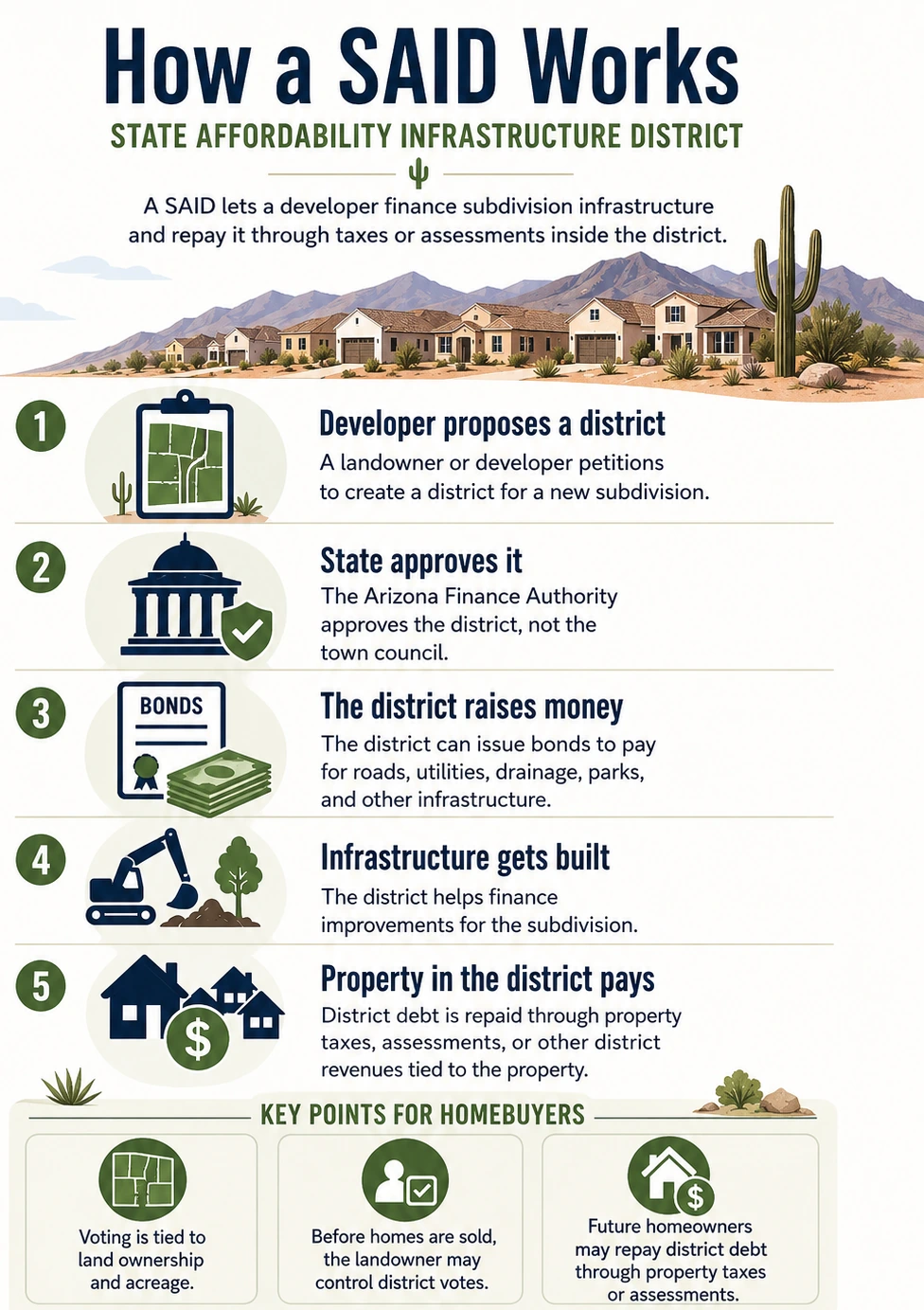
“A developer can come in, go to this board, get a district approved that has special taxing authority — and it’s not through the town, but it would be levied on the residents of that development,” Billingsley told the council.
He described the law as “a pretty big departure from the way that we’ve done things in Arizona before.”
Billingsley compared SAIDs to Community Facilities Districts, or CFDs, which have existed in Arizona for over a decade.
The key difference, he said, is governance. CFDs are overseen by the local town council, with the council serving as the decision board for bidding contracts and setting reimbursement rates. By contrast, SAIDs are approved by the Arizona Finance Authority and operated by a district board of landowners.
“If anybody’s ever lived in Anthem, in Florence, they have three different CFDs in Florence and Anthem, and that’s why they have the big beautiful community center with the Olympic-sized pool and beautiful boulevard concepts of their roads,” Billingsley said. However, he added that Anthem residents pay much higher taxes than the rest of Florence.
SAIDs can finance infrastructure through tax-exempt bonds, including general obligation bonds, special assessment bonds, and revenue bonds. Property within the district repays the debt through taxes and assessments, an obligation homebuyers take on when they purchase.
Billingsley emphasized that the taxes would not go through the town council or a normal public election. “Those are property taxes that the public doesn’t vote on, and the council doesn’t vote on,” he said.
Key dates ahead for taxes and fees
Several key dates lie ahead for residents. Billingsley said the San Tan Valley impact fees study is expected to go to the council around July 15; if approved, the new fees take effect in December. Garcia said the local sales tax is scheduled for council action in July, with collections beginning in October and the first revenue arriving in mid-December or January.
At the state level, Billingsley noted Arizona adopted an $18.3 billion budget and is the only state to adopt all the federal “One Big Beautiful bill” tax changes, resulting in a 2.5% reduction in funding across state agencies. He also noted the governor’s announcement of a three-year moratorium on tax incentives for data centers in Arizona.