Key Points
The Meeting
- The town’s consultant presented draft impact fees at the April 15 council meeting. No action was taken.
- Impact fees are one-time charges paid by developers when a building permit is issued.
Proposed Fees
- A single-family home would pay about $6,200. Multi-family units would pay about $3,100 and mobile homes about $5,100.
- Fees will drop once a required tax credit is calculated.
- Pinal County currently charges about $3,300 for a single-family home in the area.
- At the April 1 council meeting, Public Works Director Chris Wanamaker said Pinal County’s current impact fees are about half of what they should have been.
- Wanamaker also said some developers paid no fees at all under binding agreements with the county that are still in effect.
Roads
- The study projects about $37 million in street fee revenue over 10 years.
- Roads now cost $2 million per lane mile to build.
Parks
- San Tan Valley has no town parks today.
- To collect $3.2 million in park fees, the town must first invest about $19.4 million of its own money.
- A 2023 county plan envisions a $150 million park system with a 100-acre central campus and two district parks.
- Billingsley said most county park fees paid by San Tan Valley residents were spent elsewhere.
Timeline
- The first public hearing is June 3. The earliest effective date is December 21, 2026.
SAN TAN VALLEY, AZ — San Tan Valley Town Council received an update on the town’s development impact fee study at its April 15, 2026 meeting. The study will determine how much new development pays toward future roads and parks. The outcome will shape how quickly residents see new recreation space and road improvements after the town begins operating independently on July 1, 2026.
Benjamin Griffin of TischlerBise, the Virginia-based consulting firm conducting the study, presented the draft land use assumptions, infrastructure improvements plan, and proposed fees. No council action was taken.
What the Development Impact Fee Study Means for Residents
Impact fees are one-time charges collected from developers when a building permit is issued. Griffin said the money can only pay for capacity-adding infrastructure, such as new lanes of road or new parks. “You can’t use these for operations, maintenance, repair, replacement, rehab,” Griffin said.
A previous Pinal Post article, “San Tan Valley Roads: Funding Gaps, Developer Deals, and What’s Next,” reported on why road improvements have lagged behind growth. That reporting covered an outdated county transportation plan from 2008, undercharged county impact fees, developer agreements that exempted some builders from paying fees, the “growth pays for growth” philosophy, Supreme Court cases limiting what towns can require of developers, constraints on widening Hunt Highway and Gantzel Road, the limits of development moratoriums, and the general structure of the Infrastructure Improvement Plan.
This article covers what was new or clarified at the April 15 meeting.
$2 Million Per Lane Mile: The Cost of Road Capacity
The study uses $2 million per lane mile as the cost to build new road capacity. Billingsley addressed the figure during the presentation.
“I’m sure some people in the audience and maybe watching online are saying, ‘Balderdash. There’s no way it costs $2 million a lane mile to build a road,'” Billingsley said. “A couple of years ago it was a million dollars a lane mile. The research that we did initially working on this study came up with around $1.8 million a lane mile.”
Billingsley said he consulted with Pinal County city managers, who told him, “Brent, you better at least have $2 million a lane mile.” One jurisdiction is using $2.4 million. Public Works Director Chris Wanamaker verified the figure against recent county project bids.
Vice Mayor Tyler Hudgins tied the cost escalation back to the timing of road construction. “If we would have built these roads earlier, we wouldn’t have had these costs then,” Hudgins said.
Growth over the next 10 years will require about 18.6 additional lane miles of road capacity to maintain the town’s current level of service as more residents arrive. The fees do not fund improvements to existing congestion. They only cover enough new capacity to keep the current traffic-to-road ratio from getting worse. The study projects about $37 million in street impact fee revenue over that 10-year period to fund those growth-related improvements.
Why San Tan Valley Has Zero Park Land Today
Griffin said San Tan Valley currently has no town park acreage. That absence creates a legal constraint on how fees can be calculated. Under Arizona law, impact fees are calculated based on the town’s existing level of service. New development cannot be charged for a higher level of service than existing development receives unless the town identifies an outside funding source to cover the existing-development share. With zero park acres today, the existing level of service for parks is zero.
“You have no level of service today for park improvements, so you can’t have a fee based on zero level of service,” Griffin said. “We’re looking at a plan-based approach to improve 20 acres of park land.”
The plan-based component targets development of a 20-acre park as phase one of a larger future town park. Because this is a fee study, it covers only what can be charged to developers through impact fees. The fee calculation does not include land acquisition, only the cost to improve a future park site. Griffin said there are “some potential sites available” for the land itself, which the town would need to acquire through other means such as grants, general fund contributions, or intergovernmental agreements. The study draws its per-acre improvement cost from a cost estimate developed with Pinal County: about $113 million to improve a 100-acre park, or roughly $1.1 million per acre. That per-acre figure serves as a proxy for future growth-related park improvement costs. Applied to a 20-acre phase-one park, the study projects improvement costs of about $22.6 million.
Griffin explained the legal limit: “We can’t charge future development for a higher level of service than existing development receives.” Therefore, the town must fund the “existing development share” itself.
“So what Ben is showing you here is by looking at 20 acres, we stand to collect about $3.2 million in development impact fees for parks,” Billingsley said. “That $19,416,549 — that’s what we have to contribute as the town in order to collect $3.2 million because somebody has to make up for the lack of park space now in the level of service calculation. So for us to collect 3.2, we gotta spend 19.4.”
The total cost to build the 20-acre park is the $22.6 million figure described above. That total splits into two shares: about 17.2 acres’ worth ($19.4 million) is attributed to existing residents and cannot be funded through impact fees on new development, while about 2.8 acres’ worth ($3.2 million) is attributed to future growth and can be charged through those fees. For the 20-acre park to be built, the town would need to fund the existing-residents’ share from another source — general revenue, grants, bonds, or intergovernmental partnerships. The statute’s restriction is what creates this split.
The 20-acre target reflects a deliberate scaling-back. Billingsley said the original draft was four times larger — which would have required the town to commit about $100 million to unlock about $20 million in impact fees. “That’s a bridge too far,” he said.
What a Future Park System Could Look Like
The 20 acres funded through this study is a first step. A broader picture of what San Tan Valley’s park system could eventually include already exists in Pinal County’s 2023 Conceptual Parks Plan for San Tan Valley, approved by the Pinal County Board of Supervisors on March 15, 2023. While that plan is a county document and not a commitment by the town, it provides a useful reference for what a full park system could cost and contain.
The plan recommends a hybrid system totaling roughly $150 million in development costs: one central recreational campus of about 100 acres and two complementary district parks of about 25 acres each. The central campus subtotal is about $78.5 million before contingency and design costs, rising to roughly $103.8 million with those included. The plan’s top-line summary rounds the central campus total to $100 million. The amenities list is extensive and speaks directly to the shortage of sports facilities in the community. The central campus contemplates six lighted rectangular multi-sport fields, twelve lighted baseball and softball diamonds, eight pickleball courts, six basketball courts, six tennis courts, two sand volleyball courts, two playgrounds, a 50-meter competition pool, a 25-yard recreation pool, a splash pad, a skate park, a dog park, a disc golf course, and a community center. The two district parks each include their own dog park as well.
The plan also identifies specific candidate sites the town could pursue.
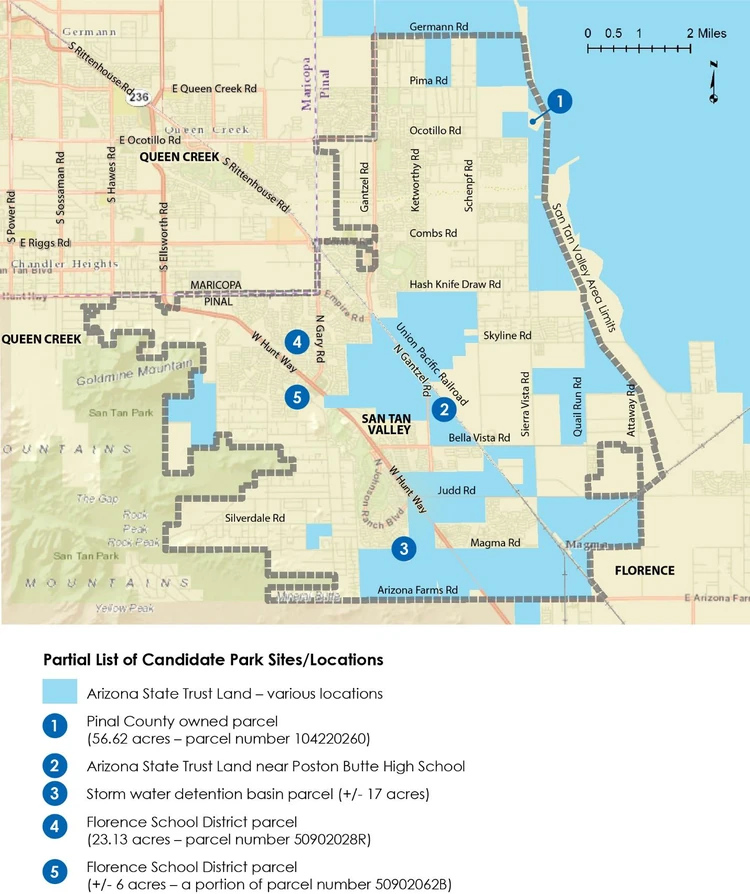
Pinal County already owns a 56.62-acre undeveloped parcel in the northern portion of the community, located north of East Ocotillo Road and west of the Central Arizona Project aqueduct, on land once occupied by the former Rittenhouse Army Heliport. Large tracts of Arizona State Trust Land are also available near the geographic center of the community, including parcels near Poston Butte High School, Central Arizona College’s San Tan campus, and the Pinal County San Tan library. The Florence Unified School District owns a 23-acre undeveloped parcel with access from Hunt Highway on the west and North Village Lane on the east, plus a smaller six-acre portion of a larger parcel that also contains San Tan Heights K-8 School. An existing 17-acre stormwater detention basin within the Johnson Ranch development could potentially serve as park space as well.
The plan also notes that when new large-scale developments are approved, the approving jurisdiction may require the dedication of land for park development as a condition of approval. That could be one potential avenue for securing future park land, though land dedication requirements are subject to legal limits on nexus and proportionality established in U.S. Supreme Court rulings summarized in the prior Pinal Post roads article. For context on land purchase costs, the county’s plan estimates park land acquisition at about $150,000 per acre, or roughly $15 million for a 100-acre parcel.
Parks Planning Is Already Underway
Concrete steps toward a town park system are already in motion. At the council’s April 1 budget hearing, covered in Pinal Post’s earlier article, “San Tan Valley Gains Spending Authority With $14.7 Million Interim Budget,” the council unanimously approved a $14.7 million interim budget that includes a $221,100 Parks and Recreation line item. Finance Director Gabe Garcia said the allocation is intended to begin foundational planning work, specifically a parks master plan that would identify which land to acquire, at what cost, and what amenities to develop. Town Manager Billingsley added that Pinal County had been in discussions with developers about potential park properties, and the budget allocation was included partly in case Pinal County Supervisor Goodman approached the town with a willing partner for a financial feasibility study.
Residents at that same meeting voiced urgency about the park shortage. Josh Statler, vice president of the San Tan Valley Little League, told the council the league fields 35 teams this spring, up from about 30 last spring, with some teams growing to 14 players due to lack of available space. He said the league uses fields at Combs Middle School that are not in good shape, and that HOAs have pushed youth leagues off community fields, preferring them for other uses. He said coaches and board members struggle to answer a basic question from players and parents: “Where do we practice?”
Following the budget adoption, Councilmember Brian Tyler asked the council to place a parks needs analysis or parks committee on a future agenda. He cited the range of sports teams and community events in the area. Mayor Schnepf agreed and noted the topic would tie into future budget discussions.
The Incorporation Argument
Billingsley said the park situation is an example of why incorporation matters for San Tan Valley. Under Arizona’s impact fee statutes, as Griffin explained, raising the level of service from zero requires an outside funding source — the town would have to commit its own money before it could charge new development to maintain that service. Billingsley argued that Pinal County, which he described as a 5,000-square-mile jurisdiction providing regional services to all county residents, was unlikely to concentrate tens of millions of dollars on parks in one community.
“Issues like park space — you just never would’ve had it, because this is a heavy commitment,” Billingsley said of the county’s position. Billingsley said the town’s development impact fee program, once in place, would require biennial audits and annual reporting, creating ongoing accountability for how the funds are spent.
Billingsley added that the town also needs to own land and establish a measurable level of service to improve the long-term park funding picture. “We really need to own some land, and we really need to have some level of service in order to provide a better financial proforma going forward,” he said.
Billingsley described the town’s $19.4 million contribution as foundational. That figure is the amount San Tan Valley must invest to unlock the $3.2 million in park impact fees from new development. “We talk about building a foundation, this is one of the bricks,” he said. “This is kind of a painful brick. This is a $20 million brick. But if we don’t put these bricks in place, we’ll just continue to have zero.”
Where the County Park Fees Went
Councilmember Brian Tyler asked where past park fees paid by San Tan Valley residents were spent.
“Current fees have been paid for parks and recreation through Pinal County. And yet you have zero square feet of parks in San Tan Valley,” Billingsley said. “That fee has been documented and collected by Pinal County as a countywide fee. But none of those collected fees from the county have been expended in San Tan Valley.”
Billingsley said the majority went to the county park off Peralta Road near Gold Canyon. More recently, funds have gone toward a regional park west of Maricopa in the Maricopa Mountains.
“I’m not saying anything bad about Pinal County,” Billingsley said. “But limited money and a county that’s 5,000 square miles, they’re trying to provide regional services to all county residents.”
Tyler said: “My comments were more associated to why it was important we incorporated. Because majority of those funds came from here that paid for parks outside of San Tan.”
Street Fees Work Differently Than Park Fees
Billingsley said Pinal County’s park impact fee is a countywide fee, but its street impact fees are divided into five separate districts.
“There are five different areas of the county because the county is so diverse,” Billingsley said. “Obviously what’s called the North Central District, which is what we’re in, is the most urbanized and dense growth in the county.”
Other districts serve the Maricopa, Casa Grande, and Copper Corridor areas, among others. Each district has its own fee because trip generation and trip length differ across Pinal County.
Negotiations With Pinal County on Unspent Funds
Councilmember Brian Tyler asked whether projects already earmarked by the county were factored into the cost calculations. Billingsley said that work is ongoing.
“One of the things that Allen and I are very involved in right now is trying to understand how to translate and develop an agreement with Pinal County to make sure that we’re being consistent with state law and investing the funds that were intended to go in this area based on those collections,” Billingsley said.
Billingsley explained the county’s position: “They used a plan-based approach in their 2020 study, so they essentially identified seven different projects in North Central. Five of those are in San Tan Valley, but they’re only into their study six years, so they haven’t collected for the full 10 years.”
The town is working to determine how those collected funds should be spent on the identified projects. “Depending upon how those negotiations turn out, we could be adding or removing things from that list,” Billingsley said, referring to the street project list in the fee study.
Census Numbers: 107,000 or 91,000?
The fee study uses a 2026 base-year population of about 106,600, with the Maricopa Association of Governments (MAG) estimating current population at roughly 107,000. Vice Mayor Hudgins raised the figure during the presentation.
“I noticed this chart and so it’s showing 107,000 population for San Tan Valley,” Hudgins said. “That would make us the largest incorporation in the country’s history, over Florida.”
Hudgins said the town is using a separate, lower figure of roughly 91,000 for state-shared revenue purposes. He asked when a more current population number would be available for work like the fee study.
“We were really hoping to have it this year as part of the mid-decade census estimate number,” Billingsley responded. “But since San Tan Valley wasn’t created until after July 1st, we have to wait one more year. MAG is pretty confident that we have about 107,000 as it stands now.”
Billingsley described the balance required in selecting the number used for fee calculations. Impact fees are calculated by spreading the total cost of needed infrastructure across projected demand — so the per-permit fee falls as the population projection rises. That creates risk on both sides. “You don’t want to underestimate because that causes problems with your justification and your data,” he said. Overestimating creates the opposite problem: if the town sets its baseline too high and growth comes in below projections, the per-permit fee ends up set too low to raise the revenue the town actually needs.
Mayor Daren Schnepf said: “We got 2030 coming up for another census, and I’m sure that number will even increase more.”
Proposed Fees Compared to County
The figures below represent the draft fees calculated by the study before the required construction sales tax credit is applied. Griffin said the fees will be lower once that credit is finalized.
For a single-family home, the draft fee is about $6,200. That breaks down to roughly $5,600 for streets and $540 for parks. Multi-family units would pay about $3,100 total, and mobile homes or other residential units would pay about $5,100 total. Pinal County’s current North Central service area charges about $3,300 total for a single-family unit, of which roughly $2,600 is the street fee. The county’s current fee also includes a roughly $493 public safety component, primarily for San Tan substation debt, that would not carry over into the town’s fee schedule because the town does not hold that debt. The county’s 2020 update reduced street fees from previous levels, and a further county update is now in progress that would raise them.
Arizona law requires a credit against impact fees to prevent developers from being charged twice for the same infrastructure. Construction projects in Arizona towns pay a transaction privilege tax (TPT) on construction activity, and when a town’s construction TPT rate is higher than its general retail rate, the statute treats that excess as a contribution toward the same growth-related infrastructure that impact fees pay for. The credit offsets the impact fee by that amount.
At a February 19 work session, the town’s tax policy consultant said he would prepare the initial TPT code draft using a 2.25% retail rate and 4.25% for construction contracting classifications — a two-percentage-point gap that, under state law, would drive the size of the credit. The town posted a public notice of the draft TPT code on February 18, opening the minimum 60-day window required before the council can formally adopt it. Rates are not final until adoption, and the exact credit offset was still unresolved at the April 15 meeting. Griffin said the credit math would be worked out before the first public hearing on June 3, 2026, so the public would see the adjusted fees at that point.
Adoption Timeline
The draft study was advertised on April 2, 2026. A public work session will occur during the required 60-day notice window. The first public hearing is scheduled for June 3, 2026, on both the land use assumptions and the infrastructure improvements plan, per the public hearing notice posted at santanvalley.gov. Council adoption of both documents is planned for July 15, 2026. The development fees themselves must then be advertised again. A public hearing on the fees is scheduled for August 19, 2026, with adoption planned for October 7, 2026. After adoption, state law requires at least a 75-day waiting period before fees take effect. The earliest effective date for the development impact fees would be December 21, 2026.
Studies must be updated at least every five years. “You can update sooner if things change,” Griffin said. “If costs change drastically, if your growth curve is way higher than we’re projecting now, you can always update sooner.”
Public Comment
During the call to the public, resident Jeanne Stockton asked whether the town can collect development impact fees on projects that were platted and approved by Pinal County but were not charged a fee. She asked staff to look into the question and report back.