Key points
- Planning and Zoning Commission voted April 16 to recommend approval.
- The project includes 145 MW of solar plus 145 MW of battery storage on 1,227 acres.
- The site sits within the former San Manuel Copper Mine complex.
- Avantus projects $69 million in property tax revenue over 35 years.
- Construction would take 16 months with 275 to 325 workers, and up to five permanent jobs once operational.
- The Board of Supervisors will make the final decision.
SAN MANUEL, AZ — The Pinal County Planning and Zoning Commission voted April 16 to recommend approval of the Ore Town Solar Project, a 145-megawatt solar farm paired with a 145-megawatt battery storage system to be built on the former San Manuel Copper Mine site. The commission forwarded both the rezoning and a Planned Area Development (PAD) overlay, a plan specifying that only solar and battery storage are allowed on the site, to the Board of Supervisors, which will make the final decision.
The project sits east of San Manuel on land already altered by past industrial use. The facility will be built within an approximately 800-acre fenced area, with more than 430 acres of natural desert left in place. A portion of the project area was previously used for ore processing, not mining. The project does not sit on the mine tailings.
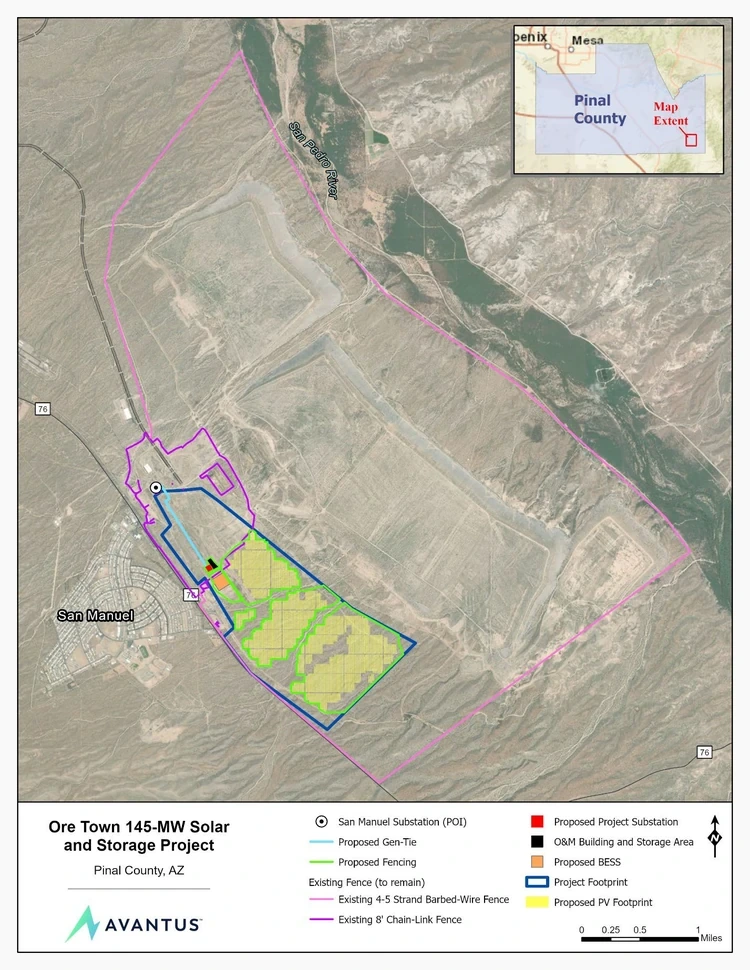
The San Manuel Fire Department sits just off the site, between the battery storage area and Veterans Memorial Boulevard.
What residents will see on the ground
The San Manuel solar project will include photovoltaic arrays, a battery energy storage system (BESS), a new step-up substation, a 0.85-mile generation tie line, access roads, fencing, and a potential operations and maintenance building. Panels will have a low height profile of 6 to 10 feet.
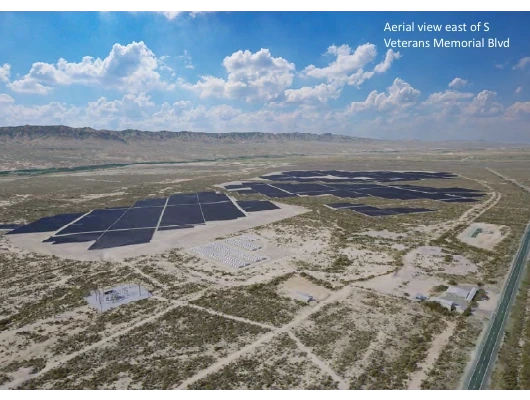
The closest solar panels will sit 400 feet from Veterans Memorial Boulevard, and the battery storage equipment will sit roughly 1,100 feet back from the road. Attorney Stephen Anderson, representing developer Avantus, said existing vegetation and the slope of the site will further screen the facility.
“Between the existing vegetation that we’ll leave in place and the slope of the site, it’s our belief that you won’t be able to see the panels or the BESS as you drive past the site on Veterans Memorial,” Anderson told the commission.
Avantus played a drive-by video simulation during the hearing showing the view from Veterans Memorial Boulevard with the project in place. The simulation is also available on the Ore Town Solar visual simulations page.
Why the site was chosen
Senior Planner Valentyn Panchenko walked the commission through the property’s history. The land was an active ore processing site from 1955 to 2003 and has since sat vacant.
Panchenko told commissioners the site is not suited for future housing, and an industrial use is the best fit for the land going forward. Whether that becomes industry or other businesses, he said, is up to the community to decide.
Growth around the site is naturally limited. The old San Manuel airport sits to the northwest, which restricts what can be built nearby. The San Pedro River runs about three miles to the east, with the former mine tailings forming a buffer between the project and the river. Four major ephemeral washes cross the site and drove several environmental stipulations in the staff report, including a required 50-foot buffer along each wash.
Existing infrastructure on site
The site comes with built-in infrastructure. An APS substation was built to serve the copper mine, so the developer will not need to build new long-distance transmission lines or cut into APS’s existing transmission system.
“We generate the power, we step it up with our own mini substation inside our fencing,” Anderson said. “That substation has a gen-tie line that runs about 0.85 miles into the existing APS substation. The folks who live there today, they know about that substation. It’s already a part of their community. It’s been there forever. We get to that substation, then the power becomes APS’s.”
Avantus must still build one new step-up substation inside its fencing and the gen-tie line to connect to the existing APS facility.
Where the power will go
The developer intends to sell the project’s electricity wholesale to Arizona Public Service (APS), pending completion of interconnection studies. Commissioner Tom Scott pressed on whether local residents would see lower bills as a result.
Katie DeSpain, the lead developer for Ore Town at Avantus, said APS sets the rates, and once power enters the grid, it flows where it flows. The developer cannot direct it to specific customers. Avantus has previously signed two power purchase agreements with APS for other Arizona projects.
Fire coverage and the San Manuel Fire District
San Manuel Fire Department Captain Jessica Castro told commissioners the department is in the process of purchasing a new 3,000-gallon tender, which is a truck that carries water to fires in areas without hydrants. The department also operates a ladder truck, two engines, a brush unit (a smaller off-road truck used for grass and wildland fires), and a 2,500-gallon tender, and carries AFFF and F-500 firefighting foams for active fire suppression. For major incidents, the department requests mutual aid from Oracle, Mammoth, and sometimes Winkelman.
Avantus battery engineer Mark Christensen explained that in a thermal runaway event, crews typically contain and cool surrounding units rather than attack the burning battery. DeSpain said Avantus typically conducts training with local fire personnel during construction, before a site becomes operational, and is open to annual trainings once operations begin. Fire Captain Castro said training would likely happen twice a year due to staff turnover.
Commissioner Gary Pranzo asked how the fire district would sustain itself financially. DeSpain said Avantus and BHP worked together to annex the project site and surrounding BHP property into the fire district. Approximately 25% of the project’s property taxes will go to the district, estimated at $17.3 million over the project’s life.
Why no wall around the battery storage
The Planning and Zoning Commission has historically applied a standard stipulation requiring an 8-foot CMU block wall around battery storage equipment. However, staff did not include that stipulation for this project.
Panchenko told commissioners the site’s topography and its history as an old mining site mean residential development next to the battery storage is not a realistic future use. The commission has typically required a wall for security reasons, but in this case that concern does not apply.
The battery storage will instead be enclosed by a six-foot chain-link fence topped with concertina wire, along with existing fencing from BHP Copper, Inc., the site’s landowner and former mine operator. Panchenko noted the commission could add the CMU wall back if members wished, but no one moved to do so.
Taxes, jobs, and economic impact
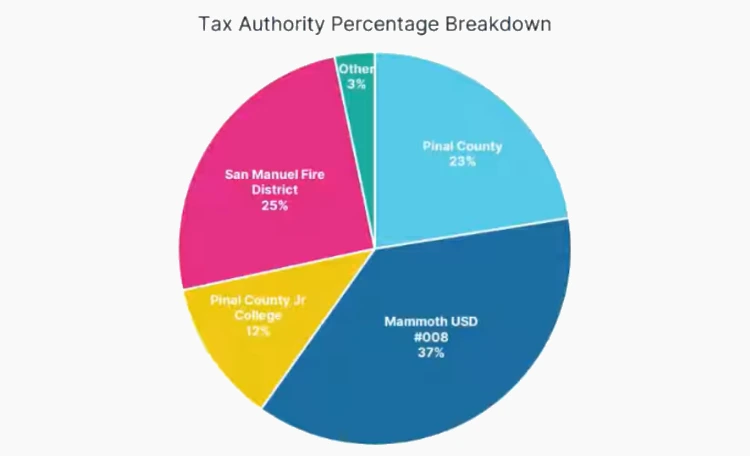
Avantus projects about $69 million in total property tax revenue over the 35-year project life. The largest beneficiaries are the Mammoth-San Manuel Unified School District ($25.8 million, 37% of the total), the San Manuel Fire District ($17.3 million, 25%), Pinal County ($15.5 million, 23%), and Central Arizona College ($8.1 million, 12%).
If the land remained vacant, it would generate only about $860,000 in property taxes over the same 35-year period.
The construction workforce is projected at 275 to 325 workers over a 16-month construction period, with up to five permanent operations jobs once the facility is running. Christensen said construction contractors typically draw much of their labor force locally, though he could not promise specific hiring numbers for San Manuel.
Commissioner Scott, who lives in Coolidge, challenged the tax projections. He argued that state statute sends all property tax to the state, which then reallocates it, with only a small fraction returning to the point of origin. He also contended that the project would depreciate over 10 years under state law, meaning the largest tax payments arrive in that window, and that values revert to the original property value plus 10% for remaining infrastructure in year 11.
Under Arizona Revised Statutes 42-14155, the full cash value of renewable energy and storage equipment is set at 20% of its depreciated cost, with depreciation capped at 90% of original cost. Full cash value is the valuation used to calculate property taxes, not the tax itself. Depreciated cost is the original cost of the equipment minus the value it has lost over time due to age and wear, similar to how a vehicle loses value each year after purchase.
According to the Arizona Department of Revenue, property taxes in Arizona are collected by the County Treasurer and distributed directly to local taxing jurisdictions such as counties, school districts, and fire districts, rather than being pooled and reallocated at the state level. That matches the breakdown in the applicant’s presentation, which identifies the Mammoth-San Manuel Unified School District, the San Manuel Fire District, Pinal County, and Central Arizona College as the largest recipients of the project’s projected $69 million in property tax revenue.
Scott’s broader concerns
Scott also raised concerns based on his experience with solar fields in what he called “the flat area of Pinal County” near Coolidge.
“From all of these solar places, probably eight of them or better, 8,800 acres. And we just got a fraction of the money, just crumbs came back to our area. But then we’ve altered our weather patterns in our community, and this is gonna have the same effect in this community too, and I’m sure that nobody’s aware of that.”
He summarized his message to residents: “My summary in all this is to the citizens, you’re not gonna get the money that’s promised. It’s not gonna come, just the way it works. You’re gonna see your temperatures are gonna go up seven to 10 degrees, you’re gonna get less rain. High pressure is associated with that kind of stuff, and it would be wonderful if you guys got a little break on your electricity being that you live there, but it doesn’t look like that’s gonna happen.”
Battery safety questions
Scott cited 55 BESS fires nationally between 2018 and 2025, including one at an SRP facility in Peoria.
Christensen explained that battery enclosures are designed with spacing, ventilation, and detection systems that prevent thermal runaway from spreading between units.
On water supply, Christensen said the industry standard includes an on-site water storage tank with excess capacity for active cooling, which will be the standard here. That would supplement the San Manuel Fire Department’s existing hydrant, which DeSpain estimated is less than 1,000 feet from the battery storage area.
Water use and drought
Scott pressed the applicant on construction water use, citing a figure of 35 million gallons during the 16-month build. He noted that at 6,000 gallons per semi-truck, that would amount to roughly 5,800 truckloads if the water is trucked in. The applicant’s submitted materials put annual operations water use at about 550,000 gallons. When Scott asked what that water would be used for, the Avantus team identified dust suppression and panel washing.
DeSpain said water would either be trucked in from a local provider or sourced through an agreement with landowner BHP, which holds existing water rights. No agreement has been negotiated yet.
Scott raised the regional drought and noted that Kearny, upriver from the project, is facing its own water situation. He urged the applicant to take downstream water conditions into consideration.
Vegetation and noxious weed management
Scott pressed the applicant on how vegetation will be managed under the panels. Christensen said vegetation can grow to about 18 inches under a panel before creating a ground fault or arcing risk.
“It’s a twofold process. There’s herbicide spray followed by mowing to get rid of the dead vegetation to a certain level. You don’t want to scarify the land, but you want to leave that growth there, because obviously it helps with runoff and other things.”
Urban Wildlife Planner Kelley Fox spoke to the noxious weed concern. She told commissioners the county is experiencing significant invasive weed infestations, and larger developments should have noxious weed management plans in place at the zoning stage. Species in the area could include Sahara mustard, buffelgrass, stinknet, and tamarisk. Different species require different treatments: pre-emergent herbicides, post-emergent herbicides, or mechanical removal. The applicant’s plan addresses each species individually.
Public comments
Nine letters of support were in the packet before the hearing, with a tenth letter from the Eloy Chamber of Commerce added on the day of the hearing. The San Manuel Fire Department and the Arizona Technology Council also submitted corrected versions of previously filed support letters that had referenced the wrong case numbers. One letter expressing concern came in from the Tri-City RC Modelers Club.
San Manuel resident Chimene Hawes spoke in support, telling commissioners the site is reclaimed mining land. She said residents will not see any panels unless actively looking for them and emphasized that the unincorporated community needs the tax revenue.
Brian Cox spoke in favor of the project and advocated for liquid cooling in battery storage systems as a safer alternative to air cooling for preventing thermal runaway. He said the applicant had confirmed at a prior hearing that liquid cooling would be used on this project.
Nancy Hartle of San Tan Valley also voiced support for the project, calling solar the best option for clean energy. She told commissioners that residents concerned about electricity costs should pay attention to who is elected to the Arizona Corporation Commission, the body that approves utility rate increases.
Written comments submitted earlier included local business proposals. San Manuel resident Angela Krause expressed interest in starting a solar panel cleaning business with two crews and requested help getting it financially off the ground. Heather Stanford of Natures Surprise Ranch LLC in Oracle proposed using goat grazing for vegetation management. Residents also submitted letters of support citing grid resiliency, tax revenue, and productive reuse of the mine site.
Decommissioning and security for removal
The Decommissioning Plan prepared by Westwood assumes a 40-year useful life for the solar panels. Work would be completed within 18 months after the lease expires or terminates. Activities would include removal of panels, racking, foundations, collection lines, inverters, transformers, substations, operations buildings, and battery components. Access roads and fencing may be left in place or removed at the discretion of the landowner. The land would be restored to predevelopment condition to the maximum feasible extent.
Under its lease with BHP, the applicant must provide BHP with security in the full amount of the decommissioning cost estimate beginning in year 10 of the lease term. A third-party engineering firm will prepare the cost estimate, which will be re-evaluated every five years. The county also requires a decommissioning plan and financial assurance before any construction permits are issued.
Commission action
The rezoning motion passed unanimously with one stipulation. A second motion to recommend approval of the plan limiting the site to solar and battery storage, with 18 stipulations, also carried unanimously.
On the road to the Board of Supervisors
The recommendation now moves to the Pinal County Board of Supervisors, which will make the final decision on both the rezoning from General Rural (GR) to Industrial (I-3) and the plan limiting the site to solar and battery storage.