Key Points
- Commission recommended approval without opposition on May 21, 2026; Board of Supervisors makes the final call.
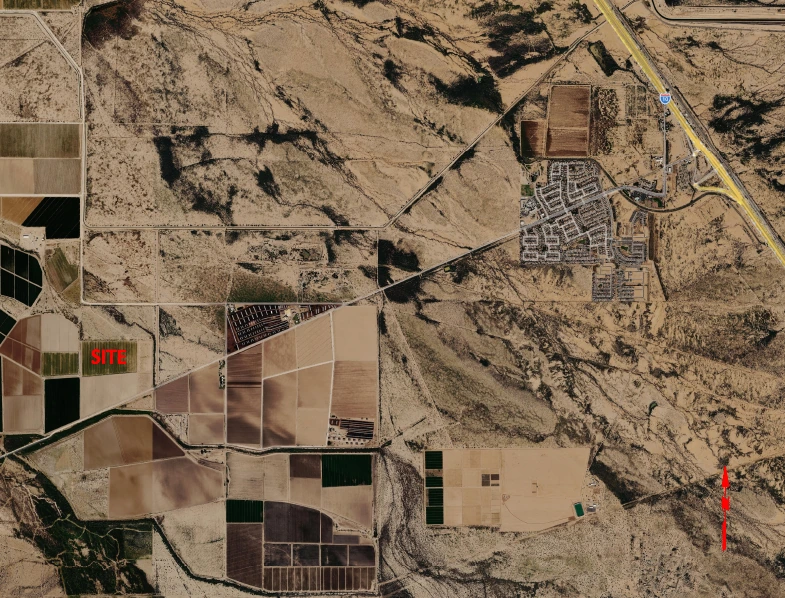
- 164-acre site southwest of Red Rock; 680 MW in Phase 1, potentially 1,360 MW with Phase 2.
- Developer Kindle Energy projects coming online in 2032.
- Plant would use about 16% less water annually than current cotton crop, but agricultural use can drop to zero in fallow years.
- Projected annual water use slightly exceeds the existing groundwater right; applicant must document lawful water rights with the state before construction permits issue.
- No specific end-use customers named, though La Osa Energy and Data Center sits about a mile away.
- Commission tightened Stipulation 23 to require a building permit within 10 years, with one possible five-year extension.
- The public hearing would not have been required if the 2025 zoning code update had taken effect; that update was withdrawn after public opposition over unrelated concerns.
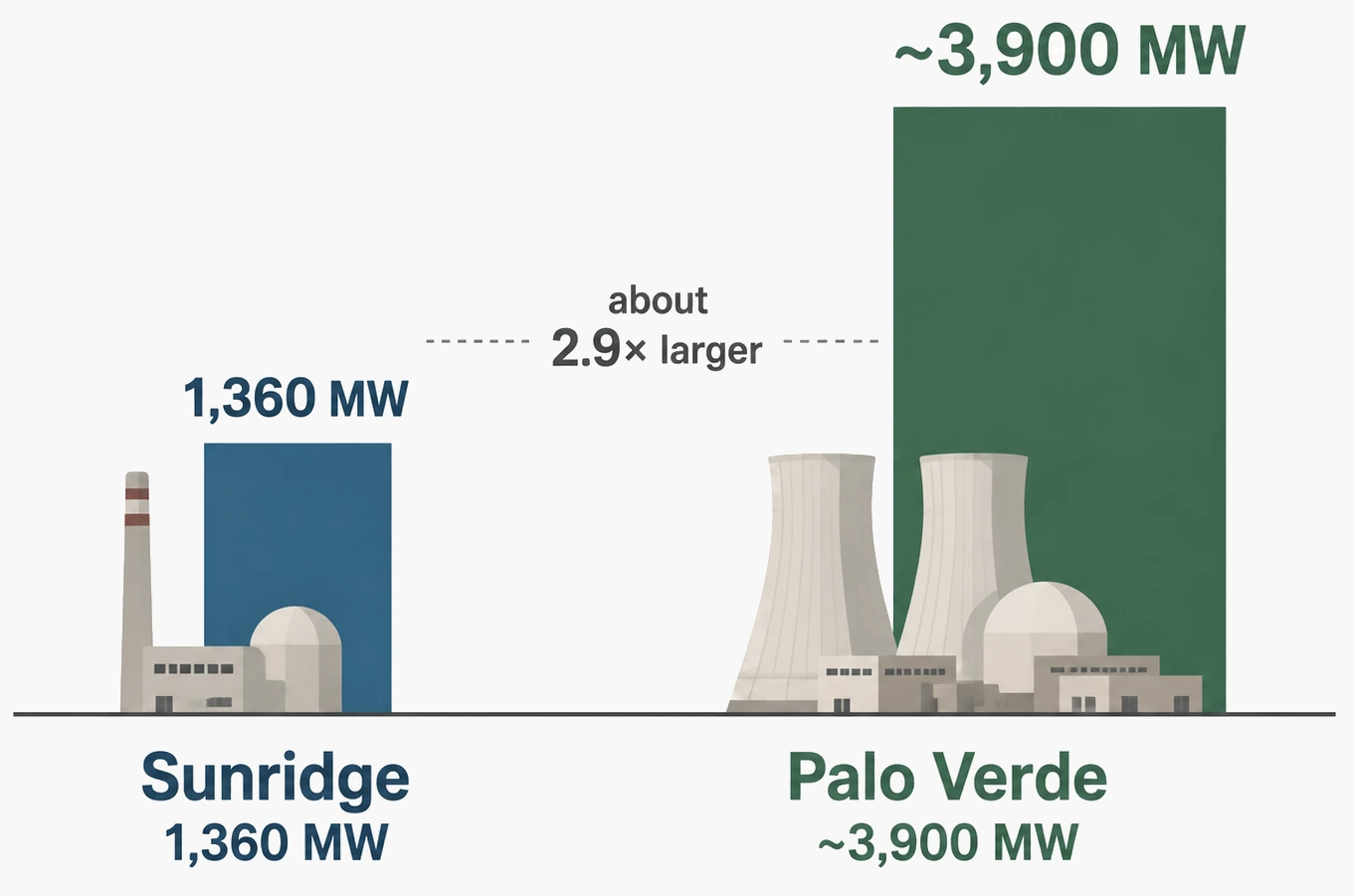
RED ROCK, AZ — The Pinal County Planning and Zoning Commission voted without opposition on May 21, 2026, to recommend approval of an Industrial Use Permit for the Sunridge Power plant Pinal County project. The 164-acre natural gas-fired facility would replace farmland southwest of Red Rock. A 680-megawatt Phase 1 generating unit would be built initially. A second 680-megawatt Phase 2 unit would follow only if a long-term power contract materializes, bringing potential total capacity to 1,360 megawatts. The applicant’s narrative says power would serve Pinal County and the broader Arizona market through Arizona Electric Power Cooperative’s Resource Governance Process. Participating member utilities would include Trico Electric Cooperative and the Southwest Public Power Agency, which represents Pinal County Electrical Districts 2, 3, and 4.
The recommendation now heads to the Board of Supervisors for a final decision. Developer Kindle Energy expects the plant to come online in 2032; Chairman Robert Klob noted the El Paso Natural Gas pipeline interconnection itself is not expected to be ready until 2030 or 2031.
Cotton Fields Southwest of Red Rock Would Make Way for the Plant
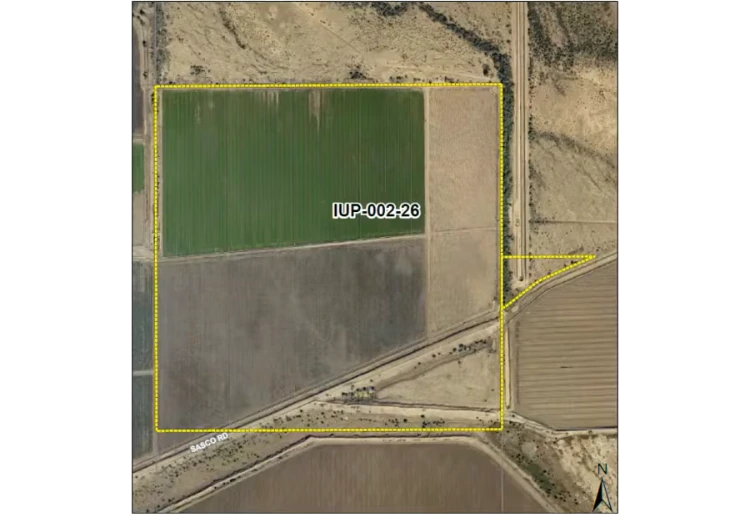
The Sunridge Power site sits in unincorporated Pinal County southwest of Red Rock, at the intersection of Sasco and Coachway roads. Surrounding properties are zoned industrial, agricultural, or as large-acre tracts. According to staff, that context limits potential conflict with residential uses. The site neighbors the proposed La Osa Energy and Data Center, a 3,385-acre data center campus with two on-site gas-fired power plants and battery storage. Neither La Osa nor data centers generally appear anywhere in the Sunridge agenda packet, application materials, staff report, or hearing transcript.
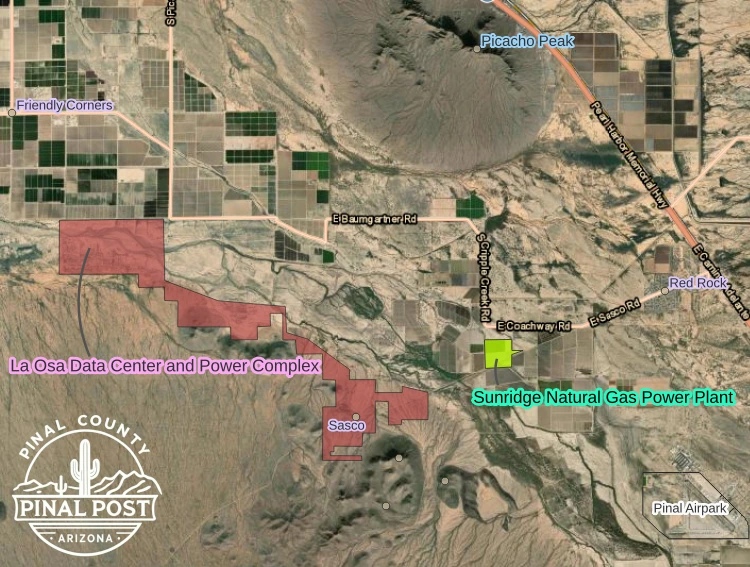
The applicant’s narrative describes the site as “more than 4 miles from the Red Rock central core.” Pinal Post’s measurements place the site about three miles from the community and a little more than a mile from the boundary of the proposed La Osa project.
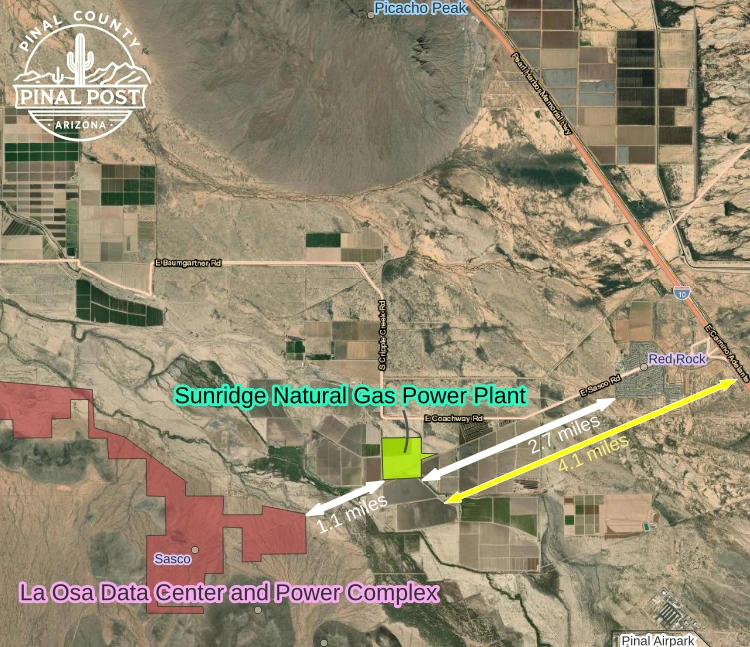
Drivers reach the site from Interstate 10 Exit 226 by traveling roughly 4.2 miles west on Sasco Road. D&S Land & Cattle LLC holds the two parcels. The project would replace active cotton fields.
The same commission voted 7-2 on April 16 to recommend approval of the La Osa rezoning, which goes to the Board of Supervisors for final action on May 27.
How a Legacy Zoning Code Triggered a Public Hearing
The public hearing the commission held, and the 23 stipulations it attached to the permit, both exist because of how the county’s older zoning code treats high-intensity industrial uses. The site’s CI-2 Industrial zoning, in place since 1966, required the project to seek Industrial Use Permit approval, a requirement not imposed by the county’s newer industrial zoning code. That approval triggers a public hearing, a Board of Supervisors vote, and project-specific conditions like the amended 10-year deadline for obtaining a building permit, none of which the newer code requires. The withdrawn 2025 code update would have moved properties like this one into the newer I-3 zone, added in 2012, which allows the same use by right, meaning no Industrial Use Permit would be required. The 2025 update was withdrawn after public opposition, so the Industrial Use Permit requirement remains in effect. The update would have completed the transition from CI-2 to I-3 that the 2012 code revision left unfinished. Had the update gone through, this county IUP proposal could have moved forward without a public hearing, commissioner debate, or the amended 10-year building-permit deadline now written into the permit.
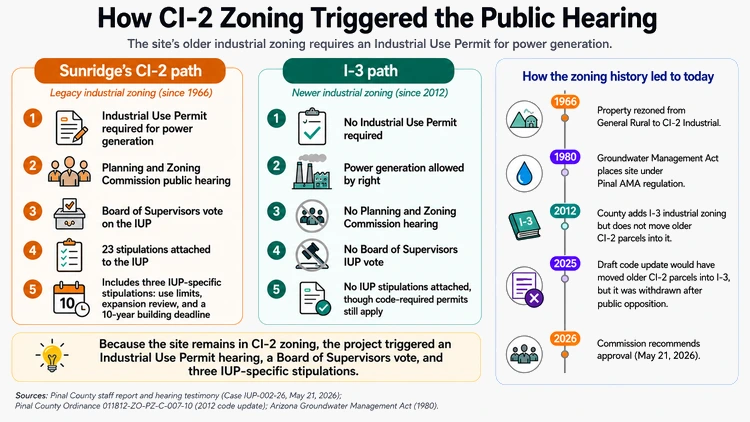
Senior Planner Valentyn Panchenko described CI-2 as “the highest intensity industrial in the old code.” According to the staff report, the property was rezoned from General Rural to CI-2 in 1966, so no rezone was required for the current proposal, only an Industrial Use Permit.
The 1966 rezone decision predates the legal frameworks now governing groundwater and industrial development in Pinal County. The county’s population in 1960 was 62,673; the Census Bureau estimated 539,380 in mid-2025, more than eight times larger. Arizona’s Groundwater Management Act, the framework under which the Type 1 Non-Irrigation Grandfathered Right the applicant plans to acquire is issued, did not pass until 1980. The same Act designated the Pinal Active Management Area, one of three AMAs with jurisdiction in Pinal County. The Pinal AMA governs the Sunridge site. Unlike the Phoenix, Prescott, and Tucson AMAs, whose statutory goal was to reach safe yield by 2025, the Pinal AMA aims to preserve agriculture as long as feasible while reserving groundwater for future non-irrigation uses. Arizona Department of Water Resources modeling in 2019 projected roughly 8.1 million acre-feet of unmet groundwater demand in the Pinal AMA over a 100-year period running from 2016 to 2115, about 10% of total projected demand.
In the 60 years since the 1966 rezone, conditions on the ground have changed substantially, but the zoning has not. Last year’s draft zoning code update would have converted CI-2 parcels to I-3, eliminating the extra Industrial Use Permit step. A parcel that has carried high-intensity industrial rights for 60 years can be developed under those rights even as the surrounding landscape and regulatory context evolve around it; the older CI-2 framework gives the public and the commission a review handle for those high-intensity uses that the newer I-3 code does not. That update never took effect after public opposition led the Board of Supervisors to withdraw it in early 2025. Panchenko said the transition “might happen in the future” through later code revisions.
Inside the Sunridge Power Plant Pinal County Proposal
Applicant Jeff Manuszak of Langan Engineering filed the Industrial Use Permit on behalf of Sunridge Power LLC, a Kindle Energy project.
Combined-cycle technology pairs a gas turbine with a steam turbine. Natural gas burns in the gas turbine to spin a generator, and the hot exhaust then heats water to drive a second steam turbine, capturing energy that a simple-cycle plant would vent and producing more electricity from the same fuel.
Development engineer Carlos Campo described the equipment at the heart of the plant. “This particular turbine that we have basis design on is the biggest gas turbine that GE makes presently, 430 megawatts,” he said. For context, he added that the machine is “probably like twice as big as any one of those machines” at the existing Gila River power plant.
How Water Use Compares to Cotton Farming
Water at a glance. The applicant projects the plant would use about 16% less water annually than the site’s current cotton crop, citing roughly 183 million gallons for the plant compared with 219 million for cotton, based on a University of Arizona study. The comparison holds only in a year the field is actively growing cotton at full irrigation. In a fallow year, which Commissioner Tom Scott noted happens periodically to let fields rest, agricultural use drops to nearly zero, while the plant would continue drawing roughly 183 million gallons.
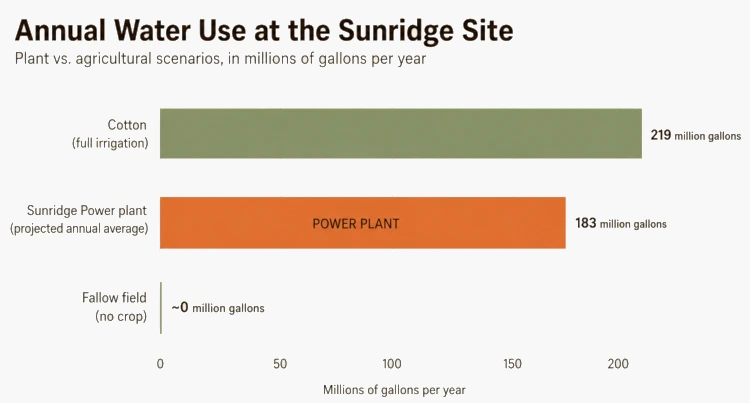
The plant’s water use is also continuous and indefinite, while agricultural use can change year to year. The plant’s projected annual use slightly exceeds the existing groundwater right of about 177.5 million gallons tied to the property, a gap of about 5.5 million gallons per year. The applicant says it will acquire the existing right as part of the sale and apply for a new Type 1 Non-Irrigation Grandfathered Right “to meet water demands at the facility.” Stipulation 16 requires documentation of lawful water rights from the Arizona Department of Water Resources before construction permits issue.
The daily numbers. Commissioner Tom Scott asked Kindle Energy Vice President of Development Thomas Flexon to confirm daily plant use of “between, let’s say, 500,000 gallons and 700,000 gallons a day, plus or minus.” Flexon responded, “yeah, at full construction,” and added that actual daily use is temperature driven, lower in winter months and higher on the hottest summer days. The 500,000-gallons-per-day figure is the applicant’s design average for both generating units, multiplied across 365 days to reach the 183-million-gallon annual projection. The narrative adds one quantified trigger: water injection into the turbine compressor for inlet air cooling activates when ambient temperatures exceed 50 degrees Fahrenheit. The 219-million cotton figure represents one growing season’s irrigation; the 183-million plant projection is a year-round average; actual daily use would vary with temperature.
The fallowed-field exchange. Commissioner Tom Scott noted that cotton farming itself varies year to year. “In agriculture, there’s different crops that take different amounts of water,” he said. “Fields are fallowed for a season to let them rest. So in those years, not very much water being used, if any, but yet your plant will consume consistently 500,000 to 700,000 gallons.” “I think what you’re bringing up is fair,” Flexon responded. “Maybe we should go back and we can look at… larger data points. The water rights on the property are even more than what we’re alluding to here.”
— Commissioner Tom Scott
How the plant saves water. The savings stem from air-cooled condenser technology. The condenser is the part of the plant that cools used steam back into water so it can be reheated and reused, and at gas plants with wet cooling towers, cooling typically accounts for most of the plant’s water use. Sunridge has chosen not to use wet cooling towers. An air-cooled condenser uses large fans to do the cooling, while a wet cooling tower sprays water across the steam tubes and lets it evaporate, sending most of that water into the atmosphere as vapor, effectively removing it from the local water supply. “A cooling tower plant would be five times that,” Campo said, referring to the 500,000-gallon daily estimate, or roughly 2.5 million gallons per day for a conventional design.
The plant would also run a reverse osmosis system to remove minerals from water used in the boilers. The resulting brine waste would go to onsite evaporation ponds. Solids left behind would be removed during yearly pond maintenance and sent to a landfill, Campo said.
The Central Arizona Irrigation and Drainage District submitted a letter of support dated April 15, 2026. General Manager Derek McEachern wrote that Sunridge Power’s technology results in “lower water consumption per megawatt of electricity generated.”
Where the Power Will Go
The applicant’s narrative says member utilities participating through AEPCO’s Resource Governance Process would include Trico Electric Cooperative and the Southwest Public Power Agency, which represents Pinal County’s Electrical Districts 2, 3, and 4.
The plant would tie into the El Paso Natural Gas pipeline, owned by Kinder Morgan, about nine miles west of the site. Sunridge Power also has electrical interconnection positions with AEPCO and Arizona Public Service, giving the project flexibility to deliver power to multiple grid points.
Carolyn Turner, AEPCO’s Director of Communications and Member Services, told commissioners the cooperative is expanding generation to serve growing rural communities. When Vice Chair Karen Mooney asked whether the partnership was firm, Flexon said the parties were “exchanging paper” on long-dated contracts.
The application does not name specific end-use customers. Flexon spoke only of “all the industry that is coming to this part of the state” and “quite a lot of industry coming” along I-10. The narrative refers to “advanced manufacturing and technology industries.” The proposed La Osa Energy and Data Center, about a mile from the Sunridge site, would need substantial power if it moves forward.
A Private Equity-Backed Developer
Flexon described Kindle Energy as a portfolio company of one of the largest private equity firms in the world. Established in 2015, the company manages about 10 gigawatts of generation assets and has invested $2.6 billion to develop 1.6 gigawatts of natural gas power across the U.S. Existing Kindle projects include facilities in Louisiana, Colorado, and West Virginia, and Flexon also cited Idaho as a location where the team has brought projects from conception to completion.
On who would run the plant, Flexon said, “we tend to operate our own fleet” and “we’re, we’re, we’re gonna operate it and we’re gonna oversee it.” He described third parties in the industry as staff augmentation rather than replacement operators: “you have third parties that will come in and just act as an extension of the operating management team.” For Sunridge specifically, he said, “Here, probably makes sense to do the same, but there’s always the chance that we would go with a third party operator.” Many Kindle staff came from NRG Energy, and Flexon said the team has collectively operated “over 60 gigawatts of power generation across the U.S.” Asked by Vice Chair Karen Mooney whether the operator has ever had violations on similar projects, Flexon said “none are ringing a bell to me” and described the Colorado and Louisiana projects as “solid” with “no violations.”
Air Quality and Emissions Controls
Sean Donovan, Sunridge Power’s environmental and permitting lead, told commissioners the team submitted its air permit application to the Pinal County Air Quality Control District on April 30, 2026, with approval expected by the first quarter of 2027. The plant will install pollution-control equipment to meet permit limits on nitrogen oxides, carbon monoxide, and volatile organic compounds produced by burning natural gas, what Donovan described as “best available control technology” for this type of facility. The NOx-control system uses selective catalytic reduction, or SCR, with 19% aqueous ammonia, a regulated material whose storage came up among hazardous-materials concerns residents raised at the April neighborhood meeting.
Economic Development Estimates
According to the applicant’s narrative, the project would create approximately 400 skilled tradesperson jobs during the two-year construction period. Once operational, the applicant projects it would support 20 to 26 permanent operational jobs, according to the staff report.
Flexon told commissioners the Greater Phoenix Economic Council recently produced an economic analysis showing the project could generate what Flexon characterized as “$1.1 to $2.3 billion [was ‘trillion’; see correction below] in economic output benefits to Pinal County over a 30 years period.” The analysis itself was not included in the application packet; Flexon offered to provide it to the commission. He compared the figure to a GDP-style measure. “There’s multiplier effects off of the income taxes and benefits that are raised through the project,” he said.
He also framed the broader power demand picture. According to the applicant’s narrative, Arizona peak demand approached 25,000 MW in 2025 including exports, and load growth in the state is expected to average approximately 3.6% annually over the next 10 years. Without new generation resources, the narrative states, Arizona will not have enough installed capacity to serve expected 2035 power demand. Flexon told commissioners that internal analysis projects Arizona will be several gigawatts short of demand by 2033.
Stipulation 23: the Timeline Question
The Industrial Use Permit carries 23 stipulations covering “air quality, water, traffic, safety, drainage, and compliance,” as Panchenko summarized. Stipulation 23, the timeline requirement, drew the most discussion. Chairman Robert Klob raised concerns about parcels sitting under approved permits indefinitely: “We’re tying up more land, nobody knows what’s going on and essentially this has given them a 15-year grace period to come and go, do whatever they want.” The commission amended the stipulation so that the permit “shall become null and void if a building permit is not obtained within the 10-year timeframe, unless one five-year extension is approved by the community development director.” Flexon said the change was acceptable to the applicant.
Public Response and Next Steps
Staff reported no public or agency comments during the county review period. Three supporters submitted cards but did not address the commission. No one spoke in opposition.
The applicant held a neighborhood meeting on April 8, 2026, at Red Rock Elementary School. Staff said attendees asked about air emissions, ammonia storage, gas leaks, and emergency response, among other concerns. Meeting minutes recorded no dissenting comments.
The application now moves to the Pinal County Board of Supervisors for a final decision. The Pinal County Air Quality Control District expects to issue a decision on the project’s air permit by early 2027.
Correction (May 28, 2026): At the May 21 hearing, the applicant’s representative put the project’s projected economic output to Pinal County at “$1.1 to $2.3 trillion” over 30 years. A consultant for Kindle said afterward that he misspoke and intended “billion.”
We don’t need this large Data Center with Pima County putting in 100+ acres Data center next county lines
I moved from El Dorado Hills in California the Data center was just 7 miles away from are home! Used 2 time the water on the paperwork !
PGE rased rate by 39% we had solar 2012 was paying $16 per month 2024 it was $280 per month?
At night fans norsis was up from 3.0 DM to 5.2 DM points.
After going to county Meeting 2019- 2024 the council finally Said they can’t over see the Data Center on all the above works only 12 jobs full time 2022 layoffs or 27 personal?