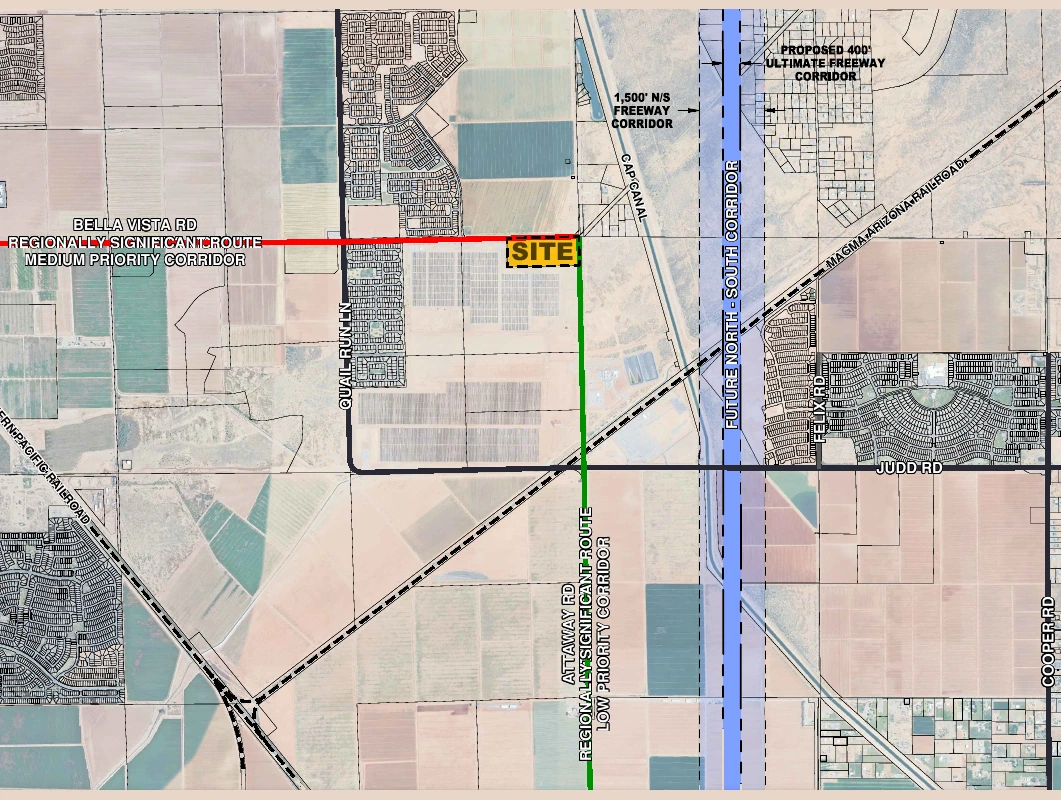
SAN TAN VALLEY, AZ — The Pinal County Planning and Zoning Commission voted unanimously on May 21, 2026, to recommend approval of the Copper Basin Energy Storage project. The 250-megawatt battery facility is planned for a 25-acre site at the southwest corner of Bella Vista Road and Attaway Road in San Tan Valley. The commissioners forwarded the three related cases to the Pinal County Board of Supervisors.
No letters of opposition were filed. Plus Power, the Texas-based developer behind the project, told commissioners the facility is targeted to come online in 2031.
Inside the Copper Basin Energy Storage project
The 25-acre site sits within the San Tan Valley Special Area Plan and borders the Town of Florence to the south. The facility is designed to deliver 250 megawatts of power and 2,000 megawatt-hours of storage capacity.
The commission recommended changing the land use designation from Suburban Neighborhood to General Public Facilities/Services. Additionally, commissioners backed a rezoning from General Rural and Single Residence zones to Industrial (I-3). A Planned Area Development overlay containing 18 stipulations will restrict the site to the battery facility use only.
Plus Power plans to install roughly 480 battery cabinets, each about eight feet tall. The project also includes substation equipment, including a static/lightning mast approximately 120 feet high and a tower structure approximately 100 feet high. Staff noted that transmission-related equipment is exempt from the county’s normal height limit. Between four and six employees will staff the site, with proposed remote monitoring also in place.
How the battery system fits beside the SRP Copper Crossing site
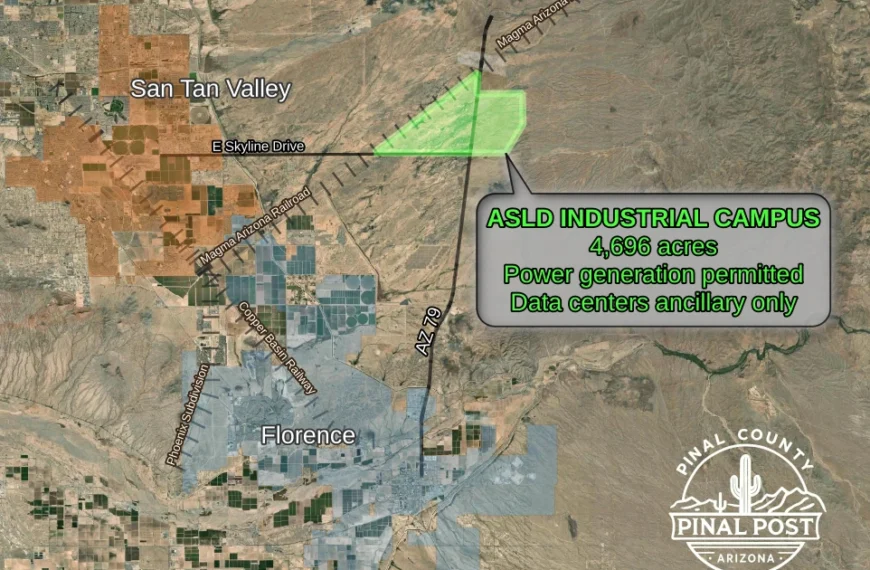
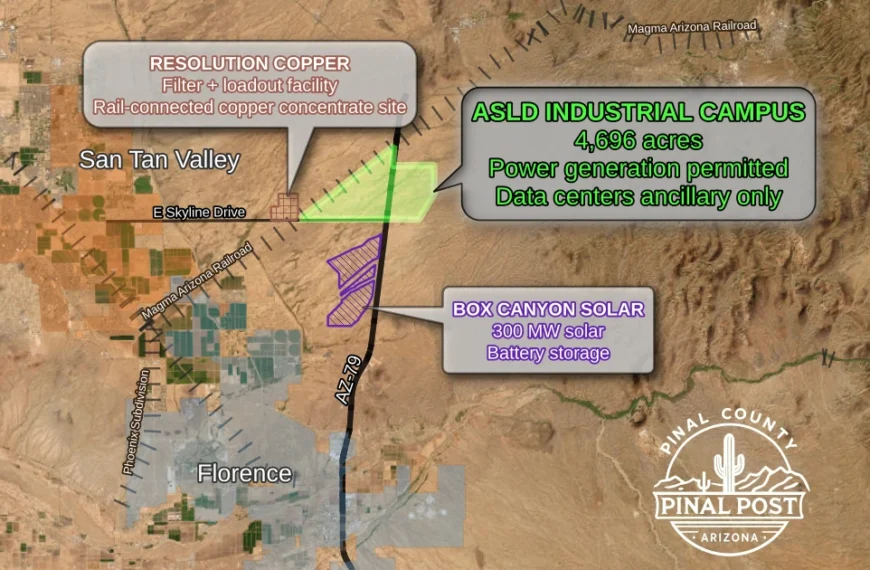
The Copper Basin Energy Storage site is bordered on the west, south, and east by Salt River Project’s Copper Crossing Energy and Research Center. Phase II of that center added 55 megawatts of solar across 270 acres, with construction completed in March 2026. Phase I, also located at the SRP site, includes two flexible natural gas turbines generating 99 megawatts, which SRP installed in summer 2024. These turbines can start up and ramp output up or down quickly to match grid demand.
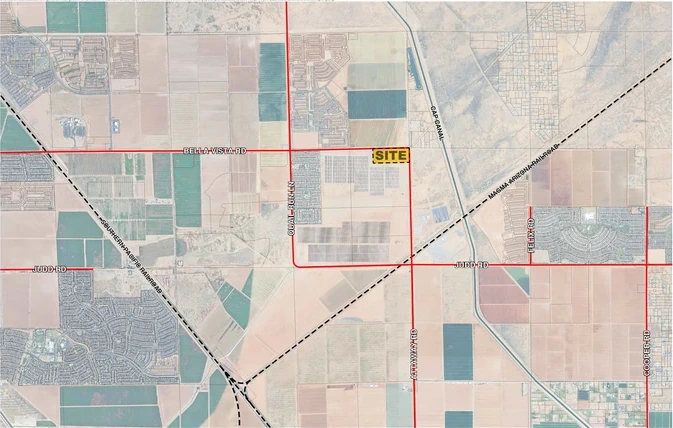
Attorney Nick Wood, representing Plus Power, told commissioners that the project connects directly to SRP’s Abel Substation. That substation sits next to the project site, with nearby 230 kV and 500 kV transmission lines. “We’re not miles away from any substation,” Wood said. “We’re just basically right next door.”
Phase III of the SRP site focuses on long-duration energy storage pilots, including the Desert Blume and Project New Horizon facilities. Desert Blume will use CMBlu Energy’s Organic SolidFlow battery system, while Project New Horizon will use ESS Tech’s iron flow battery. Those pilots use non-lithium chemistries and are expected online by December 2027. By contrast, the Copper Basin project is not part of the SRP development. It is a standalone, transmission-connected battery facility, and Wood said its interconnection to the Abel substation would proceed regardless of SRP’s adjacent operations.
To the west of the site, beyond SRP land, sits a residential subdivision roughly half a mile away. Property to the north is owned by Wolfkin Farms, which submitted a letter of support.
Why batteries matter for the grid during peak demand
Solar generation depends on sunlight, so output rises and falls with cloud cover and time of day. Meanwhile, electricity demand in Arizona spikes during stretches of high outdoor heat, when air conditioning use surges. Batteries can store energy during off-peak periods and release it when demand rises. According to staff, this process helps flatten the daily peaks and valleys of demand and can carry cost savings for ratepayers.
Wood told the commission that the Phoenix metro population has grown from 1.7 million in 1985 to more than 5.5 million today. Meanwhile, Pinal County has expanded from about 100,000 residents to over 500,000. He said power has been part of the foundation of that growth, and batteries have emerged over the past eight to nine years as a way to store excess electricity from the grid.
In terms of scale, Wood said that if the full 2,000 megawatt-hours were drawn down, the facility “could power 100,000 homes… anywhere from 8 to 16 hours” depending on demand.
Noise levels and screening
Although the batteries themselves are silent, the cooling fans that regulate cabinet temperature generate noise. According to a noise consultant retained by Plus Power, the facility will measure approximately 51 decibels at the perimeter wall, about the level of a normal conversation.
Plus Power will build an eight-foot decorative CMU wall along the northern and eastern sides of the site, which border the main roads. In addition, the project will comply with the Pinal County noise ordinance.
Safety planning and the Moss Landing fire
Commissioner Tom Scott asked the applicant about fire protocols at the site. In response, Brian Scholl of the Energy Safety Response Group (ESRG) addressed the commission. He also referenced the January 16, 2025 fire at the Moss Landing Power Plant in California, which had come up earlier in the day during another case. The fire burned through roughly 80 percent of a 300-megawatt battery section at Vistra Corp’s Phase 1 building. Local authorities evacuated 1,200 residents, and California subsequently adopted updated fire safety standards for battery energy storage facilities.
Scholl is a recently retired Phoenix Fire Department veteran with 23 years of service. According to Scholl, the Moss Landing incident involved first-generation nickel-manganese-cobalt batteries. He said today’s industry standard is lithium iron phosphate chemistry.
Scholl, who told commissioners he helped write the national standard for stationary battery storage systems, said his team tests batteries and knows what’s emitted in the smoke. He said the primary byproducts are hydrogen, carbon monoxide, and carbon dioxide. The protocol, he said, is to let an affected enclosure consume itself while protecting exposures. He added that air sampling at past incidents has not detected levels past the fence line above federal guidelines.
Battery monitoring and emergency response
Scholl told commissioners that each battery enclosure includes a 24/7 monitoring system that tracks individual cell behavior. If a single cell drifts out of specification, he said, the battery management system can shut down that row. He added that the system also monitors adjacent enclosures for heat buildup so responders can decide whether to intervene.
Plus Power has met with Rural Metro Fire Department, which submitted a letter of support. Scholl said he will write the site’s emergency response plan and provide annual training to Rural Metro personnel.
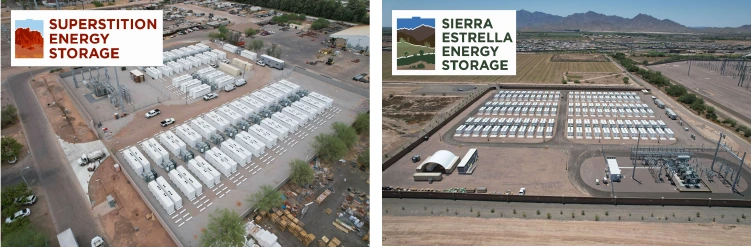
“We own and operate our facilities,” Plus Power representative Matthew Look told commissioners. Wood said the company has nine existing facilities across Texas, New England, Hawaii, and Arizona, including battery sites in Gilbert and Avondale. “They’ve never had a fire,” Wood told commissioners.
Code updates and the three-year cycle
Vice Chair Karen Mooney asked whether codes governing battery facilities evolve as the technology changes. Scholl said national fire codes follow a three-year cycle, with lessons learned incorporated each round. Planning Manager Harvey Krauss told commissioners that once a facility is built under a particular code, that code applies for the life of the project unless major renovations occur.
Krauss added that Pinal County currently operates under the 2018 codes and is working on the 2024 code. He said San Tan Valley plans to adopt the 2024 code.
Community support and economic impact
The project drew letters of support from Nevitt Farms, SRP, Wolfkin Farms, the Arizona Commerce Authority, the Arizona Technology Council, the Pinal Alliance for Economic Growth, and Rural Metro. Staff distributed an eighth letter of support from a citizen at the hearing. No letters of opposition were submitted.
Wood said Plus Power plans to spend $15 to $20 million on the project. That spending generates property tax revenue, equipment tax revenue, and construction jobs. Plus Power’s submission projects 50 to 100 jobs during the 12- to 18-month construction period.
Look told commissioners the company’s charitable giving in San Tan Valley would be continual.
Action by the commission
The commission’s three motions forwarded all the cases to the Pinal County Board of Supervisors with recommendations of approval. If approved, Plus Power expects the facility to begin commercial operation in 2031.