Update, Aug. 4, 2026: The Casa Grande City Council voted 7-0 on Aug. 3 to approve the waivers. Read the full outcome here.
CASA GRANDE, AZ — The Casa Grande City Council is weighing whether to grant a legal waiver that would clear the way, as a land-use entitlement, for a data center campus on about 480 acres of farmland, or face litigation over the landowners’ roughly $140 million compensation demand. A formal vote is scheduled for Monday, Aug. 3, and public comments are open through July 30. No tenant or end user has been publicly identified, and city officials caution that approving the waiver would only lift the permit requirement on these parcels — other approvals would still apply, and no data center is yet confirmed.
Data centers were becoming common across Arizona, but Casa Grande’s zoning code did not mention them. In late 2024 and early 2025, city staff began studying how to regulate them, believing the city needed a clear policy in place before applications arrived. The dispute unfolded from there:
- Nov. 2006 — Arizona voters approve Proposition 207. The Private Property Rights Protection Act may entitle property owners to compensation when a new land-use rule reduces their property’s value. The government may instead amend or repeal the rule, settle, or grant a binding waiver for the specific parcel.
- July 14, 2025 — Planning Department issues a written zoning interpretation. After the owners’ representatives asked whether a data center was an allowed use, the department concluded in writing that it was already appropriate on the Industrial (I-2) land under the existing code.
- Aug. 7, 2025 — Planning & Zoning Commission recommends codifying that reading. The commission approved text amendments that would list data centers explicitly as a principal permitted use in Industrial/Manufacturing zoning.
- Sept. 15, 2025 — Council rewrites the recommendation. The council modified the commission’s language, reclassifying data centers as a use requiring a Conditional Use Permit, an added round of public review, rather than one permitted outright, and passed the first reading of Ordinance 3479.
- Oct. 6, 2025 — Ordinance adopted. The council’s second reading of Ordinance 3479 finalized the change, eliminating data centers as a permitted use by right in I-2 industrial/manufacturing zoning.
- Feb. 25, 2026 — Owners file Proposition 207 notice. Attorneys for the owners submitted a formal claim asserting the new permit requirement had reduced the property’s value by about $140 million, and demanded either that sum or a waiver.
- July 20, 2026 — Council study session. Study sessions are informational only, so the council took no action.
- July 21–30, 2026 — Public comment window. Residents can submit comments through Engage Casa Grande or by email.
- Aug. 3, 2026 — Regular Council meeting. The council is scheduled to formally consider the Proposition 207 waiver and settlement agreement.
Where the 480-Acre Site Sits
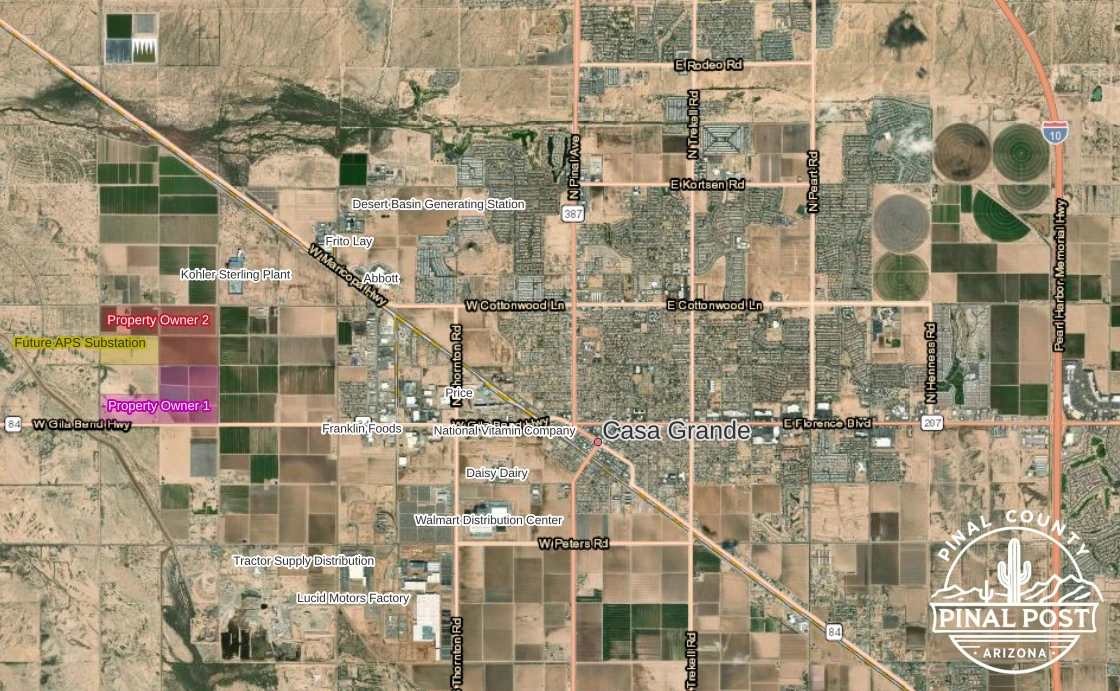
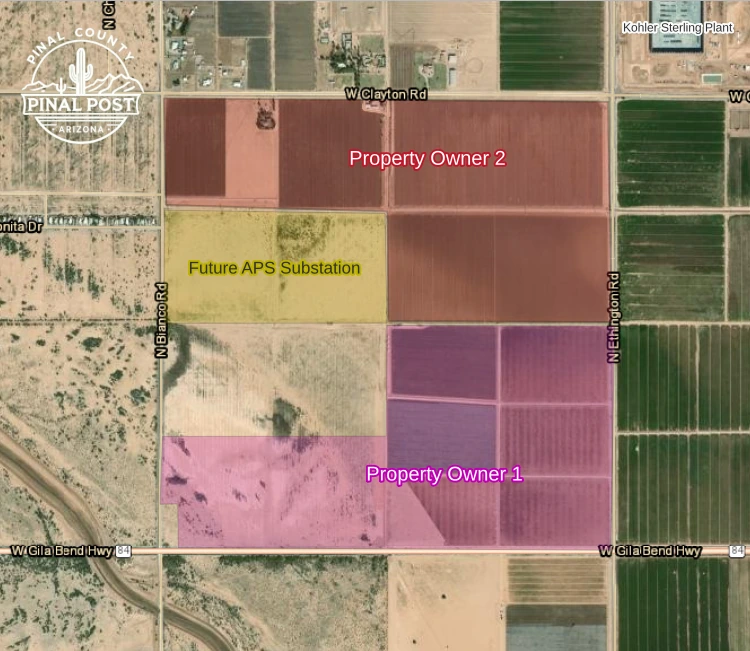
The land is near North Bianco and West Clayton roads, north of Gila Bend Highway, split between two owners’ holdings. Between them, City Manager Larry Rains said, the utility APS has acquired roughly 80 acres for a future substation. The fields are still farmed for cotton and alfalfa, and most of the surrounding land is zoned for industry. Mayor Lisa Navarro-Fitzgibbons said the city expected data centers would come eventually “because of where we’re located, we have the natural gas line that’s coming through.”
What the Waiver Would Require
Under the proposed settlement, the owners would drop the $140 million demand. In exchange, any future campus — described in city materials as potentially up to 13 buildings totaling about 3.25 million square feet — would have to follow legally binding conditions.
- Water. Annual potable water use would be capped at 800 acre-feet — 35% less than the roughly 1,240 acre-feet of groundwater the site’s cotton and alfalfa fields currently pump from the same aquifer for irrigation each year. Only potable water is capped by the proposed limit; the public materials do not describe how raw groundwater use for non-potable purposes would be treated. The city says a future end user could add Casa Grande’s reclaimed wastewater as a separate supply if it becomes available at the site. Like the farms and other industrial uses around it, the campus would draw mainly on groundwater. The developer has said it is willing to use a closed-loop, air-cooled, or hybrid cooling system. Hybrid systems use air cooling in cooler weather and evaporative cooling during the hottest periods of the year. “Closed loop” by itself refers to fluid circulating in a sealed circuit, not to how heat is ultimately rejected.
- Power. Under a “Bring Your Own Power” model, the campus would generate its own electricity on site rather than draw on the local grid, at least initially. Its generators could not run until the prospective developer obtained all required permits, including applicable air-quality approvals from state, federal, and county regulators.
- Noise. A licensed acoustical engineer would establish baseline noise levels before construction and conduct post-construction assessments within 90 days after each phase becomes operational, with results submitted to the city. The project would face stricter noise limits than its industrial neighbors.
- Decommissioning and community benefits. The proposed deal would include decommissioning requirements, and the prospective developer has pledged an extra $5 million for city recreation facilities if the project proceeds.
The waiver would cover only this property, so future data centers elsewhere in Casa Grande would still need the special permit. The project would also still face every other rule, from building and fire codes to environmental reviews that may protect burrowing owls and other native species if found on site.
Water in Context
How the proposed 800 acre-foot potable-water cap compares to Casa Grande’s overall water use and to two other data center projects being reviewed in the same Pinal Active Management Area:
| Project | Water use (acre-feet/year) | Source of figure |
|---|---|---|
| Casa Grande citywide (chamber estimate) | ~15,600 | Casa Grande Chamber SAVE IT campaign |
| Casa Grande data center (proposed potable cap) | 800 | Waiver settlement; hybrid cooling allowed |
| Project Midway data center (near Casa Grande) | ~17 average, ~40 if max-day rate persisted (contested) | Applicant’s estimate; closed-loop or air-cooled |
| La Osa data center (Pinal County) | ~600 or ~4,288 (contested) | Attorney (up to ~600, primarily gas plants; asserts closed-loop data-center cooling uses no water); engineering water memo (~4,288 total site demand, based on a standard industrial planning rate) |
Casa Grande’s proposed 800-acre-foot potable-water cap would become a binding condition if the settlement is finalized. Neither the La Osa data center nor the Project Midway data center has locked in a water-use cap. La Osa’s 33 zoning stipulations do not address water. Project Midway has a proposed stipulation requiring “closed loop or air-cooled” cooling but no cap on total water use.
The cooling language across all three projects leaves room for evaporative water use. Casa Grande’s terms explicitly allow “hybrid” cooling, which the city’s own FAQ defines as using limited evaporative cooling in the hottest weather. At the La Osa and Project Midway data centers, applicants used “closed loop” language to imply that no water would be used for cooling — but residents at each hearing pointed out that closed-loop systems can still reject heat through evaporative cooling towers, which do use water.
Both the La Osa and Project Midway data centers remain contested for different reasons. Project Midway’s water figures remain uncertain. Commissioners questioned whether the proposed fuel cells could operate reliably in Arizona summer heat, and the applicant said it would check with the manufacturer and report back. Separately, the applicant’s water memo anticipates some ongoing industrial cooling-water demand within its roughly 17-acre-foot average annual estimate. La Osa’s applicant is due back Aug. 26 with a proposal to shrink the project to no more than 11 buildings and one gas plant, from 59 buildings and two, though water figures for the smaller footprint have not been reported. Both applicants said they would accept tighter cooling language, but nothing binding has yet been adopted at either project, and the current wording at each does not clearly rule out evaporative water use.
Proposition 207 and What the Owners Argued
In July 2025, the owners’ representatives asked for a formal ruling; the planning director concluded a data center was “most similar to a warehouse” and therefore already permitted on their industrial land. In September 2025, the council reversed course, requiring a conditional use permit instead. That change, Rains said, was made to “better understand many of the environmental issues dealing with power, water, noise and the like” and to “provide additional public review and allow the city to evaluate those issues on a case-by-case basis.”
The owners’ attorneys valued that reversal at roughly $140 million and, citing Proposition 207, demanded either that sum or a waiver of the permit requirement.
Repeal, Pay, Litigate or Waive: The Four Options
Rains laid out the city’s four legal paths and staff’s view of each.
- Repeal the permit requirement. Staff does not recommend this, saying the conditional use permit process remains an important planning tool.
- Pay. The $140 million is the owners’ figure, unverified by the city, though Rains said industrial-property appraisers see a sizable value difference between data center land and typical industrial land. A payout that size would exceed the city’s available unrestricted reserves and, Rains said, likely require the city to weigh some combination of drawing down fund balances, budget reallocations, deferring capital projects, issuing debt, or adjusting future operations.
- Fight the claim in court. No one can predict the outcome, Rains said, and losing could severely limit city services on top of significant legal defense costs.
- Grant the waiver. This is the alternative the owners requested in their notice, and it is the one staff recommends.
Rains said talks have been productive, and the waiver’s restrictions “could similarly serve as conditions that would have been included in a conditional use permit process.” Rains added that approval is only a land-use step: “That does not mean that a data center is going to be built tomorrow. There are still processes that would transpire.” Final settlement terms are expected by the Aug. 3 meeting.
The proposed conditions, including the 800-acre-foot potable-water cap, will not become binding unless the City Council approves the final settlement and all parties sign it.
The Prospective Developer’s Projections
If a campus is built, the prospective developer estimates roughly $2.5 billion in construction, about 585 full-time employees within the first five years at an average $93,000 wage, and about $6 million a year in city tax revenue. These figures come from the prospective developer, and no tenant has been identified.
Council Reactions
Councilmember Matt Herman said the council could have legally handled the item as a routine vote without discussion but chose public sessions instead, “to make this transparent for our community.” Herman also noted that in some Valley cities, staff can approve these waivers with no public hearing at all — six have been approved that way, by Rains’s count. Casa Grande’s code has no such staff-approval route, Rains said, so the decision comes before the elected council.
Fitzgibbons said councilmembers were disappointed by the claim, but negotiations have continued since February, with the city consulting water and power experts rather than relying on the prospective developer. “We want to make sure that we’re getting factual information on what it means if this data center comes, because we don’t even know for sure if a data center is going to come.”
Weighing In Before Aug. 3
Through July 30, residents can read the FAQs and project timeline, fill out a comment card on the Engage Casa Grande page, or email [email protected]. On July 30, the agenda and staff report for the Aug. 3 meeting will be posted. At that meeting, “it won’t be a public hearing. However, we will have public comments,” Fitzgibbons said.
It’s obvious this is already a done deal and that a data center is definitely going to be built. They wouldn’t have lawyers fighting so hard for the proposal if they didn’t intend to build. It seems like the city is being blackmailed into giving in by the $140 million lawsuit if they don’t comply. How do other cities refuse data centers from being built in their areas? This seems like public tactics to scare the public into giving in. The center hasn’t even started building yet and we the people have been notified that our water bills are, not only increasing but, more than doubling. Coincidence??? I don’t think so. I’m totally against the data centers in our DESERT community where water is becoming more scarce with each day.
Other cities can turn away data centers, why can’t we? Oh, because the people that live here have no say in the matter. We live in a desert where the water is becoming more scarce everyday because of more people moving here and because of global warming. We have already been notified that our water bills are MORE THAN DOUBLING. Our water sources are dwindling and you want to approve data centers that use an immense amount of water just to cool machines, not even to cool people. people.