Key Points
The decision
- Pinal County’s Planning and Zoning Commission voted unanimously to delay a vote on the project.
- The utility ED3 asked for the delay first, citing unresolved questions about the project’s proposed self-generated power.
- The applicant then formally requested a continuance, and no date is set for the return hearing.
County rules
- The proposed 60-foot buildings exceed the county’s current 50-foot heavy industrial height limit, and the county has adopted no standards for data centers.
- Planning staff said they are working on a potential ordinance or standards for data centers, but the pending application must be evaluated under existing rules.
Power
- Project Midway would generate all its own electricity on site — roughly 500 megawatts using a mix of solid oxide fuel cells and natural gas engines, with about 400 megawatts of engines as backup.
- The site would not connect to the utility’s grid initially.
- The El Paso natural gas line that bisects the property is the most likely fuel source, zoning attorney Alex Hayes said, but no gas contract exists yet.
- ED3 objects that it cannot confirm the arrangement is legal, and a commissioner raised concerns that a catastrophic on-site failure could force ED3 to supply power to the site.
- ED3 General Manager Brian Yerges said up to eight gas power projects have been proposed in ED3’s territory, warning that if they all serve data centers instead of the utility, none would benefit ED3 or its ratepayers.
Fuel cells
- Fuel cells would run on natural gas but produce electricity through a chemical reaction, not combustion.
- The applicant pitches this as a key selling point: “near silent” operation, low emissions, and virtually no water use beyond an initial fill.
- The applicant’s noise study modeled Bloom Energy’s ES-5700 as the fuel cell option.
- The applicant’s own consultant said current fuel cell deployments top out at 20-25 megawatts, while the project would use about 500 megawatts.
- The applicant said he was not aware of any fuel cell installation operating in Arizona, and committed to returning with answers on how the generation would perform in Arizona heat.
- The ES-5700 specification caps operating temperature at 113°F — below what Arizona summers routinely reach — though it also mentions an optional “extreme weather kit” without defining what it covers.
Water
- Stated water demand from Arizona Water Company is 14,500 gallons per day on average, up to 35,200 on maximum days.
- Fuel cells require only a one-time startup fill. The project water memo anticipates industrial water demand for generator cooling and wastewater produced from that cooling.
- The proposed cooling stipulation says “closed loop or air-cooled,” but residents argued the language does not clearly bar water-based evaporative cooling.
- In Pinal County’s other major data center case, La Osa, the applicant similarly promised closed-loop cooling while residents argued the commitment was not stipulated or enforceable.
Noise
- The applicant’s model shows sound stays below the county’s nighttime noise limit at nearby residences.
- Rural areas typically have very low ambient sound, so residents could notice new sound even if the project stays below the ordinance limit.
- Infrasound — low-frequency sound felt more than heard, and that some animals detect — is not measured under Pinal County’s ordinance.
- Commissioners asked for an infrasound monitoring stipulation to be considered before the case returns.
Fire
- The area currently has no fire or EMS coverage.
- Pinal County Fire and Medical Authority (PCFMA), formed in March 2026, would provide it — but only after either Project Midway or the neighboring Project Bella power plant is under construction.
- The nearest planned station would sit on the Project Bella site.
- A resident questioned whether PCFMA is yet an approved entity — a question not addressed at the hearing.
Economics
- Projected capital investment: $2.8 billion.
- The applicant put two figures on the record: 225 employees at full build-out in the staff report and water memo, and 65+ permanent jobs at $93,000 average annual wages in the applicant’s presentation. Hayes described the 65 as a deliberately conservative estimate given criticism of inflated job numbers in other data center applications.
- Chairman Robert Klob asked the project to invest in trade school programs, warning that data center construction can pull electricians and plumbers away from other projects; Hayes said the project is open to that conversation.
Public comment
- Nine speakers: two industry representatives supported the project, six residents opposed the project, and ED3 asked for a postponement.
- The county also received 19 letters — 2 supporting, 8 opposing, and 9 raising general data center concerns.
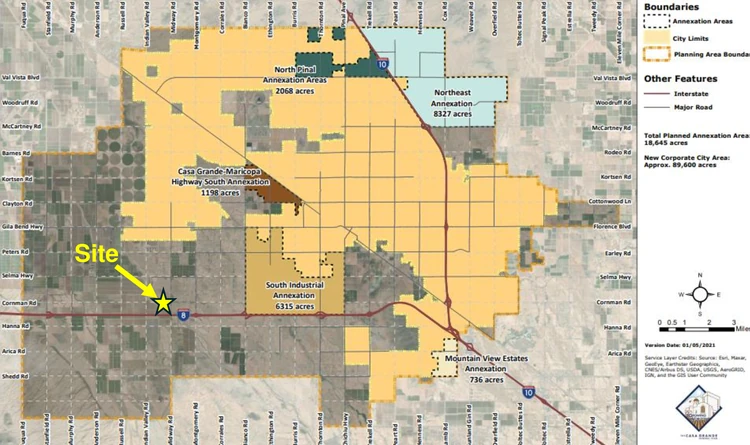
The Project Midway data center, proposed for the southwest corner of Selma Highway and Midway Road, faces a longer wait for an answer from Pinal County. On July 16, the county’s Planning and Zoning Commission voted unanimously to postpone its recommendations on both the rezoning and the accompanying overlay to a future meeting. As a result, the request to rezone ±215.8 acres of vacant desert inside Casa Grande’s planning area from rural to heavy industrial remains without a commission recommendation, and no case has moved to the county Board of Supervisors, which has the final say.
The delay followed a request from Electrical District No. 3 (ED3), the local utility, which had sent a letter that Chairman Robert Klob said arrived the morning of the hearing stating ED3 was “unable to reach a conclusion on the legality of Project Midway’s proposed self-supply.” ED3’s general manager then asked the commission to postpone. The applicant subsequently requested a continuance, and the commission voted for an open-ended delay. Project Midway consumed nearly three hours of the commission’s eight-and-a-half-hour meeting. The volunteer body, whose members serve without pay, asked about infrasound, fuel cell heat ratings, coolant chemistry, gas contracts, aquifer impacts, building aesthetics, tax incentives, and the identity of the data center’s ultimate customer.
Of nine public speakers, two industry representatives supported the project, six residents opposed it, and ED3 asked for a postponement. Commissioners will now send written questions to the applicant before the project returns.
Inside the Project Midway data center proposal
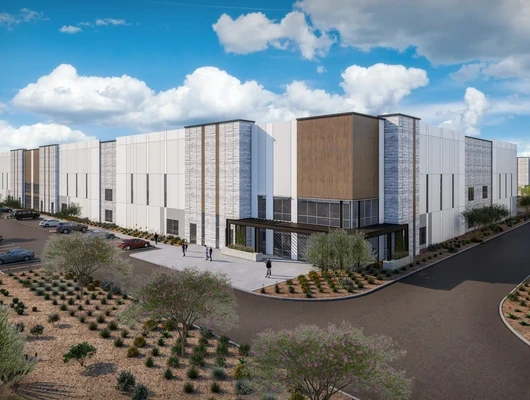
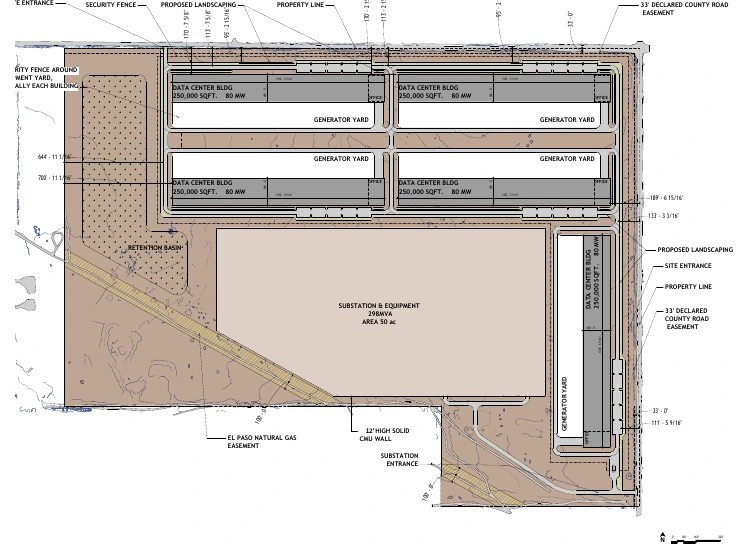
The plan shows five single-story data center buildings of 250,000 square feet each, 1.25 million square feet total, at up to 60 feet tall, 10 feet above the county’s current heavy industrial limit. Each building would have its own office and backup generator yard. Meanwhile, a roughly 50-acre substation and equipment yard sits at the center of the site, along with internal roads, conceptual gated entrances on Midway Road and Selma Highway, and a retention basin on the west side.
The official record uses different names for the applicant. The hearing agenda lists Fairview Capital LLC as applicant, while the project narrative calls LPI Company the applicant. Zoning attorney Alex Hayes of the Phoenix firm Withey Morris Baugh, who represents the project, described LPI as “a land developer who has done data center development in the past and has relationships with the ultimate data center operator and user.” LPI is based in Stateline, Nevada. Pressed by Commissioner Tom Scott on who would run the campus, Hayes said operators “really don’t actually buy the property until it’s a certain period away from actually turning power on.” No end user has been publicly named.
Pinal County is still writing its data center rules
This was the second data center to reach the zoning stage before the commission, and the county has not adopted standards for the use. “They’re asking to build the buildings taller than what’s already allowed, and we have zero code for data centers,” Vice Chair Karen Mooney said, asking whether the county should wait until rules exist. Planning Manager Harvey Krauss confirmed that “staff is working on a potential ordinance or standards for data centers,” but said the pending application still had to be evaluated on its own.
Klob answered the height request by noting 60 feet “is a six-story building, in theory,” and questioned the aesthetics, because without design standards, “typically it’s the cheapest, easiest, quickest boxes that can go up fast.” He added: “it’s hard to hold you to a standard that we don’t have.” Hayes responded that large operators are “investing heavily in the aesthetics of their buildings to contribute to their overall brand.” Mooney also asked whether the setback next to rural or residential zoning would go from 50 to 175 feet; Hayes said, “we would accept 175 feet for stipulation 11.”
An off-grid power plan that ED3 calls into question
Project Midway proposes to generate all of its own electricity on site, roughly 500 megawatts, using a mix of solid oxide fuel cells (electricity from a chemical reaction, no combustion) and natural gas reciprocating engines (piston-driven, not turbines), plus about 400 megawatts of similar piston-driven engines as backup. The applicant has not committed to specific proportions. Each of the five buildings is rated at 80 megawatts, for 400 megawatts of total data center demand. The noise study modeled about 500 megawatts of primary generation. Jeff Burke, an energy consultant with Ameresco and former director of resource planning at APS, told commissioners the site is built out beyond required capacity for reserve. “It is clean burning, utilizing natural gas, so not diesel,” Hayes said of the engines. Because the project pays for its own power, “it will not have an impact on ratepayers,” he said. On timing: “By the time the first building is powered, it would be powered on site by the generation on site. It won’t be connected to the grid.”
Burke said Ameresco has developed more than six gigawatts of energy resources, from behind-the-meter systems to utility-scale commercial and industrial projects, with a large presence in military infrastructure. Since the AI boom, he said, hyperscale customers can’t get power from utilities that need years to build new generation. Self-supply “gets the customer what they need sooner with a behind-the-meter solution, and then transitions into a utility-served customer over the longer period of time,” an approach that has “become an accepted practice across the industry over the last couple of years.”
ED3 General Manager Brian Yerges disputed that description. “I was here a year ago, and the ED3 logo was up here, and we’re getting power from Project Bella, and we’re getting power from ED3 and the grid,” Yerges said. “They never talked to us. Now it’s a different project.” He questioned the terminology: “Whose meter? Because behind-the-meter would be our meter.” He listed what does not yet exist, “There’s no emissions permit. There’s no contract for gas capacity. There’s no contract for a gas supplier,” and asked why a $2.8 billion project could not contribute “maybe $100,000” toward ED3 planning studies. Additionally, with as many as eight gas projects proposed inside ED3’s territory, Yerges asked what happens if all of them serve isolated data centers instead of the grid. ED3 requested a postponement to work out a collaborative plan, which Yerges said “could take upwards of a year.”
On legality, Yerges said, “we cannot say whether this is structured legally or not. We would like our legal counsel to engage with their legal counsel.” Burke countered that “we believe [it] is permissible in Arizona to self-supply your own electricity,” and that “we would not be a utility, nor do we want to be a utility.” Commissioner Bryan Hartman raised concerns that a catastrophic on-site failure could force ED3 to supply power to the site, creating legal exposure. Under questioning from Commissioners Daren Schnepf and Gary Pranzo, Hayes confirmed the site would sit off the grid entirely, with the risk of a power failure sitting on the developer. Burke followed that no physical connection to ED3 would exist until interconnection studies were complete. Hayes added that interconnecting with ED3 later is “probably a likely scenario,” with the project “committing to paying for all costs associated with infrastructure upgrades that are needed to support interconnection.” Hayes said a load study would come only after zoning approval. Klob responded: “If this is the level of communication that we can expect with the local power company, as a commission, I can only speak for myself, but there’s a lot of red flags here.”
Separately, Hartman asked about gas supply, including whether El Paso would have enough capacity. The El Paso line that bisects the property is the most likely source, Hayes said: “With the incoming Transwestern line, that’s gonna free up capacity on that line.” He added, “I think there’s a high level of confidence that they’ll be able to get the capacity,” but no contract exists: “Pre-entitlement, it’s too early to secure those commitments.”
Applicant describes fuel cells as quiet and low-emission, but names no Arizona example
The proposed solid oxide fuel cells would use natural gas to produce electricity through a chemical reaction, not combustion. The applicant’s noise study modeled Bloom Energy’s ES-5700 as its fuel cell option. Hayes said they are “near silent,” use “virtually zero water” beyond a startup fill, and run at data centers around the world, though he knew of none operating in Arizona. On scale, Burke said, “to date, you probably are gonna see 20 or 25 megawatt facilities as the upper end of some of the fuel cell-type facilities,” while the Project Midway data center contemplates roughly 500 megawatts.
Klob recalled recent summers above 110 degrees and asked what ensures the units survive “baking in 120-degree heat day after day.” Burke said he thought the units could operate in Arizona reliably but needed to check the manufacturer’s specification. Under the conceptual site plan, primary generation — whether fuel cells or engines — would sit in the substation and equipment area at the center of the site, not inside the data center buildings themselves. The ES-5700 datasheet, dated November 2014, lists an operating range of −20°C to 45°C (−4°F to 113°F) and offers an optional “extreme weather kit” that the document does not define. Klob said: “Having something that sounds like it’s kind of unproven in our market causes some pause.”
Air permits come after the zoning vote
The project has not applied for air emissions permits. Hartman explained his concern: there are “only a finite amount of those, especially in western Pinal County. We get in a lot of trouble for having dirty, low-quality air.” Hayes replied: “One of the good things about the fuel cell technology is that there’s no combustion and they’re very, very clean from an emissions standpoint.” The reciprocating engines, he said, “do have some emissions, but that will go through the air permitting process.” A proposed condition of approval would require the air quality permit.
Water: defining ‘closed loop or air-cooled’
The stated demand is 14,500 gallons per day on an average day and 35,200 on a maximum day. Hayes cited roughly 17 acre-feet per year on average and up to 40 acre-feet at maximum. “This is lower than pretty much any other water user,” Hayes said. Arizona Water Company would provide drinking water and water for firefighting under its state-certified assured supply, a change from February, when the applicant’s initial plan involved on-site wells for water supply. Burke described the generation cooling as a one-time fill: “fill when you begin with water, and then, radiator, put the cap on, no more water gets used,” roughly 500,000 gallons for 250 megawatts of engines and far less for the fuel cells. However, the applicant’s May water memo anticipates industrial water demand for generator cooling and industrial wastewater from that cooling.
Hayes pointed to a proposed condition of approval requiring that any cooling system for the information technology “must be closed loop or air-cooled,” a phrase that repeats across the applicant’s materials. A closed-loop, air-cooled system works like a car radiator, shedding heat directly to the air. However, the words cover more than one design. A closed loop can also reject heat through an evaporative cooling tower, which sheds heat into evaporating water instead of the air — consuming water continuously. Resident Eirini Pajak made the same point: “A closed loop just means the coolant circulates in a sealed circuit. It says nothing about where the heat goes when it leaves that circuit.” Pajak argued the proposed wording would not prevent a closed loop from rejecting heat through an evaporative tower.
Klob asked whether the applicant would accept language barring any future switch to water-based cooling.
“Evaporative cooling system will never be allowed. I mean, I think that’s kind of the intent of the stipulation, but if we’re saying the same thing there, then we’re happy to add additional language to clarify that.” — Alex Hayes, responding to Chairman Robert Klob on tightening the cooling stipulation to bar water-based cooling systems
Any tightened language could come after commissioners submit written questions and the applicant has time to respond. Scott objected that even utility-supplied water still comes “out of the aquifer that we all share,” drawn daily rather than seasonally like farming, and flagged concern about doing so during Arizona’s ongoing drought.
Applicant’s sound model puts nearby homes under the limit
“The Pinal County Noise Ordinance, which is for residential, 60 decibels during the day, 55 dBA at night,” Hayes said. All nearby residences fall below that threshold, he said. For reference, the applicant’s noise study equates 60 dBA to normal conversation and 50 dBA to light traffic at 100 feet. Typical nighttime sound in quiet rural areas runs around 32-35 dBA. Noise consultant Brad Sohm of SWCA Environmental Consultants said each scenario was modeled with all its noise sources running at full power around the clock as a worst case. The primary generation configurations were evaluated independently, and backup operations were assumed not to run concurrently. “The nearest noise source on site is approximately 1,000 feet from any residential structure,” Sohm said. Modeled project sound at the property boundary stayed below the 55 dBA nighttime limit. At nearby residences, modeled levels stayed well below the limit. Mitigation includes a 12-foot masonry wall around the generation yard, an earthen berm along the western edge, and enclosures and silencers on the engines. A second sound study, including a plan for ongoing monitoring, is required before the buildings can open. Hayes said backup generators are tested about once a month, for what he estimated as “minutes.” A proposed condition would restrict testing to weekdays between 9 a.m. and 5 p.m., excluding holidays.
Infrasound: not measured under Pinal County’s ordinance
Klob also asked about low-frequency sound, which he said has been a major concern in other communities with data centers. Sohm said infrasound sits below roughly 20 hertz, under the threshold of human hearing, “more of a feel.” Older designs, evaporative cooling towers and large combustion turbines, are the typical sources, he said, while this project uses enclosed equipment. There are “no Pinal County ordinances for low-frequency noise that we’re aware of,” he added. Any infrasound analysis he had done was not part of the noise report submitted to commissioners. Sohm added: “I do not feel that this modern data center, or believe, that this would be a significant source.”
Klob responded to that wording. “Anticipate, envision. Kind of like saying hope, pray,” he said, and asked whether the applicant would accept an infrasound requirement alongside the traditional limits. “That seems reasonable to me,” Sohm said. Mooney backed the idea from her personal experience with animals:
“Because it’s so far away, but animals pick up frequency. That was my life before this. And they pick it up long before a storm comes in, long before all sorts of things come in. So being that you’re out in the rural area, that lower one really would be concerning for me, and definitely consider a stipulation so that that could be monitored.” — Vice Chair Karen Mooney
Fire protection tied to projects not yet built
On protecting the facility, Hayes pointed to the operator’s financial incentive.
“Nobody is more invested, incentivized to have proper fire response for this project than the data center operator themself. These facilities will include billions of dollars of equipment.” — Alex Hayes
He added, “we are happy to work with Chief Heaton and this organization to help expand fire service to not only this site, but to the area.” That organization, the Pinal County Fire and Medical Authority, formed in March as “the first authority in Pinal County for fire and EMS coverage,” Chief Jeff Heaton said. It operates out of Arizona City, has added daily staffing, and has responded to 13 fires in the area since March — calls Heaton said would not have been answered without the effort. Its nearest planned station would sit on the neighboring Project Bella natural gas plant site, and Heaton confirmed to Scott that it would cover the Project Midway data center from there. However, he said the area would likely not have fire and EMS coverage anytime soon without funding from these projects, and Hayes confirmed the station will not exist until either the data center or the Project Bella power plant is under construction or built. Hayes said he believes nearby residents currently pay roughly $5,000 more per year in property insurance for lack of fire coverage. Resident Robin Davis asked whether the authority “is yet an approved entity. I don’t know. Just asking.” On arc flash, an electrical hazard Pranzo said recent university studies tie to data centers, Heaton said his crews regularly work around arc-flash-risk equipment like substations and have completed advanced training. No executed fire-service agreement, contribution amount, or delivery schedule appears in the case packet.
A $2.8 billion project projecting 65-plus jobs
The applicant presented the following economic figures for 2027 through 2047:
- Capital investment: $2.8 billion, with construction-period economic impact of $2.4 billion
- Economic impact of operations (2028–2047): $617.1 million
- Company tax revenue: $60.5 million to Pinal County, $124.8 million to schools and special districts, $53.5 million to the state
- Employee tax revenue: $1.8 million local and $5.4 million to the state
Hayes said his understanding is that the project is state-certified and eligible for a sales tax exemption on qualifying construction spending if the applicant makes the required investment.
The applicant put two employment figures on the record. Application materials projected 225 employees at full build-out, while at the hearing, Hayes cited “the most conservative, lowest range number”: roughly 65 for the five data center buildings and generation equipment, averaging $93,000 per year, “twice the average wage in Pinal County.” Hayes said the applicant took the lower figure after hearing skepticism about inflated data center job counts.
“That is all local on-site employees. That doesn’t include the induced employee numbers, indirect employee counts, or jobs created on- or off-site. That is all people that would be roughly operations and maintenance personnel, engineers on site, that sort of thing.” — Alex Hayes, asked by Chairman Klob how many of the 65 jobs are local, on-site positions
Klob asked the project to invest in trade school programs, warning that data center construction can drain electricians and plumbers from other projects in “one of the fastest growing counties in the country.” Hayes called it a “good problem” and said the project is “open to that conversation.” The application recommends road improvements with turn lanes on Midway and Selma, with final improvements to be determined through the traffic study, plus electrical infrastructure and fiber to the area.
Nine speakers, 19 letters: support and opposition on the record
Written comment totaled two letters of support, eight letters of opposition, and nine letters about data centers that named no project. One came from Deanna Pence, a resident a quarter-mile away, who recalled the 1980s, when “the aquifer was pumped dry,” and asked, “Why is it that the investors and developers have more of a voice on zoning than the people who have chosen to live in Pinal County?”
Tena Dugan, who said she has researched data centers for two years and owns property near the site, urged denial. She said door-to-door interviews near a Chandler data center found generator testing, not the hum, bothered neighbors, and she warned that “technology changes, ownership changes, and promises can change.” Any conditions, she said, must carry “meaningful consequences.”
Robin Davis, also urging denial, cited an Imperial Valley Press report from California, where a data center that had pledged to run on recycled city wastewater — not river water — is now suing the Imperial Irrigation District for water rights: “So excuse me if I don’t believe the applicant’s claim of a closed-loop system.” Pajak added that the companion standards request would allow nearly every heavy industrial use, that no end user is named, and that nothing binds the power plan, “a menu” of fuel cells, engines and a possible grid connection. Nancy Hartle called data centers “a threat to our water,” Dulaine Coleman said the reluctance to name the applicant “makes me question the whole situation,” and Vicki D’Elia argued “AI technology is here, but I don’t think that the technology to run the data centers is here.”
In support, Cepand Alizadeh of the Arizona Technology Council cited the project’s location and developer responsiveness: “It is away from homes, away from residences.” Trey Davis of Land Advisors called zoning a “threshold issue” that companies resolve before spending on deeper studies. In response, Hayes said zoning “is one step in a very long process,” acknowledged some valid questions, and asked for time to answer them.
How the Midway data center campus reached this hearing
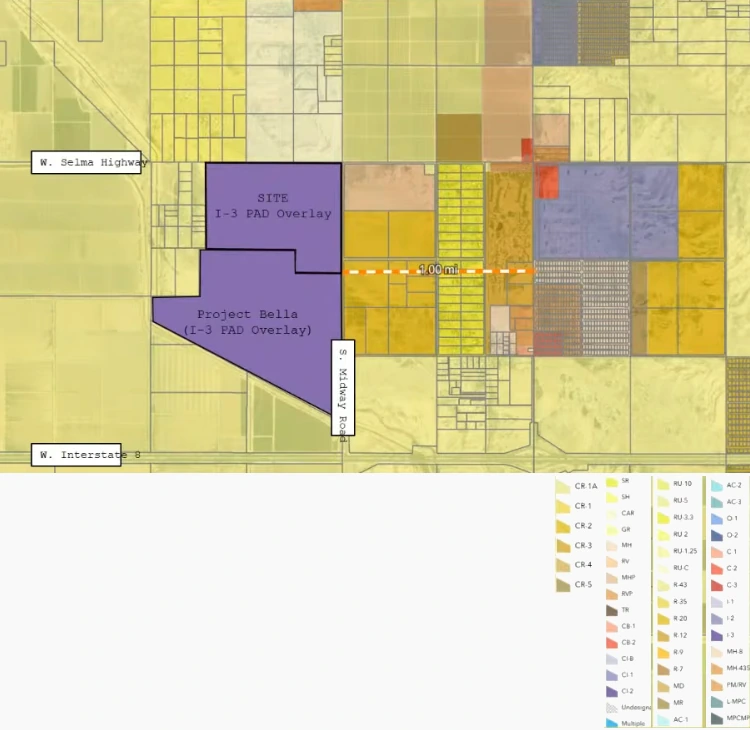
Last November, the Board of Supervisors changed the county’s long-range land use plan for the property from residential to employment, as previously covered by the Pinal Post. Directly south, the county approved the Project Bella natural gas and battery storage facility in August 2025. Asked by Klob about the two nearest cities, Hayes said Casa Grande voiced no opposition during the land use plan process and that the team has not spoken with Maricopa, while Klob said a Maricopa city official called him two days before the hearing and “I know for a fact Maricopa is not in favor of this.”
What must happen before Project Midway returns
The commission chose an open-ended delay rather than the two-month continuance Hayes had requested. Because no date was set, the county must schedule and publicly notice a new hearing before the Project Midway data center comes back. Only then would a recommendation move to the Board of Supervisors for the final decision.
I’m amazed at the complexity of the topic of Data Centers yet your team covered the Pinal County P&Z commission Meeting excellently! I’d rather read your excellent writeup than watch an 8 hour P&Z Meeting. Great Job! I’m impressed.