Key points
- Pinal County’s Planning and Zoning Commission voted 7-2 to recommend industrial zoning for 4,696 acres of State Trust land along SR 79.
- The Board of Supervisors will make the final decision.
- Rose said the state has no client in mind and plans to auction the land once zoning is in place.
- Under the Arizona Constitution, trust land sale proceeds go into a permanent endowment that supports public schools and other state institutions.
- A future employer could run its own data center on the site and generate its own power, including solar with battery storage.
- A data center that leases servers to outside companies would be barred, and any data center must stay secondary to the owner’s main business.
- Utility-scale solar serving customers off the site would be barred. Other power plants stay on the permitted-use list with no such limit.
- Commissioners questioned how the county would enforce the data center limit and whether the request was too vague to judge.
- Staff dropped a stipulation requiring a wildlife buffer along the site’s washes, saying existing county rules already require one.
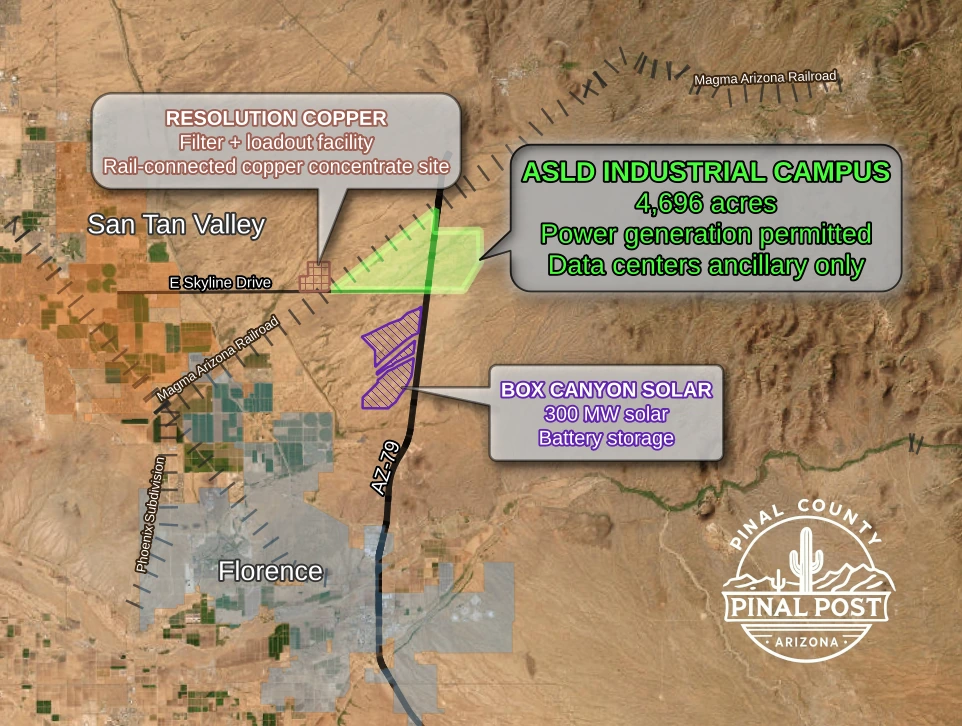
- The site joins a string of industrial and energy projects along SR 79 and the Magma railroad: the denied Silver King Energy Center, which overlaps it; Box Canyon Solar; Resolution Copper’s planned filter plant; and the site approved for the Project Ranger missile plant before Castelion chose New Mexico for Project Ranger instead.
- No residents attended the applicant’s open house or spoke at the hearing.
A proposed SR 79 industrial site covering 4,695.89 acres of State Trust land received a recommendation, not final approval, on Sept. 17. The Pinal County Planning and Zoning Commission voted 7-2 on each of three motions to recommend the proposal. The Board of Supervisors will decide whether to approve it. The land sits along State Route 79 (SR 79), north of Skyline Drive, which is to be extended east to the highway with the site’s development. The application calls it one of the county’s largest industrial sites. Rose Law Group filed the request for the Arizona State Land Department, which owns the land. Attorney Jordan Rose, who represents the department, said the state has no client in mind and will offer the land at public auction once zoning is in place.
Under the proposal, a future employer could run its own data center there, the applicant’s attorney and county staff said. It could also generate its own solar power and store it in batteries. However, the plan’s conditions would bar a data center that hosts and leases servers for third parties to store, process or deliver data. They would allow a data center only as a secondary use serving the on-site owner’s own business. They would also bar utility-scale solar that generates power for third parties outside the land. Meanwhile, power plants remain on the permitted-use list, and only solar carries a limit on serving customers off the site.
What the SR 79 industrial site would allow and prohibit
The request has three parts. First, a Comprehensive Plan amendment relabels the land as Special District. The land currently carries three designations: Employment, Moderate Low Density Residential and Very Low Density Residential. Second, a rezone moves the land from General Rural to an industrial zoning category the county calls I-3, which allows heavy industrial uses. Third, a Planned Area Development (PAD) overlay removes several uses that I-3 normally permits.
Rose said the request asks for no deviations from county development standards.
The applicant’s overlay document strikes several uses from the permitted list. Under it, the site could not become an impounded or towed vehicle storage yard, junk or salvage yard, landfill, transfer station, adult business or prison. Meanwhile, the application keeps manufacturing, heavy truck storage and repair, airports and other uses that industrial zoning allows. It also keeps “power plants, wastewater treatment plants and ancillary offices and buildings.” Only solar power carries a stipulation limiting whom it may serve. The overlay also adds research and development.
County staff wrote the conditions of approval, called stipulations, and the commission’s recommendation includes them. Two address data centers and solar. Neither bans the use outright. The data center stipulation says a data center that hosts and leases servers for third parties “shall not be permitted on the rezoned property.” It then makes an exception. A data center, it says, “as an ancillary use will be permitted to the primary enterprise functions of the on-site property owner or business entity provided it is not used to lease data storage and processing to third parties.”
Similarly, the solar stipulation bars a utility-scale solar facility built “to generate power to third party entities outside the rezoned lands.” It adds that “the use of solar facilities to serve any facilities on the rezoned lands will be allowed.” Neither stipulation sets a numerical size limit on the data center or solar it allows, though the data center must remain an ancillary use.
Site near Skyline Drive, SR 79 and the Magma railroad
The eleven parcels are vacant natural desert under grazing leases. Part of the state land was in the footprint of the Silver King Energy Center, an 8,122-acre solar, battery and natural gas project that the Board of Supervisors unanimously denied on Feb. 18, 2026. Both proposals sit on land owned by the Arizona State Land Department. However, Silver King came before the county with a developer, Arevia Power, seeking to buy the land, while the current request comes from the State Land Department itself, and Rose said the state has no client in mind.
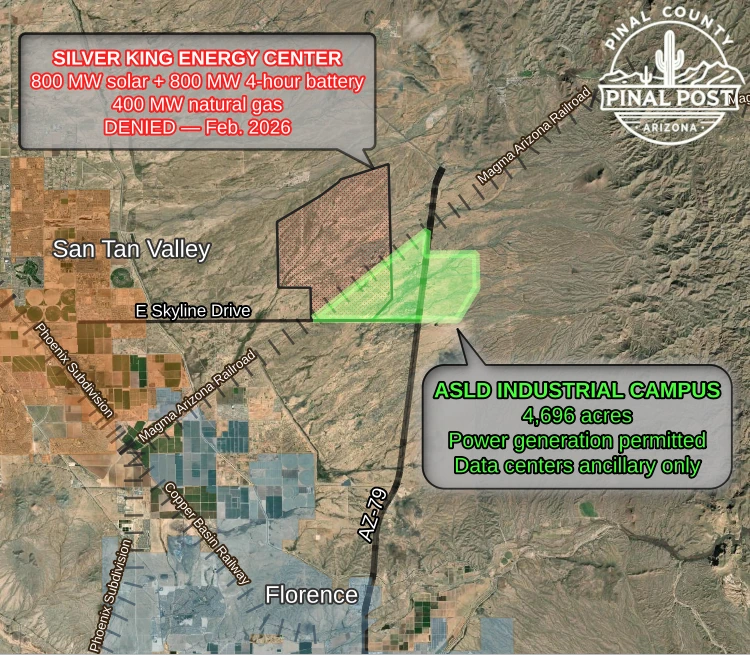
No homes adjoin the site. Planning Supervisor Sangeeta Deokar, who presented the case for county staff, said the closest house lies roughly three miles to the west. She said State Land surrounds the property and owns everything within the 600-foot notice area. The one exception is about 600 privately owned acres at the southwest corner, where the railroad meets Skyline Drive. That is the site of Resolution Copper’s planned filter and loadout facility.
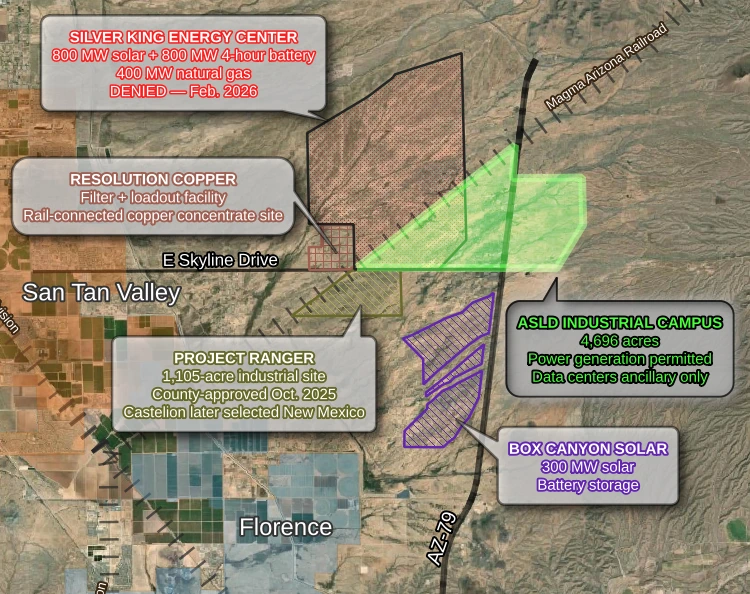
Deokar pointed to the same industrial zoning at the Box Canyon Solar project to the south, a solar facility of up to 300 megawatts with battery storage on about 2,087 acres of leased State Trust land west of SR 79. Last year, the county also approved a similar Special District for industrial manufacturing on 1,105 acres of State Land directly south of Skyline Drive. That case, known as Project Ranger, was for a hypersonic missile manufacturing and testing facility for Castelion Corporation. About a month after the approval, Castelion announced it had chosen Sandoval County, New Mexico, for the project instead.
Staff said the railroad and SR 79 offer existing infrastructure for moving goods. The Pinal Post reported last year that the railroad is dormant and that Rose, during the Project Ranger case, told the commission it would be reopened for that project and for Resolution Copper’s planned filter plant to the northwest. Resolution Copper’s environmental impact statement describes that plant as the end of a 22-mile slurry pipeline from its mine near Superior, where copper concentrate would be filtered and loaded onto rail cars or trucks, with an upgraded rail line along the corridor. The site’s only current access is Skyline Drive, which reaches its northwest corner. The staff report says developing the site would require building Skyline east to SR 79 for employees and delivery trucks. The application says that extension would give residents an alternative east-west route. In addition, stipulations require a traffic study, developer-funded road improvements and at least two paved access points.
The staff report says the remote site needs new utility infrastructure and would rely on septic because sewer service is unavailable. The auction winner must extend utilities, according to the application.
Krauss defines ancillary: a company’s own data center, not leased space
Commissioner Terrilyn Klucar said the data center stipulation’s wording was confusing, because it first says a data center shall not be permitted and then says one will be permitted as an ancillary use. She asked what that means.
Planning Manager Harvey Krauss said it means accessory to the main use.
“We have a data center on this campus right now, believe it or not,” Krauss said. “It serves Pinal County’s purposes.”
For example, he said a company like Intel could run a data center for its own campus there. However, it could not rent out its servers to other businesses to store and process their data. “That’s why we made that distinction, instead of me saying no data centers, because that’s not realistic,” Krauss said.
“What it means is that only the employer that goes there can store their data on site,” Rose said. She added that a data center project buying the land “couldn’t do anything with it.”
Klob asks what prevents an office with 27 data centers
Chairman Robert Klob said he supports a large job producer. However, he asked how the county defines an ancillary use. The data center stipulation uses that term. Using Amazon as an example, he described a company that builds an office employing 300 people. It then says it needs 27 data centers on the remaining acreage to support itself. “We can’t lease it, but we can support us. And what is to prevent this from happening?” he asked.
Klob said data centers have become a pariah in the industry, with no answers, and that “the hair on the back of your neck goes up” whenever commissioners see one. He did not dispute the need for them. He then returned to his example.
“My analogy, we’re going to build an office building and 27 data centers. The office building’s going to be the primary, data center is secondary for our use,” Klob said.
If the commission’s zoning allowed that outcome, he suggested, residents would turn on the commissioners themselves. “I think our constituents would like to see our heads on spikes going down Hunt Highway,” he said.
Krauss said the data center would be an accessory use and that, under the definition in the county’s code, an accessory use is “customary and reasonable” to the principal use of the property. “So it wouldn’t be 27 data centers on this property,” he said. “That would be a primary use. It wouldn’t be a secondary use.”
“You couldn’t have an office building with a data center farm,” Rose said. “The primary use needs to be the business.”
Mooney questions listing data centers; Pranzo questions excluding them
Vice Chair Karen Mooney raised a different worry: that excluding data centers here could signal that other industrial land in the county allows them. She noted the county has no zoning code for data centers, and its industrial zoning category does not list them. Therefore, she said, writing an exclusion into this case suggests to everyone that industrial zoning otherwise allows them. She called that very concerning. She drew a distinction between a stipulation on this property and writing data centers into the overlay’s I-3-based list of uses. The overlay changes that list for this property only; it does not amend the county’s I-3 zoning district.
Krauss said industrial zoning would be the logical place for data centers, and he hopes for a county ordinance soon. However, he said the county has no guidance yet on how to handle them. This case comes with no specific development plan, he said, so the land could end up in many employment uses, including data centers. That is why staff excluded them here, as an extra safeguard. Krauss also agreed with Mooney’s larger point. “If a property is already hard zoned I-3 and we do not have a development plan, and we do have a few of those,” he said, “yes, you are right. They could put a data center in that area.”
Commissioner Gary Pranzo asked why an industrial park would exclude data centers. He said noise and a data center’s other effects are the same ones that come with industry. Data centers also present themselves to the commission as strong employers, he added.
“State Land Department has no negativity towards data centers, just this particular property they don’t want to sell as a standalone data center site,” Rose said. She said the department wants a jobs-producing buyer because the county asked for jobs there.
“I don’t like setting limits on something that could hurt the success of developing 4,000 acres,” Pranzo said. For example, he said a small data center like one coming near Casa Grande would fit. Other companies could then use it, he said.
In response to Pranzo’s objection, Rose offered one answer. If the eventual buyer wanted a use the plan prohibits, she said, it could return to the commission and supervisors and ask for an amendment. However, it would have to go through a full public process.
Mooney asked what the process would be if the land is not selling because a buyer wants a prohibited use, such as solar, a data center or a prison.
Deokar said the buyer would have to amend the overlay. Mooney asked whether that means the buyer would come back before the commission. Deokar said yes. Krauss said the owner would file a new application asking the county to strike the prohibition on that use, following the same process as a rezoning.
Rose: on-site solar and batteries allowed, standalone farms barred
Pranzo also asked why the applicant eliminated battery storage. Rose said an employer could have some solar and its own batteries but not “just a standalone battery storage farm.”
Pranzo argued against that limit. He said one of Pinal County’s problems is that power peaks during the day and slumps at night. Therefore, one way to straighten that line is to charge batteries at night so they discharge during the day, he said. That would be very helpful to an industrial area, he added.
“Yes, and Chairman and Commissioner, they can do that here. It just can’t be 4,000 acres of that,” Rose said.
In that exchange, neither of them said where the discharged battery power would go, whether to the employer’s own operations or beyond the site. Nothing else in the hearing specifically addressed whether battery power could be sent off the site.
Pranzo said the proposal had read to him as a complete ban. Mooney agreed and said the data center statement read the same way, which concerned her. The stipulations do not address batteries at all. The applicant’s narrative does, but only paired with solar: “Datacenters and/or solar generation facility with battery energy storage will only be allowed to operate on the Property as ancillary uses to provide support to the primary use.”
Commissioner Tom Scott asked whether employers could have their own utility-grade solar, battery storage and data center on site just for themselves. Rose said yes, “in order to provide for themselves.” Scott countered that utility-grade solar is a non-employment use. Krauss said the solar would be accessory, such as panels over parking or on a roof, and the owner would not contract the power out to others.
Mooney asked who would make sure the solar limit is followed, noting that the county enforces its rules mainly when someone complains. Krauss said staff would, because a utility-scale solar facility cannot be built without county approval.
Riparian buffer stipulation dropped and trail comment removed
Mooney asked why staff dropped a stipulation that would have required a buffer around riparian habitats “to ensure wildlife connectivity as determined by Arizona Game and Fish” and the county’s Open Space division. The public staff report still lists it as stipulation 5; staff removed it in an updated packet sent to commissioners before the meeting, leaving the 19 the commission voted on. Krauss said existing county ordinances and policies already require riparian protection, so the details would be worked out at the site plan stage. He added that the stipulation’s wording “raised some ambiguity as to what that meant,” without saying which part.
The staff report supports his point. It says a riparian habitat crosses the site and buffers will be required under three Comprehensive Plan policies and the county’s development code. A preliminary Arizona Game and Fish review in the packet also flags a wildlife movement feature, riparian washes, Sonoran Desert Tortoise records and federally listed, proposed or candidate species or critical habitat nearby.
Mooney also asked why staff struck a comment about a planned regional trail along the Magma Arizona Railroad. Krauss said the north side of the tracks is more appropriate given the site’s possible use, so staff removed the comment to avoid confusion.
Scott calls the request vague; Klob asks what happens if no deal follows
“It’s just hard to vote on something that’s so vague,” Scott said. He asked whether the SR 79 industrial site means one employer or several.
“It may be that they auction the whole thing and it’s one employer. It may be that they decide to break it up and auction it in different sections,” Rose said. “I assume they’ll auction the whole thing and it’ll be one big employer, but we’ll have to wait and see what they decide.”
“What they do know is that this state, the State of Arizona, is highly competitive in the market of getting large employers here in the United States, and they want it to be even more competitive by creating sites that are ready to go,” she said. “The first stage is to get this hurdle of zoning approved so that employers can consider this when they’re looking at Texas or some other state.”
Klob said the commission would apply blanket zoning to almost 4,700 acres without knowing the user. “What if this doesn’t go through? The zoning lasts forever, lasts until it gets rezoned,” he said.
Klucar asked whether the state has a client in mind. Rose said no. Instead, the land goes to public auction, she said, and the proceeds fund Arizona’s public schools.
Rose: Arizona needs large sites ready to compete for employers
Rose said the commission and supervisors earlier rejected the Silver King solar proposal on this property. At the time, she said, the commission, supervisors and many residents called the property too important for jobs to give to large-scale solar. State Land listened and now proposes employment zoning, she added.
“The biggest thing is there’s no ability for our state to attract those big employers if we don’t have large swaths of land ready,” Rose said.
She said the county has zoned State Land for years without knowing the user, because the auction comes afterward. Without such zoning, the land would stay General Rural forever, she said. She cited TSMC in Phoenix, where the city zoned the site industrial before the land auction, not knowing who would come.
What Special District means on State Trust land
Klucar asked for a definition of Special District. Krauss said the designation exists only for Arizona State Trust land.
“We created a special district because they have to go through auction when they dispose the land,” he said. “We have a tremendous amount of state land in the county.”
In practice, the designation lets the state skip the county’s once-a-year major Comprehensive Plan amendment process and file at any time, whatever the acreage, Deokar said. Krauss said that gives the State Land Department flexibility, because finding a user through the auction process takes a long time.
According to the application, the Pinal County Board of Supervisors created the designation on Nov. 4, 2022. Rose said many sitting commissioners helped adopt it so State Land could bring projects forward.
Mooney compared the case to the San Tan Valley Urban Core, a 3,239-acre Special District on state land that supervisors approved in February 2025 as the town’s future downtown, where commissioners also did not know everything planned. Deputy County Manager Himanshu Patel said the county used the same tool there, but that plan spelled out a mix of industrial, commercial, residential and office uses, whereas this one names only industry.
SR 79 industrial site draws no public comment and moves to the Board of Supervisors
Nobody spoke when Klob opened the public hearing, and staff reported no letters of support or opposition. An Aug. 25 open house the applicant held at Central Arizona College’s San Tan campus in San Tan Valley drew no attendees, according to its report. The commission’s recommendation, which now goes to the Board of Supervisors, attaches no stipulations to the land-use change, two to the rezone and 19 to the overlay.
Case numbers: PZ-PA-018-26 (Comprehensive Plan amendment), PZ-024-26 (rezone) and PZ-PD-021-26 (PAD overlay).