Key Points
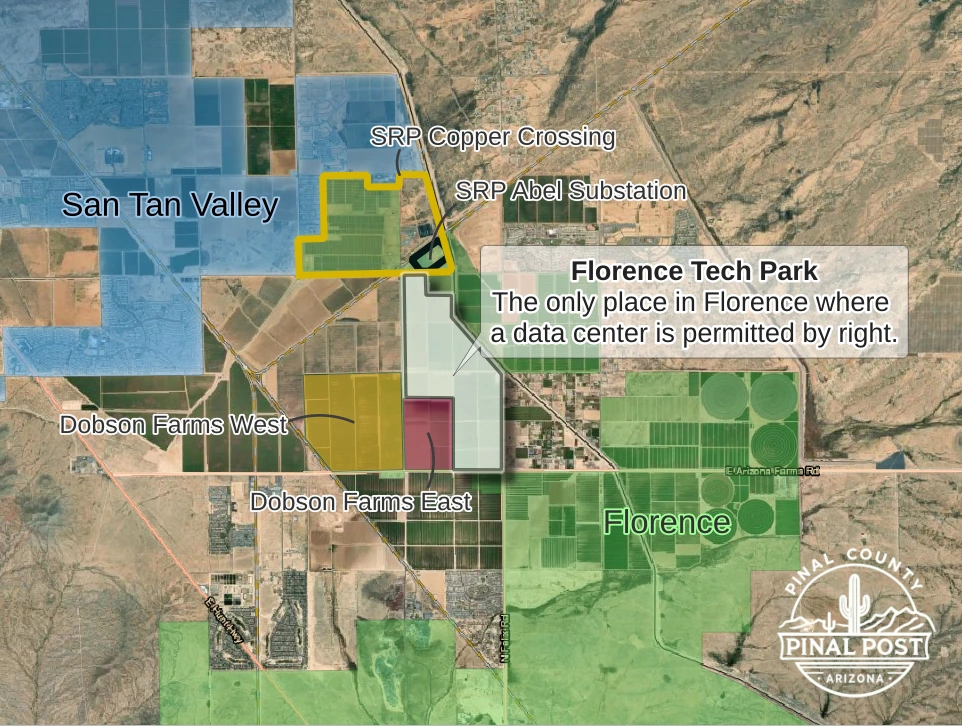
- Florence Tech Park is the only place in town where a data center can be built by right. The 780-acre site near Judd and Attaway roads was rezoned for industrial uses in 2025.
- No other zoning district in Florence lists data centers as an allowed use. A proposal anywhere else would most likely require a rezoning, with public hearings and a Town Council vote.
- A new state law removes public hearings for site plans. A data center that follows the tech park’s existing rules would not need a council vote.
- The town can still set conditions on future approvals. These could cover water, noise, setbacks, backup power and cleanup if a data center closes.
- Proposition 207 is the main legal limit. Casa Grande faced $146 million in claims after tightening its rules. Florence is better positioned because data centers have no existing right outside the tech park.
- A seven-member advisory committee will recommend those conditions. It cannot approve or deny any project. Its goal is to finish by December.
- The next meeting is Oct. 1. A University of Arizona professor will present on the costs, benefits and ethics of data centers.
FLORENCE, AZ — The Florence data center committee held its first meeting Sept. 21 and heard from town staff that a data center can be built by right in only one place, Florence Tech Park. The 780-acre site at the southeast corner of Judd and Attaway roads was once planned for homes, and the Town Council rezoned it for industrial uses, including data centers, in 2025. Anywhere else in town, Town Attorney Robert Wingo said, a proposal would most likely require a rezoning, with public hearings and a Town Council vote. The seven-member Data Center Facility Ad Hoc Advisory Committee has a preliminary schedule of six meetings. Its assignment is to recommend conditions the town could attach to future data center approvals outside the tech park.
The committee cannot approve, deny or negotiate any project. Instead, it will send fact-based findings and recommendations to the Planning and Zoning Commission and, potentially, the council. Staff called the schedule fluid but said the goal is to finish by early to mid-December, if possible, and deliver recommendations early next year. The town is not currently reviewing a specific data center proposal, according to the staff report. However, Community Development Director AJ Monroe said one developer has paused an application so the committee can finish its work. Councilmember Jose Maldonado, one of the committee’s two council liaisons, added that speakers at a meeting in Phoenix the prior week told town officials data centers are looking for sites within the next three to four years.
Data Centers Are Permitted by Right Only in Florence Tech Park
“Data center is not listed as a permitted or conditional use on our town’s use table,” Monroe told the committee, referring to the town’s Development Code. When a use is missing from the code, the community development director, a post Monroe holds, must issue an interpretation. That opinion can then be appealed to the Planning and Zoning Commission and the Town Council.
Because of that gap, he said, no zoning district in Florence permits a data center today. Florence Tech Park is the exception. The council created the tech park in 2025 through Ordinance No. 769-25, an amendment to the Dobson Farms planned unit development. According to the staff report, that PUD “expressly lists data centers as a permitted use within its Light Industrial land use category.”
Outside the tech park, any proposal would start with his interpretation of whether a data center resembles a use the code already allows. Of the town’s existing zoning districts, he said, light industrial is the one a data center most resembles. Even there, a data center would probably be “a little bit in conflict” with the district’s purpose. Later in the meeting, he suggested heavy industrial as a better home for data centers if the town changes its code. As a result, he described a conditional use permit (CUP) as the minimum. A CUP requires public hearings, where the town decides whether a use fits a specific site and can attach conditions to limit its impacts. Depending on the property, a project could also need a General Plan amendment, a zoning change or both before staff reviewed a site plan.
Monroe returned to the point later in his presentation:
— Community Development Director AJ Monroe
Wingo agreed, calling it one of the key takeaways of the night. He explained that a CUP could come into play if the council later allows data centers in a zoning district through a rezoning. In light industrial, for example, the uses probably closest to a data center all require one. For now, because no district allows data centers, he said a rezoning is the more likely path, probably a planned unit development much like the tech park itself.
How the Tech Park Became Industrial Land
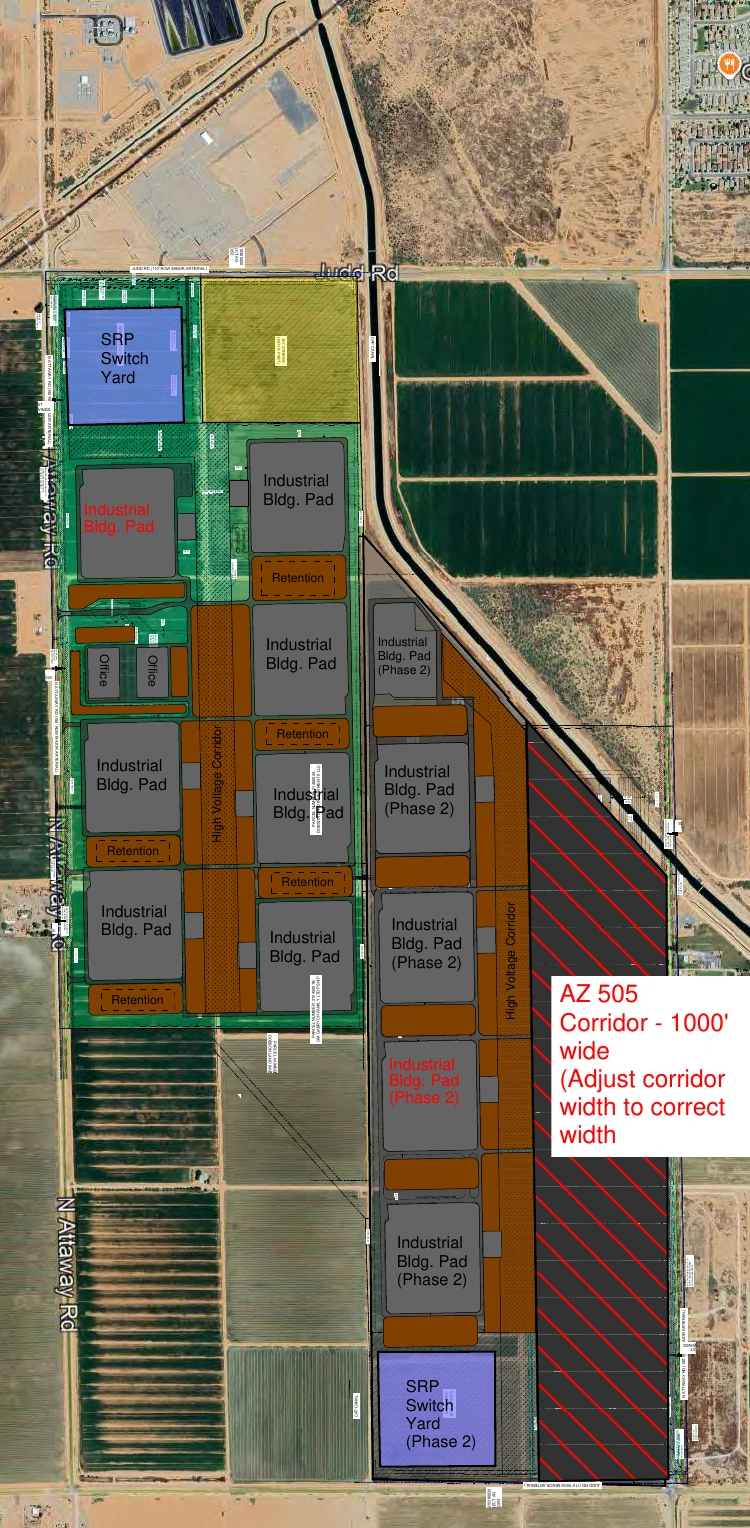
Monroe used the aerial map below to show what the commission and council weighed when they approved industrial uses at the site, which lies between Judd Road, Arizona Farms Road, Attaway Road and the Felix Road alignment.
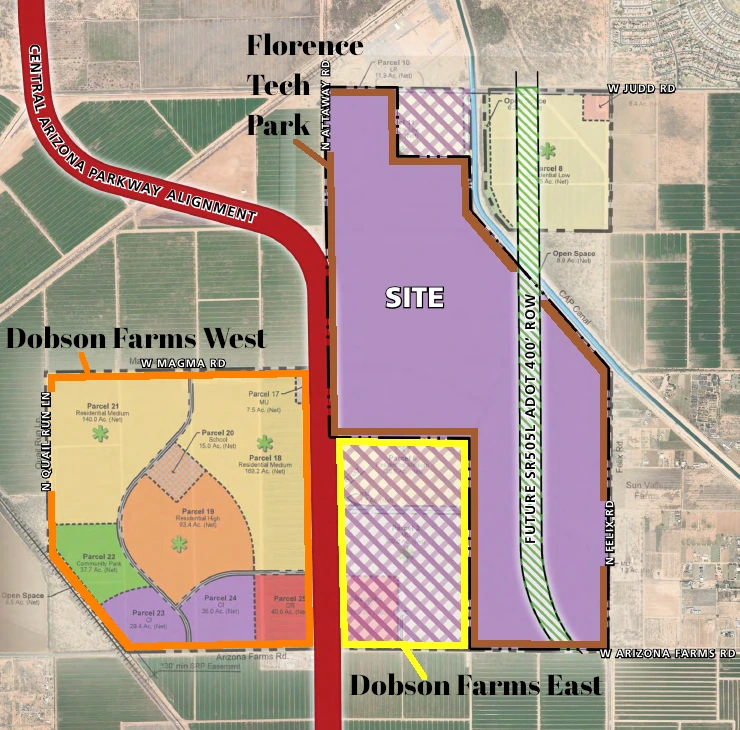
The Central Arizona Parkway alignment runs along its west edge, and the planned route of the North-South Corridor freeway (SR-505) cuts through it. The CAP canal runs along part of the site, and rail lines pass nearby.
Interactive map of Florence Tech Park, the only place in Florence where a data center is permitted by right, along with the surrounding infrastructure Monroe described, including roads, the CAP canal, the planned freeway route and SRP facilities. Zoom and pan to explore, and click any colored area for a description. Boundaries are approximations. Open the map full-screen
To the north, SRP built the Abel Substation and, next to it, the Copper Crossing Energy and Research Center, which includes two natural gas turbines and a 270-acre solar field west of Attaway Road. “It was very clear, I think, that the north was going to be an industrial operation,” Monroe said. SRP does not need town approval for such facilities, he noted. Once the utility had built there, other energy projects such as Box Canyon Solar located nearby so they could connect to the Abel Substation.
Dobson Farms was approved in 2009 as a roughly 1,800-acre residential plan, but after 15 years without development, its owners turned to industrial uses. Staff have been given the impression that the rest of Dobson Farms will seek employment or industrial uses too, he said, so they do not expect homes beside the tech park. The council approved General Plan amendments covering 1,619 acres there in October 2025.
Inside the tech park, the PUD sets the rules. Data center buildings may rise to 85 feet, and low walls that extend above the roof to hide rooftop equipment may add another 15 feet, for a total of 100. Buildings must sit back at least 40 feet from major streets, 30 feet from collector streets and 20 feet from local streets, with larger setbacks required next to homes. A perimeter fence at least six feet tall is required and may include barbed or razor wire. Mechanical equipment must be screened, and outdoor lighting must point downward. Additionally, the developer committed to closed-loop, low-water cooling, with EPCOR supplying water and sewer.
Still, Monroe cautioned that he does not yet know a building’s size, power draw or water use, because developers generally do not complete detailed designs before they hold entitlements. He expects the broader Dobson Farms area to develop with a mix of uses rather than 1,800 acres of data centers. When and in what order, he said, “is a little more difficult to predict.”
Council Has Discretion at Zoning, Not at the Site Plan
Wingo explained a distinction between two kinds of town decisions. Rezonings and General Plan amendments are legislative decisions, and the council has broad discretion to deny them. Administrative decisions are different: the criteria for approval are already set, so staff must approve a site plan once a developer meets them. A 2025 state law, House Bill 2447, sponsored by Rep. Michael Carbone, R-Buckeye, requires cities to handle site plans, subdivision plats, design review and several other development applications administratively, without a public hearing. Consequently, he said, a data center inside Florence Tech Park would not come before the council.
Conditional use permits can be either legislative or administrative, depending on how a town writes its code, Wingo said. In his opinion, Florence’s CUP rules look more legislative: they list factors to weigh but set no hard criteria that would force approval. That leaves the decision with the commission and council. CUP conditions also cannot be less restrictive than the underlying zoning.
For that reason, Wingo urged the committee to think beyond CUPs. He said terms it identifies on water, noise, heat or location could be of great value to the council when it decides on rezonings, CUPs or development agreements. Staff had framed the committee’s assignment as CUP requirements for data centers outside the tech park, and Communications and Intergovernmental Relations Manager Jeff Graves asked whether it should broaden to cover rezoning terms as well. Wingo agreed. The staff report lists nine focus areas: location and buffers; building height and appearance; noise and equipment screening; water use and cooling; energy demand and backup power; generators and fuel storage; lighting, fencing and security; traffic and emergency response; and the information applicants must submit.
Wingo also described a limit that the U.S. Constitution’s Fifth Amendment, and a similar provision in the Arizona Constitution, place on conditions attached to a rezoning or development agreement. Conditions must have a nexus to the project and be proportional to its impact. For example, the town could not demand $5 million for economic development, but it could require a developer to fund a fire station if the project creates a public-safety gap. Councilmember Tony Bencina, the other council liaison, said homebuilder Pulte did this for Fire Station 2, adding, “I understand they funded the staff for three years.”
State Law Leaves Room for Local Rules, but Prop 207 Sets Limits
Wingo said Arizona has very few laws specific to data centers, so the state has not preempted local regulation. House Bill 2756, signed June 4, is one of the first. It requires the state’s largest utilities, including SRP and APS, to report requests from new “extra high load factor” customers, such as data centers, to connect to the grid. Smaller utilities and member-owned cooperatives are exempt. It also allows the Arizona Corporation Commission to set contract terms for those customers at the utilities it regulates, including requiring them to pay for infrastructure built to serve them. The intent, Wingo said, is to keep residents and small businesses from paying for data center infrastructure.
The law Wingo said most constrains the town is Proposition 207, the Private Property Rights Protection Act, which Arizona voters approved in 2006. If a new land-use law reduces an existing right to use property and lowers its value, the owner can seek compensation, with some exceptions. Wingo pointed to Casa Grande, where two landowners filed Prop 207 claims totaling about $146 million after the city required a CUP for data centers that its staff had earlier said were allowed by right on industrial land. In August, the city settled by waiving the requirement for those properties. Florence is better positioned, he said, because data centers have no existing right outside the tech park. Still, in response to a question from Bencina, he said any recommendation the council writes into code would need a legal review for Prop 207 and Fifth Amendment issues.
Loudoun County and an Industry Forum Serve as Reference Points
Monroe said he watches Loudoun County, Virginia, a data center regulator the American Planning Association often cites. Committee members, staff and council members also attended an Arizona Data Center Alliance forum the prior week. Bencina said the alliance will provide an expert on any topic the committee requests, and he hopes town officials can attend the group’s next forum. He also said many cities and the data center industry are watching what Florence does.
Who Serves on the Florence Data Center Committee
Members introduced themselves near the end of the meeting.
- Dean Keller is a retired engineer and teacher who volunteers five days a week with the Florence School District.
- Eirini Pajak is a real estate agent who lives in the Florence area, runs the Pinal Code Watchers Facebook group and has written for Pinal Post about the La Osa data center.
- Jane Fillmore is a retired hydrogeological engineer who moved to Florence eight years ago to work in Florence Copper’s environmental department.
- James Stewart has 31 years in water treatment, including the past five working with hyperscale and co-location data centers in Arizona. He moved to Florence from Queen Creek about a year ago.
- Robert Sears, director of construction for D.R. Horton’s Tucson division, has lived in the Florence area for nearly 18 years and has raised five daughters in the community.
- Jarred Sallus is a senior data center engineer at Salesforce who lives in San Tan Valley, less than five miles from the tech park. “I work in a data center, not for a data center,” he said, adding that he wants them “done safely and effectively.”
- Dillon Lewis, a solar and battery storage developer, built a home in Florence about 25 years ago and has spent 18 years working with towns and municipalities across the country on projects that include data centers, where he said the aim is to cut power and water use and pick the right location. He said he does not care whether Florence builds them, only that the town decides based on facts what it wants.
Maldonado, a 20-year Air Force veteran who worked in civil engineering, with nearly four years on council, proposed the committee to get ahead of what he called disinformation. Bencina, on council about a year and a half, said he is neither for nor against data centers and wants to separate myths from facts.
Members Ask About Bonds, Bankruptcy and Community Benefits
Committee members raised the following questions during discussion. Staff and council liaisons responded to each.
Bankruptcy and closure. Keller asked whether the town could require cleanup if an operator fails, so residents are not left with “ten thousand battery racks.” Wingo said the town could address that risk but would not speculate on enforcement after a bankruptcy. Fillmore asked about a bond; Wingo said a development agreement could require one.
Community benefits and revenue. Sears asked whether the committee could recommend community benefit agreements, such as heritage, infrastructure and maintenance funds. Wingo said those belong in development agreements, subject to the nexus rule. Lewis said some towns and tribes have added 1% to 3% surcharges on water or electricity, which he said has doubled or tripled some budgets, and asked to explore that later.
Power plants and definitions. Pajak noted the tech park definition lets the zoning administrator approve ancillary uses, including power generation, fuel storage and substations. She said each should get its own review. Wingo said the town is not bound by the tech park’s definition and could write its own for any future rezoning. Lewis said he could be wrong, but he believes data centers need to plan their own power supply up front, so separate reviews might add time. Pajak returned to the point later, citing the La Osa Data Center and Energy Complex proposal, which paired two large gas plants with a data center. Wingo said those are the types of recommendations the committee can make.
Water. Keller asked whether a recommendation could conflict with state rules for the Pinal Active Management Area. Wingo said he needs to research it. Bencina said a future meeting will focus on water, with EPCOR among the invited speakers. Graves added that staff may invite a state water official as well.
Sunset clauses. Pajak asked whether new approvals could be made to expire, given the many idle entitlements around town, and whether the town could require cumulative impact studies. Wingo said development agreements can set schedules, and state statutes allow a rezoning to revert if development misses them. He did not directly address the impact studies.
Past approvals. Keller asked whether the committee could take up legal issues, including how the tech park PUD was approved and whether it received sufficient public review. Wingo said the amendment was a rezoning, which by law required public hearings and notices to neighboring property owners. Maldonado said the committee cannot change that approval process. However, Wingo added, it can recommend conditions the council should put on future rezonings.
Where to put data centers in the code. The tech park PUD places data centers in its light industrial category. Even so, Monroe cautioned against adding data centers to the town’s general light industrial district, because the land already zoned light industrial around town is not, in his view, where a data center belongs. Instead, he offered listing data centers as a conditional use in the heavy industrial district. Earlier in the meeting, he had told the committee that “the greatest cure to most of these things is distance.”
From Micro to Hyperscale, Committee Seeks Standards for Every Size
Bencina said a contact at the Alliance forum described five types of data centers: hyperscale campuses of hundreds of thousands of square feet, smaller data centers, modular container units, mini data centers and micro data centers that fit inside existing buildings. At a separate event at a downtown Phoenix hotel, he said, a speaker pointed out that a data center operates in the hotel’s basement. Monroe said the planning field has begun setting different standards for different types of data centers, and Florence’s code could distinguish them by square footage or another measure. Some communities, he added, treat a data center as an accessory to a building’s main use.
Keller noted the committee is building its recommendations around what it sees at Florence Tech Park. He asked to hear from people who work with the other sizes, so the committee can set standards for every type at once rather than revisit the question later. Bencina said he had met a contact who works in many data centers and was willing to talk, and he offered to arrange short sessions on micro, mini and modular units.
Resident Asks for Lower Power Bills and a Southern Freeway Start
Florence resident Gordon Leaman spoke during call to the public. He said siting data centers along major highways is a plus because highway right-of-way can carry grid and utility lines without taking more land. He urged residents to press for the southern portion of SR-505 to be built first, to keep highway traffic off local streets. Additionally, he asked that any approval include a deal for “their electrical provider to lower or eliminate entirely the power bill for all the citizens of Florence.”
Committee Aims to Finish Recommendations by December
The Florence data center committee meets next on Oct. 1, when Dr. Paul Melendez of the University of Arizona will present “The Data Center Bonanza: The Intersection of Opportunity and Opposition,” covering costs, benefits and ethics. A tentative Oct. 29 session on utilities and infrastructure is expected to include APS, SRP, EPCOR and Florence Public Works & Utilities. November and early December meetings will cover land use and community impacts, where Bencina said an ASU professor studying noise and heat transfer has offered to join by Zoom, then economics and best practices, then final recommendations.
Meanwhile, Monroe offered to have staff research items such as setbacks and noise ordinances between meetings, so the committee can build its recommendations as it goes rather than wait for a final report.