Key points
- The Planning and Zoning Commission approved the Grande Valley Data Center’s conditional use permit 6-1 on Oct. 1; the decision does not go to the City Council unless appealed.
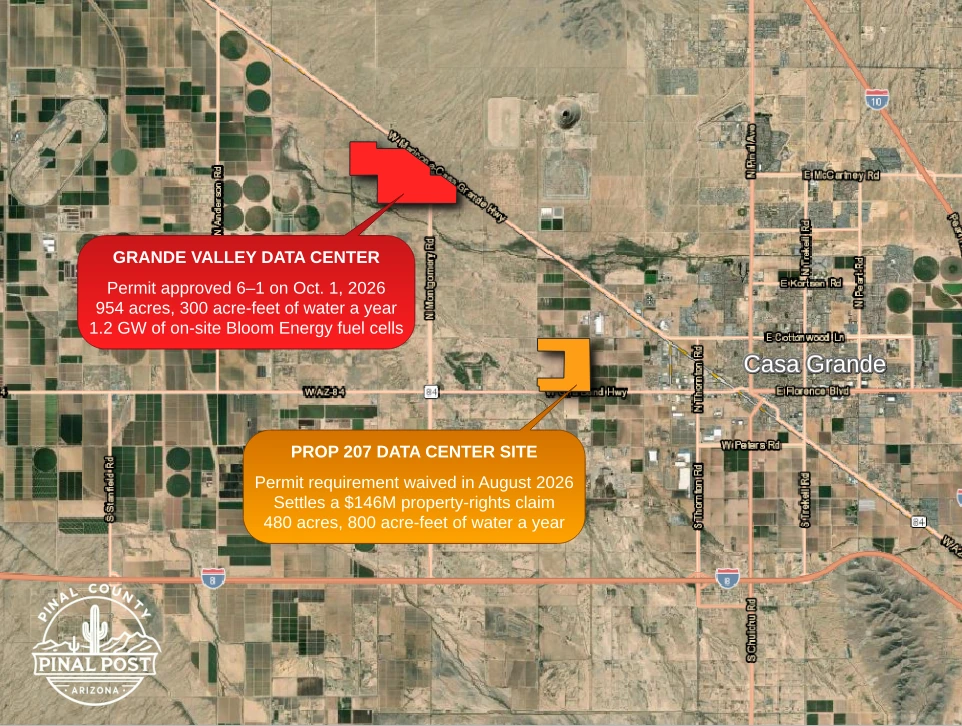
- It is a different project from the Gila Bend Highway data center the council exempted from the permit in August under a Prop 207 waiver.
- Potable water is capped at 300 acre-feet a year, compared with 800 at the Gila Bend Highway site.
- Until grid capacity is available, the campus must generate its own power on site with Bloom Energy fuel cells or similar technology the city approves.
- The fuel cells make electricity without combustion, and the applicant and Bloom say they produce fewer emissions and run quieter than gas turbines, need almost no water and use 15 to 20 percent less fuel.
- A draft county air permit describes a 1.2-gigawatt fuel cell plant. Bloom reports 1.5 gigawatts installed worldwide.
- ED3’s general manager said the project will not be subsidized by the utility’s other customers.
- The draft air permit caps four pollutants at 90 tons a year each and estimates the fuel cells alone at 68 tons of carbon monoxide, 53 tons of volatile organic compounds and 16 tons of nitrogen oxides; it does not estimate carbon dioxide.
- Noise is limited to 65 dBA at the property line of the nearest home. The draft air permit allows up to 100 hours of testing per year for each of 16 diesel backup generators, and the city’s permit sets no time-of-day limits on that testing.
- Of 11 speakers, nine opposed the project or raised concerns, led by water, heat and jobs.
- No end user has signed on, and site plan review comes next.
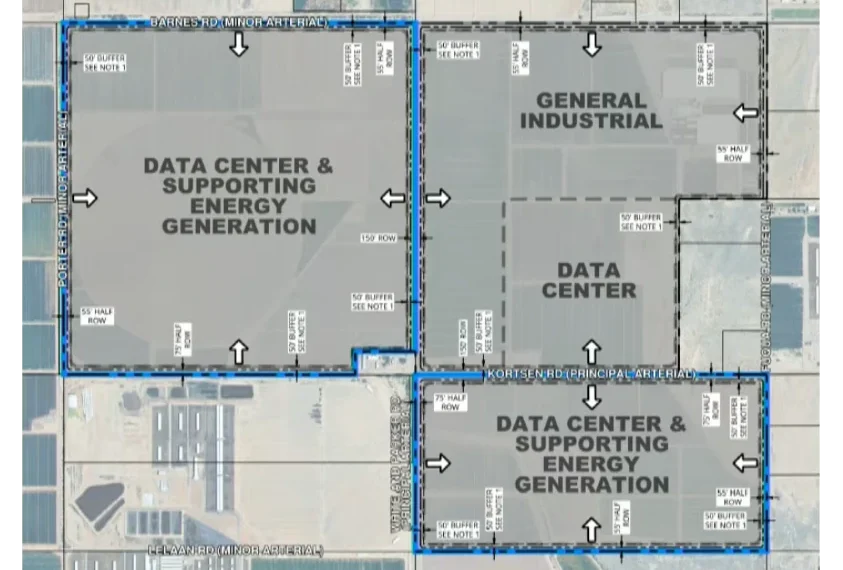
CASA GRANDE, AZ — The Casa Grande Planning and Zoning Commission approved a conditional use permit on Thursday, Oct. 1, 2026, for a 954-acre Casa Grande data center campus on the city’s northwest side. The vote was 6-1. The permit is a commission decision and does not go to the City Council unless appealed. Colliers Engineering filed the request for the Grande Valley Industrial Data Center Campus on behalf of landowner LKY Development Company. Under the permit, the owner must supply the campus’s own electricity until utility grid capacity becomes available, and the on-site power plant must use Bloom Energy fuel cells or similar technology the Planning Director approves. The campus must also use no more than 300 acre-feet of potable water per year.
The Grande Valley Data Center site sits south of the Maricopa-Casa Grande Highway, west of Montgomery Road and east of the Midway Road alignment, with the Cactus Mine to the north and the Ivanhoe Santa Cruz Mine to the south and east. The Gila Bend Highway data center approved under the Prop 207 waiver lies to the southeast. Other proposed data centers in unincorporated Pinal County appear to the west. Toggle the layers to see mine boundaries. Zoom and pan to explore, and click any colored area for a description. Open the map full-screen
The Grande Valley Data Center is separate from the 480-acre data center site along Gila Bend Highway. There, the City Council waived the conditional use permit requirement in August to settle a Proposition 207 property-rights claim, so that project never came before the commission. Every other data center in the city’s industrial zones still needs the permit.
The scale of the power plant appears in a draft Pinal County air quality permit dated Aug. 25, 2026. That document covers a power generation facility to be owned and operated by Sonoran Outrider on part of the campus. It describes a 1.2-gigawatt facility built from 3,693 Bloom Energy fuel cells, each rated at 325 kilowatts, plus up to 16 diesel-fired emergency generators of 1,000 kilowatts each and up to 16 diesel fire pump engines. The plant plans to run around the clock, and the draft caps the fuel cells’ output at 10,512,000 megawatt-hours a year. It also limits combined emissions to 90 tons a year each of nitrogen oxides, carbon monoxide, volatile organic compounds and sulfur oxides. Additionally, the draft notes the site lies in an area that does not meet federal air quality standards for PM10, a category of small airborne particles that includes dust. That status does not bar the plant, but it must meet the air-quality rules that apply in such areas.
Before the hearing, staff received about 20 emails, 17 opposed and three in support. In addition, 11 people spoke at the meeting. Nine opposed the project or raised concerns, one spoke in favor, and the general manager of Electrical District No. 3 said the project would not be subsidized by the utility’s other customers.
What a conditional use permit lets the commission decide
Senior Planner Jaclyn Sarnowski told commissioners this was the first conditional use permit, or CUP, for a data center to come before them. Last year, staff and the commission recommended allowing data centers outright in the city’s industrial zones. However, the City Council changed that recommendation to require a CUP. The council’s goal was to add public review and let the city weigh water use, electrical demand, power generation and noise project by project.
A CUP is not a rezoning. The land already carries I-2 zoning, which the council approved in May 2025 after a major General Plan amendment in December 2024. Under city code, the commission may approve a CUP when a project passes four tests covering site size, street access, effect on neighboring property and conformance with the General Plan, and it may attach conditions to protect public health, safety and welfare.
Commissioner Garrett Aldrete addressed the calls for tougher terms before the vote. A rezoning would give the commission “a lot more leverage” to impose the kinds of commitments speakers asked for, he said. “This is not a rezoning. This is a conditional use permit.” He added that it “would be wrong for us to deny a conditional use permit when they meet all of the standards of our code.” A public health, safety or welfare issue could justify denial, he said, but the city must first give the applicant a chance to mitigate it.
Assistant City Attorney Mark Graffius said the conditions can be enforced. If the owner fails to meet them, the property falls into violation of its zoning, and the city can pursue enforcement.
How the Gila Bend Highway data center skipped the hearing
Sarnowski said the conditions staff attached to the Grande Valley permit, covering water, power, noise, safety, reporting and decommissioning, are based on those the mayor and council adopted in August under the Proposition 207 waiver. That waiver covers the data center site on Gila Bend Highway, southeast of the Grande Valley Data Center. Staff added to and changed those conditions for the Grande Valley Data Center’s operating model and location. The city had told the two owners of the Gila Bend Highway site in writing in July 2025 that a data center was allowed on their property by right. When the council adopted the permit requirement that October, the owners demanded about $146 million under Proposition 207 for the lost value. Rather than pay or go to court, the council waived the requirement for their land only, in exchange for binding conditions, including an 800 net acre-foot water cap. As part of that settlement, the owners also agreed to give $5 million toward city recreation facilities, a payment the waiver calls a voluntary contribution. City Manager Larry Rains said at the time that any other data center in the city’s industrial zones would still go through a CUP, which is why the Grande Valley project came before the commission.
When Commissioner Chris Hubbard asked whether the Grande Valley applicant would offer a similar contribution, Lindsay Schube, the applicant’s attorney with Gammage & Burnham, said the two cases differ but that the applicant would consider it if the commission asked. The $5 million was part of a settlement contract, she said, while attaching a payment to a zoning decision would set a precedent. “If you’re doing a telecommunications tower, do you do a donation?” she asked. Graffius agreed: “That waiver was an agreement to settle possible litigation. I would recommend that we don’t try to impose a condition where they have to pay us money.” In a news release the day after the vote, the city said community benefit commitments would be discussed with the eventual end user during development and permitting.
Grande Valley Data Center permit caps water well below the Gila Bend Highway Prop 207 waiver approval
Water led staff’s summary of the opposition emails and came up from most speakers at the podium. Their concern was less the size of the cap than adding any new demand during a drought, the cumulative draw of many data centers, and questions about the 300 acre-foot figure itself, including how it was calculated and that it does not cover power the campus might buy from elsewhere. “Three hundred acre-feet is substantially less than what was approved with the 207 waiver, which was approved at 800 acre-feet per calendar year,” Sarnowski said. Both caps cover the data center and its on-site power plant together.
Other water conditions follow. Once-through cooling, which runs water past the equipment a single time and then discards it, is prohibited. Before a building permit issues for each construction phase, the owner must disclose its cooling technology and estimated annual water demand. Each year, the owner must report actual use to the City Manager, and the city may publish that report on its website. Additionally, water used for power generation may not exceed benchmarks for comparable power plants or heavy industrial uses.
Closed-loop cooling: what the applicant describes and what the CUP requires
The applicant attributes the low figure to two separate closed-loop systems. The first cools the computer equipment. According to the narrative, water circulates through sealed pipes, picks up heat from the computers and carries it away, and because the water never meets outside air, it does not evaporate. However, that heat still has to be released outdoors somehow, and the narrative does not say how. The term “closed loop” alone covers several designs. Closed-loop dry coolers, which work like a car radiator, and closed-loop air-cooled chillers shed heat to the air and use no water. Closed-loop adiabatic systems add a swamp-cooler stage that wets the incoming air on hot days, so they use some water in summer. Closed-loop evaporative systems shed heat by evaporating water continuously. The label “closed loop” alone does not say how much water the campus would use for cooling. By contrast, the Prop 207 waiver for the Gila Bend Highway data center named the choices for that site: closed-loop, air-cooled or hybrid, with hybrid defined by the city as air cooling for most of the year and limited evaporative cooling in the hottest weather.
The second system the applicant describes as closed loop is the fuel cells, which take an initial water fill. Schube said: “The original data centers as approved use 99 percent more water than we do. This is a closed loop system. The fuel cells will be filled with water, and they will only have to be replaced every five to seven years.” She said ongoing potable water would mostly serve restrooms and employees.
The narrative describes the applicant’s plan, not a condition of the CUP. The CUP specifies the power technology but leaves the computer-cooling method to the owner, who must stay under the 300 acre-foot water cap and disclose the design before building permits. Global Water Resources, the water and wastewater provider, has issued a will-serve letter.
How 300 acre-feet compares
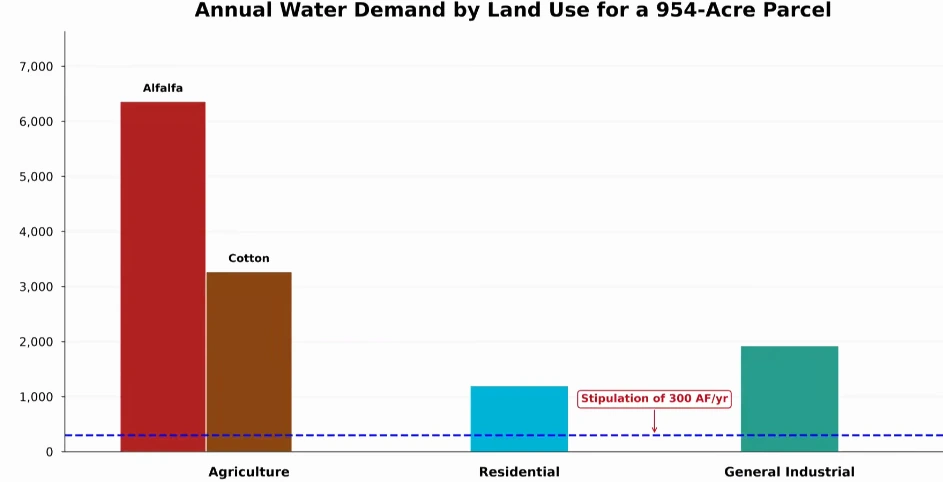
Vice Chair Celeste Garza asked for a comparison in local terms. After conferring, Schube offered approximate figures. Chang Chun Arizona, known as CCAZ, uses about 157 acre-feet on 145 acres, and Kohler about 118 acre-feet on 126 acres. Measured against the Grande Valley campus’s 300 acre-foot potable water cap on 954 acres, she calculated a per-acre figure about one-third of those two. She also noted that many uses allowed by right in I-2 zoning could consume more water without any commission or council approval. A chart from the applicant’s water engineers put 954 acres of alfalfa at more than 6,000 acre-feet a year, cotton above 3,000, general industrial near 1,900 and housing about 1,200.
Bloom Energy fuel cells planned as the primary power source
The Grande Valley campus would run on Bloom Energy solid-oxide fuel cells fed by two natural gas pipelines that already border the southern property line, so no new gas lines need to be built to reach the site. Consequently, the project does not plan a traditional grid connection for primary power. Battery storage outside the buildings would manage short-term fluctuations, balance electrical loads and support reliability, rather than serve as the primary backup power source.
Amanda Marruffo of Bloom Energy told the commission this would be the company’s first Arizona installation. However, Bloom has more than 200 installations in Southern California and more than 1,000 nationwide.
For scale, Bloom said in a January investor release that it had deployed 1.5 gigawatts across all of its installations worldwide. The draft air permit for the Grande Valley Data Center alone describes 1.2 gigawatts, or 1,200 megawatts. Both scale and heat came up at Pinal County’s July hearing on the Project Midway data center. That applicant’s own consultant said existing fuel cell installations top out around 20 to 25 megawatts, and county commissioners asked how the units would hold up in Arizona summer heat. Bloom’s datasheet for the model in the draft permit lists an operating range of minus 4 to 113 degrees Fahrenheit. At the Grande Valley hearing, Schube said she wanted the project’s power generation partner to address heat, but no one from the applicant’s team spoke to heat before the Casa Grande commission voted.
The cells pull in natural gas and ambient air and produce electricity through a non-combustion electrochemical reaction. Marruffo said emissions are minimal, with rates 50 to 96 percent below California’s Distributed Generation Certification standards. In comparing its cells with gas turbines, the company has said they cost about the same to build, use 15 to 20 percent less fuel and are easier to permit. Marruffo said the initial water fill turns to steam and recycles through the system, the reaction itself creates water, and the exhaust leaves as warm air. Aldrete raised the generation equipment’s proximity to the rail line, mentioning a possible derailment or fire, and asked whether vibration was a concern. Marruffo said it was not. The draft air permit says the cells produce electricity, heat, water vapor and carbon dioxide. Their exhaust is released to the atmosphere, and the draft separately lists the air pollutants detailed below.
Emissions under the draft air permit
The applicant’s slides say the approved air permit is forthcoming; the county’s draft is dated Aug. 25, 2026. According to that draft, the fuel cells’ estimated annual emissions are:
- Nitrogen oxides: 15.8 tons
- Carbon monoxide: 68.3 tons
- Volatile organic compounds: 52.6 tons
- Hazardous air pollutants: 0.6 tons
- PM10: less than 0.1 ton
The first three figures match Bloom’s own datasheet: the manufacturer’s emission rate for each gas, applied to a full year of running the plant at maximum output. The draft does not estimate carbon dioxide, the greenhouse gas the cells produce.
What ED3 says about rates
Schube said: “We will have no impact to the residential power or increase in residential power costs.” ED3 will serve as the retail provider under a special electric service agreement with the independent power producer and the end user.
Brian Yerges, ED3’s general manager, said the applicant has worked with ED3 for months and agreed to pay the utility’s review costs.
The permit’s power conditions require the self-supply model. The resolution states that on-site generation “shall utilize Bloom Energy Solid-oxide fuel cell technology or similar generation upon approval by the Planning Director.” That places approval of any substitute technology with the Planning Director rather than the commission. Until interconnection capacity exists, the owner must supply its own electrical capacity. If the owner later connects to a utility, it pays all interconnection costs unless a utility agreement says otherwise. Before any building permit for generation, the owner must disclose the technology, capacity in megawatts, fuel source and required environmental permits.
A 65 dBA noise limit set with future projects in mind
Sarnowski said staff does not view noise as a primary concern here because the site sits beside the Union Pacific rail line. Even so, the city wanted a baseline for other data centers that may follow. The Grande Valley campus may not exceed 65 dBA, measured at the property line of the nearest existing residential use within the city. The owner must submit a noise study before building permits and another within 90 days of operation. If the second study shows an exceedance, more mitigation is required. By comparison, the August waiver set limits of 60 dBA by day and 55 dBA at night.
When Garza asked what 65 decibels sounds like, Schube answered that it is normal conversation. The applicant’s materials make the same comparison, stating that each Bloom Energy Server operates below 65 dBA at 10 feet, per manufacturer specifications, a level “comparable to a normal conversational speaking volume.” That is a per-unit figure; the permit’s limit applies to the campus as a whole.
Those figures cover the fuel cells, which the applicant describes as quieter than combustion equipment. However, the campus would also have 16 diesel emergency generators and 16 diesel fire pump engines. The draft air permit allows each engine to run up to 100 hours a year for testing and maintenance, with no time limit during an actual emergency. Neither the city’s conditions nor the draft permit restricts the time of day for testing, although the owner must report generator testing in its annual compliance report. By contrast, the August waiver limited backup generator testing to weekdays between 9 a.m. and 4 p.m., with 24 hours’ notice to the city. The generators were not discussed at the hearing.
Neighboring land zoned for homes, owned by a mining company
The General Plan still designates the undeveloped land north, east and part of the south of the site as Neighborhoods. Sarnowski noted that the remaining Legends Planned Area Development to the south is still zoned as a residential mixed-use PAD. However, she said Ivanhoe Electric now owns that land, with its Santa Cruz Mine farther south. The company intends to bring the area into its mining operations in the future but has no timeframe for the required General Plan amendment. Ivanhoe Electric submitted a letter of support for the Grande Valley Data Center.
Residents press on drought, heat and the economics of AI
Several speakers focused on water. Raul Villanueva, who works for a water district, said the region is in a drought and nearing a Tier 3 shortage. Tyler Stein of Rural Arizona Engagement said federal cuts to Arizona’s Colorado River allocation will push Casa Grande toward groundwater. He argued the cap does not stop the developer from buying power generated with water elsewhere, and he noted the applicant has not stated how many megawatts it needs. Neither the agenda packet nor the hearing gave a figure. The 1.2-gigawatt capacity cited in this article comes from the county’s draft air permit, a separate document that was not part of the city’s packet, and it describes generating capacity, not the eventual operator’s demand. Stein also said no one mentioned a data center when the land was rezoned, and he and Lorenzo Mendoza Jr. both questioned how many permanent jobs would remain after construction.
Heat was a second theme. Nancy Wood and Mendoza said large buildings and heavy power use would add to summer temperatures. Dr. Anita Allen, who said she spent 40 years in environmental compliance, most recently with the U.S. Coast Guard, said the applicant had addressed power well by staying off the grid with “their own contained system,” adding that she is familiar with it and “it works very well.” However, she said the state’s recent loss of Colorado River water means water has to be moved around to fill the gap, so the campus’s draw adds to a shortfall rather than standing alone. She also cited research on warming around data centers and said a campus this size would warm the air for miles. “You’ve got cropland out there that will still be active, and that can’t be good for I don’t care what you’re growing,” she said. Her concerns, she added, extend beyond this data center to the dozens more in planning across Arizona.
Dr. Jessica St. Andre, an environmental scientist from Coolidge, questioned two of the applicant’s claims. She said closed-loop cooling becomes inefficient in extreme heat, so operators “have to find another way to cool it,” which could make the closed-loop pitch “a false promise.” She said natural gas power plants still produce emissions she linked to health effects, and she asked to see the calculations behind the 300 acre-foot figure.
Jobs, debt and housing
Michael Packard questioned whether the largest AI companies earn enough to support their data center spending, and he warned the campus could end up sitting empty. He compared it to Phoenix Mart, which Wood also cited.
Julia Gusse, a Maricopa resident, former two-term Maricopa councilwoman, Air Force veteran and current candidate for the Arizona House in Legislative District 16, opposed the project. She said it would raise utility costs and make it harder to build the housing Pinal County families need. She said two of the support letters came from corporations that stand to benefit most from the project, and she noted Global Water did not appear at the hearing. She described Global Water as a for-profit utility and said her own monthly bill exceeds $100 even when she uses very little water.
A Maricopa resident who gave his name as Greg was the only speaker in support. He said he has worked in the computer industry since 1989 and hires entry-level staff at $80,000 to $110,000. Eight of his coworkers commute from Maricopa, he said, and local jobs would change their lives.
Economic estimates and who would build it
The applicant presented figures from a 40-page economic study but labeled them estimates, subject to change and not a guarantee. For Casa Grande specifically, the study projects about $262 million in one-time construction privilege tax, about $32 million a year in property tax to the city and about $117 million a year in property tax to school districts. The slides list about 450 on-site jobs. Asked whether that was at full build-out, Schube said yes, then added that she believed the campus would employ about 1,200 people in total, with 450 of them on site at any one time. Construction would bring thousands more temporary jobs.
No end user has signed on yet. Schube said multiple end users are waiting in the queue, but none will commit until the permit is secured. Power generation would be built first, followed by the first phase of data center buildings.
Safety, reporting and decommissioning requirements
Before each phase opens, the owner must give the Fire Department an emergency response plan and inventories of batteries and hazardous materials. Every year by March 1, the owner must file a compliance report covering water use, cooling technology, power generation, generator testing and noise monitoring. If operations permanently stop, decommissioning must begin within 180 days and finish within 18 months after work begins, unless the city grants an extension. The conditions run with the land, so they bind future owners.
Commissioners added one condition of their own: no wall visible from a public street may run more than 50 feet without at least two design features such as changes in plane, material, windows or landscaping. The commission first voted 7-0 to add that condition, then 6-1 to approve the permit as amended, with Hubbard the lone no.
Site plan review comes next for the Grande Valley Data Center
The Casa Grande data center permit does not set a construction date. The commission’s vote is the city’s final decision unless it is appealed to the City Council within 10 days, and city code allows only the applicant or an owner of property within 300 feet of the site to file. The next step is site plan review, where staff will address equipment locations, roadways, landscaping, screening, lighting, drainage and parking. Before the relevant building permits are issued, the owner must submit its cooling-technology and water-demand disclosures and a noise study.