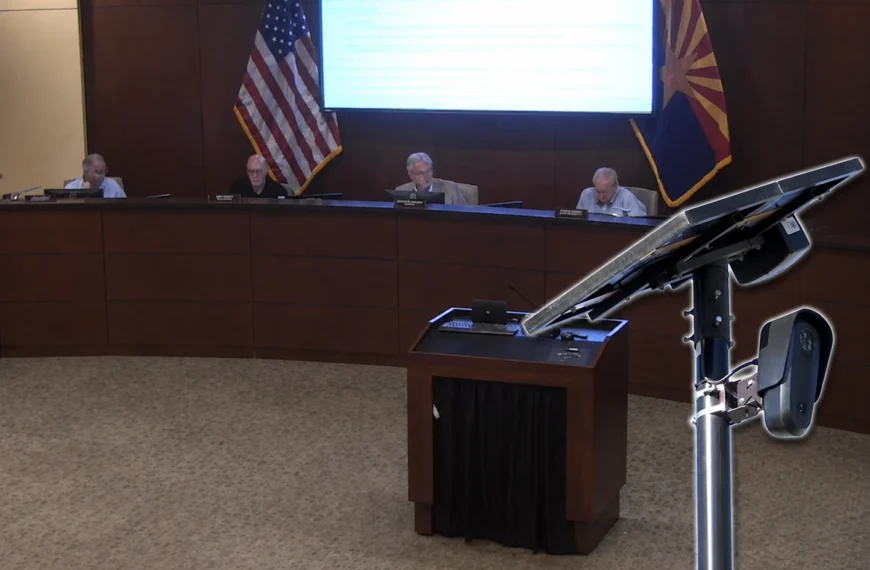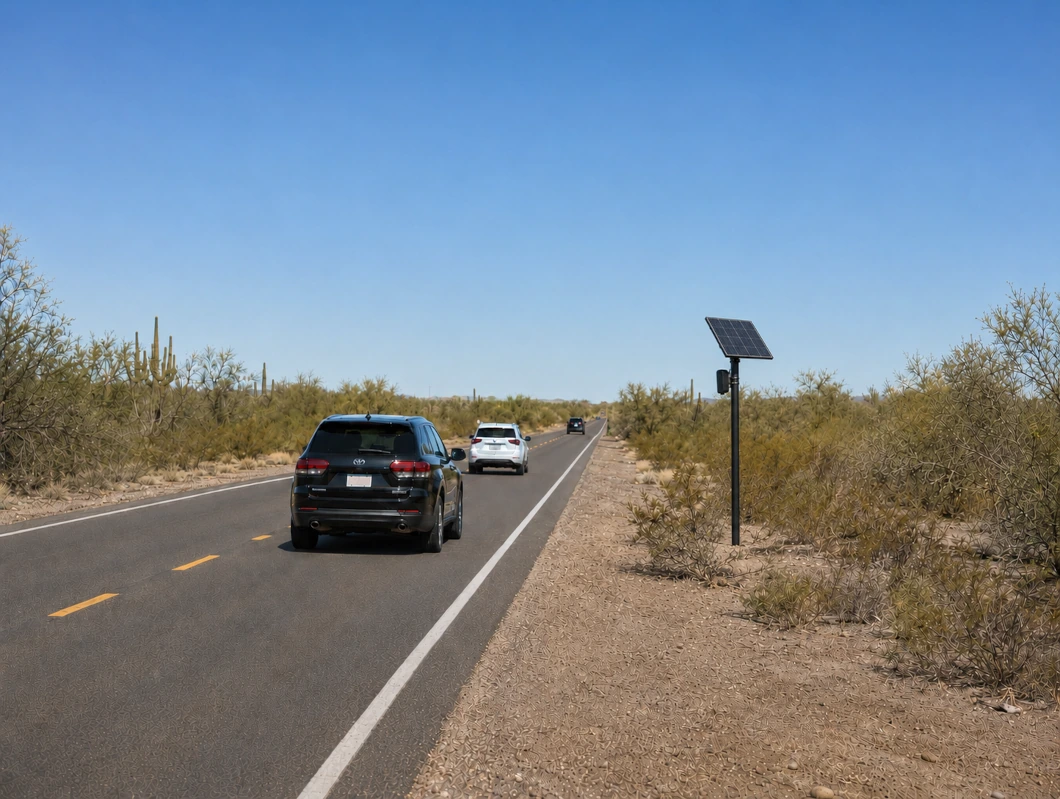
SAN TAN VALLEY, AZ — Twenty-two of the 45 Flock license plate cameras run by the Pinal County Sheriff’s Office sit inside town limits. Every image is erased after 30 days unless downloaded into a case file, and PCSO shares its scans with 124 law-enforcement agencies. Those were among the answers as PCSO leaders briefed the Town Council on San Tan Valley Flock cameras at the July 15 meeting. The agenda item was for information and discussion only, so the council took no action.
Deputy Chief Jason Villegas and Information Technology Director Matthew DiMuzio led the presentation. Lt. Mike Benedict, who oversees day-to-day patrol operations in the town, joined them. The briefing followed the council’s May 20 meeting, where it was suggested that staff contact the county about its agreements with Flock Safety. According to the staff report, Pinal County has two types of agreements with Flock: an operational contract and a right-of-way use agreement for camera infrastructure on county property.
The discussion also arrived days after the cameras factored into a fatal hit-and-run investigation on Hunt Highway. The staff report notes that groups such as the Electronic Frontier Foundation warn that such systems broaden public surveillance and chill civil liberties.
A Fatal Hit-and-Run Became the Live Example
A July 10 crash on Hunt Highway near Magma Road killed one person and injured three others, according to the sheriff’s office. The initial lookout described a black Ford F-250 or F-350. However, the vehicle turned out to be a 2024 dark blue Nissan Titan. A Florence resident was apprehended the next afternoon and was being booked to face multiple felony charges for leaving the scene.
Benedict told the council the case remains an active investigation and occurred in the county, not inside town limits. Still, he said the cameras helped place the vehicle at the scene. Because each capture is time-stamped, investigators could line up the crash, the 911 call and the vehicle’s travel.
Based on the limited information he had, Villegas said, “we wouldn’t have caught that suspect” without the technology. He told the council the person killed was a 23-year-old woman. “Just picture it,” he said. “Picture it being your granddaughter. Picture it being your daughter.” “But when something tragic happens in your city limits, to that effect, I hope you guys have answers for it,” he added.
San Tan Valley Flock Cameras by the Numbers
Those contracts run on a yearly basis, DiMuzio said. Beyond the 22 in town, two sit in Queen Creek (permitted through county right-of-way before annexation) and three in Eloy. The rest stand in Pinal County right-of-way.
From July 1 through the July 15 meeting, the system had recorded 478,692 captures and 983 searches of the data, DiMuzio said. Of the 124 agencies receiving PCSO’s scans, about 85 to 90 are in Arizona, he said. The rest are in New Mexico, Texas, Colorado and a couple of agencies farther east. When Councilmember Brian Tyler asked whether every recipient is a law enforcement agency, DiMuzio answered, “All [are] law enforcement agencies.”
‘Targeted Vehicles, Not People’: How a Search Works
“Searches on targeted vehicles, not people,” Villegas told the council. Every search starts with a reported crime and a vehicle described by a victim or witness, he said. Next, a deputy runs a targeted query for that vehicle in a specific area and time window. Any hit is a lead, not proof, and must be corroborated through interviews, surveillance video and records checks before action is taken. Finally, the query and its result are written into the case report, which supervisors review.
For example, Villegas described a witness who sees a black car flee a shooting and catches only three plate characters. A deputy can enter that fragment, and the system returns every matching vehicle. Councilmember Gia Jenkins asked how specific those queries can get. DiMuzio said searches range from something as broad as any truck down to make, model, color, stickers, roof racks and trailers. Plates are searchable from full numbers down to just two characters. However, every query requires a stated reason. “They have to identify why they’re searching this,” he said.
Villegas said the same records can also protect the innocent, partly because “some of the most unreliable information out there comes from witnesses.”
Fourth Amendment Fears and Facial Recognition
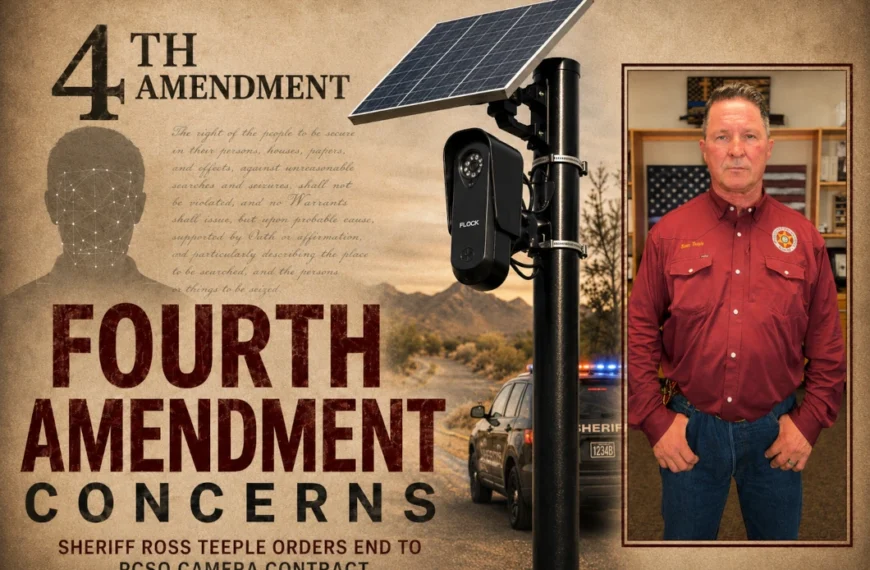
Villegas turned to the concerns he said he hears most often from the public. “I know the biggest thing is Fourth Amendment — unreasonable search and seizure,” he said. The cameras cannot zoom in to read personal information on a driver’s phone, he said, and “it doesn’t have facial recognition. It doesn’t have any of that.”
Technically, DiMuzio explained, each camera takes motion-triggered still photos and can cover two lanes. “The photos are always from the rear of the vehicle, never from the front,” he said. There is no speed measurement, and the devices are not red-light or speed cameras. Each capture is “just a snapshot in time,” he said. Villegas acknowledged a capture can sometimes include a grainy image of a driver, much like photo radar, though he said that alone cannot identify anyone with certainty.
Where the Data Lives: Flock’s Cloud and Four Carriers
Mayor Daren Schnepf asked about storage. “It’s all stored and hosted by Flock … we access it through a web browser,” DiMuzio said. Images upload over one of four cellular carriers, whichever Flock identifies as strongest at each camera site. In addition, PCSO is implementing two-factor authentication, so an officer logging in must answer a challenge text.
Schnepf then asked whether the information stays in Arizona. “I believe it’s out of state,” DiMuzio said. The mayor surmised the company likely runs its own data center.
Vice Mayor Tyler Hudgins asked whether Flock sells the data. DiMuzio said he has not seen that in his research. “There are other ALPR companies that do do that,” he said. “They’ll share reads with repo companies, stuff like that. I haven’t seen that with Flock.”
Villegas noted PCSO already relies on vendor-held data elsewhere. He recalled once hating body cameras because it “felt like it was Big Brother watching.” Nevertheless, the agency is adopting Axon body cameras this year, and PCSO is “one of the last” to do so, Villegas said. “We don’t own any of the data storage. We don’t own anything with Axon,” he said, adding later, “we don’t own that information, Axon does.” That company is based in Scottsdale, and command staff view complaint footage through links Axon sends.
The 30-Day Deletion
“Our data retention is 30 days,” DiMuzio said. “That’s 30 days’ worth of image captures.” The deletion is rolling, he told Councilmember Daniel Oakes: each image comes off on its own 30-day clock, down to the hour.
Jenkins asked who governs that 30-day clock. Each agency sets its own retention with Flock, DiMuzio said. For instance, Casa Grande could choose 90 days and Apache Junction police could choose 14. PCSO settled on 30 because longer periods generate enormous volumes of data.
Tyler asked how deletion is ensured elsewhere, once other agencies can search PCSO’s reads. “For them to save it, they would have to download it and then attach it to their case and follow their agency’s policies and protocols for doing that,” DiMuzio said. Furthermore, an outside agency’s search also remains in PCSO’s record for 30 days.
30 Cases, From a Missing Teen to a Repainted Getaway Car
The presentation summarized a 30-case sample from 2023 through 2026, drawn by a senior criminal analyst from PCSO’s records management system and dispatch logs. The methodology note says the analyst reviewed 31 closed or resolved cases, each verifiable through public records requests.
The sample included 13 property crimes, five violent crimes, five investigative-support cases, three fraud or scam cases, three sex offenses and one missing person. Five partner agencies coordinated on those cases. Geographically, they ran from San Tan Valley and the Queen Creek area to Casa Grande, Arizona City, Gold Canyon, Dudleyville, Apache Junction and SaddleBrooke. Villegas said offenders rarely stay put: “You guys are so close to the East Valley, you get people coming into your area committing crimes and going back to the East Valley.” Without the cameras, he said, developing vehicle leads could take hours, days or even weeks, partly because suspects’ relatives rarely cooperate. By contrast, hits from multiple cameras let investigators map a suspect vehicle’s route of travel and challenge false alibis.
Villegas discussed two cases in detail. In January 2026, a San Tan Valley parent reported a 16-year-old daughter who had left home during the night without her family knowing. Within about an hour, deputies had the vehicle’s last confirmed sighting, eastbound on Hunt Highway at Bella Vista. In addition, the same check flagged the car as stolen from a neighboring city, and it was recovered that morning. That trail produced the leads used to pursue charges against the adult involved. Villegas noted the town has many group homes and said such cases could involve abduction or trafficking.
“Nothing beats good old-fashioned police work. But what I’m saying is this is almost a force multiplier on some of those cases where it’s imperative that you have 48 hours to find that missing person.” — Deputy Chief Jason Villegas
In March 2026, a Gold Canyon burglary suspect spray-painted his white sedan black to defeat witness descriptions. However, a current camera photo of the repainted car went straight to the beat deputy. That deputy spotted the exact vehicle and the suspect at an Apache Junction post office the same morning. The man fled at more than 100 mph, and the case closed with him in custody.
Other cases named in the presentation included an armed-robbery suspect booked within 24 hours in Casa Grande, an Arizona City drive-by shooter’s sedan matched within six minutes, and a stolen trailer with $10,000 in quarry equipment from Dudleyville recovered the same day 40 miles away in Apache Junction. Camera hits also tracked a vehicle in a Queen Creek-area senior fraud through Gilbert and Chandler, placed a stolen San Tan Valley pickup — with a handgun inside — in the Copper Basin neighborhood and matched a motorcycle to an attempted break-in in SaddleBrooke.
‘Why Flock?’ — A Blunt Question About the Company Itself
Councilmember Rupert Wolfert distinguished the company from its technology. “I think really at the end of the day, the technology is not what people are opposed to, it’s Flock itself,” he said. “Flock has earned a very negative reputation … My question to you is, why Flock?”
“I will say, I agree with you 100% with Flock,” Villegas replied, pointing to a recent company press conference he felt did the technology no favors. Still, “for what we use it for, by far, this has been the best one,” he said.
DiMuzio’s answer:
“For us to invest in ALPR cameras that are offered by Motorola [and its competitor] … they don’t offer the product as a service. It would be up to my staff to go out, put poles in the ground, hang cameras. I’d have to hire 10 more people just to manage this one application. That was one of our main reasons why we went with Flock.” — IT Director Matthew DiMuzio
He added that his office audits Flock’s news coverage and watches for problems. Oakes agreed the vendor has hurt itself, pointing to talk that Flock lacks end-to-end encryption and, without naming a source, referring to “14 to 18 convictions of police officers” in the context of records misuse. Those cases often surface, he said, only when “a victim gets suspicious of how this person knows these things.”
Tyler asked how easily Flock can be hacked. DiMuzio said he has seen no reports of the database being breached. However, he acknowledged one incident in which Flock “inappropriately shared law enforcement searches with Bing and DuckDuckGo.” That leak exposed officers’ license-plate searches, he said, not personally identifiable information. As for the hardware: “We’ve looked into hacking the cameras. The cameras we have, we haven’t been able to hack, and it’s not the version that that gentleman has in his YouTube channel.”
Audits, Firings and the County Attorney’s Backstop
Oakes asked whether any technology, not just policy, blocks an officer from misusing the system. Villegas confirmed there is none. He compared the controls to how PCSO polices its in-car database terminals: required justifications, audits and discipline. “For every query that’s done, there better be a legitimate reason,” he said. “I just can’t go in there and start running information.” Oakes summarized, “So preventive measures are policy related and oversight related?” Villegas answered yes.
Misuse carries consequences, Villegas said. Running records for personal gain is a firing offense, and PCSO has terminated and criminally prosecuted officers over records abuse. Additionally, the Arizona Department of Public Safety (DPS) prosecutes violations of its procedures and motor-vehicle-records access as a Class 6 felony. “Everything is documented and you better have a reason as to why you’re going into that system, and it’s gonna be linked by a report,” he said. He described the process this way: DPS runs monthly audits of state records systems and kicks red flags back to PCSO. The agency must respond with the departmental report number and the associated Flock records. DPS makes a determination, and PCSO opens its own professional standards investigation on top. So far, he said, no Flock-related misuse case has occurred at the agency.
Villegas argued that no audit system anywhere catches every violation. Even at DPS, an agency he called top-tier, “their audits, they’re not 100% foolproof.” In nearly 30 years at PCSO, he said, he had seen only two such convictions. If that agency cannot catch every violation, he doubted any other law enforcement agency could either.
Oakes responded: “You saying that doesn’t create confidence.”
Villegas said the Pinal County Attorney’s Office has access to the query records on charged cases and has used the data in successful prosecutions. Moreover, when Jenkins asked whether downloaded images hold up in court, DiMuzio tied admissibility directly to documentation. “Anything that you’re presenting to the county attorney better have an audit trail,” he said. “You better be able to show what we refer to as a chain of custody with any physical evidence.” The investigating officer must then testify that he alone downloaded the image and attached it to the case file.
August Renewal and More Talks Ahead
Villegas said PCSO has no stake in the town’s eventual choice. “We’re not advocating one way or the other,” he said, noting the county could decline to renew next year or, if the town objected, redeploy the San Tan Valley cameras elsewhere in the county.
The San Tan Valley Flock cameras remain in operation under the county’s contract, which next renews in August.
For more on Flock cameras across Pinal County, see Pinal Post’s ongoing coverage.