APACHE JUNCTION, AZ — Florence Copper told city leaders that its extraction technology could be applied beyond its Florence site. Afterward, Councilmember Darryl Cross, who arranged the visit, said he would welcome a mining site near Apache Junction. Both statements came during a Florence Copper Apache Junction City Council update on Tuesday, July 7. Sophie Dessart, the company’s manager of communications and public affairs, delivered the presentation. It also covered community grants, local hiring and a scholarship program for which Apache Junction high school seniors are automatically eligible.
Cross closed the item by thanking the company. “It’s amazing the work that you’re doing and the benefits you’re providing for not only Pinal County, but the State of Arizona and the local community of Florence and Apache Junction,” he said. He added: “If we can find a site for a mining operation somewhere here close by, that’d be good too.” Mayor Chip Wilson added, “I want to personally say thank you as well.”
Councilmember Peter Heck asked about expansion. The process appears to have far less environmental impact than other mining operations, he observed. He then asked whether it needs an ideal location or could be set up anywhere. In response, Dessart said, “You do need specific hydrogeologic conditions to make the process possible.” However, she continued, “We are convinced that there are other opportunities to apply this technology elsewhere and in the United States.” She added that the company is “very excited in the longer term to have the ability to apply our technical knowledge and expertise to expand.” Councilmember Heck replied, “Good.” Dessart did not identify a specific expansion site or project.
Growing the Florence Copper Apache Junction Partnership
Since 2013, the Florence Copper Community Foundation has donated more than $225,000 in grants to local nonprofits and initiatives, Dessart said. Recipients include Good Shepherd Horse Rescue and Learning Center in Apache Junction and the local Salvation Army. “We do want to put that out there to any local community organizations that might be looking for support,” she said. Additional grant announcements appear on the company’s Copper Wire blog.
“We also do have a scholarship program, and all high school seniors in Apache Junction are automatically eligible for that scholarship program,” Dessart continued. “And we’ve given over $130,000 in scholarships to local students.” Her slides identified it as the Creating Opportunities Scholarship. As for eligibility, the program’s webpage says applicants must live in or attend high school in Pinal County. Awards fund full-time enrollment at accredited U.S. colleges, universities, and business and trade schools, and applications for the 2026 awards closed in March.
Dessart said local hiring is climbing as well: the company had roughly 35 employees about four years ago, employs more than 200 today and is still hiring. Moreover, most workers added during the ramp-up are Pinal County residents, including some from Apache Junction, she said.
Dessart also cited an Arizona State University analysis. The economic impact study by ASU’s Seidman Research Institute projects that the operation will add about $4.3 billion in cumulative gross domestic product to Arizona. The estimate, in constant 2024 dollars, covers a modeled 26-year span from construction through reclamation. Of that total, $2.5 billion is projected for Pinal County. Her slides also cited $593 million in cumulative state and local tax revenue.
First New Major U.S. Copper Producer in More Than a Decade
“Florence Copper is incredibly proud to be the first major source of US copper that is new in over a decade in the United States,” Dessart said.
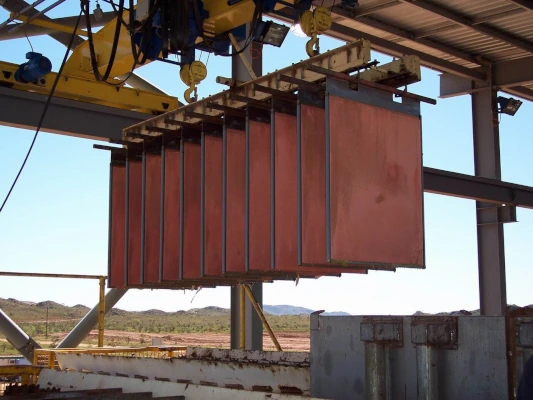
“Between the end of February, when we produced and harvested our first copper cathode, and the end of March, we already have produced 1.5 million pounds of copper,” she said. “And we’re continuing to expand that production today.” Start-up of the commercial wellfield, the network of wells that dissolves and recovers copper underground, began in October 2025.
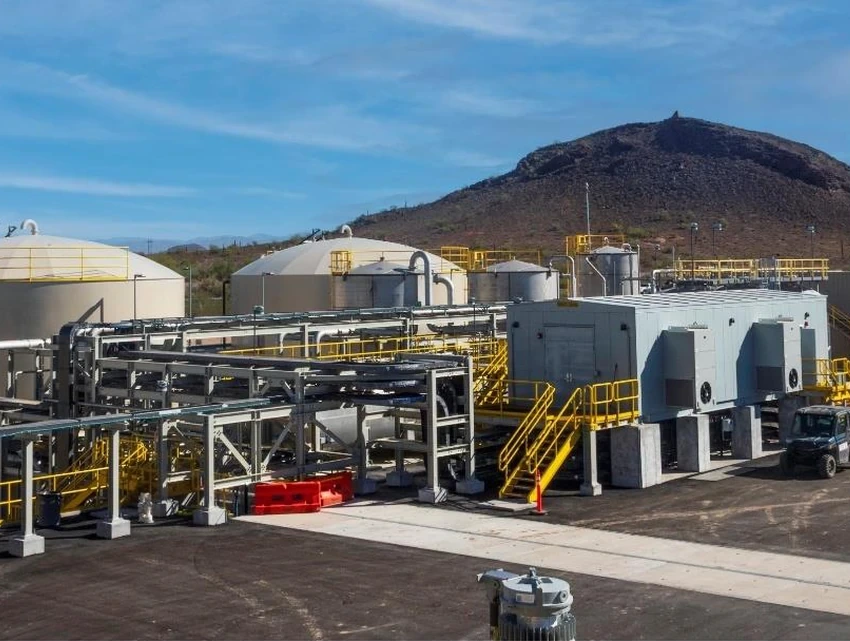
That expanded wellfield was one of two major components of the construction program, Dessart said. The other was a larger on-site plant for plating copper.
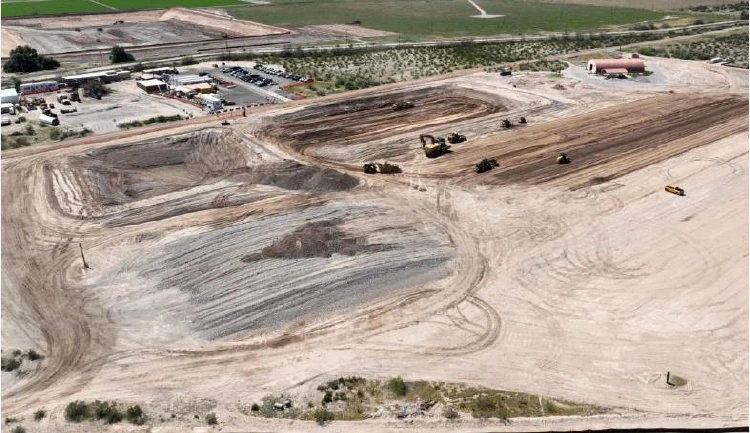
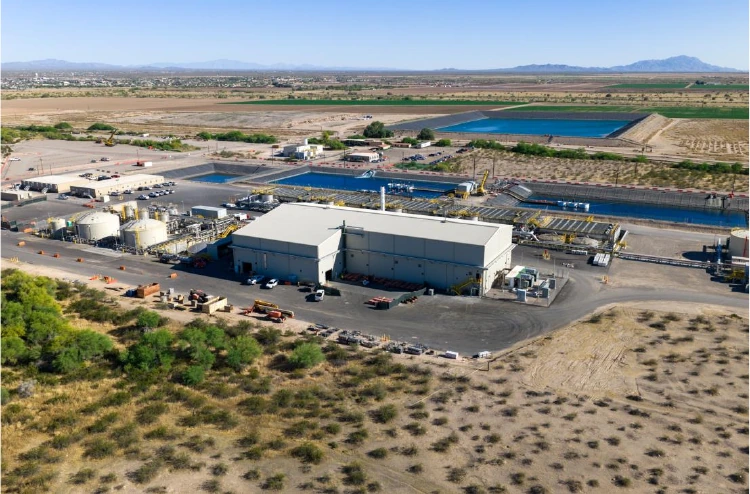
Dessart said the operation has an annual production capacity of 85 million pounds of copper and a 22-year mine life. That output would lift U.S. refined copper production by about 5% over 2025 levels, she added. It would also make the parent company the third-largest U.S. copper cathode producer. “All of our copper is staying here in the United States,” she said.
A Vinegar-Strength Solution, 1,200 Feet Down
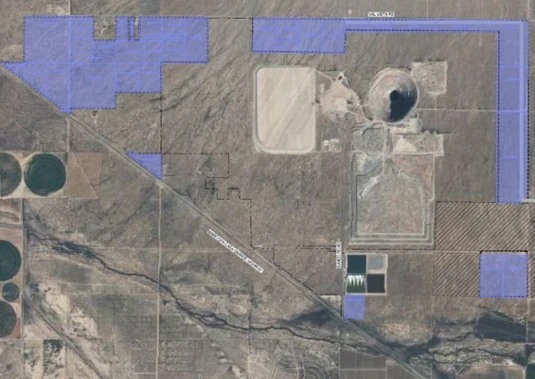
The operation covers just over 1,300 acres of state and private land in the town of Florence. It sits along Hunt Highway across from Poston Butte, the hill topped by the pyramid tomb of Charles Poston. The site is minutes from Florence’s historic downtown and several master-planned communities.
Instead of digging, crews drill wells into a copper oxide zone 400 to 1,200 feet underground. They then circulate a lightly acidic solution that dissolves copper minerals in the rock. Dessart compared its acidity to household vinegar. Recovery wells pull the copper-rich liquid back to the surface. Finally, an on-site plant uses electricity to plate the metal into solid form.
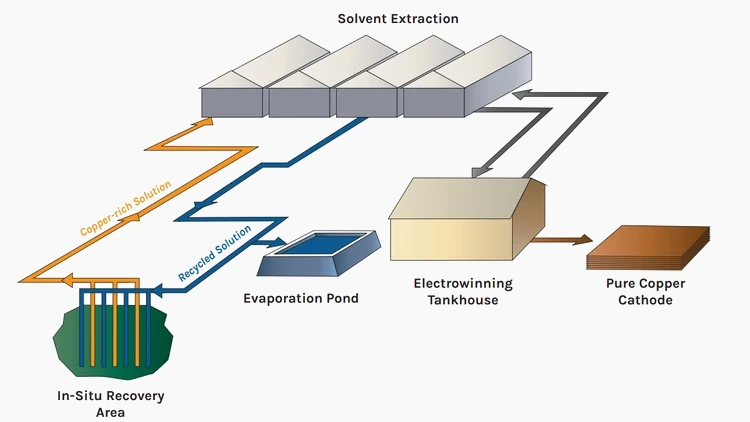
Florence’s copper oxide zone consists of extensively fractured, porous and water-saturated bedrock, according to her presentation. Those hydrogeologic conditions make a traditional open pit or underground mine a poor fit, Dessart said, but are “perfect for the process that we use at Florence Copper.”
‘An Empty Field’ Instead of an Open Pit
Dessart contrasted the site with a typical copper mine and showed a photo of the wellfield, the site’s network of copper-recovery wells. “It basically looks like an empty field with a couple pieces of equipment sticking out of our ground,” she said. “I promise you it’s even less impressive in person.”
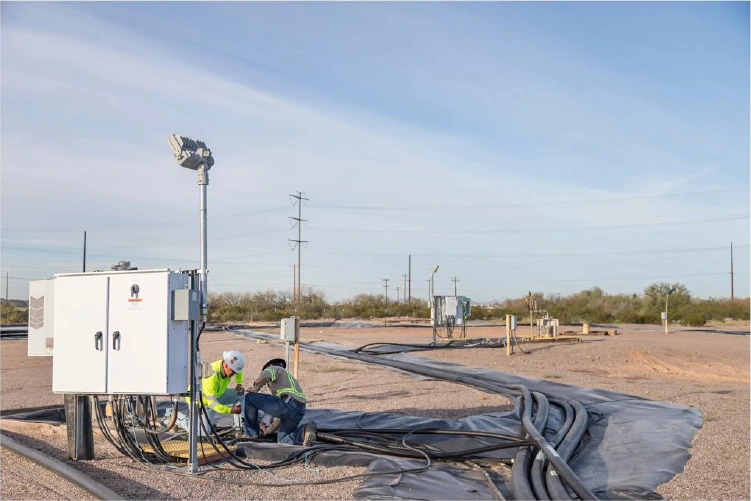
Dessart listed what the site lacks. “We have no open pit at Florence Copper. We are not sending workers below ground to haul out millions of pounds of rock. We have no major earth movers. There’s no large-scale blasting. … There’s no waste rock or tailings. There’s no haul trucks. None of that traditional mining activity with our process.”
“We save a lot of energy. We emit less carbon and less dust. We also use significantly less water compared to a traditional mining operation,” Dessart said. Compared with a conventional Arizona open-pit mine, her slides showed 65% less energy use. They also showed 75% lower carbon emissions and 78% less water per pound of copper.
Afterward, she said, the land can be reused. “We have a very, very small footprint, and when we’re done, all of this equipment that you see on this slide can be pretty much pulled up, and with that, the land really looks like how it was when we started,” Dessart said. “So it can be redeveloped into housing, into agriculture, really whatever the community priorities are at that time.”
Council Questions Turn to Water and Farming
Questions during the Florence Copper update in Apache Junction focused first on water. Councilmember Bambi Johnson asked what the solution contains and how much water the site consumes. Dessart identified the working liquid as a solution called raffinate. In plain terms, the solution injected at Florence is dilute sulfuric acid, roughly 99.5% water and 0.5% acid, according to a CIM Magazine article about the project. The plant strips out the copper, she said, and the liquid goes back into the loop. “Because it’s mostly water-based, we’re recycling the majority of the water that we use at Florence Copper,” she said. In fact, “we actually technically produce more water than we need,” she added. The reason, per CIM Magazine: to keep the solution from spreading, the wells always pump more water out of the ground than the site puts back in. That extra water is the surplus.
“We have a partnership with a local farmer that farms on our land and is actually able to get water from our operation to help irrigate his fields,” Dessart said. When Johnson followed up on the crops, Dessart said the farmer grows alfalfa on company land. “We have a reverse osmosis system and we’re able to provide that water to him,” she added. The treated water meets state water-quality standards for irrigation under an authorization Arizona granted in 2025, the magazine reports.
Vice Mayor Robert Schroeder asked whether the extraction method is proprietary. “We are the world’s first greenfield in situ copper recovery operation,” Dessart answered. Site visitors cannot take photos because of the proprietary technology involved, she explained. Still, the underlying in-situ method itself is not proprietary and has been applied to other minerals and resources. “But for copper, we are the world’s first,” she said.
Defense and AI Push Copper Demand Higher
Dessart opened her talk with the market case, citing an S&P Global study released early this year, “Copper in the Age of AI.” The study identifies four growth drivers: core economic demand, the energy transition, military applications, and artificial intelligence and its data centers. Florence Copper’s parent company, Trekor Metals, co-sponsored the study under its former name, Taseko Mines.
“Without copper, we would not have the lights on in this building,” she said. “We wouldn’t have the air conditioning that keeps us cool during the hot Arizona summer months.” On the defense front, “copper is the second most used material by the US Department of Defense,” she said.
Worldwide demand should climb about 50% by 2040, she said, and the United States is not adding domestic sources of copper fast enough.
From a 1969 Discovery to First Commercial Copper
“The copper deposit was actually discovered in 1969, and it took many, many years to bring us to where we are today,” Dessart said. After acquiring the property in 2014, the company ran a smaller-scale Production Test Facility from late 2018 into 2020. The test facility produced more than 1 million pounds of copper and, in Dessart’s words, “highlighted the environmental responsibility, the effectiveness, the safety” of the process. Afterward, the company paused to expand its permits. Its final major federal approval, an underground injection control permit from the U.S. Environmental Protection Agency, came in September 2023.
Construction of the commercial facility began in January 2024 and reached substantial completion in fall 2025.
Parent Company Trades the Taseko Name for Trekor
Dessart also noted a corporate name change. Florence Copper is wholly owned by Trekor Metals Limited of Vancouver, British Columbia. The parent also runs Gibraltar, which Dessart described as the second-largest open-pit copper mine in Canada. Until late June, Trekor was called Taseko Mines Limited; shareholders approved the new name at the company’s annual meeting. The Vancouver company was incorporated under the Taseko name in 1966, per its corporate history.
Ramp-Up to Full Capacity Runs Into 2027
Per the presentation, the ramp-up from first cathode production to full commercial capacity runs through 2026 and 2027. Dessart closed the Apache Junction Florence Copper update by saying: “We look forward to continuing our collaboration and expanding our collaboration here in Apache Junction.”