Key points
- Pinal County supervisors approved the Ore Town Solar project Aug. 5 with no opposition.
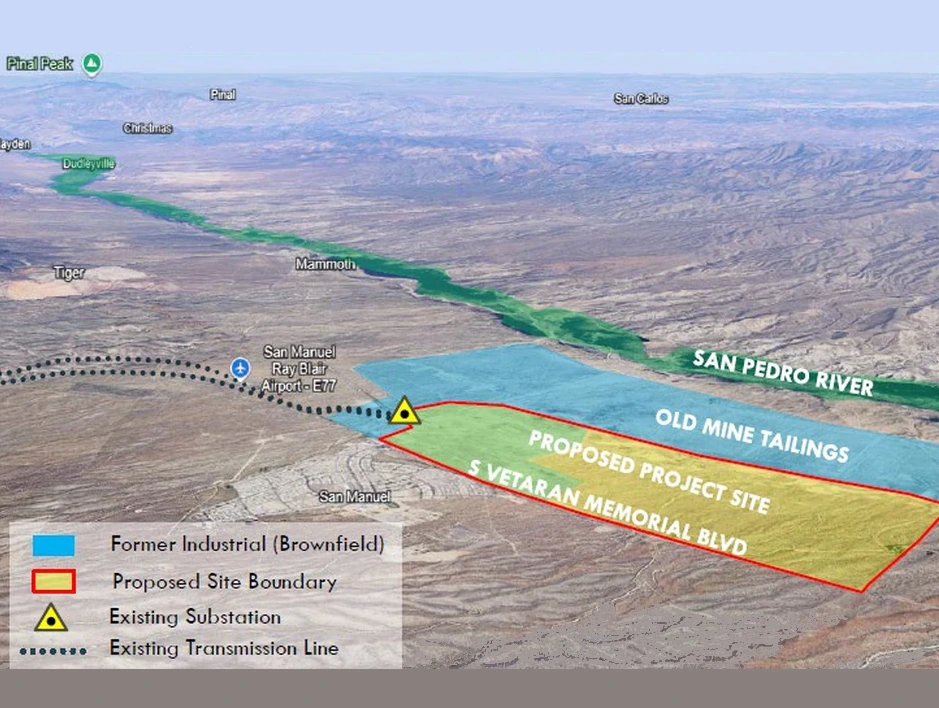
- The plant will put about 145 megawatts each of solar and battery storage on 1,227 acres of the old San Manuel mine’s ore-processing site.
- Officials say chemicals from the site’s mining days make the land unlikely to ever hold homes or most other development.
- The developer projects more than $60 million in tax revenue over 35 years, mostly for local schools and fire service.
- Construction would start in late 2028, with power flowing in 2030.
SAN MANUEL, AZ — For nearly half a century, the ground east of San Manuel processed copper ore. On Aug. 5, the Pinal County Board of Supervisors approved the Ore Town Solar project on that ground: about 145 megawatts each of solar generation and battery storage on a 1,227-acre stretch of the decommissioned San Manuel Copper Mine complex. The land is a brownfield, a former industrial property that county planners and the developer say is unlikely to ever hold homes, everyday businesses or most other development because of the chemicals once handled there. That history is why many residents welcomed solar panels here, and why the county’s own planner now calls the site a potential national model.
Neighbors will not see construction for a while. Developer 310SM 8me LLC, a subsidiary of Avantus, is targeting commercial operation in 2030, according to its presentation. Meanwhile, some tax money is already flowing: the developer worked with landowner BHP Copper and the San Manuel Fire District to annex the property into the district ahead of the hearings, and it is already paying property taxes, the applicant’s attorney told supervisors. Over a 35-year projection period, the developer estimates the project will generate more than $60 million in tax revenue for schools, fire service and other local districts.
Supervisors approved two companion items: a rezoning from rural to industrial, and a Planned Area Development (PAD) overlay that restricts the acreage to solar, battery storage and supporting infrastructure under 17 conditions.
Covered in April: The Planning Commission Hearing
This project cleared the Pinal County Planning and Zoning Commission on April 16, and our report from that hearing covered the groundwork in detail, including:
- The commission’s unanimous 9-0 recommendations on both cases
- The site layout, panel setbacks and the drive-by visual simulation
- How the power would flow to Arizona Public Service, and why rates are set by the utility rather than the developer
- Fire district equipment, training plans, and the reasoning for skipping a block wall around the batteries
- The applicant’s initial tax revenue projection, plus Commissioner Tom Scott’s challenges on taxes, heat, rainfall and water
- Battery fire statistics, thermal runaway safeguards and on-site water storage
- Construction and operations water estimates amid regional drought
- Herbicide, vegetation and noxious weed management
- Early public comments, including local business pitches
- The decommissioning plan and the removal-cost security that BHP, as landowner, will hold
BHP Copper, the mining company that ran the San Manuel mine until 2003, still owns the land and is leasing it to Avantus for the solar project, according to the zoning application.
‘A Textbook Example’ of Brownfield Reuse
Senior Planner Valentyn Panchenko told the board that chemicals from the site’s decades of ore processing make it a poor candidate for housing. “It’s not going to be used by any residential development because of chemicals that was present there before,” he said.
That constraint, he argued, works in the project’s favor. “It might become a textbook example from the brownfield-style renewable energy redevelopment projects in the whole country,” Panchenko said, calling the parcel one of the best places in the county for this use.
Additionally, he pointed to what neighbors themselves said at the commission hearing. “People who live there, they referenced that no one wants to live there, that side of the town, because they know about all those chemical stuff and mining,” Panchenko said. His department’s report reached the same framing, calling the project a “brownfield-style renewable energy redevelopment opportunity.”
Why Ore Town Solar Landed on the Old Mine
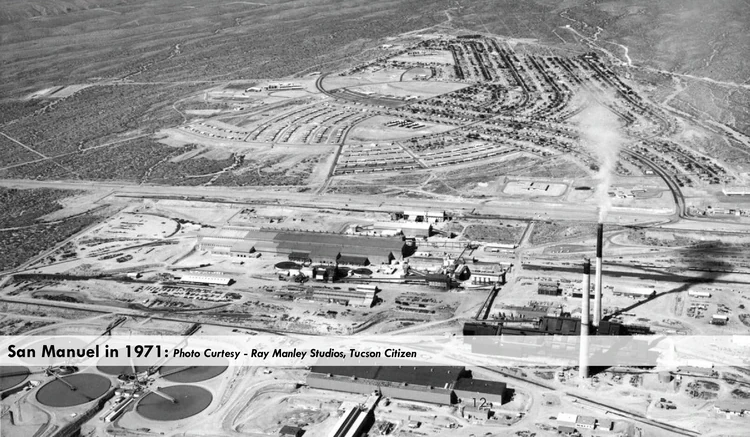
The site processed copper ore railed in from the mine itself, about five miles north, from the mid-1950s until operations ended in 2003. BHP then demolished the facility, dug out contaminated soil and capped the ground with clean fill, and state environmental regulators signed off on the cleanup in 2007; the land has sat fenced and vacant since. According to attorney Stephen Anderson of Gammage & Burnham, who represents the applicant, BHP spent 20 years looking for a new purpose and entertained multiple proposals before identifying solar as its most desirable use — a “productive yet passive” one.
The project’s name is part of that story, too: the “ore” in “Ore Town Solar” is the copper ore this ground once processed. Anderson said the name was chosen after the project’s predecessor, the San Manuel Copper Mine, “to pay tribute to that which came before us.”
The groundwork was laid in October 2024, when supervisors changed the county’s long-range plan for the site from future housing to green energy production — so, Anderson argued, the Aug. 5 votes simply bring the zoning in line with a decision the board already made. He also stressed that the land “is not suitable for either routine commercial uses or for residential uses or even for regular public use or access,” and therefore does not sit “in the path of other future development ambitions.”
The Build: What Exists, What Gets Added
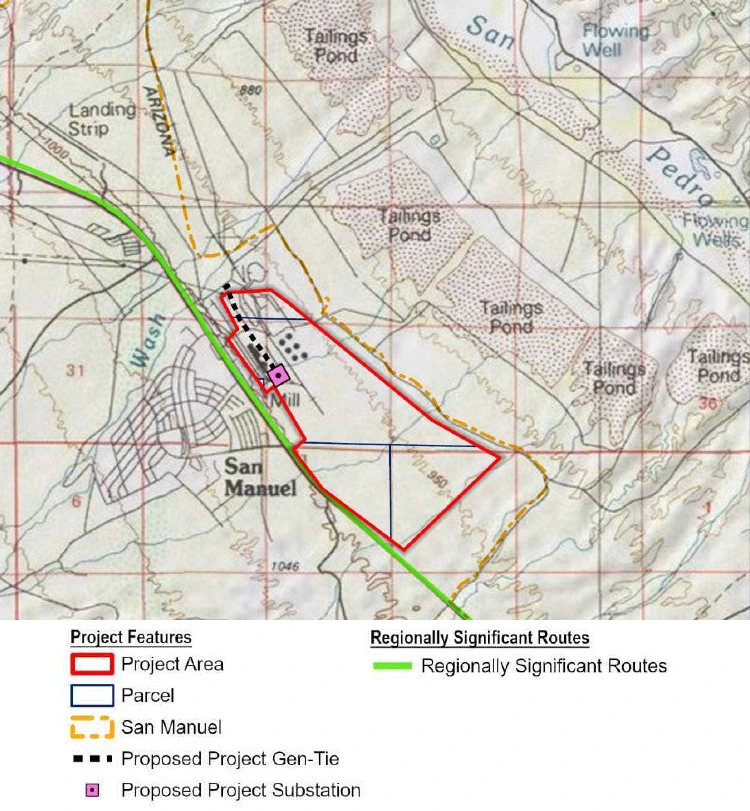
The San Manuel solar project would build on infrastructure already in place. An existing 115-kilovolt APS substation, built decades ago to serve the mine, sits less than a mile away, reducing the need for major off-site transmission lines. Likewise, BHP’s reclamation security fence already surrounds the property, a drainage channel already crosses it, and existing vegetation already screens the site from the adjacent road and from San Manuel.
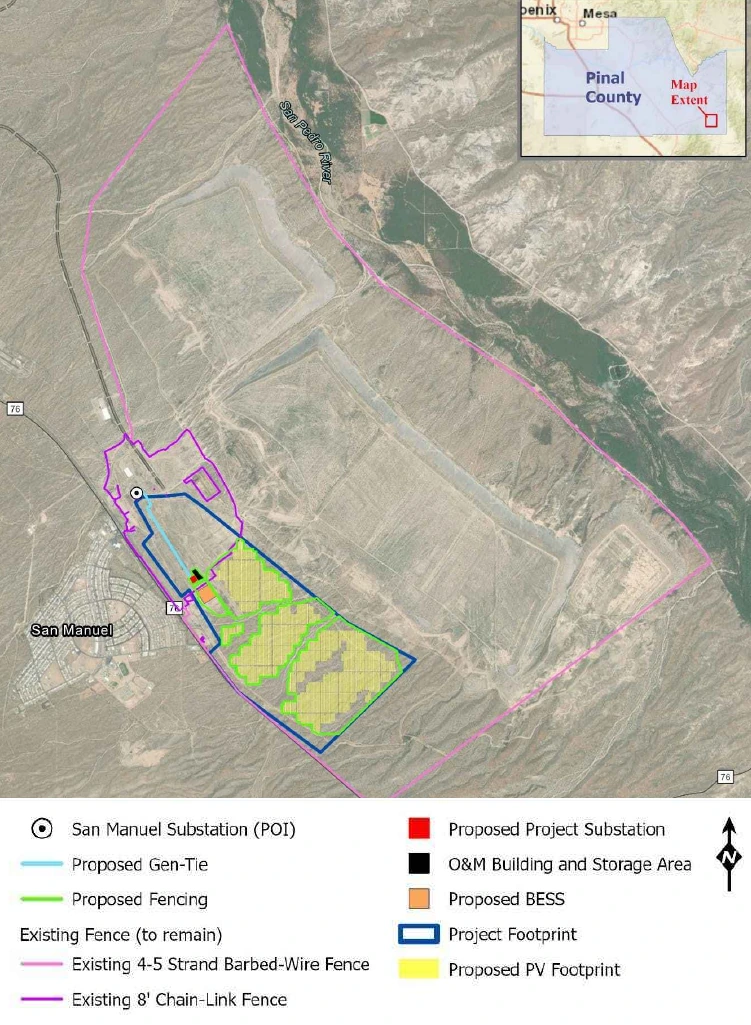
Avantus plans to add the solar arrays, the battery storage yard, its own step-up substation, and a roughly 0.85-mile generation tie line carried on about 13 poles up to 100 feet tall. The plans also call for two paved access roads at least 28 feet wide, security fencing, retention basins and a possible operations building. According to the developer’s project fact sheet, the panels could produce enough energy to power an estimated 35,000 Arizona homes.
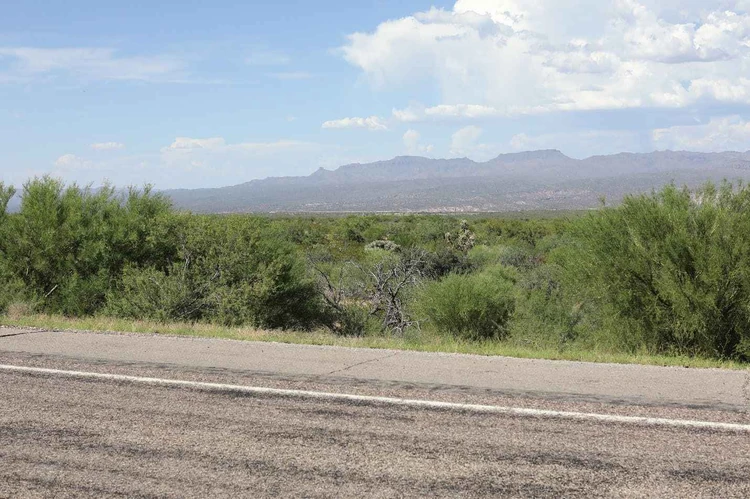
At the same time, more than 430 acres — about 35% of the site — should stay untouched, Anderson said, including the northern quarter and corridors along four major washes. Visibility came up again, too. The ground drops about 250 feet from the road toward the river, which prompted Chairman Jeff McClure to observe that the project is “almost out of sight ’cause it’s downgrade from everything.”
Vice Chairman Jeff Serdy pressed on the adjacent tailings piles, noting that reclaimed tailings near Globe and Miami now support vegetation. “You hate to have just stick solar in there, and that’s the end of it,” he said, suggesting this “might be the last chance” to restore a pre-mining look. In response, Anderson clarified that the tailings sit outside the project and outside Avantus’ control; BHP capped them with soil during reclamation, and the cap is designed to capture runoff rather than let it pass through the tailings toward the San Pedro River, about two miles east.
Tax Projections: Just Over $60 Million
The applicant’s benefits slide projects $60.3 million in property tax revenue over 35 years, calculated at 2025 rates and labeled subject to change. The Mammoth-San Manuel Unified School District would receive the largest share at $22.5 million, or 37.3%. The San Manuel Fire District follows at $15.1 million (25.1%), then Pinal County at $13.6 million (22.5%) and Central Arizona College, the county’s community college district, at $7.1 million (11.8%). The remaining sliver, about 3%, is spread among smaller items such as the county library and flood control districts. By contrast, the same land left vacant would generate about $860,000 over that period, according to the applicant. Separately, Anderson told supervisors the fire district annexation alone raises the project’s property taxes by about 33% over its life. “We are happy to make that contribution,” he said, describing the development as “a large nine-figure investment into this community,” meaning at least $100 million.
On jobs, the peak construction workforce is projected at 275 to 325 workers, per the traffic impact statement. Afterward, the statement anticipates up to two full-time remote workers, with occasional site visits.
Batteries a Quarter Mile From Homes, Next Door to the Firehouse
Supervisor Rich Vitiello opened the battery discussion by asking whether the equipment would be American- or Chinese-built. Avantus project developer Katie Despain answered that “we have not identified specific suppliers for our equipment,” because sourcing follows a power purchase agreement and construction contracts. The question echoed a contrast from weeks earlier: when supervisors approved the Valley Farms Energy Center near Coolidge on July 1, that developer told the board its batteries would be LG units manufactured at LG Energy Solution’s new Pinal County plant.
He then turned to where the batteries would be placed. “I’m very concerned about where batteries are stored,” Vitiello said. “I am actually a very big advocate for batteries… But the one question I do have is why can’t you move the batteries further away from San Manuel?”
Despain explained that the batteries belong beside the project’s own substation, which collects the energy from the panels. Moving the batteries or the substation farther away would waste electricity over the added distance and require extra equipment, she said, and keeping everything together also helps emergency access. The nearest home sits about a quarter mile away across Veterans Memorial, she said, while the fire station sits on the project’s side of the road, “currently located very close to the battery energy storage area.”
Vitiello responded: “The battery safety situation has gotten better over the last 10 years, and especially over the last year or two,” he said, adding that technology should improve further before the plant’s targeted 2030 completion.
Later, San Manuel Fire Department Captain Jessica Castro described a 21-firefighter department with two engines, a ladder truck, a brush truck, a rescue unit and a truck that hauls 3,000 gallons of water, plus a hydrant 100 feet from the station. A second water-hauling truck is on the way, she said. Because the batteries sit so close to the station and its water source, “our response time will be much faster,” she said, and the department plans in-house and quarterly training with Avantus. County staff, meanwhile, skipped the county’s usual block wall around battery equipment because the batteries sit roughly 1,150 feet back from the boulevard, screened by existing terrain and vegetation, and not next to any homes. The battery area will still be enclosed by security fencing, per the project plans.
Support Stacks Up, From Letters to the Podium
Panchenko opened the hearing by adding 17 new support letters to the 17 already on file, for 34 in total. They came from residents and organizations including the San Manuel Fire Department, the Eloy Chamber of Commerce and the Arizona Technology Council, and generally cited economic benefits and long-term resilience for San Manuel. Additionally, Eloy Mayor Sutton and the Eloy Chamber of Commerce wrote about their positive experience with Avantus’ Kitt project in Eloy, a 100-megawatt solar and 100-megawatt battery plant now built, in testing and targeting operation by the end of 2026. The county’s lone concern letter came from the Tri-City RC Modelers Club, which leases a nearby flying site; Panchenko said the club confirmed it is not opposing the project. In the participation record that Avantus itself compiled for the county, one email opposed the project outright, citing costs and desert impacts, while another writer raised concerns about fire risk, water use and wildlife. Even so, no one spoke in opposition at either the commission hearing or before the supervisors.
At the podium, four residents who had signed up to comment passed on speaking and simply registered their support. Chimene Hawes of San Manuel, who said she drove more than an hour to attend, told the board “there is no bigger tree hugger on this Mother Earth than myself” and praised the developer’s environmental work and a design she called essentially invisible from town. She also viewed the plant as a local backstop: if APS ever suffered a power loss on its grid, she said, “San Manuel will still be able to generate power for our community.”
Brian Cox, a San Manuel resident of several decades, framed his support entirely around water. “Any other use would be a continuous water supply drain,” Cox said. “The Department of Agriculture has issued a state of emergency for several counties in Arizona. This is not a laughing matter.” He pointed to Kearny, which he said “is in a water crisis” and imposing restrictions, and to a similar situation in Willcox. “I support it because it is not a continuous source of water use. It ensures that there will be livable life for me and my neighbors for many years,” he said. “I have 100% approval for this.”
Kearny, in eastern Pinal County, declared a water emergency in March after receiving almost none of its usual Gila River water allocation this year, and it has since banned watering landscaping with drinking water and other nonessential uses. As for Willcox, state water regulators designated that groundwater basin an Active Management Area in January 2025, citing severe overdraft and ground that is sinking and cracking. A ban on irrigating new farmland there is already permanently in effect, and the state’s draft first management plan would cut most existing farms’ irrigation allotments by 10%.
Ore Town Solar’s Asks, and the County’s Answers
Under the approval, equipment must stay at least 50 feet inside the property lines — more than 500 feet in places — behind a buffer of preserved desert vegetation that helps keep the project out of view from the road and town. Structures are capped at 50 feet, with exemptions for power equipment such as the transmission poles. Despite the industrial label, the land also cannot become a junkyard, landfill or prison — the overlay strikes those and a list of other industrial uses.
Days before the vote, the board also granted Avantus’ request to drop a blanket rule requiring 50-foot buffers along every desert wash and streamside area. County staff went along because required engineering studies will still set buffer widths wash by wash before construction, and Avantus separately promises 50-foot buffers along the major washes, keeping those corridors open for wildlife to cross the site, plus roughly 450 preserved acres of natural features.
‘I May Have to Vote Yes on This One’
Before the votes, Serdy told the board: “It’s kind of unprecedented to not have any opposition from local residents, and I’m not really very pro solar, but I may have to vote yes on this one.” McClure answered with “shock and awe.”
Both items then passed with no supervisor opposed.
Ore Town Solar’s construction remains at least two years out. Avantus still needs county sign-off on detailed site, drainage and traffic plans, a funded plan guaranteeing the plant’s eventual removal, and APS grid agreements expected to run into late 2027. If everything lands, construction would start in late 2028 and last up to 16 months — peaking at an estimated 680 to 710 vehicle trips a day, including 30 to 60 trucks, per the project’s traffic study — with power flowing in 2030.