Key Points
- Pinal County supervisors approved the Eloy Valley Energy Center III on Sept. 2. No supervisor voted against it.
- NextEra plans 400 megawatts of solar and a battery system that can deliver 400 megawatts for four hours, on about 1,263 acres south of Eloy.
- Construction could start in late 2026. Power could flow as early as December 2027.
- The power is already contracted for local utilities. The applicant told the board the project is “contracted, not will be contracted,” and Electrical District 3 said it signed its contract in 2025, before the county vote. Supervisor Rich Vitiello said he was “glad to hear that all these EDs [electrical districts] and Trico all are going to benefit Pinal County.”
- The buyer is AEPCO, a cooperative serving Pinal County’s electrical districts. Utilities say the power will help replace Hoover Dam and other Colorado River hydropower lost to shortages.
- NextEra’s fire consultant told the board that fires at modern battery sites do not require evacuations, and the Eloy Fire District said in a letter it has no fire protection concerns.
- Batteries are contracted with LG, which has a battery plant in Pinal County. Panel sourcing is not settled. New federal tariffs will raise the cost of most imported solar panels starting in December. NextEra says it is still assessing the impact and will decide which panels to use closer to construction.
- No one showed up to speak against the project. Letters ran 29 in support to 13 opposed. Opponents included nearby horse owners and residents worried about losing rural land.
Pinal County supervisors approved the Eloy Valley Energy Center III on Sept. 2 with no opposing votes. The decision grants zoning approval for a planned 400-megawatt solar array and a battery system that can deliver 400 megawatts for four hours. NextEra Energy Resources plans to build it on about 1,263 acres of farmland just south of Eloy’s city limits.
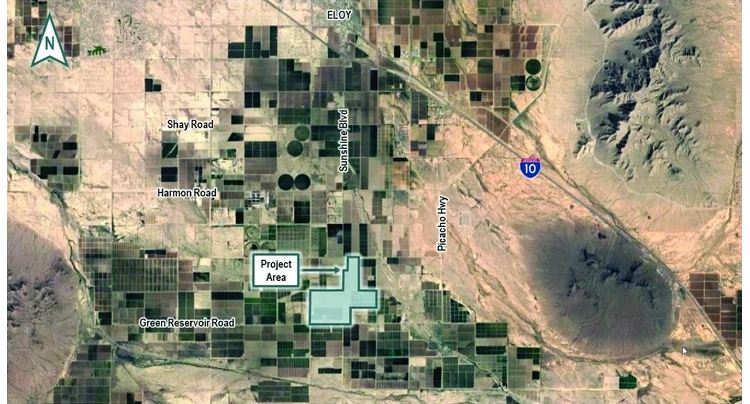
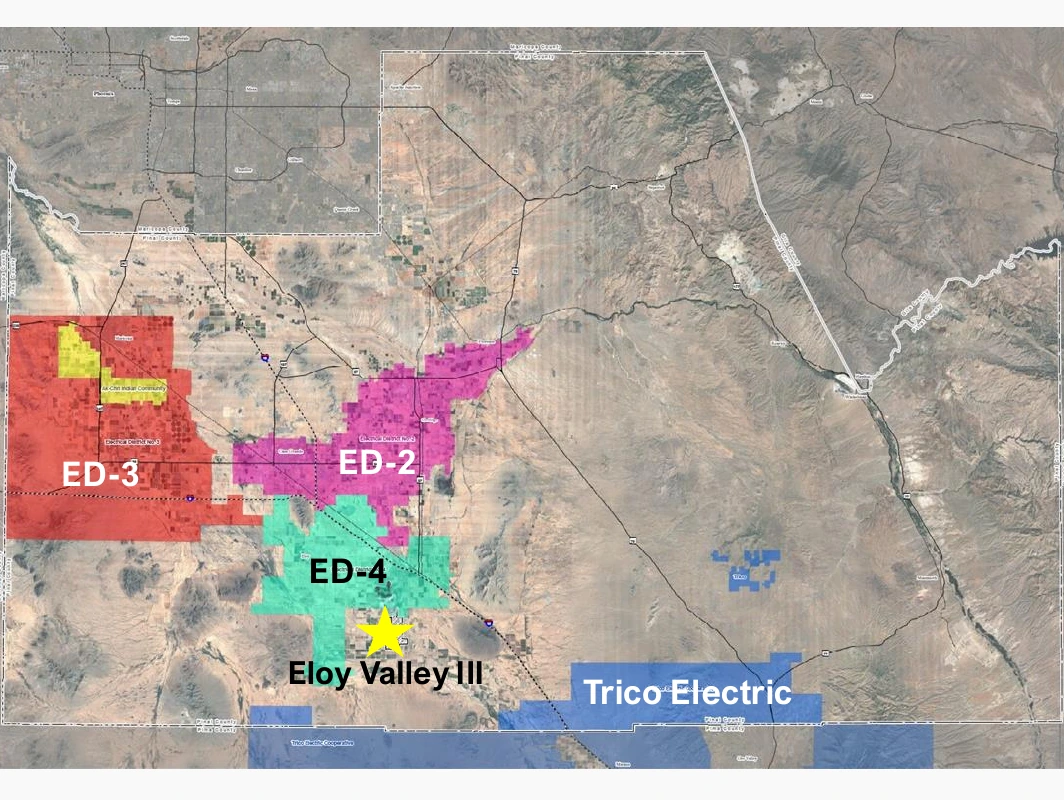
What sets this project apart, utility leaders told the board, is who it is being developed for. It was developed for Arizona’s public power entities and is already contracted to AEPCO, a nonprofit cooperative. Its power will go to the electrical districts serving the City of Maricopa, Casa Grande, Coolidge, Florence and the Eloy area, and to Trico Electric Cooperative in southern Pinal County, according to the applicant. Those utilities say the project will help replace Hoover Dam hydropower that is shrinking along with the Colorado River. Additionally, no one spoke against the project at the hearing, and the Eloy Fire District has said it has no fire protection concerns. NextEra hopes to start construction late this year, with power flowing as early as December 2027.
What NextEra Plans to Build South of Eloy
The site is bounded by Pretzer, Greene Reservoir, Eleven Mile Corner and La Palma roads in unincorporated Pinal County.
Solar panels will cover most of the property. Meanwhile, the roughly 40-acre battery yard and a new substation will occupy the southwest corner near Greene Reservoir and Eleven Mile Corner roads.
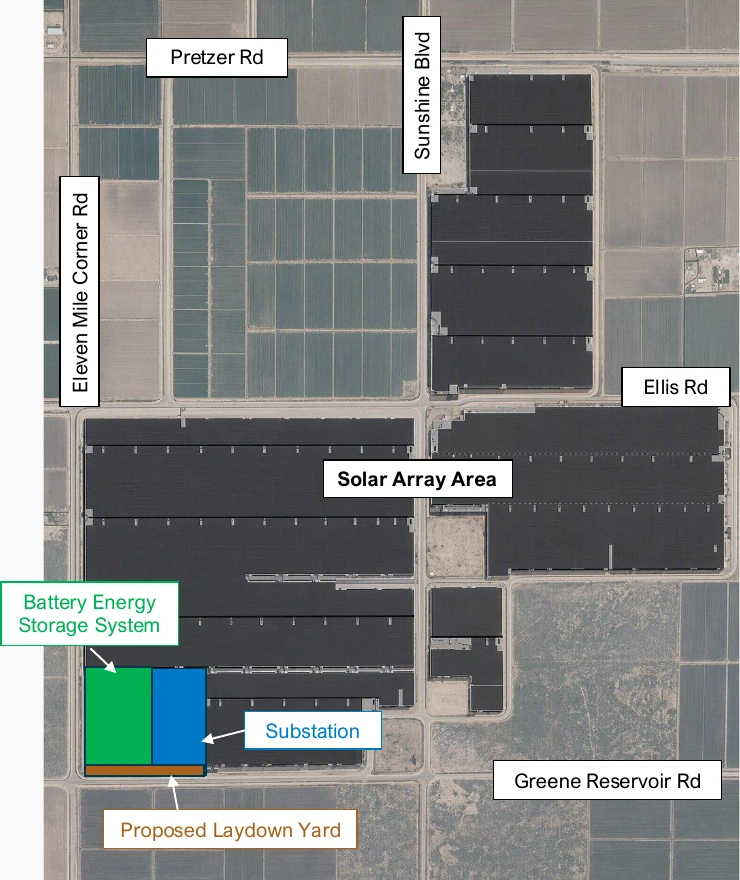
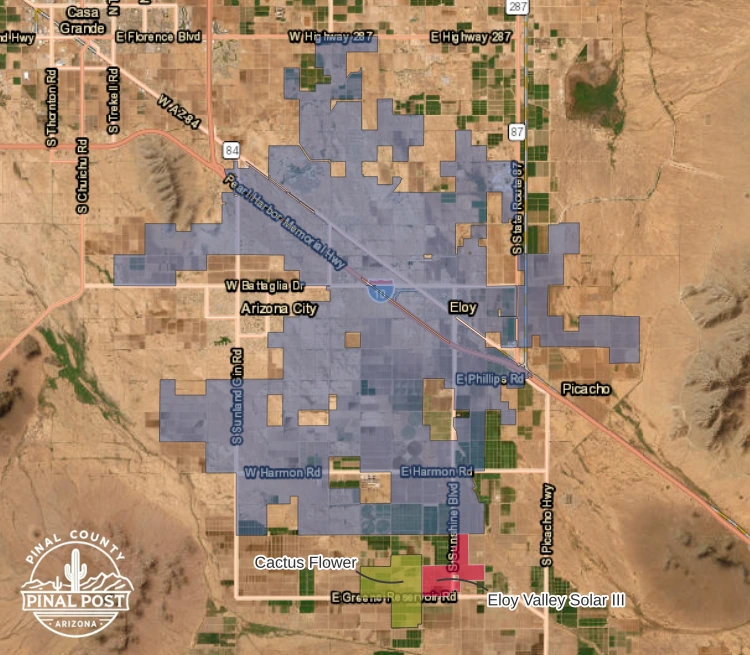
A new 230-kilovolt line will carry the power to an existing substation that NextEra says is 1.1 miles south of the site. That substation belongs to the Western Area Power Administration, or WAPA, a federal agency that runs a high-voltage transmission network across the West, built to deliver hydropower from federal dams. NextEra is buying the land from the Donley Family Trust and the John Patrick & Melinda Donley Trust. The overall project also has a northern portion inside Eloy, which the city approved separately in 2024.
County planners said the request matches the land’s existing designation. In 2021, the county designated the land for Green Energy Production through a major comprehensive plan amendment. The site also falls inside the City of Eloy’s solar overlay, which restricts industrial solar to land south of Interstate 10. Furthermore, the land directly west was rezoned for the Cactus Flower Solar project in December 2025.
Why Local Utilities Say They Need Eloy Valley Energy Center III
The project already has a buyer for its power, applicant Sean Lake of Pew & Lake told the board. “This is contracted, not will be contracted. This is contracted with AEPCO, and they will be providing power to ED-2, ED-3, ED-4 and Trico,” he said. AEPCO is Arizona Electric Power Cooperative, a nonprofit power supplier for cooperatives and public power utilities across rural Arizona. ED-2, ED-3 and ED-4 are Pinal County electrical districts, and Trico is an electric cooperative that serves part of the county.
Brian Yerges of Electrical District No. 3 and Logan Gernet of Electrical District No. 2 explained why. Those utilities have relied for decades on hydropower from Hoover Dam and the Parker-Davis dams, they said. ED2 serves Casa Grande, Coolidge, Florence and nearby farmland. Now, they said, Colorado River shortages are cutting that supply. NextEra’s presentation estimated a 27% decline in that hydropower by May 2028. Jordy Fuentes, executive director of the Arizona Power Authority, described his agency’s stake. “Arizona Power Authority is a state agency. It was created in the ’40s to be the offtaker for Hoover Hydropower,” he said. He called the project one way to firm up that lost resource. “It’s in the right location, it’s the right size, and it’s for the right people,” he said.
Yerges said ED3, which serves the City of Maricopa, signed its contract in 2025 after working on the resource with AEPCO before that. He said the project connects to WAPA transmission lines ED3 already uses for its hydropower. ED3 customers have been paying for those lines for decades, he said. Therefore, ED3 will not need to build a new transmission line to receive the power. He also said one large project delivers better economies of scale than eight scattered 50-megawatt projects.
Gernet called the project unusual because it was developed specifically for Arizona’s public power entities, meaning the electrical districts and cooperatives. “I don’t know that I’ve seen a solar project or a storage project in the state like that,” he said. Gernet added that AEPCO applied for a New ERA grant from the U.S. Department of Agriculture and, as far as he knows, received it. That grant helps offset construction costs, he said. As a result, Fuentes said, the project is likely to produce some of the least expensive power in the state.
Supervisors Ask Whether the Power Stays Local
Supervisor Rich Vitiello asked whether 100% of the power stays in Pinal County. Lake said he “can’t guarantee every electron and where it’s going to go on the grid,” but he pointed back to the contracts.
Supervisor Stephen Miller said electricity cannot be kept inside county lines. Pinal County draws power from Maricopa and Pima counties too, he noted, and once on the grid it flows in every direction. Chairman Jeff McClure recalled when the county produced no power of its own and imported all of it.
Yerges clarified where the power goes. A substantial portion is for Pinal County, he said, but the project also serves cooperatives and public power agencies across the state. Several utilities in Arizona, Nevada and New Mexico wrote that they will share in the power through AEPCO.
NextEra’s Fire Consultant Explains What Happens When a Battery Burns
Vitiello asked NextEra to bring up its fire expert. He wanted the public to hear how battery storage has changed since the Moss Landing fire, which he said comes up every time he talks with someone about the topic. James Caulfield is a senior fire protection consultant with Fire & Risk Alliance. He described himself as a firefighter who works mainly with local fire departments on response tactics.
Caulfield said comparing Moss Landing to this project is apples to oranges. That facility, in Monterey County, California, began operating in December 2020 with its batteries packed inside a former power plant’s turbine building, according to owner Vistra’s announcement at the time. It caught fire in January 2025 and burned for several days. Caulfield said it was roughly the size of two Home Depot stores, used nickel manganese cobalt batteries, and was designed before today’s codes and standards. Those newer standards have made battery storage much safer, he said. Today’s systems, he said, use lithium iron phosphate batteries in fire-tested outdoor containers, a chemistry he called much less volatile.
On smoke, Caulfield said large-scale burn tests reveal exactly what is in the plume. He listed the three main gases as carbon monoxide, carbon dioxide and hydrogen. He acknowledged those gases can be harmful and noted that vehicles also emit all three. Distance and dissipation are what matter, he said. He said fire crews will set up community air monitoring and that testing shows the gases stay inside the fence line. He added that recent battery storage fires in this area required no evacuations and posed no risk to public health. According to Caulfield, each site gets a site-specific emergency response plan that forms the basis of local training.
Caulfield then contrasted a battery container with a house fire. Firefighters must enter a burning home to protect lives, he said, and they cannot know whether a garage holds fertilizer, kerosene, gasoline or paint. At a battery site, he said, crews stay 100 feet back and let the container burn. He said water is used only to cool neighboring containers, and only when temperatures cross a set threshold. “The application of water to a container that’s on fire will actually prolong that event,” he said. He said the goal is to return fire departments to service as soon as possible.
The Eloy Fire District wrote that it would likely respond to the site even though it lies outside district boundaries. Division Chief and Fire Marshal Robert Jarvis wrote that his department reviewed the site plans and has no fire protection concerns.
Batteries From LG, Panels Undecided Amid New Tariffs
Vitiello also asked where the batteries and panels will come from and whether they will be American-made. Stuart Baird, NextEra’s project manager, said the company has contracted with LG. “So the batteries that we’ll be using are with LG just down the road,” he said, calling it another benefit to the local community. LG Energy Solution has a battery manufacturing plant in Queen Creek, in Pinal County.
Baird was less certain about the panels. He said NextEra buys solar panels for its nationwide portfolio and is still working through the Section 232 tariffs announced a couple of weeks earlier. He said the company will decide which panels to use for this project closer to construction. Those tariffs, signed Aug. 6, set a minimum price on imported solar panels and add a 15% tariff starting Dec. 4, 2026. Exceptions apply to some countries and products. Solar procurement firm Anza estimates imported panel prices could rise 40% or more as a result. Vitiello summarized that the batteries are settled but the panels are not, and Baird agreed.
Farmland, Water and Tax Revenue
Kirk McCarville of Land Advisors, speaking for the Donley trust, said they have worked with NextEra for seven years. McCarville said the landowner farms about 5,000 acres but has water for about 1,500, and he has no heirs he wants to carry on the farm. More broadly, McCarville said the Central Arizona Irrigation and Drainage District covers about 80,000 acres with water for perhaps 30,000. As an example, he said taking 2,000 acres out of production frees roughly 10,000 acre-feet of water for neighboring farms. He added that most of those farmers survive on federal Risk Management Agency subsidies that could disappear in the next farm bill.
NextEra’s presentation compared property taxes. In 2025, the Eloy Valley III site was assessed $62,940 in property tax. Of that, $4,266 was for Pinal County and $9,791 for schools, while most of the rest was for the irrigation district. By comparison, a nearby operating solar and storage project was assessed $939,726, most of it tax on equipment rather than land. That total included $247,186 to Pinal County and $487,228 to schools.
Letters of Support Outnumber Opposition
Staff have received 29 letters of support and 13 letters of opposition. Eight of the support letters arrived after the staff report was published, three from members of the public and five provided by the applicant. Supporters include Eloy Mayor Andy Sutton and former Mayor Micah Powell. The Arizona Power Authority, ED3 and cooperatives and public power agencies from Arizona, Nevada and New Mexico also wrote in. Meanwhile, opposition letters came from nearby horse owners and breeders worried about heat, dust, noise, water contamination and property values. Other residents objected to the cumulative loss of rural land to energy projects across the county.
The Pinal Post reported on the supporters’ and opponents’ letters in its coverage of the July 16 Planning and Zoning Commission hearing. That story also covered commissioners’ questions about whether heat from the panels could damage nearby crops, a home that would be surrounded by the development, wildlife fencing and the county’s lack of solar-specific zoning rules.
Six people spoke at the Sept. 2 hearing, and all supported the project. Nancy Hartl of San Tan Valley said solar and renewable energy are what Arizona needs. Andy Tobin of Western Way, which he described as a group that advocates for affordable rates, reliability and safety, thanked the board for its courage. He cited APS forecasts of a 40% increase in energy needs and SRP projections of roughly 6% growth per year. The other four speakers were Yerges, Gernet, Fuentes and McCarville, whose remarks appear above.
Vice Chairman Jeff Serdy said he was “not so impressed with the folks that are for this project.” However, no one spoke against the project at the hearing. Because he saw no opposition, he said, it “must be in a good location, that people are okay with it, and that does matter a lot into my yes or no votes.”
What Changed After the Planning Commission Vote
The Planning and Zoning Commission recommended approval of both cases on July 16 by 7-1 votes, with Commissioner Bryan Hartman abstaining. Serdy asked why. Yerges later said Hartman is an ED3 board member and abstained partly for that reason, because he thought it appropriate.
Between the commission vote and the board hearing, NextEra asked to amend stipulation 17. The original version required an 8-foot block wall around all battery equipment. The amended version requires that wall only along the Eleven Mile Corner and Greene Reservoir road frontages. Those are the west and south sides visible to the public. Interior sides will use a 7-foot chain-link fence, which NextEra said keeps the site secure without limiting first responder access. Staff said the change was mainly aesthetic and did not require another commission hearing.
Conditions on the Approval and What Comes Before Construction
Although the land is now zoned industrial, the approval limits it to solar panels, battery storage and related equipment; anything else would need new county approval. Buffers are required where the site borders rural or residential property, and wildlife-friendly fencing where needed. NextEra has submitted a preliminary plan for removing everything at the end of the project’s life, and a full version is required before the county signs off on its site plans. The preliminary plan would trigger removal after 12 continuous months without delivering power, or if the site is damaged and the owner decides not to repair it. Outages caused by events beyond the owner’s control do not count while repairs are underway.
The county must still review NextEra’s detailed site plans before construction can begin, and the staff report says traffic and lighting concerns will be reviewed then. NextEra told neighbors in February that it aims to start construction in late 2026 and begin sending power to the local districts as early as December 2027.
PZ-009-26 | PZ-PD-009-26 | 2026-PZ-009-26 | 2026-PZ-PD-009-26