Key Points
- Pinal County’s Planning and Zoning Commission voted July 16 to recommend denial of a permit for the State 48 Microschool near San Tan Valley.
- The Pinal County Board of Supervisors will make the final decision.
- The nonprofit school operates from a family home in unincorporated Pinal County and serves about 20 students, many with special needs, from elementary through high school.
- Neither state law nor Pinal County code defines “microschool,” so staff had to interpret existing rules to review the case.
- Microschools have grown rapidly in Arizona since the pandemic and the expansion of state education vouchers, but Pinal County’s zoning code doesn’t yet recognize the category.
- An earlier 2025 code draft included microschool definitions and rules, but was withdrawn amid public pushback against the broader update.
- Open questions for the upcoming code rewrite remain subject to public input: student caps, age limits, operating hours, where microschools can operate, and how to distinguish a home-based school from a commercial one.
- Neighbors raised concerns about noise, traffic, and roadway safety; the family says it has moved performances off-site and made other changes to address complaints.
The Pinal County Board of Supervisors voted Sept. 16 to continue the State 48 Microschool permit hearing to Nov. 18. The school has asked the county Board of Adjustment to rule on whether the word “school” in the zoning code already covers microschools, which it says would make a special use permit unnecessary. Read the full story.
SAN TAN VALLEY, AZ — The State 48 Microschool will now take its case to the Pinal County Board of Supervisors. On July 16, the county Planning and Zoning Commission voted to recommend denial of the school’s special use permit. However, the commission only advises, and the supervisors will make the final decision. In early June, county staff told a nearby resident that the case was tentatively expected before the board on August 5 or August 26. A separate public notice will announce the confirmed date.
The case also feeds a larger county decision. Pinal County is rewriting its development code section by section, and microschool rules are among the planned topics. Meanwhile, county planners built their review of this application on an earlier draft of those rules. As a result, the hearing aired the same questions the rewrite is expected to address: how many students a home site can hold, which ages a home-based school should serve, what hours it may keep, and where such schools belong.
Commissioners praised the school’s mission repeatedly before voting. Even so, most concluded that an operation of this size fits commercial property better than a 1.49-acre residential lot.
A Nonprofit Classroom Built Around Special Needs Students
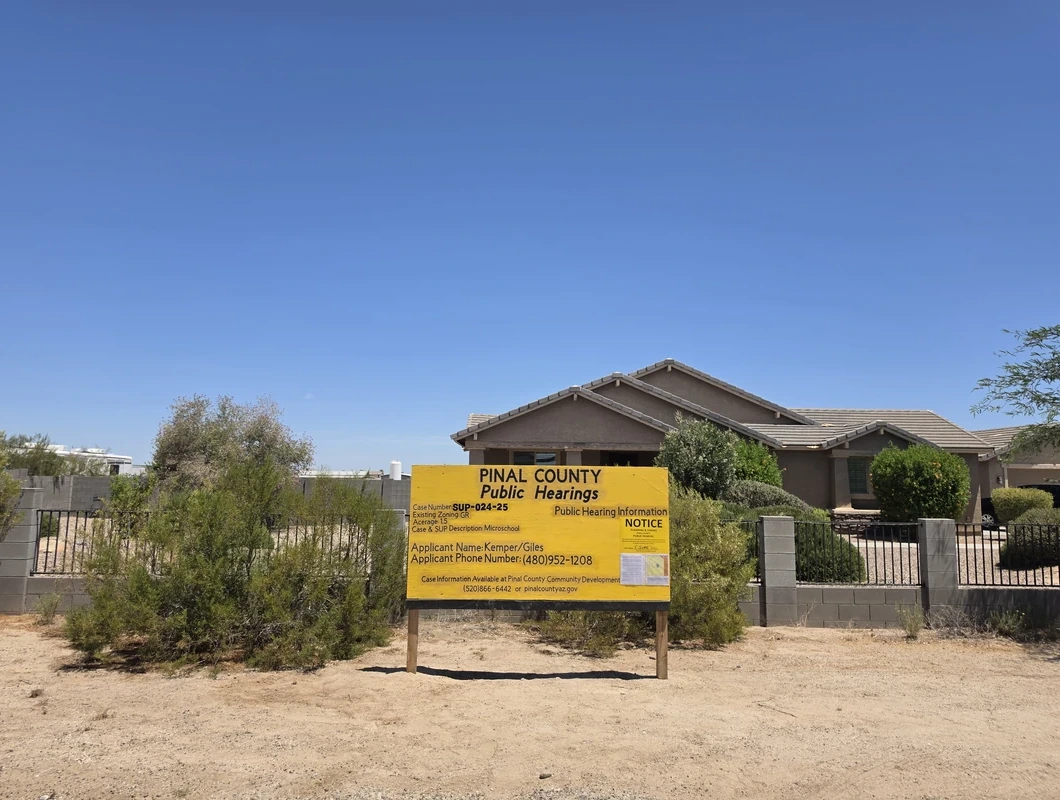
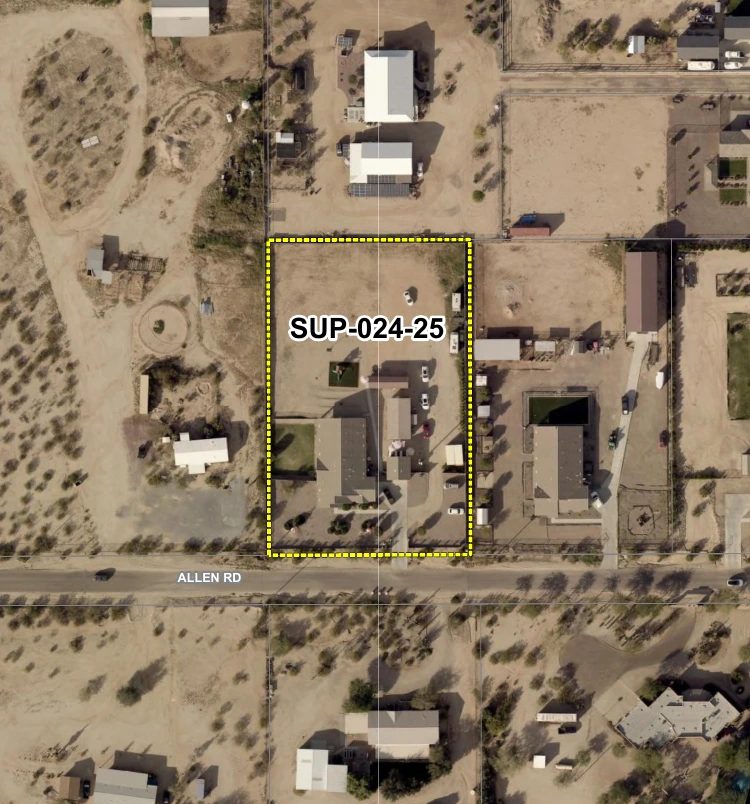
State 48 Arts and Academics is a nonprofit 501(c)(3) school founded by Karli Kemper and run by her family. It operates from the family’s home and detached buildings in the Chandler Heights Ranches area of unincorporated Pinal County, just outside the Town of San Tan Valley’s limits. The property carries a San Tan Valley mailing address, common for the area, but sits outside the town’s boundary — which is why the county, not the town, decides the permit. The land is zoned General Rural. The family started the program in 2024 for their own special needs children and for other students who struggled in traditional settings. Classes blend core academics with choir, dance, drama, and music, according to the school’s website, and six instructors, most of them family members, teach the age groups.
Kemper told commissioners the teachers are state-credentialed, and several came from public school special education departments. The largest class holds 10 students with one teacher, and college volunteers assist where needs are greater. Parents pay tuition directly. Roughly 20 students attend at any one time this year, although the permit request asked for a cap of 35. The application described students ages 9 to 18. During the hearing, Kemper referred to the school’s elementary grades and to high school students who come to earn a diploma. In addition, the school keeps a waitlist and has turned away entire families to protect its small class sizes.
“We are a family of educators with our community’s interests at heart,” Kemper said. “Our family lives in this community. Our students live in the community. We care deeply about the community, and we want to continue serving it while being respectful neighbors.”
Sixteen parents sent support letters. They described children with autism, ADHD, auditory processing challenges, and other needs who gained confidence, attendance, and academic ground at the school. Several also credited the arts-integrated lessons and the sense of belonging that small classes provide.
Rural Quiet Weighed Against a Place for the Kids
Commissioners returned repeatedly to one tension: neighbors chose the rural, large-lot subdivision for its quiet, while local families need a school like this one. Commissioner Gary Pranzo spoke from personal experience. He raised children with special needs about 40 years ago, he said, “when it was impossible to find some place where they could be armed with the tools to be successful,” and he told Kemper the specialized teaching is “quite challenging.” The applicant, he said, had “demonstrated the need for a school for special needs children.” Still, he concluded the area was not large enough for the activity, and he warned that a school next door can shrink a home’s pool of buyers. “I really want the kids to have a place to go,” he said, before describing the choice as one between the neighbors and the students.
Chairman Robert Klob shared the conflict. He comes from a family of teachers and has relatives with special needs, and he said the case “is really conflicting me a lot.” However, he compared the impact to a business with 15 or 35 employees, which the county would not allow on a similar lot. “As much as I like what they’re doing, and 100 percent agree that there’s a need for this — and I support that with every part of my being — just not here,” he said. Testimony from two neighbors who share property lines, he added, weighed heavily.
Other members echoed the location concern. Commissioner Daren Schnepf said he loved the choice and opportunity the school offers, but he saw it as suited to a commercial property; otherwise, he said, it would be “stipulated to high heaven.” Commissioner Wallace Keller said off-site staff and parent drop-offs pushed the operation well beyond what the county’s home-occupation model contemplates for General Rural zoning.
Kemper offered the family’s reasoning. The lots are spread out, instruction happens mostly indoors, and the family bought the property specifically for the space its multi-teacher model requires. Unlike single-guide programs capped around 15 children, she said, State 48 Microschool runs multiple classes with multiple teachers. Many students live nearby, and some ride bikes to class.
What Neighbors Said, and How the School Answered
Three residents spoke on July 16, all in opposition. Cory Corcoran, who lives beside the property, said the site began as a theater operation two years ago with roadside parking and noise, and he asked the commission to treat the current use as commercial. Drawing on his sister, a certified special education teacher who works with autistic children, he also questioned whether one teacher and an assistant per 10 students was enough for the kind of one-to-one or one-to-two care those students often need. Jennifer Corcoran, a neighbor of 10 years, said the noise disturbance from the school is tremendous, with children screaming outside for hours at a time — not a fifteen-minute recess, she said, but all day. She cannot open her windows on nice days, she added. She also warned that drop-off and pickup traffic on Allen Road creates a serious safety risk, saying it will only be a matter of time before there is a wreck or a student is hit. She additionally cited the disclosure she would owe future buyers. Art Hargrave, whose land adjoins the property, raised safety, noise, and the student count. He pointed to Eduprize Schools’ San Tan Valley Campus a short distance away, whose pickup lines already congest Roberts Road, where he said speed bumps were installed, and he feared Allen Road would follow. Even so, he credited the family for ending on-site performances. “I do commend them,” he said, “it’s just not the right place.”
Written comments followed the same pattern. Three opposition letters cited daily drop-off and pickup traffic, inadequate parking, roadway safety, loud amplified music and bright lighting from past outdoor events, continuing noise from children outside, questions about on-site oversight, the disclosure owed to future homebuyers, and the argument that a school belongs on commercially zoned land. One neutral letter from a longtime resident noted the outdoor programs stopped over the past year, thanked the family for the change, and said the remaining worries were traffic and occasional street parking. Vice Chair Karen Mooney, who lives in the neighboring San Tan Heights community, added her own account of the traffic from the nearby school. That school also sits on General Rural land, she said, and the roughly 2,000 cars dropping off students there prompted her community to request the Roberts Road speed bumps.
Kemper responded point by point. When neighbors objected to outdoor performances, the family moved them off-site, including to the Combs Performing Arts Center. Afterward, they relocated the basketball hoop to the backyard, centered play areas away from property lines, redesigned drop-off so vehicles stay on the property, and spent about $10,000 on a ficus privacy screen, with more planting planned. The property carries an open code compliance case tied to a complaint about a shed addition and about school activity, noise, and traffic. Enforcement is paused pending the permit’s outcome, and staff said site visits did not confirm any ongoing theater operations. Kemper said the family did not know a special use permit would be required when they started. They had looked up “vague references” to the code, she said, and taken “schools are allowed” at face value. Once county code compliance flagged the issue, the family entered the permit process and has cooperated with each step since.
Why the Code Left the State 48 Microschool in Limbo
Senior Planner Valentyn Panchenko explained why the case didn’t fit neatly. The General Rural chapter lists “school” among a broader group of public and quasi-public uses — including church, club, library, playground, athletic field, and hospital — but does not say public or private. County definitions do. A public school is government-run and, under state law, includes charter schools. A private school meets state education requirements but does not receive most of its funding from a government agency.
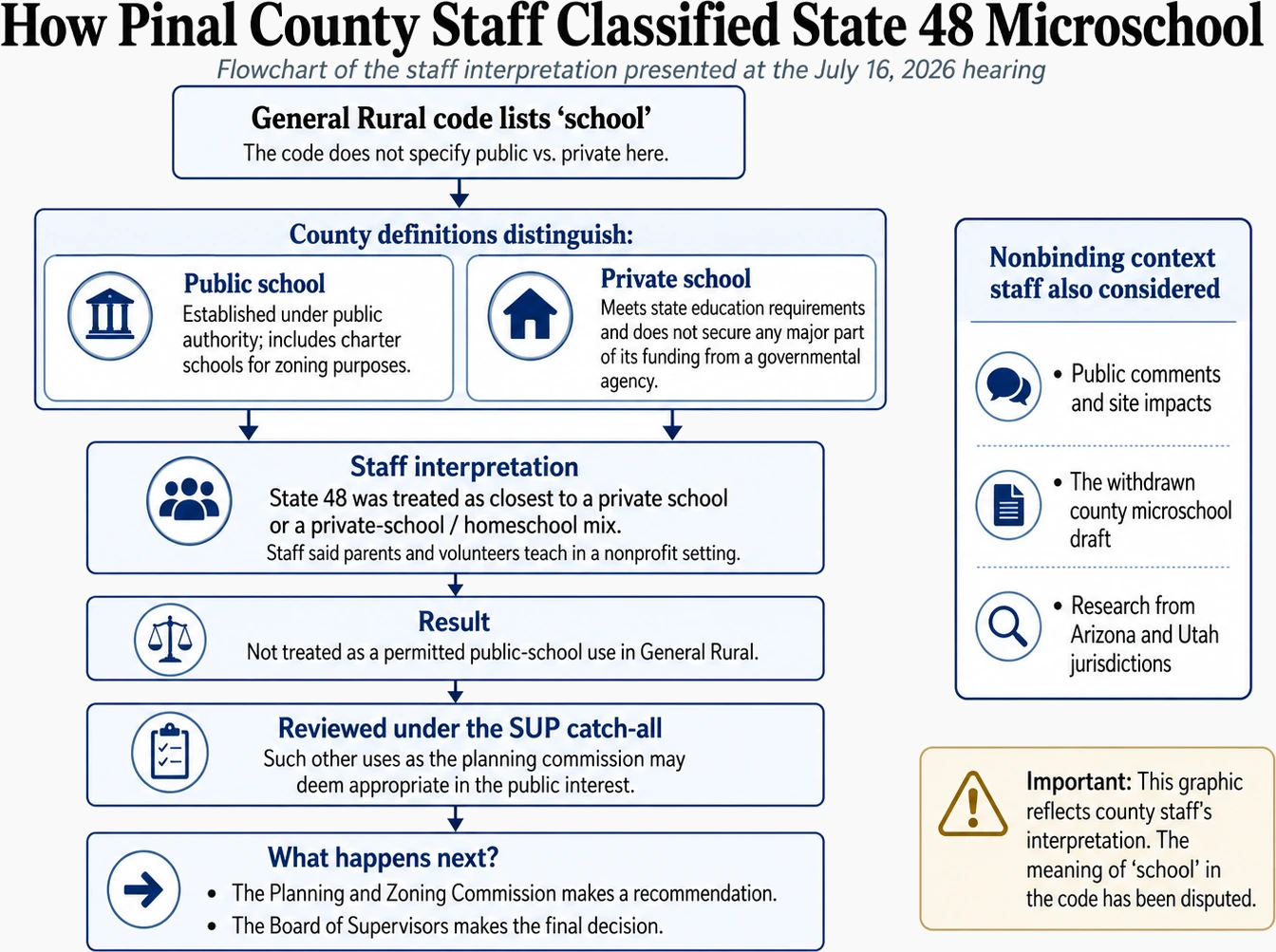
Under those definitions, staff read State 48 Microschool as closest to a private school — or a mix of private school and homeschool, since parents and volunteers teach in a nonprofit setting. Panchenko tied that reading to state law. “It’s only public school and charter school that are exempt from zoning requirements,” he said, so staff interpreted the unqualified “school” in the General Rural list as referring to public schools only. Pinal County has a separate chapter permitting public schools in every zoning district, he added, but “state statute says nothing about private schools or micro schools that they exempt.”
Neither state law nor county code defines “microschool” at all.
Therefore, staff routed the request through a catch-all in the county’s special use permit rules: “such other uses as the planning commission may deem appropriate in the public interest.” That standard asks the commission to weigh traffic, neighborhood fit, public health and welfare, community need, and public input, among other factors. Staff stressed that approval would authorize only this site and would not make microschools a by-right use in rural zones.
Because no adopted standard existed, staff applied the special use criteria and the county’s comprehensive plan. For added context, they drew on public comments and the microschool provisions from the county’s earlier 2025 Development Services Code update. They also researched how other Arizona communities and Utah counties — where microschool rules are more developed — regulate them. That research found home-based microschools typically capped near 15 students, kindergarten through eighth grade, on at least one acre, operating 7 a.m. to 6 p.m. Commercial microschools ran up to 49 students in commercial zones. Panchenko noted Pinal County has no student-count rule that would push a microschool into commercial-zoning territory, as other jurisdictions do.
When a Home Counts as a Commercial Use
Staff explained that, at this operation’s scale, they treated the microschool as a commercial use for building, fire, traffic, and parking purposes, even inside a residence, because it creates impacts a typical home does not. That framing came from staff’s policy research, not adopted county rules. Moreover, Planning Manager Harvey Krauss said the building’s occupancy classification would change under the school use, so building code and Americans with Disabilities Act (ADA) requirements apply regardless of the commission’s recommendation.
At the requested cap of 35 students spanning high school ages and multiple structures, staff judged the operation commercial rather than home-based. Consequently, the recommended conditions required a site plan review, a step typical of new commercial projects, because a home-based school would ordinarily skip it. The 19 draft conditions also capped enrollment at 35, limited activity to 7 a.m. through 6 p.m. weekdays with no evening or weekend events, kept all drop-off and parking on the property, banned amplified sound, required permits and fire inspections before classroom use, and allowed revocation for violations.
What Arizona Law Locks In, and What Pinal County Decides
An Arizona statute bars counties from requiring more than one acre for a nongovernmental primary or secondary school. The 1.49-acre site clears that threshold, though the special use permit review and stipulations still apply.
That one-acre law also figured in a 2023 letter from the Institute for Justice, included in the case packet on behalf of a different microschool founder. The firm’s filing argued that the code’s unqualified “school” includes private schools, not just public ones, and that a school’s funding source has no bearing on its land-use impacts. Staff treated the letter as advocacy from a separate matter. In staff’s view, within those state limits the county still decides where private schools and microschools may operate and what conditions attach.
Why Microschools Are Growing in Arizona
Microschools have grown rapidly in Arizona since the pandemic, driven in part by the state’s Empowerment Scholarship Account program that lets parents customize their children’s education. The ESA program itself faces active debate statewide, with Proposition 212 on the November 2026 ballot proposing new eligibility limits and state oversight. A recent conversation between Brad Miller of the Pinal County Attorney’s Office and Paul Carver, president of the Deer Valley Unified School Board and a Republican candidate for Arizona House District 2, discusses the ESA program and the current debate over its future.
The Earlier Draft That Shadowed the Hearing
The earlier 2025 draft came up throughout the hearing. Schnepf started with what would happen to an approved permit if microschool rules ever return to the books. Krauss answered that it would “probably be grandfathered in,” since new codes rarely apply retroactively unless public health or safety is at stake. Panchenko added a wrinkle: at this size, the operation would only qualify as a commercial microschool under the draft. Klob then flagged the reverse problem: the commercial category excluded rural zones entirely, leaving an operation this size with no home in rural zoning — “something to think about,” he said, as the rules are rewritten.
Mooney pressed the gap between the draft and this case. “I actually have a copy of the code that we drafted,” she said. “There is a section called home-based microschools for rural zoning, and there is a whole list of items in there that I don’t personally see addressed in this particular case.” That draft, which was not adopted, would have split microschools into two categories with different zoning rules: home-based and commercially-based. Regardless of category, though, it would have required every microschool — even a small home-based one — to meet the building, fire, and residential codes for the largest number of students and staff on site at any one time. Both would follow the county’s private school standards, covering setbacks, buffers, paving, and lighting. Both also preserved county authority over parking, traffic, hours, and location. The home-based track added a special use permit with reapplication every five years, a rule keeping home-based microschools 1,200 feet from any other microschool, and a cap on school use at 30 percent of the property’s structures. A summary of the earlier provisions, with links to the county’s draft document, is on the site of Pinal Code Watchers, a resident group monitoring the county’s code update.
Klob believed the site would already run into the draft’s 1,200-foot separation rule because of another school nearby. Panchenko cautioned that staff can regulate only adopted code, not drafts.
Head Counts, Age Limits, and School Hours
Mooney recalled that the earlier draft set the same home-based cap of 15 students, kindergarten through eighth grade, and she suggested the commission could “meet in the middle” between 15 and the requested 35. Klob said his research showed anything above roughly 15 to 20 students flips a microschool into commercial territory in most places. Meanwhile, Pranzo floated a cap of about 25, warning that limiting students also limits the cash flow that sustains the school’s quality. Mooney also raised enforcement: “Nobody’s going in and counting the students every day,” she said, since the county acts on complaints. Kemper answered that the waitlist already serves as the school’s own cap.
Kemper said the kindergarten-through-eighth-grade limit was her main objection to the draft, because high school students, many with special needs, come to State 48 Microschool to earn a diploma. Mooney proposed set outdoor windows so neighbors could plan around them. Pranzo pushed back, saying the school’s wide age range would require different times for younger and older students.
The hours question drew similar back-and-forth. The stipulation allowed 7 a.m. to 6 p.m. weekdays, while the school’s own handout listed Monday through Thursday, 9 a.m. to 3 p.m., September through May. Schnepf floated locking in the tighter schedule, but Klob flagged early drop-offs, late pickups, and before- or after-school care. Kemper ultimately asked to keep the wider window as a cushion and to preserve Fridays in case an enrollment cap forced her to split students across days. Panchenko noted that 7 to 6 is the generic window used in the earlier draft and staff’s research framework, and that trimming days or months was an option open to the commission to limit impact.
One Property, Two Functions
Klob asked what to make of two uses on one property — the school and a separate community theater. Todd Williams, the county’s deputy director of community development, saw them as one: the website markets personalized arts education, he said, so “I think they’re one in the same.”
Two Motions Settled the Recommendation
Before any motion, Mooney floated a one-year review so staff could check in with neighbors. Krauss said a time limit could likely be written into the permit, though he questioned how the county would judge it; Deputy County Attorney Daron Garey said he had never seen an approved permit called back, since under the code a documented violation is what triggers review. Pranzo objected regardless, saying a mandatory review where the school could lose its permit “puts them in an impossible situation” for planning and investing, with “that cloud hanging over your head.” Mooney countered that the program has operated for two years while the permit case was pending.
A motion to approve the permit with 19 stipulations failed. A subsequent motion to recommend denial passed 6-2.
The San Tan Valley Microschool’s Next Stop: the Board of Supervisors
Ahead of the supervisors’ hearing on the San Tan Valley microschool, residents can follow the microschool section of the code rewrite when it returns through the county’s Development Services Code Update page or through the citizen-run Pinal Code Watchers, whose “What’s in the Code” page includes a section tracking the schools provisions in the code update, alongside their Facebook group.