Key points
- SRP says data centers are not driving up other customers’ bills in its territory.
- Large customers pay all transmission costs before receiving power. They also sign 15-year generation contracts backed by collateral averaging in the hundreds of millions of dollars.
- In 2025, 24 data centers asked SRP for 7.2 gigawatts of new power. Three remain after the first deposit deadline, seeking about 1 gigawatt.
- SRP first priced the needed transmission upgrades at $12.8 billion. The three remaining projects now share an estimated $1.5 billion.
- Their final deposits are due Sept. 15.
- Project Midway, a Casa Grande-area proposal that plans to generate its own power, is on hold after ED3 objections.
- The county has no data center standards yet. Planning staff are working on a potential ordinance.
Data centers draw about 7 percent of Salt River Project’s peak power demand. So Supervisor Rich Vitiello asked: if that tripled over the next three to five years, “that would really put a major strain on you, correct?” “No,” answered Scott Scharli, SRP’s director of strategic energy management. The rest of his Aug. 12 presentation to the Pinal County Board of Supervisors explained what stood behind that single word. It laid out who pays data center power costs in SRP territory and described a new vetting process whose inaugural run has already cut 24 applicants to three.
County Manager Leo Lew had opened the session with a separate question about bills. Communities worry that data centers raise everyone else’s utility rates, he said, calling it “a major concern of our communities.” He asked, “how is that calculated, and how are they ensuring that that’s a true statement?”
The presentation was part of the county’s continuing-education series on data centers, and the board took no votes. Earlier in the meeting, Dr. David Ebert, the University of Arizona’s chief AI and data science officer, also addressed the board.
The 24 applicants together asked SRP for 7.2 gigawatts of new power. By comparison, the utility’s entire system peaked at roughly 9 gigawatts this summer — a level that took more than 100 years to reach. In response, SRP calculated what the needed grid upgrades would cost and required deposits based on that price. Most applicants dropped out when the first deposit came due in February. The three data centers that stayed must post a final deposit by Sept. 15 to keep their projects moving.
Who covers data center power costs, according to SRP
Scharli said he often hears one statement — that “data centers are driving up costs for all the other customers” — and he rejected it for his own utility. “At least in SRP territory, that is one hundred percent not true,” he said. The claim is SRP’s own, and the presentation laid out the payment structure behind it.
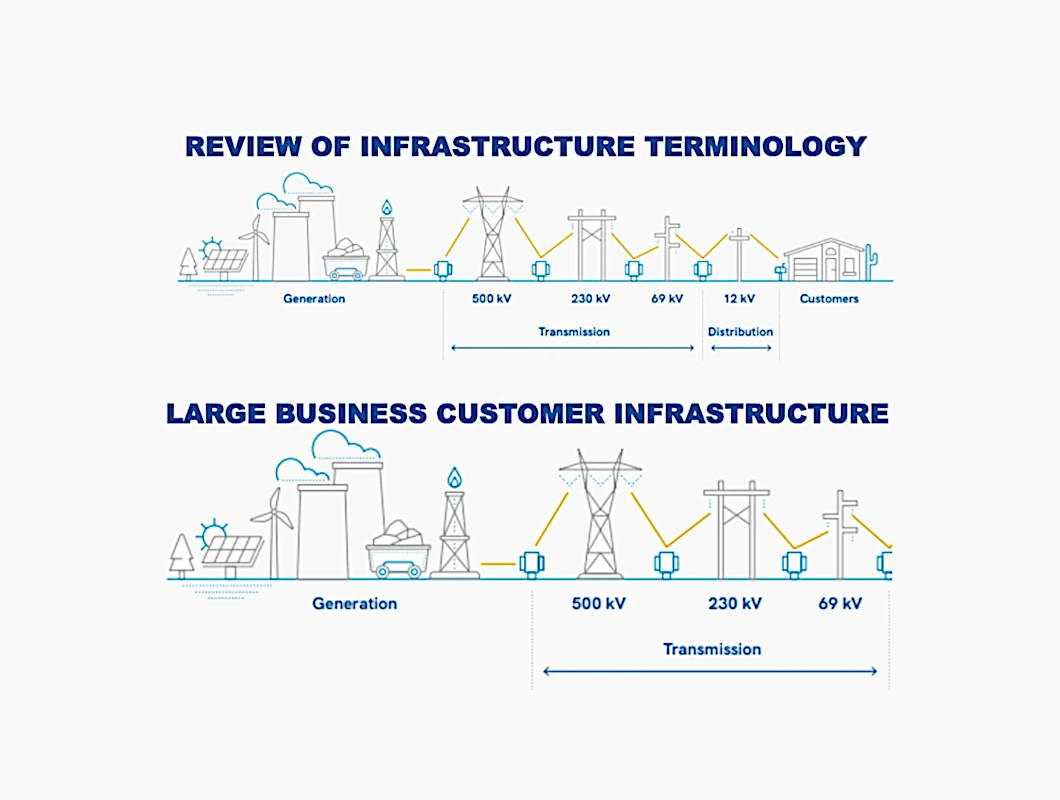
He split the costs into two buckets. The first covers the transmission infrastructure that delivers power to a large customer’s site. For roughly 40 years, he said, SRP has required every large customer to pay that full cost up front.
— Scott Scharli, SRP director of strategic energy management
Supervisor Mike Goodman asked him to confirm that “it’s not the current customers that are here paying for the infrastructure.” Scharli replied, “Correct, supervisor.” Additionally, applicants pay a $40,000 application fee and a $250,000 study fee that cover SRP staff and engineering time, so “no other ratepayer’s picking up that cost either,” he said. Both are nonrefundable.
The second bucket is generation, which large customers pay for through rates under SRP’s E-67 large-load price plan. Scharli called generation the side “where maybe a little bit more risk was present.” In response, SRP’s board of directors adopted new terms in a public pricing process: a 15-year contract that he said keeps those large customers from walking away from that risk, plus a monthly minimum charge of at least 80 percent of their contracted power, even if they use less.
Furthermore, each large customer posts collateral averaging in the hundreds of millions of dollars, Scharli said. It usually takes the form of a strong surety bond or an irrevocable letter of credit, not a parent guarantee that a company could sign and then escape by declaring bankruptcy. The companies must also project their load monthly for all 15 years so SRP can build generation to match.
From 24 applicants to 3: the cluster study filter
About a year and a half ago, Scharli said, “everything broke.” By his account, SRP faced unprecedented requests, demands for capacity sooner than it could be built, and significant strain on its staff. “Who’s real? Who’s not real? There’s no way that we can serve this,” he recalled thinking. As a not-for-profit utility, SRP “slammed on those brakes” and rebuilt its intake process.
The new intake process — SRP calls it the Large Customer Integration Process — launched in April 2025 and studies applicants together instead of one at a time. That group review is known as a cluster study. “When you bring in a new large load like this, you break the system,” Scharli said. Consequently, the study identifies what breaks, prices the fixes and splits shared costs among the projects responsible. The upfront power costs for data centers are therefore known before construction ever begins.
The first cluster drew 24 participants, every one a data center. In October 2025, SRP delivered the results: 83 required network upgrades across the SRP, APS and WAPA transmission systems, totaling $12.8 billion. To continue, each project had to post a deposit covering 30 percent of its share of those costs, as an irrevocable letter of credit, by Feb. 2. “These were gigantic dollar amounts, and they can’t walk away from it,” Scharli said.
Three projects paid — two in the East Valley and one in the West Valley — and the combined request fell from 7.2 gigawatts to about 1 gigawatt. As a result, a restudy delivered July 15 cut the needed upgrades from 83 to eight and the transmission bill from $12.8 billion to $1.5 billion, split among the three in proportion to their loads. Deposits totaling 60 percent of the costs are due Sept. 15. After that, Scharli said, SRP will consider the remaining projects committed and move to design and construction contracts. Neither Scharli nor his slides identified the three companies.
Even committed projects can wait years for full service. Building transmission usually takes four to five years after a study ends, Scharli said, and generation “could be ten years.” He said SRP spells out those timelines in its study results, before the companies commit to paying for the transmission. Meanwhile, a company requesting 100 megawatts might get transmission for the full amount but only 15 megawatts of generation at first, ramping up over time. Asked whether power could take five to 10 years to arrive, he answered, “It could be.”
‘Braggawatts’: why SRP says announced megawatts run high
Scharli has a name for announced power figures that he says rarely match actual use: braggawatts.
That practice has a commercial logic, he said, because data centers compete for their own clients: “They are all out there touting X, Y, and Z because they’re trying to land a customer.” Moreover, SRP has served data centers for more than 20 years and has “years of data to prove” that the power-use schedules companies submit — how much they will actually draw, and when — “are just not accurate.”
Large customers: 12 percent of the peak today, 39 percent forecast by 2035
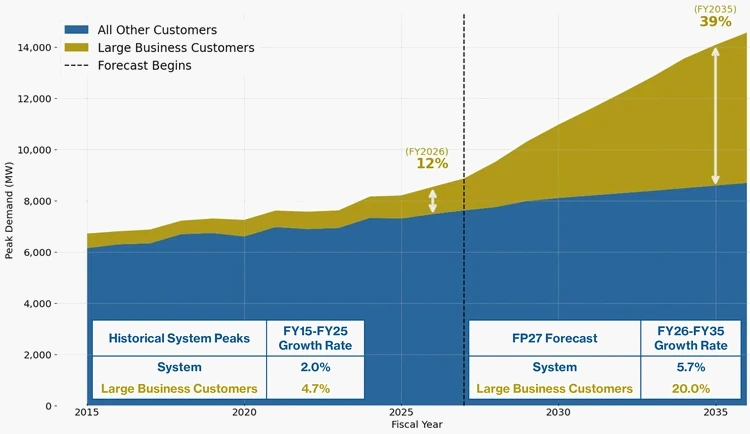
By SRP’s count, the approximately 20 data centers in its territory drew 7 percent of its roughly 9,000-megawatt summer peak. All large business customers together — those at 20 megawatts and above — made up about 12 percent, including the data centers’ 7. “The vast majority of the power demand that we are providing our customers is residential, small business, regular-sized business,” Scharli said. “It is not large customers.”
However, SRP’s forecast shows the balance shifting. Large business customers are projected to reach about 39 percent of peak demand by fiscal 2035, with that segment growing 20 percent a year against 4.7 percent over the past decade. The overall system is forecast to grow 5.7 percent a year. Scharli attached a caveat to his own chart. “A prediction is just that. It doesn’t actually mean that it’s gonna come to fruition,” he said, though “everything that we know today, that is our prediction rate that we’re forecasting.”
Scharli also listed five reasons the projects keep coming:
- Almost no natural disasters, since reliability is a data center’s prime responsibility.
- A chip industry anchored by TSMC and Intel.
- Very reliable power across APS, SRP and TEP.
- Abundant low-cost land.
- A robust fiber network built over many years — the data centers he talks to, he said, commonly run four redundant fiber feeds.
Chairman Jeff McClure added a caution about the word “grid”: it is really many separate grids, he said — SRP’s, APS’s, ED3’s, WAPA’s — “not one big pot.” Scharli agreed, saying utilities across the Western power grid buy and sell power among themselves, and noted, “I’m just talking about SRP sphere right now.”
Behind the meter, the electric districts and Project Midway
That distinction came up again in the meeting’s final exchanges. Vitiello raised “behind the meter” power — electricity a project generates on site instead of buying from a utility — and said generators that would have to run around the clock concern him. In response, Scharli argued that data centers do not want that arrangement permanently.
Grid connection means reliability and redundancy for their clients, he explained. Still, “speed to power is the absolute most important thing to them,” so on-site generation can serve as a temporary bridge while utility service ramps up. He added that no data center has told him it wants to rely entirely on self-supply.
Vitiello then pointed to the electric districts, such as ED3, where some of these projects want to build. Those districts generate no power of their own, he said, and rely on suppliers like SRP and APS — which, he argued, makes getting power for such projects even more difficult. Scharli called that a fair assessment, saying “your local utility is needing to create some other contract with a different supplier.”
Pinal County already has such a case. Project Midway, a proposed 215.8-acre data center campus southwest of Casa Grande, plans to self-generate roughly 500 megawatts, as the Pinal Post previously covered. On July 16, the county’s Planning and Zoning Commission voted unanimously to postpone its recommendation on that rezoning. The delay followed ED3’s statement that it could not reach a conclusion on the legality of the self-supply plan. ED3 General Manager Brian Yerges said the proposal had changed from an earlier version that involved his utility: “They never talked to us. Now it’s a different project.” He also asked why a $2.8 billion project could not contribute “maybe $100,000” toward ED3 planning studies. At that July hearing, Commission Chairman Robert Klob responded, “there’s a lot of red flags here,” referring to that communication. The project’s own energy consultant described self-supply as a way to get power sooner that then “transitions into a utility-served customer over the longer period of time” — a path resembling the step-up Scharli described, though he was speaking about the industry generally, not about Midway.
At the SRP presentation to the Board of Supervisors, Klob asked whether SRP requires land entitlements — zoning approvals and site control — before its power process starts. No, Scharli said, because state statute obligates SRP to serve customers in its territory. SRP does due diligence and will warn an applicant, “We notice you don’t have site control,” but the process can begin anyway. Therefore, a project can pursue rezoning and power on separate tracks. That is the “disconnect” Klob described: the county asks applicants for power-load calculations they may not have until they reach the utility’s process. McClure added that without entitlements, “they’re not gonna be able to get their financing and their backers.”
Pinal County drafts its own data center rules
Goodman called the presentation “great information” the county had long requested, and Supervisor Stephen Miller repeated a point he said he has made from the beginning: “If they can’t get the power, they won’t build it. If they can’t get the water, they won’t build it.”
SRP’s process decides who pays data center power costs in its territory. Deciding where data centers can build in unincorporated Pinal County is the county’s job. However, the county has no standards for them yet. Planning staff said at the July hearing they are working on a potential ordinance or standards.