Key points
- The Pinal County Planning and Zoning Commission voted Oct. 15 to recommend the Arizona Independent Technology Campus land-use change.
- The plan would shift 956 acres from residential to Employment. Industrial zoning would need a separate approval.
- The applicant hopes to seek I-3 industrial zoning for all 1,517 acres next year.
- Older development plans covering the area allowed about 7,600 home lots.
- The Zinke family says its dairy, now home to 5,000 cows, will stay, with industry planned around it.
- Data centers are part of the campus concept. Any data center would still need a rezoning and county development review.
- The applicant cites a groundwater right allowing about 1.44 billion gallons a year.
- The City of Maricopa and the Ak-Chin Indian Community oppose the change.
- Supervisors are scheduled to hear the request Nov. 18.
The Pinal County Planning and Zoning Commission voted Oct. 15 to recommend a land-use change for 956 acres within the proposed 1,517-acre Arizona Independent Technology Campus. The amendment would change those 956 acres from Moderate Low Density Residential, a designation for 1 to 3.5 homes per acre, to Employment under the county’s Comprehensive Plan. The campus’s other 561 acres already carry the Employment designation. The site sits southeast of Porter and Barnes roads, about two miles east of Highway 347 in unincorporated Pinal County, south of the City of Maricopa. The Board of Supervisors, which makes the final decision, is scheduled to hear the request Nov. 18.
Zinke Investments, LLC owns the land, where the Zinke family operates a 5,000-cow dairy. The family wants industrial development, possibly including data centers, built around the dairy, which it plans to keep. The applicant also intends to seek a separate rezoning of the entire 1,517-acre campus from residential and business districts to the I-3 Industrial Zoning District.
The amendment covers land now designated for homes. However, the county staff report says it would not authorize development or change the property’s zoning. Those decisions, including any data center, would require separate approvals, and the county is still writing data center rules.
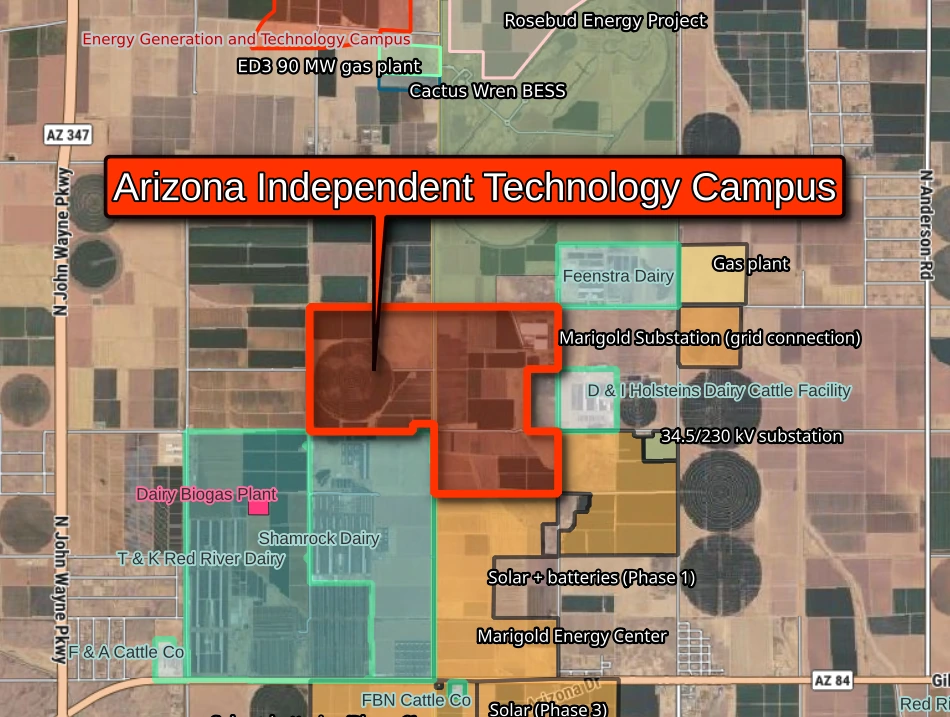
The site lies in farmland dominated by dairies, south of the Ak-Chin Indian Community and west of Casa Grande. Nearby, data centers, power plants, mines and other industrial projects have been proposed or approved, though most are not yet built. Explore the interactive map below to see the campus and its surroundings.
The Arizona Independent Technology Campus site, surrounding dairy farms and the proposed industrial corridor. Zoom and pan to explore, and click any colored area for details. Project statuses are current as of publication. Open the map full-screen
Plan Would Shift Land Once Zoned for Thousands of Homes
The land has been farmed since the 1960s, “and probably before,” said attorney Carolyn Oberholtzer, who represented Zinke Investments. Under two older development plans for the Stanfield Ranch master-planned community, dating from before 2013, the area was planned for housing at up to 3.5 homes per acre overall, along with some commercial uses. Much of the property still carries CR-3 residential zoning. But Oberholtzer said the Zinke family bought the land in 2013 to build a dairy, not homes.
Together, those plans allowed about 7,600 lots, Oberholtzer said. However, she added that they also cover land outside the Zinke property, including part of SRP’s planned Marigold Energy Center site next door. Oberholtzer said she believed plats had once existed but had long since expired, although hundreds of thousands of dollars had been paid to the county in review and transportation fees.
Chairman Robert Klob said that lot count matters to nearby residents. He hears regularly from people in the Hidden Valley area, where he said a recent figure put already-platted lots at nearly 80,000. Referring to the proposed change as “we’re removing 7,600 lots,” Klob said, “that’s a big impact.”
Oberholtzer framed the change as a response to what already surrounds the site. She noted the whole area was once expected to become housing developments. “But when you have all these dairies here, is residential really going to come to where all the dairies are? Are we going to push them out again, or can we embrace this infrastructure and industry that’s coming in with a different land use?” she said.
The applicant’s written narrative adds that homes could bring noise, odor and dust conflicts with the dairy, and that no water or sewer service exists to serve them.
Commissioner Tom Scott endorsed that approach. “They want to stay as a dairy farm and continue with that,” he said. “Their outlook is to bring in industry that’s compatible with that, and not necessarily homes. I think it’s a pretty good idea.”
Data Centers Discussed, but Plans Remain Conceptual
Senior Planner Tanya Bedward stressed that the land-use plan is conceptual because precise plans for the area have not yet been defined. “I reiterate that it is conceptual at this stage,” she said. She struck the same note at work sessions in August and September, where neither the commission nor the Board of Supervisors took a vote.
The campus concept shows manufacturing, warehousing and distribution, an industrial park, possible data centers supported by energy facilities, and an industrial buffer.
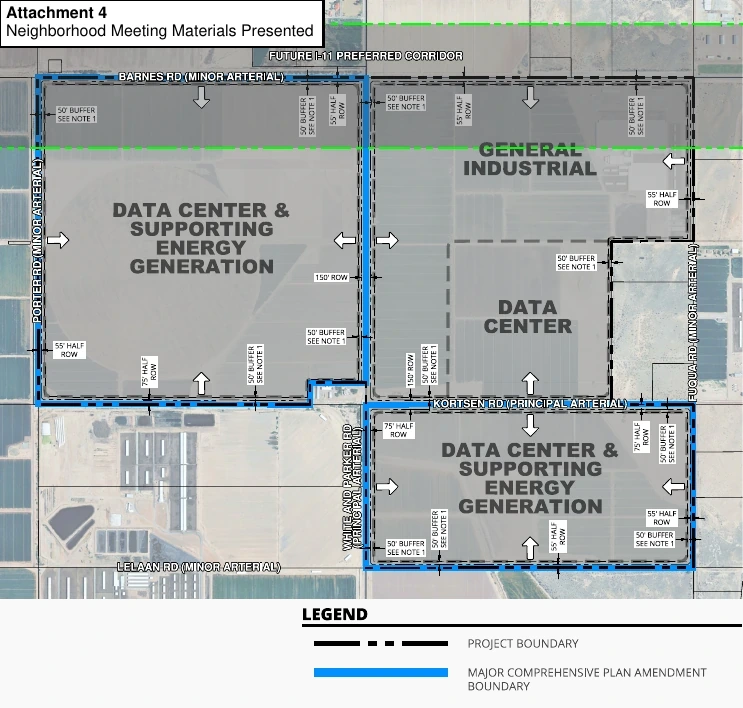
Although the application lists data centers among the intended uses, Oberholtzer said the applicant is not yet seeking approval for a data center. “We are not applying for data centers right now,” she said. “We know the county is working on an ordinance to establish rules and regulations for data centers. We would come in after that with any application.”
Scott asked whether a specific data center operator is in mind. In response, Oberholtzer said many companies have inquired whether the family would be willing to sell.
The applicant estimates full buildout could support 1,350 to 2,800 permanent jobs and 3,000 to 6,500 peak construction jobs. In the applicant’s breakdown, most permanent jobs would come from warehousing and manufacturing. For data centers, the applicant assumed a 150- to 300-megawatt campus for planning purposes and estimated 150 to 400 permanent jobs. The applicant calls these planning-level estimates, and the staff report notes they are not guaranteed.
‘Basically Becoming an Industrial Corridor’
To the north lies the 2,809-acre Nissan Technical Center North America test track. Less than half a mile southwest, a 17-acre renewable natural gas plant processes manure from area dairies. To the south, SRP has acquired land for its Marigold Energy Center, a planned 5,267-acre mixed generation and storage project. According to the applicant’s presentation, Marigold’s plans include a 230-kilovolt/500-kilovolt substation, about four miles of new 230 kV transmission lines, 600 megawatts of solar generation, 400 megawatts of battery energy storage and up to 675 megawatts of gas-fired generation.
Oberholtzer said White and Parker Road, running from the Maricopa-Stanfield Highway toward Interstate 8, “is basically becoming an industrial corridor.” She described the Zinke site as “kind of the missing link in the middle.” She also called Marigold “a phantom land use case” — land still zoned in residential planned area developments but headed for energy production. Meanwhile, the planned Interstate 11 preferred corridor follows the Barnes Road alignment along the project’s northern edge.
A 5,000-Cow Indoor Dairy That Says It Will Stay
The Zinke family has run dairies in Arizona since 1963. It bought this land in 2013, Oberholtzer said, and completed the operation in 2016, so the dairy has run for about ten years. “There are dairies all over the place” in the area, Oberholtzer said. Neighboring operations include Shamrock Farms, T&K Red River Dairy and Red River Cattle to the south, and D&I Dairy to the east.
The Zinkes’ 5,000 cows live in a primarily indoor facility that the applicant’s narrative calls “the only one of its kind in the southwest.” It holds more than 55,000 cubic yards of concrete, according to the narrative, and stays at or below 79 degrees, cooled by 550 fans. Those fans represent a $900,000 investment and cost about $50,000 a month in power, Oberholtzer said. She described the stainless-steel rotary milking carousel as “probably biggest in the United States, if not beyond” — 100 cows ride at a time through an eight-and-a-half-minute milking cycle. The operation employs 67 people and grows all of its own feed, including alfalfa, oats, sorghum and corn.
Manure travels 3.5 miles to an off-site methane digester that serves dairies across the area. There, it produces renewable natural gas. The leftover material is then split into solids, which become compost or stall bedding, and liquids. The Zinkes contract to pipe those liquids back to their fields as fertilizer, so they bring in no outside fertilizer, Oberholtzer said.
Next, the applicant’s presentation says, the family plans to replace roughly $1 million in milking equipment to improve productivity and better track each cow’s milk output. It also plans to build its own methane digester on site, so its byproducts could feed industry built around the dairy. Oberholtzer said the family’s contract with the off-site digester runs to 2030, and it hopes to have its own digester operating around the time that contract ends. The University of Arizona has also provided grant funding for irrigation improvements. Oberholtzer said the family’s targeted pivot irrigation uses nearly 60 percent less water compared with other agricultural production. The university remains involved in the case, she said, studying which industries can operate alongside agriculture.
The family home sits on an out-parcel inside the project. “The dairy’s staying, and so are they,” Oberholtzer said. “The idea is that everything they build around this is going to be around them. … This is their fourth dairy. They want it to be their final.”
Applicant Cites Type 2 Right for 1.44 Billion Gallons a Year
The applicant says the owners hold a Type 2 groundwater right of approximately 4,417 acre-feet, or 1.44 billion gallons, per year. It also cites five on-site wells and separate grandfathered irrigation rights, without specifying their volume. Oberholtzer acknowledged that dairy farms use a lot of water. “Even in the most efficient operation as we have here, they’re very large water users,” she said.
Under Arizona law, a Type 2 non-irrigation grandfathered right belongs to its owner rather than the land, so it can generally be sold separately. The water must still be pumped within the Active Management Area where the right was issued, from wells listed on its certificate. Adding a new well requires approval from the Arizona Department of Water Resources. Only a limited number of these rights exist. By contrast, an irrigation grandfathered right stays with the land and cannot be sold separately. Details are available from the Arizona Department of Water Resources.
Oberholtzer argued the conversion would reduce groundwater pumping. “We have a lot of water rights, but we have a lot less use if it’s industrial,” she said. “So it is a water positive story.”
Residents Ask the County to Pause
The county received one letter of support, submitted through the applicants by David Feenstra. He owns the land where Feenstra Dairy operates, across Barnes Road from the site’s northeast corner, and called the change “a logical land use decision.” His letter cited the surrounding farms and employment uses, nearby transportation corridors including the planned I-11, and potential jobs and investment. Bedward said the county also received ten letters of opposition that named this case specifically, along with eight general opposition letters that addressed data centers, energy facilities and similar projects.
Common themes ran through the letters, Bedward said. Writers asked the county to:
- Halt approvals until it adopts rules and safeguards for these projects.
- Study the cumulative impact of the many projects reshaping the county.
- Weigh effects on groundwater, wildlife and endangered species.
- Preserve open space and the area’s rural character.
- Balance economic growth against residents’ quality of life.
- Gather more research before approving more projects.
The staff report adds that many letters focused on water, warning that data centers and other large industrial users could strain the county’s already constrained supply. Earlier, four people attended the applicant’s July 15 neighborhood meeting in Stanfield, and none took a position on the project, according to the applicant’s report on the meeting.
Maricopa Says Campus Clashes With Its Growth Plan
The City of Maricopa opposed the re-designation in a Sept. 10 letter that described the project as “multiple data centers, energy generation facilities, and general industrial uses.” Maricopa’s general plan marks the area for a master-planned community with homes, shops, schools and parks. A data center campus offers none of those, the city argued, and would split up planned neighborhoods. It would also permanently take land reserved for balanced growth, the letter said.
In addition, the city warned that highly automated data centers need few workers once built. Ultimately, it called a heavy industrial data center there “a clear contradiction” of its long-range growth plan.
The city also asked that any approval require the applicant to first seek a Maricopa general plan amendment, build to city standards and sign a pre-annexation agreement if it needs city fire or EMS service. The applicant lists Rural Metro Fire as the site’s fire provider. The commission’s recommendation carried no stipulations.
Oberholtzer responded that the applicant met with city officials the week before the hearing. The city had not been aware of projects approved or underway in the county, she said, and its ten-year general plan update — going to voters within weeks — simply carried forward designations matching the existing residential zoning. Oberholtzer said that when city officials asked the applicant to amend Maricopa’s general plan too, they put the fee at $75,000, so the two sides agreed to keep talking. She characterized the city’s position as “very soft opposition.” Moreover, she said there is no path to annexation: the site sits about 5.3 miles from Maricopa and about 4 miles from Casa Grande, with many landowners and the Ak-Chin community in between.
Ak-Chin Chairman Calls for Direct Consultation
Gabriel Lopez, chairman of the Ak-Chin Indian Community, gave the hearing’s only public comment. He described the community as a sovereign tribal government and “first and foremost a farming community,” whose land and water must sustain many generations. The amendment would open farmland a few miles south of the reservation to heavy industry, he said, with data centers a large use alongside power plants, manufacturing and warehousing.
“We know very little about this project — neither does the public,” Lopez said. The developer has not said what will actually be built, has shared nothing about how much water the campus would use, and has not reached out to or consulted the tribal council, he told commissioners. Lopez said the Ak-Chin tribal council sent the commission a letter in September asking developers to treat the tribe as a sovereign neighbor with a direct stake, not as one more member of the public — meaning early, genuine dialogue with the tribal council before county-level decisions are made.
Lopez then listed four concerns. First, water and agriculture: Ak-Chin’s water rights rank among the area’s oldest, the campus could draw heavily on those resources, and the effects on tribal farming operations are unknown. Second, cultural sites: he called a cultural resource survey vital, because nearby projects recently turned up ancestral remains, funerary objects and artifacts where no one anticipated them. Third, cumulative impacts: he pointed to the developer’s own map of 11 surrounding projects, saying that rapid development “threatens our environment and our way of life.” Finally, he urged long-term site restoration plans, with developers setting aside dedicated funds so the land can be safely restored.
Without further information, Lopez said, the community opposes the Arizona Independent Technology Campus amendment at this time. He also said that for tribal governments, true consultation means “sitting down and meeting with the decision-makers of those tribes,” not meeting with a representative.
In response, Oberholtzer explained that the county sends every major plan amendment to a list of outside agencies for a 60-day comment period. For this case, that period ran from June 11 to Aug. 10, according to the staff report. A county staff member confirmed at the hearing that Ak-Chin was on the list. Oberholtzer said the applicant received no comments from the community during that time, and the hearing was “the first that we’ve heard of that issue.” She added that the site is not adjacent to, or within a mile of, the reservation, and said the applicant is willing to discuss the concerns going forward. The applicant’s written narrative places Ak-Chin about 2.5 miles north and calls it the closest community to the site.
Advisory Committee Backed the Arizona Independent Technology Campus 12–1
Before the hearing, the Citizens Advisory Committee met on Sept. 11 and voted 12–1 to recommend approval. Supporters there cited the site’s location near dairies, the Nissan facility, transportation corridors and other industry. They also said industrial uses could help the dairy continue. Meanwhile, the applicant pointed to possible reductions in agricultural water use, as well as power from a future on-site methane digester.
Questions also arose about how many permanent jobs the project would bring. Members also raised concerns about groundwater, electrical capacity, transmission lines and data center cooling. They questioned moving ahead before the county sets data center standards for water, noise and energy. In addition, public commenters asked for a closer look at the combined impact of nearby projects.
Supervisors Hearing Nov. 18; Applicant Hopes to Seek Rezoning in 2027
The commission’s recommendation of approval passed with no opposition. The case now goes to the Board of Supervisors, which has scheduled it for Nov. 18. The site lies in Supervisor Stephen Miller’s District 3.
If the amendment is approved, the applicant intends to seek I-3 industrial zoning with a planned area development overlay for all 1,517 acres. Oberholtzer said the applicant plans to return with that request after the county finishes its data center ordinance, “hopefully sometime next year.”
Case number: PZ-PA-015-26 (Major Comprehensive Plan Amendment).