Key points
- The Horseshoe Energy Project goes back before the Pinal County Planning and Zoning Commission tomorrow, Oct. 15.
- Epic Star Energy wants to build a natural gas plant and a battery storage system on 159 acres near the Thunderbird Farms and Hidden Valley communities.
- Each facility would be up to 500 megawatts.
- Epic projects about $530 million in property taxes over 35 years.
- Epic doubled the gas plant from 250 to 500 megawatts after its November 2025 neighborhood meeting.
- On Sept. 17, a motion to approve failed 8-1 and a motion to deny failed 4-5.
- Several commissioners said residents were not properly told about the larger plant.
- Residents raised concerns about noise, fire, water and the growing number of energy projects nearby.
- Residents also objected to switching land planned for homes to heavy industrial use through a minor comprehensive plan amendment. The site falls less than an acre short of requiring a major amendment, which can be heard only once a year and adds review by outside agencies and a citizen advisory committee.
- Epic offered to go back to 250 megawatts. The Oct. 15 agenda does not say which size will be considered.
- The Board of Supervisors will make the final decision.
The Horseshoe Energy Project returns to the Pinal County Planning and Zoning Commission tomorrow, Oct. 15, four weeks after commissioners could neither approve nor reject the natural gas plant and battery storage campus proposed near Fulcar and Table Top roads in the Hidden Valley and Thunderbird Farms area. On Sept. 17, the first of four cases, which would remove the land from an old residential development plan, came to a vote twice, and neither motion passed: a motion to approve failed 8-1, and a motion to deny failed 4-5. Commissioners then voted to postpone all four cases.
Several commissioners said the region needs the power. However, they objected to the applicant doubling the gas plant from 250 to 500 megawatts after the formal neighborhood meeting. Chairman Robert Klob said the larger plant did not get the same outreach as the original proposal, which was meant “to make sure that everyone fully understood what was happening.”
Energy projects proposed around Pinal West Substation
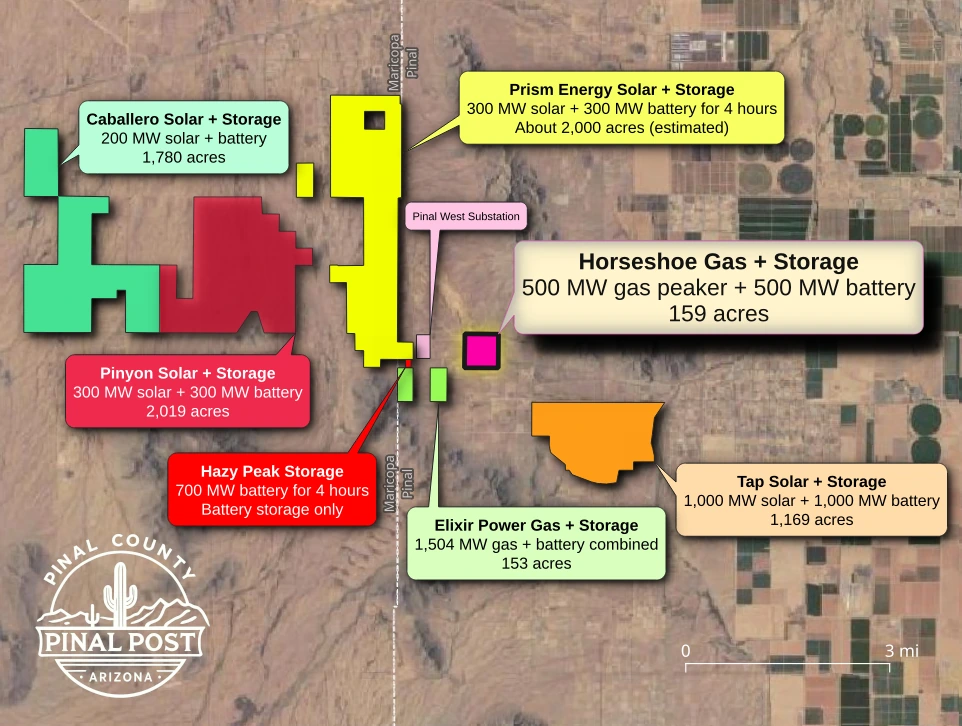
Horseshoe is one of several generation and storage projects planned around the Pinal West Substation, which the applicant describes as a key regional hub inside a federally designated energy corridor.
Planned and proposed energy projects around the Pinal West Substation, including the Horseshoe Energy Project site. Zoom and pan to explore, and click any colored area for a description. · Open the map full-screen
| Name | Type | Capacity | Acreage |
|---|---|---|---|
| Pinal County | |||
| Horseshoe Energy | Gas | 500 MW | 159 |
| Battery | 500 MW | ||
| Elixir Power | Gas | 1,504 MW | 153 |
| Battery | Size not stated | ||
| Tap Solar | Solar | 1,000 MW | 1,169 |
| Battery | 1,000 MW | ||
| Hazy Peak | Battery | 700 MW for 4 hours | Not published |
| Maricopa County | |||
| Pinyon Solar | Solar | 300 MW | 2,019 |
| Battery | 300 MW | ||
| Caballero Solar | Solar | 200 MW | 1,780 |
| Battery | Size not stated | ||
| Prism Energy | Solar | 300 MW | About 2,000 (est.) |
| Battery | 300 MW for 4 hours | ||
| Totals | Solar | 1,800 MW | About 7,280 (Hazy Peak not included) |
| Gas | 2,004 MW | ||
| Total generation | 3,804 MW | ||
| Battery storage | 2,800 MW* | ||
*Battery total counts only projects that reported a battery size; Elixir Power and Caballero Solar did not. It reflects power output in megawatts, not how much energy the batteries can store, which only Hazy Peak and Prism Energy reported. Sources: Pinal County staff and applicant filings; BLM National NEPA Register; developer project pages for Hazy Peak, Elixir Power and Prism Energy.
What Epic Star Energy proposed
Horseshoe BESS LLC, a subsidiary of Epic Star Energy, wants to build on 159.2 acres at 56950 W. Fulcar Road in unincorporated Pinal County, southwest of the City of Maricopa and the Ak-Chin Indian Community. Desert Leasing LLC owns the land and would lease it to the developer long term.
The plan calls for an up-to-500-megawatt battery energy storage system, or BESS, and a 500-megawatt simple-cycle gas peaking plant with ten 50-megawatt turbines, designed to run when demand peaks rather than continuously. An on-site substation would connect the batteries and the gas plant to the Pinal West Substation about a half mile west. The layout also includes a lined evaporation pond, a 50-foot landscaped setback on all four sides and trail corridors, and the applicant counts about 66 acres, or 42 percent of the site, as open space, including the buffers, stormwater basins and trail area. Amy Conway, a Tetra Tech land use planner representing the applicant, said the main facilities sit toward the interior of the property, using distance from neighbors to reduce visual effects. County staff said the added distance would also help noise and lighting fade before reaching neighboring properties.
Kelly Sarber, Epic Star’s co-founder and chief commercial officer, said construction probably would not start until 2029, and Conway said it would run into early 2031. Once operating, the campus would be staffed around the clock with about 30 on-site jobs, Sarber said, and construction would support 773 jobs. The applicant’s presentation assumes a quarter of those workers would be Pinal County residents.
The applicant’s economic study projects about $310 million in economic output during construction, $53 million a year in operations and about $530 million in property taxes over 35 years, with half going to the Maricopa school district and 27 percent to the county general fund. Additionally, Sarber said Salt River Project builds host community benefit packages into its contracts so all developers are held to the same standard. If SRP selects Horseshoe, she said, the project would generate about $1.5 million “expected to be given to the local community.” She said Pinal County would help decide how the money is used, with input from neighbors, and Epic’s July letter describes it as a one-time payment.
Why Epic doubled the Horseshoe Energy Project’s gas plant
Epic Star held its formal neighborhood open house on Nov. 12, 2025, where about 51 residents signed in. The materials that night described a 250-megawatt gas plant. Then, in a July 28, 2026, resubmittal to the county, Epic raised the maximum gas capacity to 500 megawatts.
Sarber told the commission that SRP asked Epic to develop projects in its territory and that SRP’s resource plan shows a power deficit by 2031. She said SRP released a report showing what she believed was about 4,000 megawatts of demand for gas and battery storage, and Epic used that as its basis for the larger plant. SRP is expected to choose projects at the end of the year, she said. However, when Commissioner Daren Schnepf asked whether SRP specifically requested the larger plant, Sarber said it did not and agreed the decision was Epic’s. She said the goal was to give SRP “a menued approach” to its power needs, and that Epic would build to whatever SRP says it needs, whether that is a smaller 250-megawatt gas plant or just the batteries with no gas plant at all. She also said support eroded about three months ago as the data center debate spread to energy projects. “There’s no data center that is even being discussed here,” she said.
Epic has hosted six noticed public meetings, Sarber said, and mailed notices to property owners within one mile of the site rather than the required 600 feet. Documented meetings include a Sept. 23, 2025, session at Supervisor Rich Vitiello’s office, an Oct. 27, 2025, gathering at the Raceway Bar and Grill, the November open house at the Ak-Chin Casino Resort’s event center and two meetings at the Raceway on Aug. 20 and Sept. 10, 2026, both after Epic’s July 28 resubmittal doubled the gas plant from 250 to 500 megawatts.
After Hidden Valley resident Susan Buonsante held up the invitation postcard for those two meetings, Conway acknowledged it did not mention the larger plant. She said a separate mailing, the postcards announcing the public hearing, did describe a 500-megawatt gas plant, and that a handout at the meetings described the turbines. In her own conversations there, she said, no one raised the increase. Commissioner Tom Scott responded that the change “should’ve been a major talking point.” Conway replied, “It was not an intentional omission.”
Residents’ arguments against the campus
Five residents spoke against the project, and three others submitted opposition cards without speaking. A business owner and two landowner representatives spoke in favor. Planning Manager Harvey Krauss said the county had received 44 letters in opposition and 11 in support, including letters from Electrical District No. 3, the Maricopa-Stanfield Irrigation & Drainage District and the Pinal County Fire and Medical Authority.
Maryeileen Flanagan, who lives about five miles from the site, said an earlier meeting described battery storage with a small gas turbine, and she never heard about the later meetings despite signing up for updates. She also challenged the minor comprehensive plan amendment. At 159.206 acres, the site falls 0.794 acre below the 160-acre threshold that would trigger a major amendment. Krauss said a major amendment can be heard only once a year and needs a 60-day review by eight outside agencies and stakeholders and a citizen advisory committee’s recommendation, while a minor one skips those steps but gets the same public notice and hearings. “A gas turbine, regardless of the number of acres involved, is not a minor change,” Flanagan said. She added that homes surround the property on three sides, that gas turbines are extremely loud, and that residents deserve to sleep and sit on their porches without that sound. She called the area a wildlife corridor and, because the land is fallow, questioned the claimed water savings.
Buonsante said residents gave input on a 250-megawatt plant, not the 500 megawatts now before the county. She pointed to other changes as well: drainage documents show developed acreage growing from about 114 to 148 acres, the evaporation pond was moved and substantially enlarged, and the water strategy was revised. Like Flanagan, she questioned the use of a minor amendment instead of a major one. The site “may technically fall below that numerical threshold,” she said, but there is “nothing minor” about turning nearly 160 acres planned for homes into an industrial site. The campus would employ at most 33 permanent workers, she noted. Buonsante also warned that several utility-scale projects are proposed around Pinal West, including a Night Peak Energy battery and gas plant on Fulcar Road. Approving them one at a time, she said, “risks creating an industrial energy corridor without ever comprehensively planning for this.”
Gary Metivier, who lives about four miles east, said the jump from CR-3 residential to I-3 industrial zoning, and the applicant’s attempt to avoid a major comprehensive plan change, should be grounds for denial. He asked why the applicant could not add solar instead of turbines, and said the decibel meters “used by the county and others” average noise across an area and miss the low- and high-frequency vibrations large turbines emit. Metivier also said the county has no code written specifically for energy or data center projects and urged the commission to push the Board of Supervisors for one. When Vice Chairman Karen Mooney asked, he said he could accept the batteries but not the turbines.
Doris Levy of Thunderbird Farms, about two miles east, drew on 20 years as a 911 dispatcher. She said water only cools burning batteries rather than extinguishing them, that a fire would send toxic gases toward nearby homes and animals, and that monsoon brush adds risk. Levy said SRP does not serve the area and asked why the plant was not placed in Maricopa County. She added that Thunderbird’s 30 to 40 volunteer firefighters would need special training and that she heard little about funding for them.
Anna Wright, who with her husband owns land directly north of the site, said they oppose the project because it is where they plan to raise their families. She said the land was sold to them without legal access and that Desert Leasing has not responded to their lawyer’s request to cross its property. In response, Sarber said a ravine along the Amigos Road alignment makes a road there impractical.
Among supporters, business owner Sylvia Marquez said the project would give construction work to local contractors, letting residents work close to home instead of commuting out of the area on State Route 347, where she said “a lot of people lose their life.” Brad Kuiper, representing Desert Leasing, said the owner bought the land to farm it, but cuts to Central Arizona Project supplies and trouble getting suitable water kept it from ever doing so. Tyler Dugan, also representing the landowner, disputed the idea that a project serving SRP would not benefit the community. He said Electrical District No. 3, a public utility serving Pinal County customers, already gets power from an SRP-operated natural gas plant called Mesquite under a long-term agreement. That shows the region’s utility systems are connected, he said.
Noise limits, turbine enclosures and a study still underway
Staff stipulations would cap sound from the campus at 65 decibels between 8 a.m. and 9 p.m. and 55 decibels overnight, measured at the property lines. Before getting a building permit for the power plant, the owner would also have to commission a study by a licensed acoustical engineer that measures existing noise at each property line and models the plant’s future noise. A second study would be due within 90 days after the plant starts operating. Krauss said the county has no sound meters and will rely on the developer’s acoustical engineer for those certifications.
Chris Hulik, Tetra Tech’s acoustic engineer, said ambient measurements would be taken that week, and his model will assume every source running at full load. The applicant’s presentation said the completed acoustic report would be available before the Board of Supervisors hearing. In response to Metivier, he said the team’s meters capture the full range of human hearing and beyond. Possible mitigation includes silencers, enclosures and barriers, and each turbine would sit in its own acoustic enclosure. When Schnepf asked for a comparison, Hulik said 65 decibels is roughly a vehicle passing at 65 mph about 25 feet away.
Scott pressed the team on why it had not measured existing sound before the hearing. “We don’t know what the starting point is,” he said. A 65-decibel limit may suit Maricopa or Casa Grande, he added, “but for people that choose to live out in the sticks, it’s a different conversation.”
Water: 200 acre-feet, turbine washing and the evaporation pond
Epic says the Horseshoe Energy Projects would use less than 10 acre-feet a year during construction and no more than 200 acre-feet a year, about 65 million gallons, in routine operation. Axel Buchwalter of Clark Hill, the applicant’s water consultant, called 200 acre-feet an “absolute maximum” that applies to either the 250- or 500-megawatt design, and said actual use would likely be significantly lower. The property carries an irrigation grandfathered right of about 562.8 acre-feet a year.
Buchwalter said the batteries would use very little water. At the gas plant, he said, cooling water would make up most of what goes into the lined evaporation pond. Dan Quesenberry, Tetra Tech’s gas plant engineer, said each of the 10 turbines would be washed four times a year at about 600 gallons per washing, or 6,000 gallons per round and 24,000 gallons a year. That wash water, with its detergents and lubricants, would be captured in tanks and hauled away for treatment rather than sent to the pond, he said. A separate 50,000-gallon tank would hold fire water, and Buchwalter said fire trucks could also fill up there for emergencies elsewhere in the area, which has no potable water system. That would “essentially” provide hydrants for that part of the community, he said.
Scott asked why the project would not treat and reuse the cooling water or return it to the ground. Buchwalter said that is conceptually possible but would require a reverse osmosis plant and injection wells for a small volume of water. Therefore, he said, evaporation is a better use of resources and more environmentally supportive at this scale. Sarber said the pond was moved toward the southwest portion of the site so it could become a fenced open-space feature that attracts migrating birds, subject to state water quality standards.
Epic has not settled on a water source. The farm’s existing water right allows groundwater pumping for irrigation only, so using it for the plant would require agency approval to convert it to industrial use. Alternatively, Epic could buy credits for Colorado River water that the Central Arizona Project has already stored underground and pump that water instead. In that case, Buchwalter explained, the plant would run on imported water rather than local groundwater, and the farm’s groundwater pumping would end. “There are scenarios here where this project ultimately is a net positive for water imports into Pinal,” he said. The Maricopa-Stanfield Irrigation & Drainage District, which operates the site’s wells, has offered to keep running them for the project. Still, staff noted that an irrigation right is not final authorization for industrial use and stipulated that a water resource plan must document the supply before site plan approval.
Why Epic chose a farm beside Pinal West
The property has carried residential zoning since the Hidden Valley Estates planned area development, or PAD, was approved in 2007. That 320-acre plan allowed 1,052 homes, but nothing was built and the land remained agricultural.
Sarber said that after Epic focused on the Pinal West Substation, it went to farming friends she has known for more than 20 years and was invited to use their farm. Five natural gas pipelines owned by El Paso Natural Gas and Transwestern cross the property diagonally, and Conway said two more are planned. A 500-kilovolt power line crosses it as well, Sarber said. SRP has proposed a second 500-kilovolt line into Pinal West, and Tucson Electric Power plans a 345-kilovolt line in the corridor. In addition, the site abuts the planned Interstate 11 corridor to the south and sits between parts of a proposed regional park.
Klob asked what would charge the batteries. Sarber said they charge during off-peak periods with excess power already on the grid. The two facilities would be separately metered and the gas plant is not intended to charge the batteries, she said, though some of its power could reach them through the grid.
Battery fire smoke, 72-foot stacks and dark-sky lighting
Conway said the lithium-ion battery yard would include fire detection, alarm and battery management systems designed to isolate failing equipment, plus on-site fire-response facilities. Evan Balcombe of Fire Risk Alliance said the national fire code requires training for responding fire departments before operation, and Epic would pay for it. No fire service contract exists yet. Asked who would provide fire protection for the site, Sarber said Epic first reached out to the City of Maricopa, whose fire department serves homes along Papago Road, and that Arizona City is also interested in the area. When Scott asked why the volunteer Thunderbird Fire Department was not prioritized, Sarber said she has had calls with the man who runs it and attended three of its fundraisers. When Scott pressed her to commit, she said Epic will work with the Thunderbird and Hidden Valley fire departments. Under Scott’s questioning, Balcombe acknowledged smoke from a container fire cannot be kept on the property. About 90 percent of that smoke is carbon monoxide, carbon dioxide and hydrogen, he said, and it dissipates.
Peyton Wilson of BlueScape Environmental said the 10 stacks would emit carbon monoxide, nitrogen dioxide, particulate matter, sulfur dioxide and hazardous air pollutants, with carbon dioxide making up the majority of emissions. The plant needs an air permit from the Pinal County Air Quality Control District before it can operate, and Wilson said the district would review the project’s emissions modeling against health thresholds. A 72-foot stack, taller than the standard 50-foot industrial limit, is typical for such plants, Wilson said, and taller stacks dilute pollutants before they reach ground level. Conway said only the stacks are expected to exceed 50 feet, although the written proposal allows the extra height for energy-related structures more broadly. The stacks “are going to be visible” despite landscaping, she said.
Commissioner Bryan Hartman asked whether the lighting would harm the area’s dark skies. Krauss said fixtures would be shielded and aimed downward, and Sarber said she is open to the stricter lighting standard if it is legal.
Where commissioners stood before the Oct. 15 hearing
Before the votes, Sarber offered to scale back to 250 megawatts. “I think looking back on it, we didn’t do a great job once we did double it,” she said.
Klob said he does not oppose the project itself but called doubling it “a fundamental change,” and Scott echoed that concern. Mooney agreed the county will soon be short of power but said, “I don’t feel the citizens got the proper due process.” Commissioner Wallace Keller also agreed the power is needed but said the site was chosen for the convenience and cost of tying into existing pipelines and transmission. He asked when the need outweighs “the people that already live there, the people that bought their land there to live in the quiet.” Commissioner Terrilyn Klucar asked why the noise limit could not stay at 55 decibels all day. Commissioner Gary Pranzo, who cast the only vote to approve, said the county’s patchwork of small plants wastes efficiency, warned that “our power bills are going to look like a mortgage,” and welcomed 500 megawatts.
Commissioner Albert Lizarraga’s motion to approve failed 8-1. Scott then called Sarber’s offer “a deathbed repentance” and moved to deny. That motion failed 4-5. Mooney, Keller, Scott and Klucar voted to deny the case. Klob, Hartman, Lizarraga, Schnepf and Pranzo voted against denying it.
Klob said postponing would let Epic work with neighbors and return at the “same size or smaller.” The commission then voted unanimously to continue all four cases.
Horseshoe Energy Project back before P&Z on Oct. 15
The commission’s Oct. 15 agenda lists all four cases: removing the land from the old housing plan, redesignating it in the county’s long-range plan for business and industrial use instead of homes, rezoning it for heavy industry, and setting project-specific development rules for the gas plant and batteries. The agenda descriptions do not say whether Epic will return at 500 megawatts or the 250 megawatts Sarber offered. Deputy County Attorney Daron Garey said county rules allow two continuances. The cases had already been continued once, from Aug. 20, so the September vote used the second. Whatever the commission recommends, the Board of Supervisors has the final say.
Case numbers: PZ-PD-004-26 (PAD severance), PZ-PA-004-26 (Comprehensive Plan amendment), PZ-004-26 (rezone) and PZ-PD-005-26 (PAD overlay).