Key points
- Commissioners unanimously recommended approval of the 350-megawatt Desert Crest battery project west of Casa Grande.
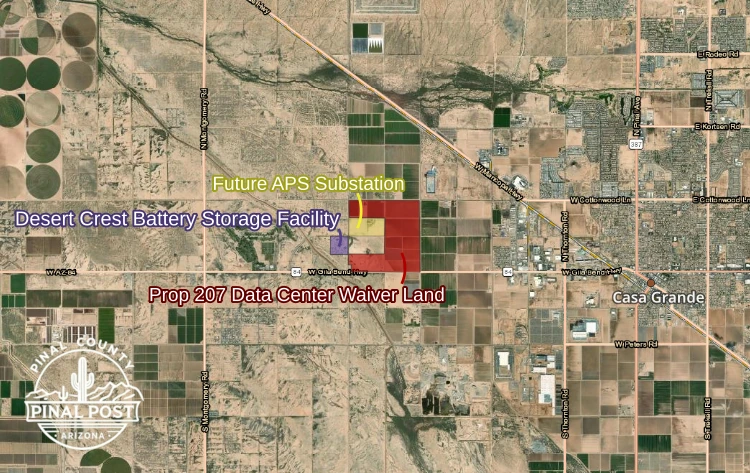
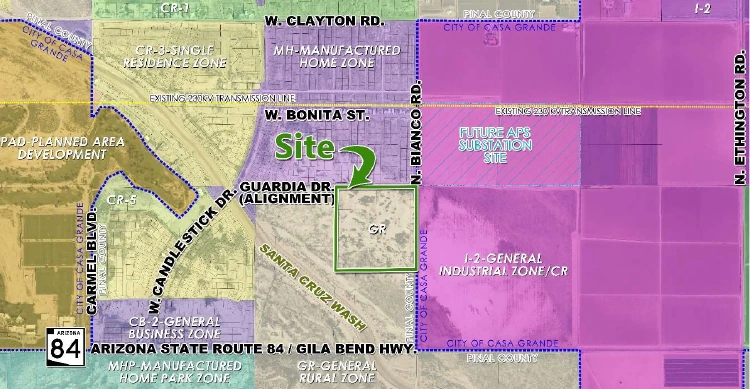
- The 40-acre site sits across Bianco Road from a future APS substation. Beyond it lie 480 acres tied to a possible data center under Casa Grande’s Proposition 207 settlement.
- Plus Power plans 664 battery containers. An eight-foot block wall would enclose them, set back at least 100 feet from property lines.
- The applicant’s attorney said the site could hold enough energy for 56,000 homes for eight hours if the grid went down. He put Casa Grande’s housing count at 24,000.
- Commissioner Tom Scott questioned fire safety, water hauling and the tax estimate. He voted for the project anyway.
- No residents spoke. Seven letters of support were filed, including from APS and Rural Metro Fire.
- Operations would use about 150 gallons of water a week and draw roughly 20 vehicle trips a day.
- The Board of Supervisors makes the final decision. The facility would open in 2031.
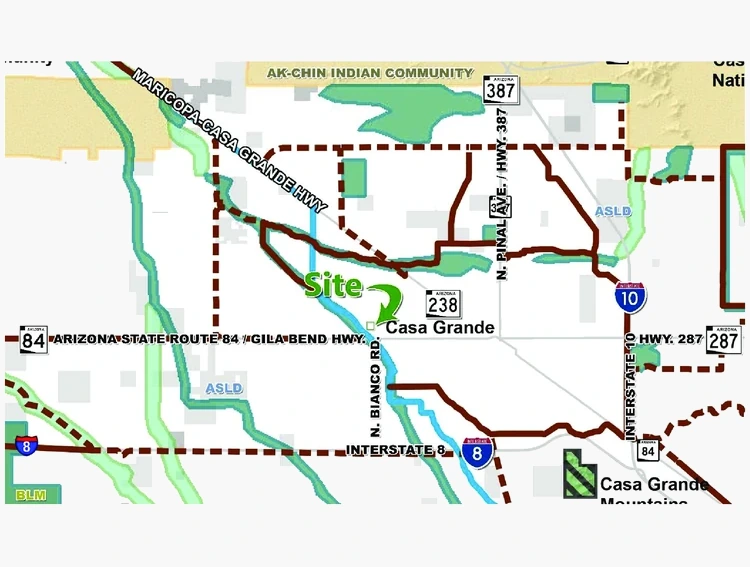
A 350-megawatt battery facility cleared its first hearing on Thursday, Aug. 20. The Pinal County Planning and Zoning Commission voted unanimously to recommend approval of Desert Crest Energy Storage, a 40-acre project at Guardia Drive and North Bianco Road in unincorporated Pinal County west of Casa Grande. As a result, the final decision now rests with the county Board of Supervisors.
The applicant told commissioners the site will use almost no water and generate little traffic once built. According to the developer, the batteries could hold enough energy to serve 56,000 homes for eight hours if the grid went down. The applicant’s attorney, Nick Wood, said that is more than twice the number of homes in Casa Grande, which he put at 24,000. However, the developer does not expect the facility to open until 2031, after the neighboring Arizona Public Service (APS) Bianco Substation is built.
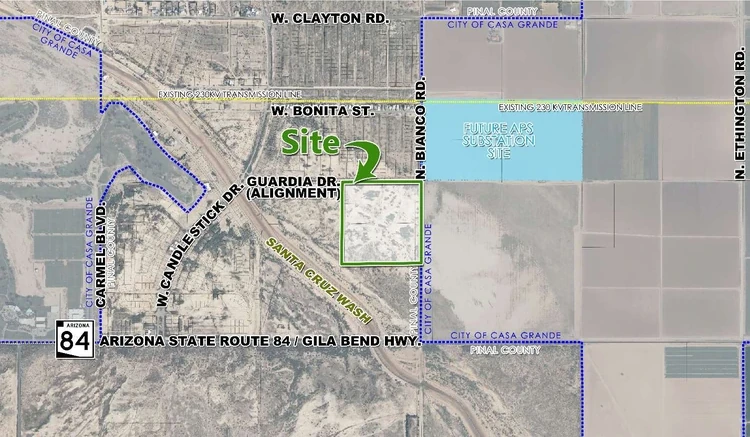
The project will build its own substation on site, connecting to the planned APS substation less than 500 feet to the northeast, across Bianco Road. Meanwhile, the same corridor holds the roughly 480 acres where the Casa Grande City Council settled about $146 million in Proposition 207 claims on Aug. 3. The council waived a conditional use permit requirement for a data center on those parcels, attaching binding limits on water, power and noise in its place. No end user has been identified, and the vote did not approve construction.
From Rural to Industrial
County planner Sam Amaya presented three linked cases. The first would amend the comprehensive plan from Moderate Low Density Residential to General Public Facilities/Services. The second would rezone the land from General Rural to Industrial (I-3). The third would add a Planned Area Development overlay limiting the site to the batteries, an on-site substation, transmission equipment and supporting facilities. Once operating, the site would draw little traffic. The applicant’s traffic study expects only three to five employees on site on weekdays, generating up to 20 vehicle trips a day.
664 Containers Behind an Eight-Foot Wall
Developer Plus Power plans 664 battery containers, each eight feet tall and spaced about 10 feet apart.
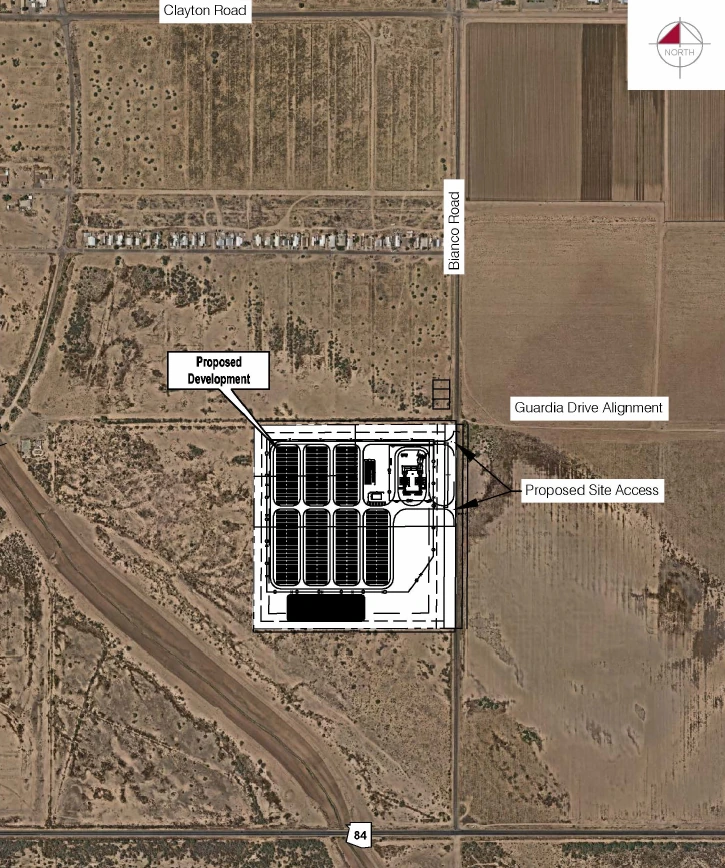
Its substation would sit at the northeast corner, the point closest to the APS site. The preliminary plan sets the batteries at least 120 feet from the property lines. Separately, the county’s conditions require all equipment and buildings to sit behind a 100-foot buffer, double the 50 feet normally required for industrial sites. Early drawings showed an eight-foot chain-link fence topped with barbed wire. Instead, county staff required a minimum eight-foot block wall, citing the residentially zoned parcels nearby.
Attorney Nick Wood called the wall decorative and said it will wrap all four sides so the containers stay out of view. He told commissioners battery storage is the company’s only business, with two Arizona facilities operating in Avondale and Gilbert, four in Texas, two in the Northeast and one in Hawaii. In May, the same commission unanimously recommended Copper Basin, a Plus Power project Wood called almost identical. Supervisors approved that 250-megawatt facility in San Tan Valley on June 17, and it is also targeted to open in 2031.
Substation Timeline Sets the Pace for the Desert Crest Battery Project
Chairman Robert Klob pressed the applicant on its relationship with APS. Tennison Brady-Steen, a project development associate at Plus Power, said the company is still working with APS. However, she added, “the status of a contract with them is confidential at this point.” Any eventual arrangement would take the form of an energy storage agreement, she said. Meanwhile, she gave a timeline for the neighboring substation. The APS-run Bianco Substation is coming online in 2028, she said, with construction starting in the fourth quarter of 2026 — “just in a few months.” She added that state regulators approved the substation’s environmental certificates earlier this year. Because of that short distance to the APS site, the application says the project can connect with a minimum of added transmission infrastructure.
Industrial Neighbors to the East, an Unbuilt Subdivision to the North
Across Bianco Road, the land falls inside Casa Grande city limits and carries General Industrial zoning. That is the corridor where the Proposition 207 settlement would let one or more data centers proceed without a conditional use permit. Nick Wood told commissioners that batteries next to an industrial center give the grid extra support when demand spikes.
Housing came up as well. To the north lies the undeveloped Desert Carmel subdivision, which Nick Wood described as “paper lots” — land divided into parcels on a recorded map, but never built. Its owner, Sonoran Land Fund, submitted a support letter and has no near-term building plans, he said. He also tied storage to growth: Pinal County has grown from 103,000 residents in 1985 to more than 530,000 today. Commissioners had taken up a 1,052-home subdivision earlier the same day. Separately, the City of Casa Grande told county staff it supports the project. Still, the city is deferring consideration of annexing Desert Carmel’s residential lots until it sees how the Bianco Road corridor develops, citing existing and potential homes that could be adversely affected by the proposed development.
‘You Allow It to Burn’: Fire Safety Under Questioning
Eric Wood of Energy Safety Response Group, a retired Ohio firefighter, answered most safety questions. The project must meet NFPA 855 and UL 9540A standards, he said, and Plus Power will train local firefighters on an ongoing basis, a commitment county staff also listed. When a container catches fire, he told Commissioner Tom Scott, crews protect the units around it and “allow it to burn.” Testing has shown what comes off a burning unit is “no different than a residential structure fire,” he said.
Scott rejected that comparison. “People live in houses. People don’t live in battery storage containers,” he said. Furthermore, he cited a Peoria battery fire last year that forced evacuations, and counted 55 battery fires nationwide between 2018 and 2025. Eric Wood countered with Electric Power Research Institute data showing a 98% drop in failure rates, which he credited to redundant safety systems, and said the institute drew on more than 1,500 U.S. sites. Matthew Look of Plus Power added, “We have not had any fire incidents at any of our sites.”
Burned-out units hold no remaining charge, Eric Wood told Vice Chair Karen Mooney, so specialized firms can haul the material away under federal transportation rules. At the end of the project’s life, the applicant’s decommissioning plan says materials will be salvaged or recycled where possible, with remaining waste sent to a licensed solid waste facility.
Seven Support Letters and No Public Speakers
No residents spoke when Klob opened the public hearing, and no one submitted a speaker card. By contrast, the applicant filed seven support letters from APS, the Pinal Alliance for Economic Growth, the Arizona Technology Council, Rural Metro Fire and three neighboring landowners. Rural Metro, which intends to serve the project, wrote that it expects emergency response resources in place near the site before the facility opens.
Money and water also drew questions. Brady-Steen said the project will generate at least $25 million in property taxes over its operating life, assessed on the land and the battery equipment. The applicant’s decommissioning plan puts that life at 20 to 30 years. Scott questioned how that was calculated, saying batteries are not taxed. Brady-Steen replied that the tax applies to the land and the battery equipment. Scott was somewhat unconvinced.
On water, the applicant team said operations need only about 150 gallons per week for a restroom trailer, while construction water is limited to dust control. Even so, Scott noted that water will be hauled in and pointed to the county’s scarcity. Before the vote, he concluded, “I think the location’s pretty good. There’s not a lot of residentials around there, and it’s not on farmland.”
Conditions Attached to the Recommendation
The commission backed all three recommendations without opposition. The comprehensive plan change carries no conditions. The rezoning carries two, tying it to that change and to all required agency permits. Meanwhile, the PAD carries 18. Beyond the block wall and equipment buffer, those require a 75-foot right-of-way dedication along Bianco Road and paved, all-weather access at least 28 feet wide, with two permanent entrances. Additionally, the developer must submit drainage and traffic studies at the site plan stage. Any road improvements the traffic study calls for, such as turn lanes or signals, come at the developer’s cost. An emergency response plan goes to the county and the local fire department before site plan approval. Finally, full site plan review comes before any building permit.
All three Desert Crest Energy Storage cases now advance to the Pinal County Board of Supervisors for a public hearing and final decision.
Case numbers: PZ-PA-019-25 (comprehensive plan amendment), PZ-022-25 (rezoning), PZ-PD-017-25 (planned area development overlay).
Yes, solar power panels are great/battery and storage great!