Key points
- Pinal County supervisors took no final vote on the La Osa data center and continued both zoning cases to August 26, 2026.
- The applicant requested the continuance to return with a smaller project: a roughly one-gigawatt cap of no more than 11 buildings, down from up to 59, and one gas plant instead of two. That reduction is not yet binding.
- The property is listed for sale online, where it is marketed as having “Potential to be largest Data Center in the United States.” The applicant confirmed the land is for sale, saying the developer intends to sell to an end user.
- Water was the central dispute. The applicant said the data centers would use closed-loop cooling and no water for cooling, while residents said that commitment is not stipulated or enforceable and that the project taps the shared Pinal Active Management Area.
- Turnout was large. One speaker counted at least 174 people across the main room and two overflow rooms, 71 signed up to speak, and 66 more comment cards were filed, 64 of them opposed.
- More than a dozen speakers urged the board to deny the project and adopt a temporary countywide moratorium on data centers until a regulatory framework and standards are in place.
- The supervisors disagreed over how long to wait. Rich Vitiello wanted a longer delay until December and voted no, while Mike Goodman pushed for the sooner August 26 date and Stephen Miller seconded it. Jeff Serdy left early for a signing event he said congressmen would attend, leaving once it was clear the matter would be a continuance and saying he would not have missed a final vote. Chairman Jeff McClure backed the August 26 continuance, which passed with Vitiello the only no.
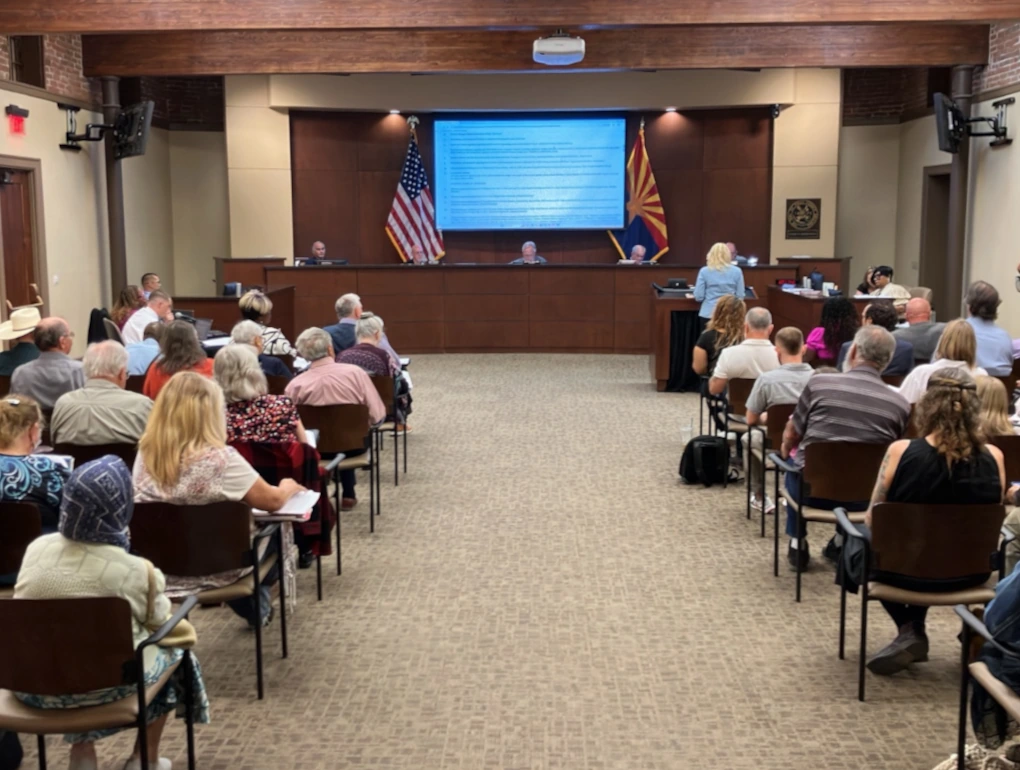
The Pinal County Board of Supervisors delayed its vote on the La Osa data center on May 27, 2026. After hours of public testimony, the board continued both zoning cases to August 26.
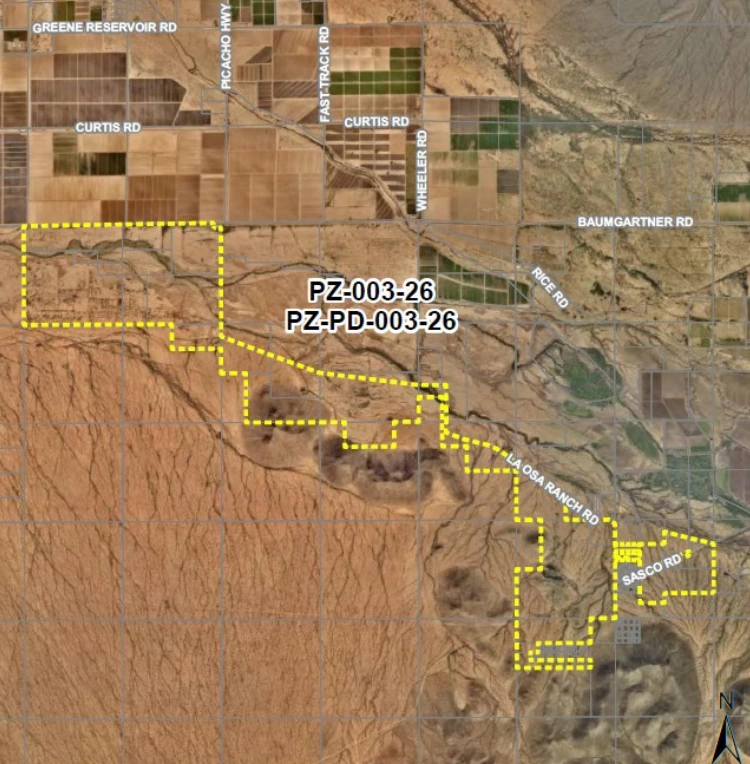
The project spans roughly 3,385 acres south of Eloy. The applicant asked to rezone about 2,393 of those acres to industrial for data center buildings, gas-fired power plants, and battery storage. Residents pushed back at the hearing. Some asked the board to simply slow down, while more than a dozen called for a moratorium on new data centers until the county develops a framework, standards, and oversight for them.
What the La Osa data center rezoning would do
The applicant, Vermaland LLC, asked to rezone the land from General Rural to Industrial (I-3). The request also includes a Planned Area Development overlay, known as a PAD. This overlay sets custom building rules for the site instead of the standard industrial rules. Court Rich of Rose Law Group represented the applicant. Planning Supervisor Sangeeta Deokar told the board the request covers 2,393 acres of I-3 zoning and about 992 acres of proposed open space, meaning land set aside to stay undeveloped.
The conceptual plan, a draft layout rather than a final design, showed up to 59 data center buildings and two gas-fired power plants. In addition, staff described it as the first proposed data center campus in unincorporated Pinal County. Rich said it was the first data center to go through the county’s zoning process. Other projects in the county’s own area have cleared an earlier land-use step, but none has yet won the zoning approval needed to build. The land is largely vacant desert and sits along the Greene Wash.
A packed hearing room and a wave of opposition letters
The hearing drew a large crowd. Antonio Ramirez, the political and policy director for Rural Arizona Engagement, said he counted at least 174 people in the main room and two overflow rooms. Alex John told the board both overflow rooms were packed. He said the fire marshal sent more people outside, and that many others had to leave for work.
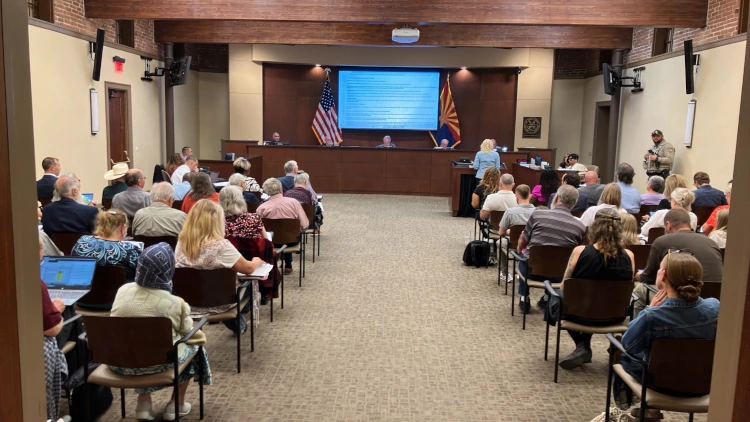
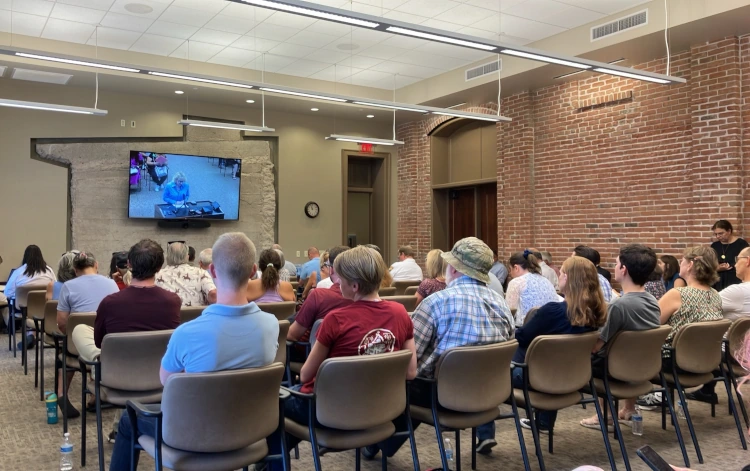
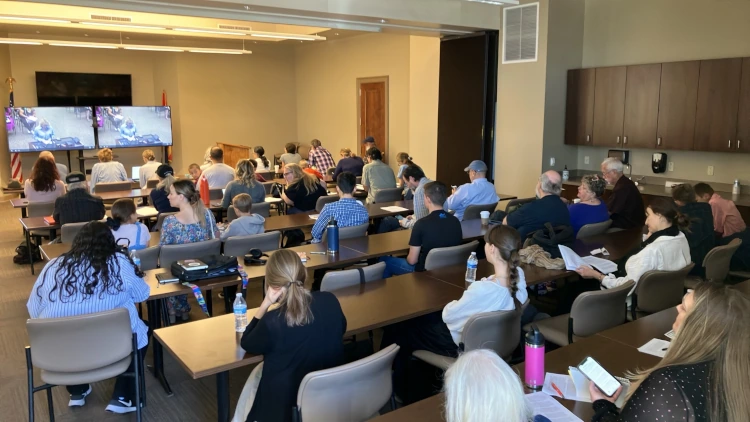
The turnout shaped the testimony. Chairman Jeff McClure said 71 people signed up to speak, so he cut each turn to two minutes. Even then, the public hearing ran more than two hours. Beyond those speakers, he logged 66 more cards from residents who did not wish to speak. Of those, 64 opposed the project, one supported it, and one took no position.
The written comments grew quickly before the meeting. Planning Supervisor Sangeeta Deokar said that as of the board’s submittal, the county had logged two emails of opposition and 11 letters of support, most from owners near the project. The City of Eloy mayor also sent a letter of support. However, staff received roughly 50 more letters the day before the meeting, and only one supported the project. Supervisor Jeff Serdy said the board had received well over 50 emails. Those late letters raised concerns about the Greene Canal, aquifer levels, private wells, air quality, noise from battery storage and data center buildings, utility bills, subsidence, and wildlife. In addition, the Coalition for Sonoran Desert Protection submitted a letter seeking larger buffers, though it did not formally oppose the project.
The board delayed the decision after a motion split the supervisors
The applicant first raised the idea of a continuance. During his presentation, Court Rich asked the board to continue the cases to August 12. He said the applicant would return with a smaller project and new stipulations. That request came before the public hearing and before supervisors discussed any timing.
After the testimony, Supervisor Rich Vitiello moved to continue the cases all the way to December. He said the project carried too many open questions. “There is a lot of ifs, maybes, and buts that I can’t answer myself,” he said. Moreover, he doubted answers would arrive by August.
However, Vitiello’s motion died for lack of a second. Supervisor Mike Goodman then proposed a continuance to August 26, earlier than the December date Vitiello had sought. He argued the process already requires many stages and that a long delay would burden the landowner.
Miller said he was ready to vote that day. He treated the request as a zoning decision and pointed to the landowner’s right to proceed. He called himself “a very strong constitutional conservative” and a capitalist who defends individual liberty and property rights. He said the founders built the system so an individual can pursue what they judge to be in their best interest. As long as an applicant clears every hoop and provides the required information, he said, the government should let the project move forward. He likened it to not telling a neighbor what color to paint a house. “I just have a hard time telling somebody no when they’ve done everything that was required,” he said. He added that the state, not the county, decides whether a project gets water and power, so one that cannot secure them would never be built. He said the developer’s own engineers would handle the site’s geology and foundations. He argued the company would not sink millions into a project destined to fail, so it would engineer the site properly to protect its own investment. Even so, he seconded Goodman’s motion for the earlier August 26 date. “I’d vote today, but I’ll second that motion,” he said.
Vice-Chairman Jeff Serdy did not take part in the vote. He excused himself to attend a signing event he expected congressmen to attend, calling it a big day. He left only after it became clear the matter would be a continuance, and said he would not have missed an up-or-down vote. With Serdy absent, the continuance passed on both cases, and Vitiello voted no each time. Therefore, residents will get another chance to comment on August 26.
Water was the biggest issue at the La Osa data center hearing
Rich called water the project’s biggest issue. He told the board the data centers would use a closed-loop cooling system and “will not use water for cooling.” He described sealed pipes that recirculate fluid. “That means there will be no water use associated with cooling this project. Zero,” he said.
Rich also offered to make that commitment binding. He said the applicant had pledged in its zoning application to use a closed-loop system and no water cooling. “That becomes the law of this case,” he said, “but we’re also happy to stipulate to it, whatever y’all want.” He said the applicant would “agree and stipulate to dry cooling and air cooling only, no water cooling.”
The water use, Rich said, would come mainly from the gas plants rather than data-center cooling. He estimated the original two-plant project would draw up to about 600 acre-feet per year, or roughly 196 million gallons. He framed the project as a major source of tax revenue and a low water user. At full build-out, he said, the original 59-building campus would have ranked as the fourth-largest employer in the county.
Rich also said the applicant already arranged water rights. The applicant has “a contract for 1,200 acre feet of historical water rights” that can be used on the property, he said, an amount equal to about 391 million gallons a year. He added that the deal involves a neighboring owner and would reduce agricultural water use.
Residents said the water commitment is not yet enforceable
Several speakers challenged whether those commitments carry legal weight. Eirini Pajak, a Florence resident who wrote an opinion-column series on the project, said “closed loop cooling” is not one technology but many systems with very different water profiles, and the application does not specify which one.
Pajak noted the closed-loop system appeared in the project narrative “as if it was an assured aspect of this project, but it was never stipulated.” Consequently, she said, “nothing’s stipulated about anything, the gas, the way the gas plant is, the way the water and closed loop system is.” She also said the applicant’s own engineer based the water-use figures on the cooling-equipment maker’s claims. That company’s underlying data is confidential, she said, so no outside expert could verify the numbers.
Seraphim Larsen of Cactus Forest said the water concern is regional, not just local. He noted that the whole area draws on the same Pinal Active Management Area, the regional groundwater area they share. “We’re all on the same AMA,” he said, which is why he opposes the project even though he lives well away from the site. Larsen also faulted the conditions. “There are 33 stipulations on this project, but not one of them addresses water usage,” he said. He argued dry cooling and consumption limits “should be enforceable” and “should not just be an option that they can change later.” Likewise, Maryeileen Flanagan, who said the same aquifer is over-allocated, asked for separate stipulations on each water use, including gas-plant evaporation ponds.
Tyler Stein, a policy analyst with Rural Arizona Engagement, cited the project’s own engineering memo. He said the preliminary water memo lists projected demand of 3,828,780 gallons per day. That figure, he said, equals about 4,288 acre-feet per year, or roughly 1.4 billion gallons. Stein also disputed the applicant’s comparison to homes or farms. The land is currently desert, he said, so the project would add water demand rather than replace a thirstier use. He warned the site sits in the same management area, which already faces water limits, and said pumping there could affect water-supply applications elsewhere in the region.
Other speakers pointed to closed-loop systems elsewhere. Milica Jacobs asked Rich to name a single closed-loop data center that used no added water after construction, saying she could not find one. Adria Adams cited the Meta data center in Morgan County, Georgia, where residents have reported brown tap water.
Gas-plant emissions and air quality drew health concerns
Several residents focused on health and air quality. Catherine Seidel said burning gas at this scale produces nitrogen oxides, fine particulates, carbon monoxide, and volatile organic compounds. She noted the site sits near the West Pinal PM10 Serious Nonattainment Area, which the EPA found in 2023 had failed federal standards. She also pointed to other gas projects in the same air shed, including a Sunridge Power proposal near Red Rock. Seidel urged the board to reject the rezoning, warned against concentrating emission sources near a nonattainment area without a comprehensive regional environmental review, and asked for a moratorium on data centers while the county develops a framework and ordinances to evaluate projects of this size.
Michelle Emery, who said she had worked at one of New England’s largest data centers, said the gas turbines emit nitrogen oxides linked to heart disease, lung damage, asthma, and strokes, along with formaldehyde that can cause chronic respiratory illness and cancer. Brian Cox, who once worked at a power utility, warned that gas plants rely on bulk ammonia, which he called lethal. He tied that hazard to the unstable ground at the site.
Heat was another concern. Olivia Wauer cited an Arizona State University study finding that air-cooled data centers raise nearby temperatures by 4 to 16 degrees, with heat carried up to a third of a mile downwind. Laurel Sotelo, who lives in Red Rock near the Sasco Road school, said construction dust and lost dark skies would harm families there.
More than a dozen speakers asked for a moratorium and stronger guardrails
A recurring request ran through the testimony. More than a dozen speakers urged the board to vote no and then place a temporary moratorium on data centers on a future agenda. They wanted that pause to last until the county writes an ordinance and framework for large projects.
Stein asked the board “to establish a data center moratorium while the county develops a framework and standards for large-scale data centers.” Several other speakers made similar requests, and one asked for an 18-month pause.
Several speakers questioned whether the county is ready to decide. Laurie Fuller asked whether data centers are even covered in the county code. “What guardrails are in place?” she asked. She urged the board to continue the decision “until there is a code that’s written and there are ordinances in place.” Helen Heveran added that a pause “allows for good governance to step in and good policy to be shaped.”
Michael Hedrick pushed back on the property-rights framing some supervisors favored. “If we don’t have boundaries, we have chaos. Every right has a boundary,” he said. The applicant may be within his rights to seek the rezoning, Hedrick argued, but approving it would override the rights of other Arizonans.
Vivek Bharathan traveled from Pima County with a warning. He said his county sold county land to a data center developer after assurances about water. The company later used water anyway, he said, and that commitment “was not stipulated.” Therefore, he urged Pinal County not to repeat that path.
Speakers questioned the smaller project and the jobs claims
Rich offered to shrink the project. He said a stipulation would “limit this to a gigawatt size, which would be no more than 11 buildings.” He called that “an 80% reduction in the number of buildings” and said the applicant was “willing to stipulate to the 11 buildings.” That reduction was not yet part of the application before the board, and Rich said he would return with it as a binding condition after the continuance.
However, Susan Buonsante of Hidden Valley doubted the move. She called the reduction “obviously a temporary tactic to ensure future rezoning once this initial project gets approved.” Similarly, Vince Siebert said the change carried “no legal binding at all” and that the larger footprint could return later.
Speakers also disputed the job projections. Michele Sparrow said the applicant estimated 100 to 500 permanent employees per building, which she called unrealistic. Gregory Heers argued the applicant overstated the jobs and could not source the figures. He said the attorney’s per-building estimate came from ranges he had “heard,” and that the numbers described a different kind of project, a smaller campus run by one known tech company. La Osa is not that, Heers said. Vermaland is a land developer, and the future tenants are unknown. He added that no development agreement with enforceable employment targets is in the public record.
Supervisors pressed Rich on phasing, power costs, and the land sale
Chairman Jeff McClure and Vitiello asked Rich to clarify the 11-building plan. Rich said the phasing remains preliminary. “The phasing plan is preliminary, but we’re willing to stipulate to the 11 buildings,” he said. He explained the buildings’ exact locations would depend on later engineering and utility coordination. As a result, the details are not fully settled.
Vitiello raised the timing of power. He noted the gas plant could be built last and that such plants can take five to seven years. He worried residents could pay more if the project buys power in the meantime. “I’m worried about the constituents in that area about their power bills going up,” he said.
Rich answered that the developer would cover those costs. “If we buy power, we pay for that power,” he said. “If we install additional infrastructure, we pay for that infrastructure.” He said rates rise for others only when a data center does not pay for the infrastructure it needs. “We’ve committed and ED4 has committed that we’re gonna pay for it,” Rich said, adding that the alternative, with the district covering costs and recovering them in everyone’s rates, “we’re not gonna let that happen.”
Vitiello also raised the land sale directly. “My understanding is the land is back up for sale from a loop realtor,” he said, referencing an online listing. Rich confirmed it. He said Vermaland is a land developer, not a data center operator, and intends to sell to an end user. “It should be for sale,” he said. “That’s their goal.”
A LoopNet listing advertises the roughly 3,000-acre property as land for sale and markets it as having “Potential to be largest Data Center in the United States.” The listing, accessed June 1, 2026, identifies Vermaland as the contact.
Miller pressed Rich on long-term water management
Miller pressed Rich on how the water would be managed long term. He noted the project relies in part on converting agricultural water rights, and that a development this large would likely need subdivided lots and a new water designation, such as Ag-to-Urban. He warned the state would enforce replenishment rules.
“You all have to buy water from other places to replenish, preferably in the same aquifer,” Miller said. He added, “That’s how the State of Arizona works and that’s how we are being able to maintain water supply to folks all over.” Rich agreed the project would have to work with the Arizona Department of Water Resources on water.
Miller also noted the conceptual nature of the plan. “You haven’t done soil studies,” he said, adding that the applicant does not yet know how to position the buildings. Rich responded that such work follows zoning. “You don’t do that before you have the zoning approval,” he said, while confirming preliminary hydrology reports were done.
Local residents and the fire chief spoke in favor
Most who spoke opposed the project, but not every voice did. A few local residents backed it. Ronella White, a Red Rock resident for more than 50 years, supported the project. She said it would “improve our infrastructure, the roads” and bring fire service the community has never had. “Compared to the amount of jobs that are available in Red Rock right now, any number of jobs would be an improvement,” she said. A title report filed in the project’s application packet lists White as the borrower on a $610,000 loan recorded in 2022 and secured by several of the project parcels. As of the report’s December 2025 date, that loan was still listed among the items to be cleared before the property could be sold. The report also notes part of the loan was released in 2023.
Brian Delfs, who signed the will-serve letter as chief of the Avra Valley Fire District, also backed the project. He said revenue from the facility “will directly allow the fire district to lower property tax burden on all of our residents.” Moreover, he said the developer addressed water, backup power, noise, and public safety to his satisfaction. He called the site “a highly secure, low occupancy” use with little strain on emergency resources. Staff listed the Pinal County Fire and Medical Authority and Avra Valley Fire as the project’s fire and emergency responders. The Avra Valley will-serve letter, however, says service depends on the property’s pending annexation, with fees set later.
A candidate for office focused on tax incentives
Julia Romero Gusse, a resident of Maricopa and a candidate for the Arizona House of Representatives in LD16, marked her card neutral. She said many residents, including herself, do not fully understand data centers. Even so, she urged the board to push to end the incentives drawing the projects to Arizona.
Gusse criticized the transaction privilege tax exemption for data centers. She called the exemption “ridiculous” and the breaks “absolutely crazy.” That exemption, she said, cost Arizona about $38.5 million in lost revenue in fiscal year 2025. Separately, she noted the project lies entirely within Foreign Trade Zone 75, which she said would qualify it for an 80% reduction in real estate and property taxes.
“We need to work together to close these loopholes and these incentives for more data centers to come here,” Gusse said.
A call to form a citizens’ committee before the next hearing
Jennifer Hilsbos asked the board to create a citizens’ group before the next hearing. She introduced herself as the chair of the Pinal County Democratic Party and said she holds a BS and MS in chemistry with an environmental focus. Her thesis, she said, examined subsurface hydrothermal systems.
Hilsbos asked the board to “convene a citizens’ advocacy group on this issue before you select a date to hear the applicant’s application in full.” She offered to serve as a subject matter expert. Furthermore, she warned that the buildings’ extreme weight combined with pumping groundwater from the aquifer could open even a small fissure under the nearby gas pipeline, which she said could threaten communities. She urged “a tempered approach” and more time to examine the risks.
Procedural record and the path to August
Both cases reached the board with a Planning and Zoning Commission recommendation of approval. The commission voted 7-2 on April 16 to forward each case. The rezone, Ordinance No. 2026-PZ-003-26, carries one stipulation. The PAD overlay, Ordinance No. 2026-PZ-PD-003-26, carries 33 stipulations.
Residents can expect the cases to return on August 26, 2026. At that hearing, the applicant plans to present a smaller project and proposed stipulations. The public hearing is expected to remain open, allowing comment again before a final vote.
Background reporting on the La Osa project
Pinal Post has tracked this project through every stage. These earlier reports cover ground this article does not:
- 3,385-Acre La Osa Data Center and Power Complex Faces Rezoning Vote on April 16: the April 16 commission hearing preview, the full stipulation framework, and how the multi-stage approval process works.
- La Osa Data Center with On-Site Gas Power Wins Board Approval: the November 2025 unanimous comprehensive-plan vote, the roughly $20 billion investment figure, and how the project would generate its own power under Arizona law.
- La Osa Power and Data Center Complex Advances Despite Concerns Over Details and Environmental Impact: the October 2025 commission vote, the tax-revenue projections, and wildlife-corridor and workforce testimony.
- La Osa 3,374-Acre Energy and Data Center Complex Adds to High-Risk Flood Zone Proposals in Pinal County: the July 2025 work session, the FEMA Zone A flood risk, offsite stormwater flows, and earth-fissure concerns.
Separately, Pinal Post’s Opinion section has published a guest series on the project, the Pinal Unlocked La Osa Data Center Series, examining its jobs, geology, water accounting, power supply, and tax figures. Those columns reflect the authors’ views, not Pinal Post’s news coverage.