Key Points
- The Planning and Zoning Commission will hold a public hearing on April 16 at 9:00 a.m. in Florence on rezoning 3,385 acres with a Planned Area Development overlay
- The Board of Supervisors unanimously approved a comprehensive plan amendment in November 2025, but the project cannot move forward without rezoning approval
- The project includes up to 59 data center buildings, two gas-fired power plants, and battery energy storage
- Battery storage, previously not planned according to the developer, now appears in the rezoning application
- County staff has recommended approval with conditions
- Anyone may attend and speak at the hearing
The 3,385-acre La Osa Energy and Data Center project faces a rezoning hearing on April 16, 2026, before the Pinal County Planning and Zoning Commission.
The Pinal County Board of Supervisors unanimously approved a comprehensive plan amendment for the project in November 2025. That vote updated the county’s long-range vision for how the land could be used. The proposed data center, gas-fired power, and battery storage complex is on rural land south of Eloy along the Greene Canal of the Santa Cruz Wash system.
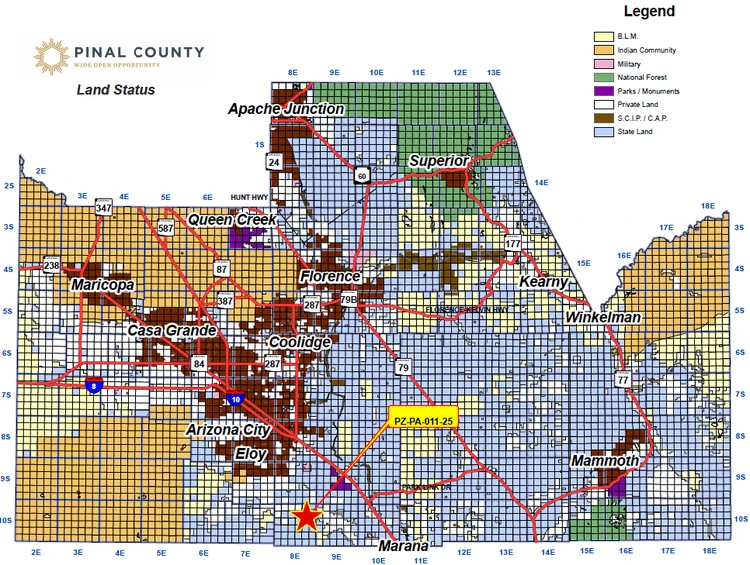
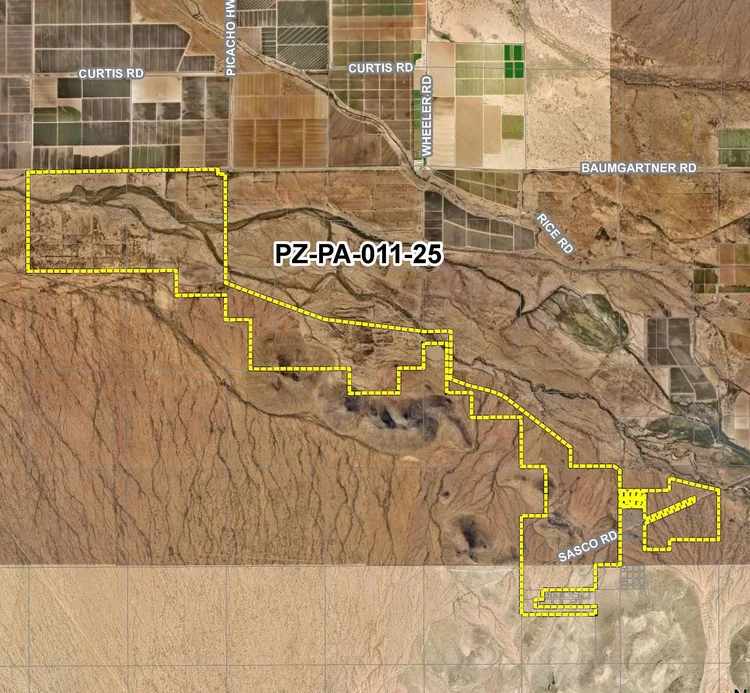
This hearing is where the actual zoning would change and binding development rules would take effect. If approved, the land would shift from General Rural (GR) zoning to Industrial (I-3), and a Planned Area Development (PAD) overlay would set project-specific standards for permitted uses, building heights, and design requirements. The commission’s vote would be a recommendation to the Board of Supervisors, which would hold its own hearing before making a final decision. Developer Vermaland LLC, represented by attorney Court Rich of Rose Law Group, is requesting two actions under cases PZ-003-26 and PZ-PD-003-26.
What the Commission Will Decide
The commission will vote on two linked requests. The first would rezone 2,393 acres from General Rural (GR), which allows low-density homes and ranching, to Industrial (I-3), which allows facilities like data centers and power plants. An additional 992 acres would be designated as Proposed Open Space. The second request would apply the PAD overlay, which sets project-specific development standards, across the full 3,385 acres.
The PAD overlay specifically allows data centers, gas-fired power plants, battery energy storage, and associated office and facilities including fire district stations and sheriff’s facilities. Battery storage appeared in early project planning documents but was not part of the proposal when the commission reviewed it. During the October 2025 commission hearing, Court Rich stated the project had no battery storage planned. It now appears in the rezoning application.
What Would Be Built on the La Osa Site
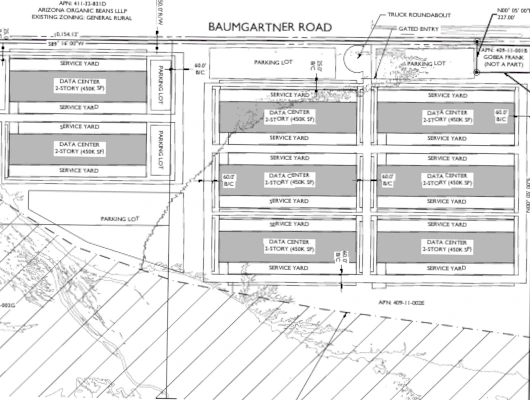
According to the staff report, the project could include up to 59 data center buildings, two gas-fired power plant sites, and battery energy storage built across three phases. The developer has stated the project represents nearly $20 billion in investment. The PAD overlay would increase the maximum building height from 50 feet to 60 feet. About 23% of the site would be developed, while roughly 30% would remain as undisturbed open space including the Greene Wash area.
Power Generation and Water Use
The La Osa project would generate its own electricity on site using gas-fired power plants. The developer is working with Electrical District 4 on the technical details. Specific power generation capacity has not been determined. During the October 2025 hearing, Rich said the project is planning for hundreds of megawatts but that the final figure depends on coordination with Electrical District 4. Battery energy storage capacity has also not been specified. Existing high-voltage power lines already cross the property, and a natural gas supply line is located approximately 2.5 miles away.
The developer has committed to not using water-cooled technology for the data centers. Court Rich stated during the October 2025 commission hearing that the project would use air-cooled or closed-loop cooling systems rather than water-intensive evaporative cooling. Rich stated this commitment would become a legally binding stipulation at the zoning stage. The preliminary site plan shows evaporation ponds near the gas-fired power plants. During the October 2025 hearing, Rich stated the gas plants would use minimal water for cooling. For water supply, private wells and septic systems would serve the initial phases. Global Water has agreed to be a potential public water supplier as the development grows.
Site Location and Surroundings
The surrounding area is zoned General Rural (GR), allowing only low-density rural use, and is largely vacant. The property has carried its GR zoning since 1962. The site also sits within the Arizona Department of Transportation’s preferred alignment for the future Interstate 11 freeway.
Flood Zone and Environmental Concerns
A large portion of the site falls within FEMA Zone A, a federal high-risk flood designation meaning there is at least a 1% chance of flooding in any given year. According to the Area Drainage Master Plan referenced in earlier proceedings, the Greene Wash receives approximately 10,000 cubic feet per second of stormwater runoff from the Casa Grande-Eloy Watershed. A full flood study will be required before the county approves detailed site plans.
During the 2025 comprehensive plan amendment hearings, commissioners and environmental groups raised concerns about flooding risks, wildlife corridor impacts, and desert ecology. Those discussions are covered in detail in the previous Pinal Post articles linked below.
The rezoning stipulations include environmental and archaeological protections. These require undeveloped buffers along the Greene Wash, the Santa Cruz Wash system, and riparian areas. They also require wildlife-friendly fencing, native vegetation preservation, saguaro salvage, and a cultural resources mitigation plan, which is a plan to protect any historical or archaeological finds. The Arizona State Museum has identified 28 archaeological sites that intersect portions of the project area.
Fire, Noise, and Lighting
The Avra Valley Fire District confirmed it will provide service to the project once the property is annexed, or formally added, into the district’s coverage area. A service agreement will be finalized before building permits are filed. The developer has offered to designate and donate a site for a future fire station if the district determines one is necessary.
The staff report also addresses noise and lighting standards, including sound walls, shielded lighting with motion sensors, and unfenced wildlife corridors per Arizona Game and Fish Department guidelines.
How the La Osa Energy and Data Center Approval Process Works
Pinal County uses a multi-stage process for large developments. The La Osa project has already completed the comprehensive plan amendment stage, receiving three favorable votes along the way. A Citizens Advisory Committee recommended approval with an 11-4 vote on September 4, 2025. The Planning and Zoning Commission recommended approval by a 7-3 vote on October 16, 2025. The Board of Supervisors followed with a unanimous vote on November 19, 2025.
If the rezoning is ultimately approved by both the commission and the Board of Supervisors, the project would still require detailed site plans, engineering permits, and floodplain use permits before construction can begin. Those remaining approvals are generally handled at the staff level.
County staff has recommended that the commission forward approval of both requests to the Board of Supervisors. The rezoning recommendation includes one stipulation. The PAD overlay recommendation includes 33 stipulations covering environmental protections, infrastructure requirements, and design standards.
Community Response and Support Letters
At the time of the staff report, county staff had received four letters of support and no letters of opposition for the rezoning cases. This contrasts with the earlier comprehensive plan amendment stage, which drew 27 letters of opposition and nine in support. Support letters for the rezoning came from neighboring landowners and the Arizona Technology Council.
Opposition during the 2025 hearings focused on flooding, wildlife habitat, water usage, desert ecology, and utility costs. Those concerns are covered in detail in the previous Pinal Post articles linked below.
How Residents Can Participate
The public hearing takes place at 9:00 a.m. on April 16, 2026, at the Pinal County Emergency Operations Center, 301 E. 11th Street, Florence, Arizona. Anyone may attend and speak.
For questions, residents can contact Planning Supervisor Sangeeta Deokar at [email protected].
Topics Covered in Previous Reporting
Pinal Post has published three previous articles covering the La Osa project in detail. These articles contain additional information on flood zone analysis, environmental testimony, wildlife corridor concerns, land subsidence (sinking ground) and earth fissures (ground cracks), landowner perspectives, commissioner debates, project layout challenges, energy infrastructure details, and public comment from both supporters and opponents.
- La Osa 3,374-Acre Energy and Data Center Complex Adds to High-Risk Flood Zone Proposals in Pinal County (July, 2025) — Covers the initial Planning and Zoning Commission work session, flood zone challenges, commissioner concerns, and environmental preservation areas.
- La Osa Power and Data Center Complex Advances Despite Concerns Over Details and Environmental Impact (October, 2025) — Covers the 7-3 commission vote on the comprehensive plan amendment, economic projections, water cooling commitments, energy details, and public testimony.
- La Osa Data Center with On-Site Gas Power Wins Board Approval (November, 2025) — Covers the Board of Supervisors’ unanimous approval, the $20 billion investment figure, fire safety planning, noise concerns, and supervisor perspectives.