Key points
- The Planning and Zoning Commission voted 4-3 on Nov. 12 to table the PhoenixMart data center rezoning. It returns to the commission in January.
- Commissioner Garrett Aldrete sought the delay. He wants lighting and architectural standards for large buildings written into the plan, not left to a later permit.
- The amendment would change allowed uses on 251 of the development’s 585 acres. Data centers, battery storage and grid power plants would each need a conditional use permit.
- The 1.6 million-square-foot PhoenixMart building has stood unfinished since the mid-2010s and has never opened. Few users can afford to complete it, and a data center is one of them, applicant attorney Court Rich said — the only option the landowner has found in 12 years.
- The elected City Council decides the rezoning. The Planning Commission, whose members are unpaid volunteers, decides the permit that would actually allow a data center. Vice Chair Celeste Garza called that “a cop-out.”
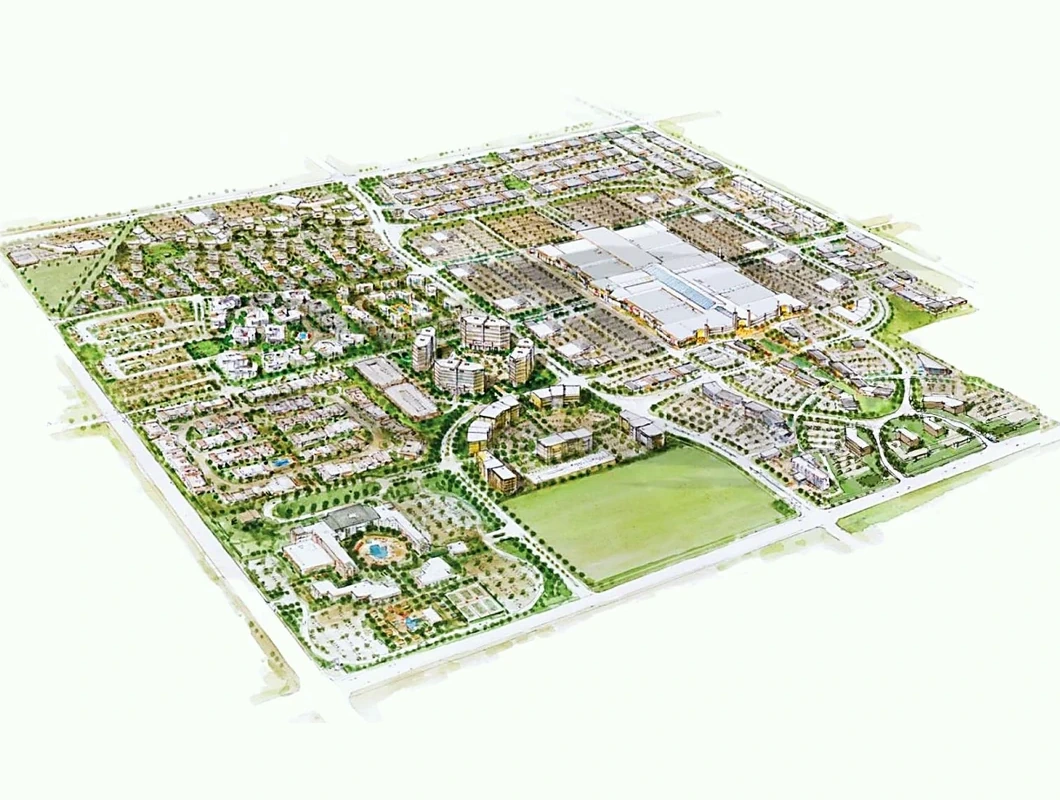
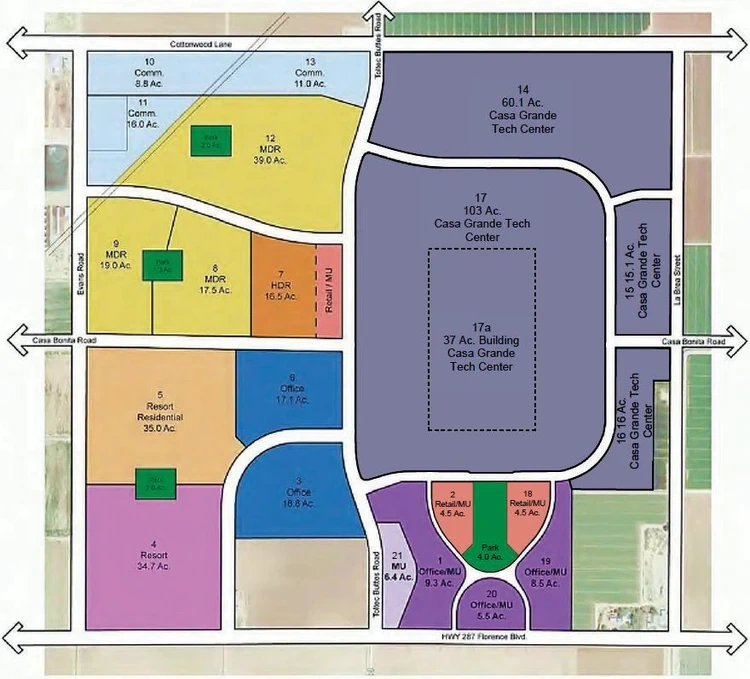
- The city’s General Plan designates the land around the site overwhelmingly for neighborhoods, Senior Planner Jim Gagliardi said. The development plans about 855 homes of its own, west of the tech center area.
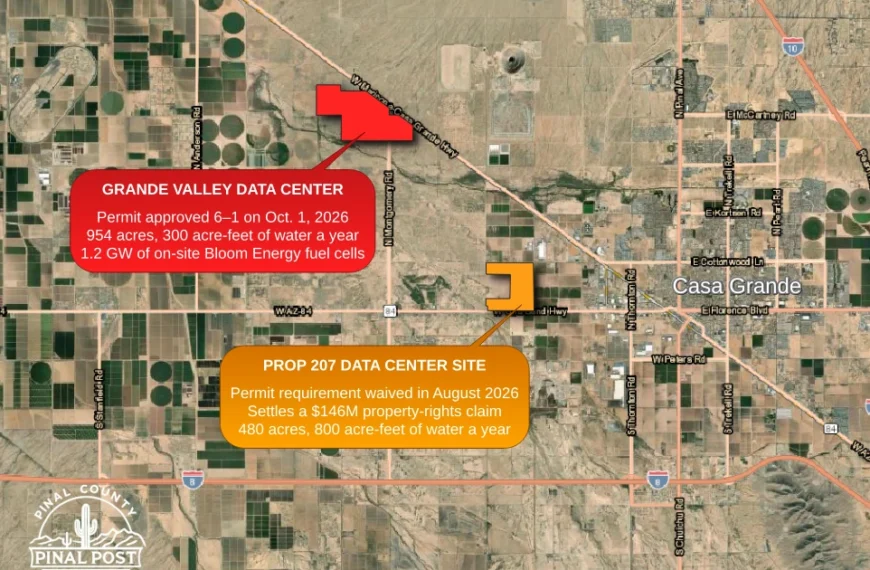
- The city’s industrial area is on the west side, Commissioner Chris Hubbard said, and the PhoenixMart site, on the east side, should keep its zoning as it is. Garza said the Grande Valley Data Center, approved in October, sat between two mines, a railroad and a wash, where nobody was planned to live.
- Minimum setbacks run 500 feet for data center buildings and 200 for battery storage, from land zoned for six or fewer homes per acre. The development’s densest housing parcel sits above that line. The commission can require more at the permit stage, but not less.
- Neither the amendment nor the original 2015 plan sets a decibel limit for data center equipment. The 55-decibel rule both contain covers amplified sound, measured at the development’s outer boundary. Any equipment limit would come as a permit condition.
- The applicant projects 261 permanent jobs. Its study puts Casa Grande’s tax share at $29.1 million during construction and $2.8 million a year after, Pinal County’s at $13.9 million and $162.6 million over 25 years.
- Twelve people spoke at the hearing. None supported the request.
CASA GRANDE, AZ — The Casa Grande Planning and Zoning Commission voted 4-3 on Nov. 12 to table the PhoenixMart data center rezoning. The request would change allowed uses on 251 acres of the stalled site, to be known as the Casa Grande Tech Center, clearing the way for a data center to be considered there. The commission returns to it in January, delaying City Council review. Commissioner Garrett Aldrete asked for the pause. He wanted lighting and architectural standards for large buildings written into the zoning plan rather than left to a later permit.
Rose Law Group filed the request for landowner AZ Sourcing LLC to amend the 585.9-acre NALTEC-PhoenixMart planned area development, or PAD. Inside it, warehousing, laboratories, light manufacturing, machine shops and offices would need only staff-level site plan approval. Data centers, battery storage, power plants selling to the grid and heavier manufacturing would need a conditional use permit, or CUP, at a later hearing, and could be heard together. Staff recommended approval, subject to a condition requiring the owner to give the city land for future roads. The council had been set to hear it Dec. 21.
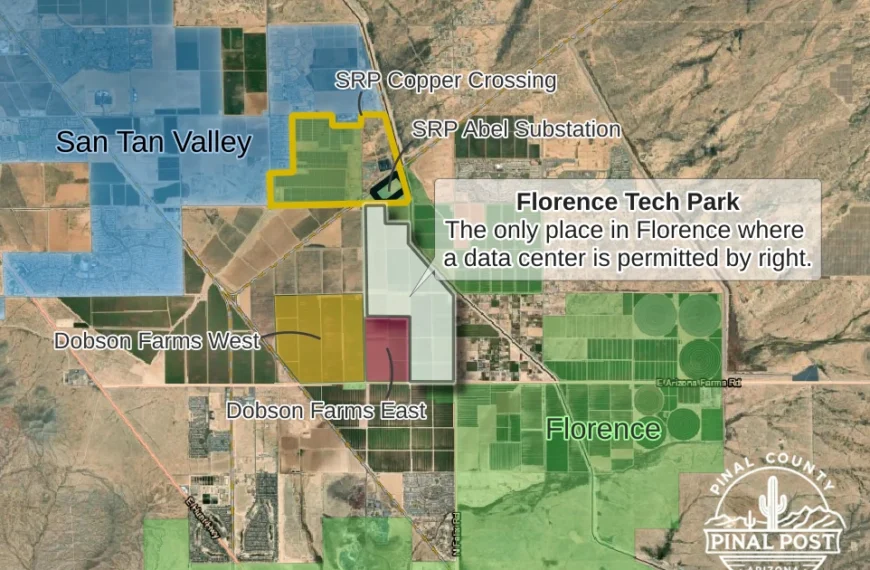
The Casa Grande Tech Center amendment area, outlined in red, is on the city’s east side, about three miles from Interstate 10, with the existing PhoenixMart building shaded within it. Turn on the planned area developments layer to see housing and other land uses already approved by Casa Grande, color-coded by intended use. Zoom out to explore data center and energy projects in and around Casa Grande. Click any colored area for project details, recent developments and current approval status. (Map: Pinal Post. Planned developments: City of Casa Grande, November 2026; may not reflect every later amendment. Imagery: USDA NAIP 2025.) · Open the map full-screen
Garza Calls Conditional Use Permits “a Cop-Out” at Her Final Meeting
Vice Chair Celeste Garza opposed the amendment and questioned how Casa Grande decides on data centers. “I feel like CUPs are kind of a cop-out for council,” she said. “We ultimately have to make the decision up here when I think it should be the elected officials making the decision on types of projects like this.”
A data center needs two approvals from two different bodies. The elected City Council decides the amendment, which only makes a data center eligible. The Planning Commission, whose members are unpaid volunteers, then decides the permit that would allow one. Applicant attorney Court Rich confirmed the split: “This is where the buck stops with you all on conditional use permits.” The commission used that authority on Oct. 1, approving the permit for the 954-acre Grande Valley Data Center 6-1 — its own decision, appealable within 10 days and only by the applicant or an owner within 300 feet.
Garza also tied the request to PhoenixMart’s history. “It’s where the city got sold a bill of goods on a future development that never saw the light, and I fear we’re doing the same thing again here tonight,” she said. She then compared the site with the Grande Valley Data Center.
— Vice Chair Celeste Garza
“It’s a no on my side,” she said. “Tonight’s my last meeting, so I was just gonna say it all.”
Aldrete Wants Lighting and Design Rules Written Into the Plan
Aldrete agreed something must be done with the building. However, he said the original plan overlooked how its industrial portion would fit with everything around it. Its lighting standard amounts to directing fixtures downward, he said. “That is it.” The rule, unchanged from 2015, also requires shielding that aims light away from residential uses and lets the city call for landscape buffers. It sets no limit on brightness or light color, the standards Aldrete wanted. When the plan is silent, city code applies, and he said the outdoor lighting code dates to 1983, before white and blue LEDs existed.
“Our city code is not robust enough to handle the compatibility issues that come with this,” Aldrete said. “If we don’t put those standards on there, somebody could come in with very bright white cold colors that are disruptive to people and neighborhoods.” Securing a building that size will take a lot of light, he said, and bright lights across a site that large could become more of an eyesore than the empty shell. He also said the plan lacks the architectural variation the city requires of self-storage buildings, adopted because such buildings are large and can become eyesores if poorly designed. “Those standards, in my opinion, need to be written into the PAD and not at a later point in time,” he said, and should apply to any large building, not only a data center.
Rich responded that the applicant is “certainly happy to stipulate to being dark sky compliant,” was fine with the self-storage rules and expected them at the permit stage. “If you want that at the PAD stage, we’re happy to have that applied to us,” he said.
Aldrete said he would rather the applicant draft the standards than have the commission write them from the dais, and signaled a continuance. “If the interest is to have those standards, we’re happy to take that continuance and write that, if there’s no opportunity to do that tonight,” Rich said.
Hubbard Cites Lack of Regulation; Benedict Sees Little Change From the Existing PhoenixMart Plan
Commissioner Chris Hubbard said the city already has an industrial area to the west and this zoning should stay as it is. “I honestly believe that the data centers are not regulated at this moment,” she said. “I’m in the mortgage industry, and we weren’t regulated, and look what happened to us.”
Chairman Brett Benedict saw it differently. He had expected the existing plan to fill the land around the building with “a whole lot of warehouses” and constant truck traffic, “in and out, in and out.” Compared with that, he said, the amendment worried him less than he had expected, and he doubted it allows much more than the current plan already does. He remained concerned about industry beside the housing planned around it. He cast the last vote against tabling: “I don’t wanna table it. I wanna decide now.”
What the PhoenixMart Data Center Rezoning Would and Would Not Approve
A standard rezoning assigns one of the city’s off-the-shelf zones. A planned area development instead spells out what one property may do: which uses are allowed outright, which need a permit, and the site’s own limits on height, setbacks, parking and design. It therefore defines the 251 acres more precisely than a rezoning would, replacing the business park and support retail categories around the building with a single Casa Grande Tech Center category. A use not on the list can still be allowed without a hearing if the city’s planning director finds it similar to a listed one.
At the permit stage the applicant must satisfy four tests, among them that abutting properties face no significant adverse impact. For data centers, Senior Planner Jim Gagliardi said the city imposes water and energy caps, a noise limit and decommissioning rules. However, Planning and Development Director Dan Coxworth said the council has not formally adopted those measures: they are standard conditions used on two data centers so far, and vary with a project’s impact on surrounding communities. Neither the amendment nor the 2015 plan sets a decibel limit for the equipment a data center runs. The 55-decibel rule both carry covers “amplified sound level (generated from an amplified sound system)” at the development’s outer boundary, a holdover from a plan whose commerce uses included nightclubs and outdoor entertainment. Where both are silent, each says the city zoning ordinance controls.
Commissioner Cortez Smith asked whether state legislation after the recent election could affect the site, particularly on water. Gagliardi said the city may tighten standards as laws change, and the permit process lets it judge each project “case by case as it comes in.”
The General Plan designates the site Large Mixed Use, which supports a mix of industry, homes and businesses. The surrounding land is designated overwhelmingly for neighborhoods, Gagliardi said. Industrial uses may cover no more than half the development; the tech center area is 43 percent. Asked by Smith about industry surrounded by planned homes, Gagliardi said buffers are the hardest part, and the permit stage is where the city can press for more landscaping and better design. Because one owner controls the entire development, he added, good buffers are in that owner’s own interest: the homes on the other side of the road are part of the same project.
Inside the Proposed PhoenixMart Data Center
Rich introduced DataX Energy chairman and founder Herb Hughes, Tom Strickland and landowner Marshall Stahl; DataX would handle Phase 1. Strickland has 40 years of experience building, auditing, designing and securing data centers, Rich said. The plan is to retrofit the 37-acre, 1.6 million-square-foot shell into a data center on a mix of grid electricity and on-site generation, which the written plan calls “bring your own power.”
— Court Rich, Rose Law Group
The remaining 334 acres would stay as planned, Rich said. The applicant’s presentation lists 90.5 acres of open space across the whole development, 19.4 of it parks.
— Court Rich
Rich said the applicant accepts the stipulations now standard for data center projects. The cooling will not use water, he said, and “at the CUP stage, we’re prepared to stipulate to water restrictions and caps and reporting, just as the city has demanded.”
PhoenixMart: From Global Wholesale Hub to Idle Shell
The PhoenixMart PAD was first approved in 2012 for a wholesale sourcing center meant to draw buyers from around the world. What followed:
- Nov. 7, 2013: Groundbreaking ceremony, per a press release from Rep. Paul Gosar’s office, which said the project would create about 9,000 jobs.
- 2014: Construction begins, per the applicant’s presentation.
- July 1, 2015: The City Council approves the last amendment to the PAD. It renamed the plan NALTEC (Phoenix Mart), changed the uses on the office-warehouse lots north and east of the building and on a live-work site, and adjusted road sections and landscape widths.
- 2017–2021: The shift to online retail and the COVID-19 pandemic halt the project, per the applicant’s presentation.
- 2021 on: The building sits idle, per the applicant’s presentation.
- 2026: The Casa Grande Tech Center amendment is filed. The commission tables it Nov. 12.
The amendment narrative says the shell was built “and then abandoned.” The building has never opened.
Around the building, current zoning allows warehousing, product development and testing, commercial, offices and support retail. West of Toltec Buttes Road, the plan allows a resort, commercial, offices and about 855 medium- to high-density homes. The 2015 plan gave the tech center ground separate use lists by category, among them the PhoenixMart building and parking and a business park; in both, light manufacturing, offices and product testing were already permitted outright. Data centers, battery storage and energy generation are named for the first time.
Building Heights, Setbacks and the Homes Planned Nearby
Height limits would not change: 75 feet in the tech center area, up to 200 with a conditional use permit, and up to 45 feet in the residential portion west of Toltec Buttes.
Gagliardi called the area rural farmland but noted two residential neighbors: the planned homes across Toltec Buttes inside the development and property along La Brea already zoned residential. Aldrete asked about a third, the subdivision approved a couple of years ago south of Florence Boulevard that commissioners named as Post Ranch; Gagliardi confirmed it holds certificates of assured water supply. Post Ranch 589 LLC was among the 13 landowners the applicant notified.
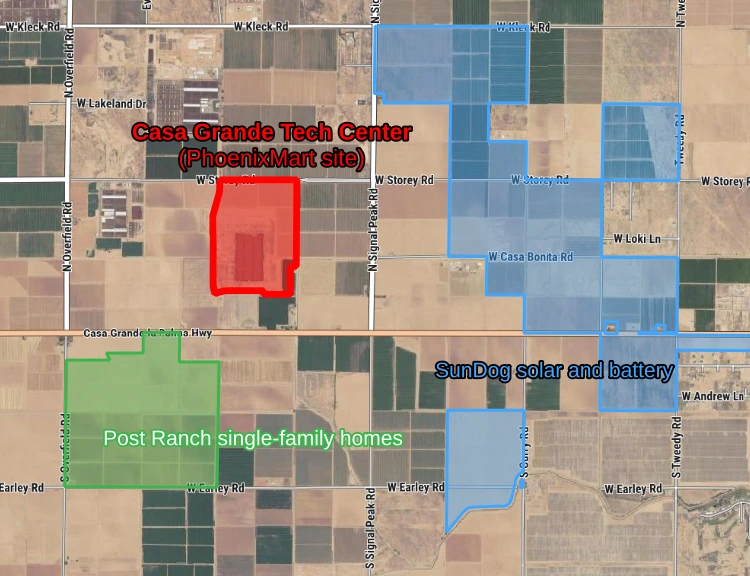
The amendment’s surrounding context section names four neighboring planned developments: Overfield, covering virtually all the land north of Florence Boulevard around the site; a Storey Farms parcel on the east; and Post Ranch and EJR Ranch to the south. To see them, turn on the Planned Area Developments layer under Casa Grande Maps on the interactive map above; each is shaded by housing density or use.
The 2015 plan required 550 feet between the PhoenixMart building and single-family development. The amendment replaces that with 500 feet for data center buildings and 200 feet for battery storage, tying both to land zoned for six or fewer homes per acre. The development’s densest parcel sits above that line, planned for 330 homes on 20 acres. “That five hundred feet is a standard that can’t be lowered,” Gagliardi said, and the commission could require more at the permit stage. Other industrial buildings may stand 20 feet from a property line. Gagliardi said the differing uses would be separated by Toltec Buttes Road, the planned spine road, and that the traffic analysis shows likely lower volumes than the original retail center, because light industrial uses generate fewer trips.
PhoenixMart Data Center Jobs, Wages and Tax Revenue
Elliott D. Pollack & Company projected the economic impact, and Rich said the job estimates cover only the data center portion. Construction would support 6,766 job-years, one job for one year, and $480.9 million in wages. Once open, the facility would support 261 jobs with $20.2 million in annual wages. Of those, 142 would be at the data center itself; the other 119 are jobs the study expects its spending to support elsewhere in the economy. Smith asked how that figure was reached; Rich said the economists produced it and he views it as “rather conservative.” Hubbard asked how that compared with the Grande Valley Data Center, approved in October. Coxworth called it a much larger project; that applicant’s slides listed about 450 on-site jobs at full build-out.
The study puts Casa Grande’s share at $29.1 million in construction-period taxes and $2.8 million a year once operating, or $72.2 million over 25 years. The city’s elementary and high school districts would share $9.5 million a year, or $236.7 million; Pinal County $13.9 million during construction and $162.6 million over the 25 years, most of it from the fuel cells. The study projects $869.6 million in all, from the data center and its energy facilities together. Rich said such facilities are often a community’s largest taxpayer, which “can have the effect of lowering everyone else’s taxes or keeping their taxes lower.”
Who Pays for Sewer, Water and Power
Aldrete asked whether a development agreement from PhoenixMart’s groundbreaking spelled out who was on the hook for utilities, sewer in particular, and whether it still applies. He noted Arizona Water Company may partner with the city on an east-side wastewater reclamation facility. “Personally, I don’t think we should give up utility power to private companies,” he said.
Rich said the developer will pay for the infrastructure to serve its site. Coxworth said the east side of Interstate 10 is at sewer capacity, and that the city, the applicant and other landowners are talking with Arizona Water about extending lines. “Didn’t really get answers, but okay,” Aldrete said.
Hubbard asked whether Electrical District No. 2 can supply the project. Rich said the applicant is in a study process with ED2, and the plan involves “an amount of grid power, but then also on site, the development of a mix of rooftop solar, there’s gonna be a large roof, battery energy storage and fuel cells.”
— Court Rich
Notification Radius Questioned From the Dais
Garza asked why outreach on such a large property reached only 13 owners. Gagliardi said city code, amended within roughly the past year, sets a 300-foot minimum, and the applicant mailed notices a half mile out at staff’s discretion. Garza suggested 2.5 miles instead. Hubbard asked whether Mission Valley, which she called the closest neighborhood, was contacted; Gagliardi said staff did not reach that far west. The applicant met the Mission Royale HOA president and manager on Sept. 25, its citizen participation report says, and held a neighborhood meeting Nov. 9.
Residents Raise Water, Power, Noise and Trust Concerns
Twelve people spoke. None supported the request.
Water led. Andrea Varela of Rural Arizona Engagement said the region is in a mega drought, Colorado River cuts take effect next year, and Pinal County farmers have lost virtually all their Colorado River water. She asked the commission not to approve a third data center without a report on water and energy use, and said Proposition 207 allows exceptions to protect public health. Others disputed that the cooling would use no water, asked what the water would be for if not cooling, and sought a study on nearby dairies and livestock.
On power, Malorie Martinez described power outages lasting days during her childhood in the San Carlos Irrigation District service area, which she said covers the site. “If we reach our energy capacity, who will take priority when the power outages are imminent?” she asked, citing people who depend on oxygen or refrigerated medication such as insulin. William Cassalata said energy use rose 6 percent in a year after data centers came to Phoenix, and that APS sought rate increases of 14 percent for residents and about 30 percent for businesses. He wanted an outside party or government agency to enforce any promises made.
Several doubted the economics. Varela said PhoenixMart promised 9,000 jobs and delivered a shell. Michael Packard, who works in tech, said AI companies carry trillions in hidden debt and “the bubble is popping.” Speakers said the jobs will never materialize, questioned how a finished building generates construction jobs, and said many data center jobs are remote. Cynthia Jones of Arizona City called DataX Energy unproven, formed only in February 2026, and asked why landowner AZ Sourcing has done nothing since 2012. Jose Lopez said he would welcome manufacturing on the site but not a data center. Rebecca Jones said the other 330 acres could hold vocational schools, labs, resorts and homes instead, doubted her taxes would fall and wanted the 261 jobs described.
Health and noise drew the rest. Gloria Johnson-Storie, who has asthma, asked how diesel backup generators would affect air quality. Jack Lacommare said residents near facilities elsewhere, including in Arizona, have reported low-frequency humming and disrupted sleep even where the facilities stayed within their noise limits, and that he does not believe “an abandoned commercial development automatically makes this an appropriate location for a data center.” Speakers cited heat and noise from generators and transformers, the prospect that no one would build next door, and the applicant’s silence on stormwater retention, lithium battery heat, the urban heat island and who supplies the “bring your own energy.” Nancy Wood, who rescues burrowing owls, said generators and gas turbines would harm a fragile environment and the building would be a worse eyesore as a data center. Audra Taylor said she helped stop a Michigan data center, linked data centers to cancer and worries about rising bills. Connie Goss urged a one-year hold to learn from other states.
Rich Responds: “This Is Not a Data Center Application”
Rich said the missing water and energy data belongs with a later conditional use permit, not with the PAD amendment before the commission. “This is not a data center application in front of you,” he said. “This is an application that just allows someone to come to you to ask you if they can try to solve this problem that is this building using a data center.” Arizona has 180 operating data centers, he said, and he knows of only one published complaint about an operating facility, in Chandler in 2014.
On enforcement, he said the developers “are gonna be investing literally billions of dollars, and if they don’t follow those conditions, they risk losing that investment.” On power, he said SCIP, the San Carlos Irrigation Project, “has tremendous problems” but will not serve this site. ED2 will, and “we fully expect them to hold us accountable.” To the claim that no one will live near a data center, he cited Eastmark in Mesa, where he said million-dollar homes sit 1,000 to 2,000 feet from a Meta AI data center.
PhoenixMart Rezoning Returns in January; a Data Center Would Still Need Its Own Permit
Aldrete moved to table the request so the applicant could “come back with additional standards for the building,” which he said were not permit requirements. Garza and Hubbard questioned the delay. “Why are we tabling it?” Garza asked. “Let’s make the decision.”
City code allows a tabling of no more than 70 days, which reaches January. The motion set no conditions on the applicant.
Ibrahim, Andrew Clegg, Smith and Aldrete voted yes. Hubbard, Garza and Benedict voted no.
Benedict and Garza, both no votes, leave the commission before the next meeting. If the council later approves the amendment, a PhoenixMart data center would still need its own conditional use permit. The applicant’s timeline, drawn up before the tabling vote, had that hearing on Feb. 4, 2027.
Case number: DSA-26-00139 (PhoenixMart PAD major amendment).