Key Points
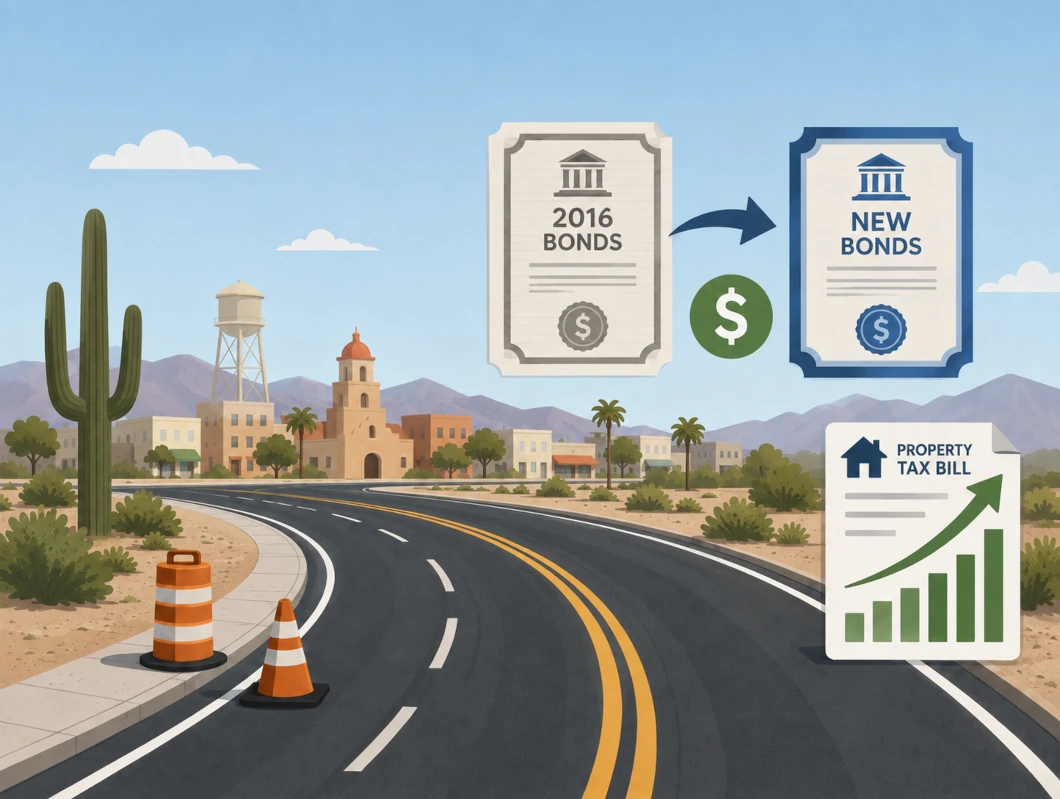
- The city plans to sell $35 million in bonds for street work, including McCartney Road.
- The city’s secondary property tax rate rises from $0.4154 to $1.1291 per $100 of assessed value.
- The sale is expected in early October.
- Voters approved this borrowing in 2022.
- The city may also refinance about $11.24 million in 2016 bonds, saving an estimated $654,831.
- The council voted 7-0 to approve the bond sale.
CASA GRANDE, AZ — Casa Grande property owners will pay a higher secondary property tax rate this year. The City Council has cleared the way to sell Casa Grande general obligation bonds to pay for street improvements and possibly to refinance bonds from 2016. On Monday, Aug. 17, the council voted 7-0 to approve Resolution 5964.
The sale has two parts, totaling roughly $45 million. The first part is $35 million in bonds for street improvements such as McCartney Road, drawn from the $51 million voters approved in 2022. The resolution allows up to $38 million for the street improvement piece. The $3 million difference between the two numbers is a cushion, available only if needed, for issuance costs, unexpected project costs and potential bond premiums. The second part is a separate refinancing of about $10 million. The city would borrow that amount from new investors and use it to pay off older 2016 bonds, so the refinancing itself would not increase the city’s net debt, and it does not use any of the $51 million. The debt being paid off totals about $11.24 million; bond premiums or other city funds could make up the difference, and both figures are preliminary. Staff estimates the refinancing, if it goes forward, would save about $654,831.
The city’s secondary property tax rate, which pays for bond debt, is $1.1291 per $100 of assessed value for fiscal year 2026-27. That compares with $0.4154 last year, according to the preliminary offering document. Finance Director Brenda Hasler told the council the city anticipates holding the rate level for the life of the bonds. Meanwhile, the bond sale is expected in early October.
Where the Money Comes From and Where It Goes
A bond is essentially a loan from investors to the city, paid back over time through the secondary property tax. Raymond James, the underwriter, would buy the bonds and resell them to investors, who earn interest until the city pays them back. Each group of bonds carries a formal name that identifies it in city records and financial markets. The street bonds are Series 2026A; the letter simply distinguishes them from the refinancing bonds, Series 2026B, sold in the same offering. The street bonds are scheduled to be repaid between 2027 and 2046. Underwriter Nick Dodd said the city expects to lock in a fixed rate of about 4% for 20 years.
All of the $35 million is for streets, but it arrives in two ways. According to the staff report, the city has already spent General Fund money on street improvements ahead of the bond sale, and the report notes that without the sale, that money would not be reimbursed to the General Fund. The rest will remain available for the authorized street improvements.
Council discussion identified McCartney Road as part of the street work the $35 million is intended to fund.
How the 2022 Vote Led to the Casa Grande GO Bonds
The funding traces back to a special bond election on Nov. 8, 2022. Voters authorized $51 million in general obligation bonds for streets and transit improvements. This sale is the first from that authorization, according to the preliminary offering document. Hasler said the remaining portion is intended for future years, potentially in fiscal year 2028.
Voters approved more borrowing at a second election on Nov. 4, 2025, when Proposition 496 authorized $67 million for parks and recreation projects. After this $35 million sale, the city will have about $83 million in authorized but unissued bonds from the 2022 and 2025 elections combined, according to the preliminary offering document.
Before the sale, the city sought credit ratings. Dodd said Fitch and S&P Global visited the city earlier this summer, were impressed with its growth, and delivered very positive rating outcomes. The preliminary offering document lists a AAA rating from Fitch.
Refinancing the 2016 Bonds
The refinancing works much like refinancing a mortgage, Dodd explained. The city would sell the Series 2026B bonds and use the proceeds to pay off older bonds. According to the staff report, the new bonds would not extend the repayment period.
Staff asked for authority to refund portions of two sets of bonds the city sold in 2016, known as the 2016A and 2016B bonds. Hasler said the 2016A bonds financed the design, construction, furnishing and equipping of the recreation center under a bond authorization voters approved on Nov. 7, 2006. City financial records show the 2016B bonds were themselves a refinancing, issued in 2016 to replace older city debt. Hasler said the bonds could not be replaced with new ones until Aug. 1, 2026, and Dodd said that restriction is why the city could only start considering the refinancing this year. As of now, though, only the 2016B bonds are in the refinancing plan. The preliminary offering document lists about $11.24 million of 2016B bonds coming due between 2027 and 2034, all carrying a 4% interest rate.
Staff estimates the refinancing would save about $654,831. Hasler said those savings would have a direct impact on the General Fund.
Dodd said there is a fair amount of volatility in the market, and the city may end up selling only the $35 million in street bonds approved by voters in 2022, leaving the refinancing out. The resolution also sets a floor. The refinancing can go forward only if its savings, measured in today’s dollars and after costs, equal at least 2% of the principal being replaced. The resolution permits the entire sale, both the street bonds and the refinancing, but does not require it. If interest rates rise too far or the savings fall short, the city can wait. Hasler said the offering includes guardrails, letting the city wait on the whole issuance if rates rise. Dodd added that it costs the city nothing to have the option.
The resolution also caps interest rates: none of the new street bonds may carry a rate above 6%.
Paying Off the Casa Grande General Obligation Bonds
General obligation bonds are repaid with property taxes, collected as part of the regular property tax bill. For the street bonds, the offering document states the tax may be levied “without limitation as to rate or amount.”
The effect on a tax bill depends on assessed value. Owner-occupied homes in Arizona are assessed at 10% of their limited property value, the taxable value set by the county assessor, which is typically lower than market value. For example, a home with a limited property value of $200,000 has an assessed value of $20,000. At this year’s secondary rate, that home pays about $226 a year toward city bond debt. At last year’s rate, the same assessed value would have meant about $83. As a result, the city’s total property tax rate, including the unchanged primary rate of $0.9643, is $2.0934 per $100 this year, up from $1.3797.
The following five-year history shows how the primary rate has stayed flat while the secondary rate has moved.
| Fiscal Year | Primary Rate | Secondary Rate | Total Rate |
|---|---|---|---|
| 2026-27 | $0.9643 | $1.1291 | $2.0934 |
| 2025-26 | $0.9643 | $0.4154 | $1.3797 |
| 2024-25 | $0.9643 | $0.3184 | $1.2827 |
| 2023-24 | $0.9643 | $0.4197 | $1.3840 |
| 2022-23 | $0.9643 | $0.3993 | $1.3636 |
Rates per $100 of assessed value. Source: preliminary offering document, Table 9.
Hasler said keeping the rate steady depends on two things. First, the city assumed its total assessed valuation would grow an average of 2.5% a year. Second, it plans to use funds the city already has on hand. Therefore, she said, the secondary rate should stay at about the same level throughout the repayment term.
Interest Rates and the 10-Year Lockout
Councilmember Sean Dugan asked whether the city could refinance again if interest rates fall in two years. Dodd said the new street bonds would carry a customary 10-year period during which the city cannot pay them off early. Investors value that protection, he said, because a reliable borrower like Casa Grande will keep paying them interest for those years, and shortening it would make the borrowing more expensive. In his view, many people would take a fixed rate of about 4% for 20 years. Still, the city could reconsider refinancing in 10 years, something he said Casa Grande has done often.
The same lockout explains why the city is only refinancing the 2016 bonds now. Dodd said the city could have refinanced in 2020 or 2021, when rates were very low, but it was locked out until the August 2026 date. Consequently, the city combined the refinancing with the planned street bond sale.
Councilmember Matt Herman noted the city sells its voter-approved bonds in stages rather than all at once, keeping its options open for future decisions. Responding to Herman’s point, Dodd noted the refinancing opportunity shrinks over time, because some of the 2016 bonds reach their scheduled payoff in the next year or two. With plans for park improvements and other roads still ahead, he said, the council could be discussing bonds again in a year or two, though by then, less of the 2016 debt would be left to refinance.
Council Vote and Final Terms
The council approved Resolution 5964 on a 7-0 vote. The resolution lets the mayor, city manager and finance director set the final terms, including the sale date, interest rates and which 2016 bonds to refinance. Separately, the preliminary offering document notes the city previously filed some required financial disclosures late or incorrectly, and that those items were filed as of July 9, 2026.
October Sale and Future Borrowing
The sale is expected to be completed on or about Oct. 8, 2026. Staff will decide at the time of sale whether the 2016 refinancing goes forward or whether only the street bonds are sold. Meanwhile, the rest of the 2022 authorization could be issued in fiscal year 2028. Beyond that, Dodd told the council the city has plans for park improvements and other roads. Residents can review the full Casa Grande bond sale packet, including the resolution and the preliminary offering document, on the city’s meeting portal.
why can’t the state give seniors on S.S. a break on property taxes. if that is all the income they have it takes a huge chunk out of their check