A Pinal County supervisor says property rights should let the La Osa data center proceed. American land use law has a more complicated answer.
Part 9 of a Series Case No. 2026-PZ-003-26 and 2026-PZ-PD-003-26
Guest opinion column by Eirini Pajak of Pinal Unlocked, published in Pinal Post’s Opinion section. Views are the author’s own.
Update, August 21, 2026: An earlier version of this article stated that no stipulation caps the on-site power plants’ generating capacity. The county’s staff report for the August 26 hearing, dated August 17 but not made public until August 21, includes a stipulation capping the combined generating capacity of the on-site gas plants at 1,000 megawatts. The same report notes that county staff and the Planning Commission have not reviewed the additional stipulations, including the capacity cap. This article has been corrected to reflect the report’s contents.
At the May 27 hearing on the La Osa data center, Supervisor Stephen Miller said he is “a very strong constitutional conservative,” said he has “a hard time telling somebody no” once an applicant meets the requirements, and likened the decision to telling a neighbor what color to paint his house.
This is a property rights argument, and it rests on a real principle. But it is only one aspect of American land-use law, and it verges on treating the vote as a formality.
A rezoning is a discretionary legislative act, not an administrative permit that is issued once an applicant checks the boxes. Meeting the requirements does not entitle anyone to approval; Arizona courts have held a county cannot be compelled to grant a rezoning (Mehlhorn v. Pima County, 1998), and the Board is free to say no.
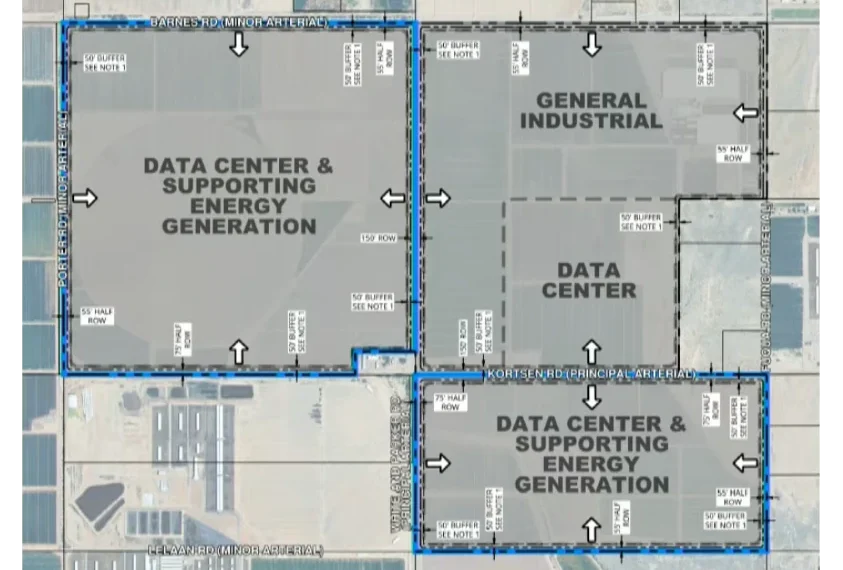
The La Osa project would rezone 2,393 acres south of Eloy from rural to industrial for data centers and gas-fired power, part of a 3,385-acre site. Ahead of the August 26 vote, the applicant, now represented by the firm Earl & Curley, has offered additional stipulations including a cap of eleven data center buildings, down from a proposed 59, each up to 400,000 square feet plus unspecified ancillary structures, and a promise that the developer, not the public, would pay for the electric interconnection.
The stipulations change some details but leave the largest questions untouched. Some restate existing requirements, while others add new disclosure, monitoring and study requirements. But several of the biggest design questions remain unanswered until permitting. There is a noise cap and the developer would cover interconnection costs. There is a building cap, though it limits only data center buildings, not the gas generation, battery storage or other uses the industrial zoning allows. And the one numeric water limit covers only the on-site power plants, not the data centers, whose cooling, depending on the method, could be the larger and more variable draw.
Much of the rest restates what the law already requires or defers the real questions to permitting. Promises to follow water, air and fire code rules bind the owner to obligations that already apply. A few conditions are genuinely new, the decibel limits, and a pledge to meet non attainment emission standards the parcel would otherwise escape, but even these are resolved at the building-permit counter, an administrative review, not a public one. The final cooling method, water demand, power technology and geologic study would not be known until after the vote.
Property rights have never been unlimited
Property rights have never meant that anyone has an unlimited right to use land without regard to its effects on others. That is one of the reasons zoning, setbacks, noise rules and nuisance law exist at all.
The impulse to keep noxious industry away from shared water is old. In the early 1700s, colonial Boston moved its tanneries and slaughterhouses outside the town limits because their runoff drained into the water supply. Over the nineteenth century, American cities progressively pushed the noxious trades to the outskirts, restricting slaughterhouses and piggeries in Philadelphia, Baltimore and New York. Neighbors who sued a noxious use could sometimes have it abated or moved, on the principle that an owner’s rights carried limits where the public welfare required them.
The old maxim, sic utere tuo ut alienum non laedas, use what is yours so as not to injure another, is a foundational principle of nuisance law, and the Supreme Court invoked that tradition when it upheld zoning.
A data center is not a paint color.
Painting a house can hardly be compared to a massive data center development that, together with its power source, would draw heavily on groundwater in a basin where subsidence and earth fissures are well documented.
The applicant is not just a homeowner. It is a set of land-holding companies, Verma La Osa Ranch I-10, Sasco 3700 LLC and Casa Grande 3677 Acres LLC, together with the developer Vermaland, a corporate industrial venture rather than an individual with a paintbrush.
The Constitution protects property through the Fifth Amendment, but the courts have long upheld reasonable land-use regulation as constitutional. In 1926, in Village of Euclid v. Ambler Realty Co., the Supreme Court upheld zoning itself as a legitimate exercise of the police power, which the Court tied to nuisance law. Miller’s conception of property rights leaves out the other half of that tradition: the founders’ law, and the Constitution, hold that an owner’s rights and the community’s authority to weigh them exist together.
“We don’t vote on the water”
Miller’s second argument is that water belongs to the state. “We don’t vote on the water,” he told the board.
He is right that the county does not issue the state’s groundwater permits. But the county does vote on land use. Arizona law gives counties broad authority to consider the impacts of zoning decisions, and the zoning application itself asks the applicant to identify a water source. At the county’s own August 12 work session, Dr. David Ebert, the University of Arizona’s chief AI and data science officer, told the board the same thing: “you have the authority to decide and put regulations on to decide what type of technology and what plans go into your community.”
The Board is not being asked to issue a water permit. It is being asked whether this industrial use belongs on this land. And the state’s own framework has fallen behind.
Kathleen Ferris, who helped write Arizona’s 1980 Groundwater Management Act and now researches water policy at ASU’s Kyl Center for Water Policy, said in a July email responding to my questions that the framework “has not kept pace.” When the Act was negotiated, she noted, copper mining and power generation were essentially the only large industrial users of groundwater. Regulating industrial users more tightly has been discussed for years, she said, but it has not happened. Asked about a basin in long-term overdraft, she noted that general industrial-use permits are governed by state statute and remain relatively easy to acquire.
The project has no irrigation entitlement of its own; the developer has said it would rely on wells and on 1,200 acre-feet of historical water rights under contract from a neighboring property. The applicant’s attorney told the Planning Commission that Global Water, a possible future provider, had issued a will serve letter, but none has appeared in the public record, and the site sits outside the company’s service area.
Any groundwater pumping would come from the Pinal Active Management Area, a basin already in documented decline. ADWR’s groundwater model found more than 8 million acre-feet of unmet demand over the next century, and in 2021 the state stopped approving new groundwater-based subdivisions there.
A new residential subdivision here must prove a 100 year assured water supply, a test Pinal groundwater can no longer meet. A large industrial user operates under a different state permitting system that imposes no comparable assured-supply requirement.
The stipulations bar once-through cooling, the kind that draws fresh water and discharges it, and cap the water for on-site power at 600 net acre feet a year of potable water. But they set no numeric limit on the data centers’ own cooling water, nor on construction or dust control. An earlier engineering estimate, prepared for the larger 59-building version of the project, put total demand in the range of 4,300 acre feet a year, many times the capped figure. And because groundwater is regulated by the state, not the county, it is unclear whether the county could enforce a water limit it writes into a zoning stipulation.
This is not a distant concern. In 2026, on track to be the driest year on record for the Colorado River basin, cuts to the Central Arizona Project have fallen hard on Pinal County agriculture, pushing it to lean even harder on groundwater the basin is already overdrawing. Existing users are being squeezed, even as the county weighs a new industrial use whose data center water draw no stipulation caps.
Not eleven buildings, but 2,393 acres
The eleven-building cap and the 400,000-square-foot limit reach data center buildings only. On-site gas generation and battery storage are governed by separate stipulations added late in the process: the gas plants’ combined generating capacity is capped, but at 1,000 megawatts, the scale of a major utility power station. County staff and the Planning Commission both note they have not reviewed the additional stipulations the applicant offered in August, the building cap, the water and cooling limits and the capacity cap among them. The buildings shrank from 59 to 11; the size of the land being rezoned did not. Vermaland markets itself as a land-banking company and one of Arizona’s largest landholders, and at the May 27 hearing its attorney acknowledged the company would not operate a data center but intends to sell to an end user. The entitlement, not the buildings, is the asset.
The comprehensive plan calls this part of the county one of the most active areas for subsidence and fissures in Arizona, and land near Eloy has subsided up to 19 feet since the 1950s. Immediately to the north, across Baumgartner Road, lies the West Pinal PM10 Serious nonattainment area, which the EPA rates in violation of the federal dust standard; grading fissure prone soil at this scale, on the boundary of a struggling airshed, would add to the strain. To the south the site runs up against Ironwood Forest National Monument and two mapped wildlife corridors that carry desert bighorn sheep and the Sonoran desert tortoise, and the Coalition for Sonoran Desert Protection, which helped establish the monument, has written several opposition letters.
These are impacts that do not stop at a property line, and the rezoning is the one point where the Board can weigh them together before the entitlement is granted. The hardest questions, the cooling method, the true water demand, the geotechnical work, are all pushed to the building-permit stage, an administrative review; any later review would concern how a particular building is laid out, not whether heavy industry belongs on this ground. A permanent industrial rezoning granted to a land banking company is a blank check written to an unknown buyer: the county fixes the land use now, with no numeric cap on the data centers’ own water and no public say over how a future owner will build or operate the site.
What the Board must weigh
Before the rezoning, the project needed a comprehensive plan amendment, which changed the land’s long range designation to one the plan defines to include power plants. But the plan grants no entitlements by its own terms, and it directs the county to weigh subsidence, fissures and water impact in reviewing development. The amendment did not grant the zoning now before the Board, or resolve the questions this ground raises.
Arizona law tells the Board what to weigh. It authorizes counties to zone “to conserve and promote the public health, safety, convenience and general welfare”, and it requires that every rezoning “conform to the adopted comprehensive plan.” The same law directs the Board to consider the individual property rights and personal liberties of the residents of the county.
That means more than the applicant’s rights. It means the farmers drawing the same declining aquifer, and the neighbor who would sit beside a heavy industrial campus. Protecting one owner’s right to rezone does not require setting aside theirs.
Pinal County residents turned out. At the May 27 hearing, 64 of 66 comment cards opposed the project, and at least 174 people filled the main room and two overflow rooms. Roughly a dozen letters and the mayor of Eloy backed the project, but the turnout ran overwhelmingly against it.
American land-use law has never treated property rights as a license to make everyone else absorb the costs of a private use. The vote is not about whether one property owner has rights, but whether this use, on this land, with these consequences, is one the county should authorize.
Whether the rezoning goes forward, and on what terms, is up to the Pinal County Board of Supervisors, who take it up on August 26. The hearing is open to the public, August 26 at 9:30 a.m., at 135 North Pinal Street in Florence. You can make your comment part of the permanent record by emailing [email protected] and including the case numbers 2026-PZ-003-26 and 2026-PZ-PD-003-26.
Eirini Pajak is a licensed real estate agent, freelance photographer and Pinal County resident. She covers local land use and development decisions through her Pinal Unlocked page on Facebook and runs the Pinal Code Watchers community group. Her chiweenie Peso joins her on county rounds and features in the photo series accompanying this work.