Key points
- Developers can give up-front estimates of water use, power needs and how the water will be supplied, a University of Arizona expert told supervisors.
- The county has authority to set rules on data center technology and design, in his view.
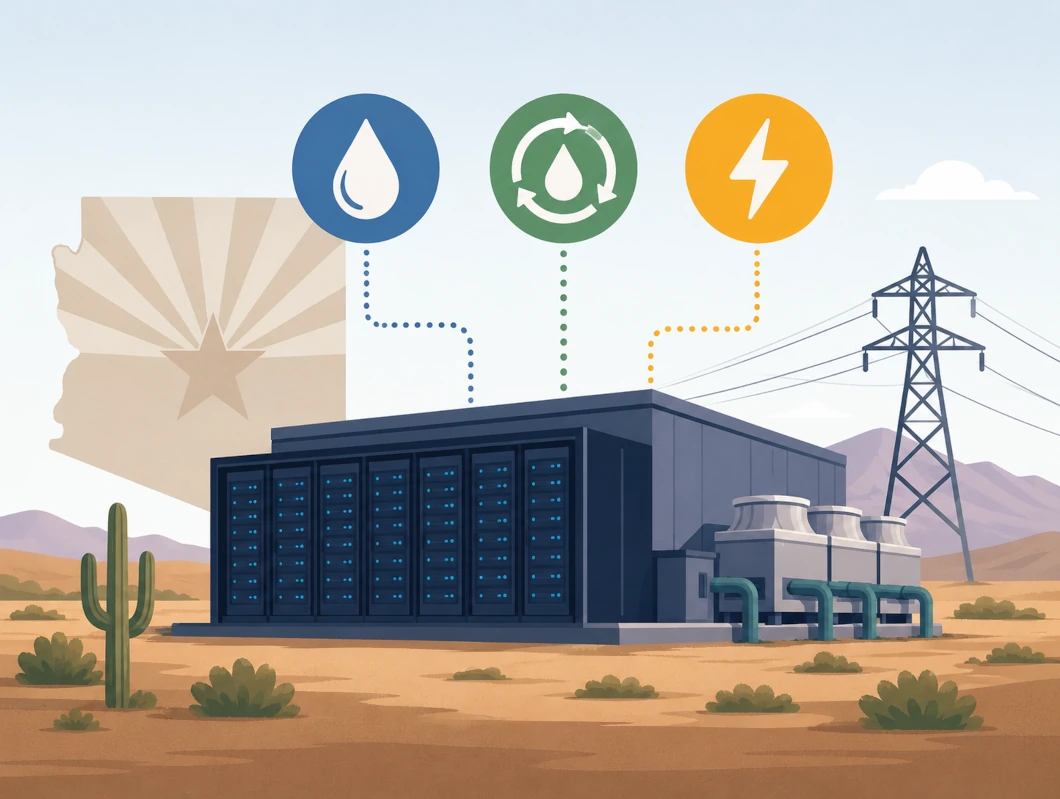
- New closed-loop cooling can make facilities nearly water neutral, he said.
- Regulators are moving to make data centers pay for their own power and grid upgrades.
- Demand for computing will outrun the pace of data center construction for at least five years, he predicted.
- After that, more efficient technology should slow the need for new buildings, he said, but existing ones can be refilled with newer machines.
- Planning commissioners want firm answers on power, water, jobs and location before recommending more projects.
Data center developers can give Pinal County up-front estimates of how much water and electricity a project will need, a University of Arizona expert told supervisors on Aug. 12. In his view, the county also has the authority to decide what technology and plans go into one. David Ebert, the university’s chief AI and data science officer, based the first point on five years of working with data center providers. He offered the second as his own opinion as a computer scientist. Ebert fielded questions on Pinal County data centers during an informational work session of the Board of Supervisors. All five supervisors took part, and the board took no votes. However, the discussion produced a list of open questions. Several planning commissioners said they need answers before recommending more projects, and supervisors pressed for more information. Supervisor Stephen Miller said the market will decide how many get built.
The session comes as county leaders field questions from residents about Pinal County data center proposals. Supervisor Rich Vitiello said his constituents ask about water and power “day in and day out.” Meanwhile, one planning commissioner told the board he cannot recommend projects without knowing whether the county has the water or electricity to support them.
Why the board turned to a University of Arizona computing expert
County Manager Leo Lew opened the item as part of the board’s continuing education series on data centers. The series covers the industry and the utilities that support it. He described Ebert as one of the first industry-experienced experts to appear before the board on the topic. Ebert, in turn, said he was there as “a technical resource for you.” He said he would explain the current state of the technology, some history and the trends ahead.
How AI changed data centers in three years
Ebert traced data centers to the machine rooms of the 1940s and the cloud services of the late 1990s. In 2006, he said, Google opened its first hyperscale data center. Over the following 20 years, the industry moved to more efficient designs. As a result, he said, it now does about six times more computation for the same utility use.
Then came AI. “Over the past three years, we’ve had the demand for AI-enabled technology driving the boom in data centers,” Ebert said. The systems built for AI “have very dense circuits, require a lot of computation,” he said, “and that generates a lot of heat and a lot of electrical use.” Consequently, he said, each rack draws far more power than it once did. Even a Google search now runs AI in the background, so “it takes more resources to give you the same response.” He credited the rapid rise of Microsoft Copilot, ChatGPT and Claude to plain-English access, which “made it accessible to so many people.” Building designs have not kept pace with the hardware, he said. “We’re now playing catch up in that area.”
What supervisors can require of Pinal County data centers
Supervisor Mike Goodman said he had a series of questions for developers. He asked whether it would be reasonable to ask them, “or maybe even put them in part of an ordinance or something that we might possibly do for data centers.” First, can a developer determine how many gallons of water a project will use each year, during construction and at build-out?
“You should be able to get an estimate from them,” Ebert answered. Providers he has worked with over the past five years gave those numbers up front to the boards they dealt with, he said. They also described plans for supplying the water, such as recycled gray water. Goodman then asked whether developers could also state how many megawatts they will need. “Absolutely,” Ebert said. “All the plans I’ve seen, people have been talking to the utility companies, and they can give what their need will be per year for the next five years.”
Ebert also spoke to the county’s role, calling it his own view. Even though he is a computer scientist who understands the need for data centers, he said, he is “very concerned about the environment” and thinks the county needs to ask questions and keep the public informed.
— David Ebert, University of Arizona’s chief AI and data science officer
Planning and Zoning Vice Chair Karen Mooney proposed measuring average temperatures for a full year before groundbreaking. She proposed testing again after a facility is fully running, and doing the same for noise. On noise, she worried about wildlife as well as people, since animals can sense things people miss, and asked how far out the effects would reach. “I completely agree that that should be done,” Ebert said. The county should have accurate studies, he added, “and potentially see what limits you want to put on things as you’re considering it.”
In his opening remarks, Ebert also described a shift in how the industry measures data centers, drawing on what he has heard at international conferences on sustainable, resilient designs. Right now, he said, people pick a single figure, such as power use, water use, heat or carbon. However, there is a growing consensus that all of those must be combined to judge how sustainable and resilient a design is, he said. “We need to get away from just thinking of consumption to what are they doing?” A data center can use the same amount of heat and cooling whether it is sitting idle or doing productive work, he said. So the emerging measure is “how efficiently are you generating computation from everything that’s going in.” In practical terms, that means asking not just how many kilowatt hours or gallons a data center consumes, but how much useful computing it gets from them. He put it as “computation per kilowatt hour” and “computation per water use.”
Water use and the shift to closed-loop cooling
Chairman Jeff McClure described a 400,000-square-foot data center in Goodyear that supervisors toured a couple of weeks earlier. Operators there said they would fill the system once with about 200,000 gallons of water and a like amount of coolant, a 50-50 mix. “Basically, you know, your car radiator,” McClure said. That fill would last seven or eight years before draining. Goodman added that a Google facility in Mesa won approval for “quite a few acre feet” of water. By the time it was built, he said, a closed loop cut that to less than a third, mostly to fill the system. Closed-loop systems like that are now reaching the market, Ebert said.
Direct-to-chip and other liquid-cooled systems are one of the big developments coming forward, Ebert said. They circulate recycled liquid, so they use “zero net liquid or water.” In terms of water consumed, he said, that is much more efficient than evaporative cooling and other water-driven systems. There are single-phase and two-phase ways of doing liquid cooling, he said, and the two-phase systems are making it much more efficient.
Running machine rooms far warmer than the traditional 65 to 68 degrees is “relatively new,” Ebert said. “Just a few people are experimenting with” it, he said. For example, he cited an Intel high-density facility that ran at 95 degrees and needed only a few dozen hours of supplemental cooling a year. A 2015 Intel white paper describing such a facility says servers took in air of up to 95 degrees, and outside air handled the cooling except for “39 hours or less per year.” In Arizona, he said, “given how dry it is, you can actually use air being blown from the outside to pull the heat away from the computer systems.” Overall, he said, available designs mean facilities “can be virtually water neutral or completely water neutral.”
Vitiello said two county officials from other states described harm from low-frequency sound in their communities. He met them at a national conference of county leaders. They also told him closed-loop coolant is toxic when it is dumped, he said. He asked what happens then, noting one community in another state found contamination in local water. He also raised fire risk.
Ebert said he was not an expert on those issues and suggested the county consult one. He has not seen good studies on low-frequency noise, he said. Still, he said, the county can write sound abatement, hours of operation and exterior lighting into approval conditions. On coolant, he said, “having the right processes and procedures and inspections to make sure that works makes a lot of sense.” He said he would not expect fire risk at a well-designed data center to differ from a server room’s.
Mooney raised two cases elsewhere involving water discharged from data centers. She cited a $10,000 fine against Meta in Wyoming after a rare soil bacterium turned up in a city’s wastewater system. She also cited a $20.5 million settlement in Oregon over nitrate-contaminated groundwater tied to industrial wastewater, including from data centers. Meta has appealed the Wyoming fine, and Amazon settled the Oregon case without admitting fault. Mooney also said a closed-loop system, whatever its water savings, still has to be emptied at some point. Echoing McClure’s comparison, she said: “Your radiator does need to be drained. There are chemicals in it.” She urged testing of discharge before it enters any public system. Miller offered a different view. Mechanics drain car radiators every day and antifreeze is already highly regulated, he said, so a data center should be no different. “There’s tons of regulations that are already in place for the discharge of these types of fluids,” Miller said. “And I don’t know that more regulations will help.”
Power: how much data centers need and who pays
Goodman asked whether developers could be a big part of paying for the infrastructure to generate their power. “Absolutely,” Ebert said. Some are building on-site power plants and others use solar, he said. In Pennsylvania and New York State, developers “are hooking into idle capacity or restarting nuclear power plants.” Further out, he said the University of Arizona is working with Department of Energy labs on what he described as their goal of commercial fusion power by 2035. Getting from a lab breakthrough to round-the-clock commercial power is a “big engineering challenge,” he said.
Goodman recalled reading that the Arizona Corporation Commission is looking at requiring data centers to bring their own power so existing customers are not burdened. McClure said a recent executive order or mandate says the same. Ebert said talking with power providers about their plans and the effect on consumer rates is a great idea. At an April 16 workshop this year, Arizona Public Service (APS) and Salt River Project (SRP) recommended a “bring your own power” policy. The commission also discussed aligning with the federal Ratepayer Protection Pledge, announced by the White House in March. It calls on leading U.S. data center operators, known as hyperscalers, and AI companies to build, bring or buy their own power. They would also pay the full cost of the infrastructure that serves them. Then on Aug. 12, the same day supervisors met, the commission unanimously approved a process for six electric cooperatives. Under it, service agreements with very large customers, such as data centers, will follow a common checklist and go to the commission for approval. Those customers will continue to cover all costs of serving them, including new infrastructure and transmission construction, a commissioner said.
Two planning commissioners raised the supply question. Gary Pranzo said APS told commissioners at a recent visit that the county needs to grow its power by 13%. Electrical District 3 (ED3) told them it will lose about 20% when hydroelectric power fails, he added. He called those “very soft numbers,” but said together they mean the county needs about a third more power. Robert Klob said local electric companies told him a new gas line and its power generation are five to 10 years out. Therefore, he said, the county is allocating, or potentially allocating, land for data centers before the power exists. That could repeat the land-use speculation already found across the county, he warned. He pointed to Hidden Valley and South Maricopa, where 80,000 home sites were approved and some have sat as empty, mapped-out lots for 25 years.
Why data centers cluster here and who uses them
Vice Chairman Jeff Serdy said he has asked the same question for a year. Why do data centers need to be here rather than “the most godforsaken part of New Mexico”? “It depends what you’re using it for,” Ebert said. A Google search can run in Oregon or Washington. Providers balance loads nationwide, so “they are all connected in a grid.” However, real-time flood prediction, air traffic control, emergency response and computer-vision-guided surgery cannot wait. “That multi-second to ten-second delay to get something computed remotely can mean the difference between life and death,” he said. “So either you put the compute on site, which doesn’t get used twenty-four/seven, or you do it in a local data center so you can still get that real time.”
Serdy then asked whether some data centers serve one company. Ebert said they do, naming AWS, Microsoft and Meta, which has its own in Arizona for Facebook. Companies like that can build their own or rent from a cloud provider, he said. Serdy said the board “would all be in favor of approving” a data center a specific company builds for its own use “if they need it.” By contrast, he said, vague “we may need this” proposals turn people off. Later, Mooney asked why so many buildings go in one place. Ebert said the power, backup generation and high-speed connections needed for 100-megawatt-plus campuses give companies economies of scale.
Will there be too many data centers in Pinal County?
Vitiello cited figures he found: 82 data centers in Arizona, the sixth most of any state, and 320 in Virginia. He asked how many is too many, especially in 100-plus-degree heat. Ebert said use “is increasing greater than the rate they’re being built.” Therefore, he does not expect over-building within five years that leaves empty buildings. Still, “how many is right for Arizona is a question I haven’t studied,” he added. Everyone should ask why a project should be here, he said.
Vitiello followed up. A data center approved today would take about three years to build, he said. If technology will shrink within five years and fewer data centers will be needed, why keep approving more? Ebert said need will outrun efficiency gains for five to 10 years. The uses range from phone apps to precision agriculture that analyzes video in real time. “I would believe anything approved today that will be constructed over the next three years, and even over the next five years, is going to have demand,” he said. After that, he said, new uses for computing will still grow, but not as fast. He also said the building itself does not need to change as the computers inside are replaced. Newer, more powerful machines can do more work in the same space.
Miller said the market will settle the question. “I think the issue that our society has is they don’t have any faith in capitalism,” he said. “Capitalism will determine when there’s too many data centers. When I build a data center and I can’t sell any space, that will be the end of data centers being built.” He predicted companies will increasingly build their own. An owner left with an empty building “will convert it into something else that’ll be used,” he said. Planning Commissioner Tom Scott said he agreed “a hundred percent” that demand will decide, but his problem is that commissioners “don’t know what we’re getting.” Klob, meanwhile, asked how the county would pivot if a facility that promised to use only 100 gallons of water a day needed double that five years later. Setting regulations is important, he said. He also cited the La Osa project’s proposed 59 buildings and 26.5 million square feet. He said he understands the project has been scaled back. That much construction would strain building trades, he said, which homebuilders in other states say data centers are absorbing. McClure replied that tradespeople follow the work: they left for Texas in the 2007-08 crash and would come here for jobs. Klob responded that the crash hit the whole country, and the data center boom is just as widespread. Construction is under way in Texas, Florida, Georgia, Arizona and California at once. The places local workers came from or went to are seeing the same thing, he said.
Planning commissioners list what they still need to know
Scott said presenters at Planning and Zoning “just know what was on the card,” unlike the Goodyear staff who answered every question. One applicant told commissioners a 400,000-square-foot building would employ 100 to 500 people, he said, and then told supervisors 28.
He also cited a CNN report from earlier this year on temperature increases near data centers. That March 30 article described a not-yet-peer-reviewed study of more than 6,000 data centers worldwide, whose authors include a University of Cambridge professor. It found average surface temperature increases of 3.6 degrees Fahrenheit, up to 16.4 degrees in extreme cases, with effects extending up to 6.2 miles. An outside researcher told CNN the reported effects “seem very high” and need more verification. Earlier, Miller had said 1,500-home subdivisions raise temperatures too. He called the data center heat concern “a myth, in my opinion.”
Pranzo, a retired engineer, said farmers are digging wells 100 feet deeper than two or three years ago. Data centers, he said, are “off the hook for taxes till ’29.” “How do I recommend to you whether a data center should go in or not when I don’t know whether we have the resources to support that data center?” he asked. “Are we robbing resources from residential?”
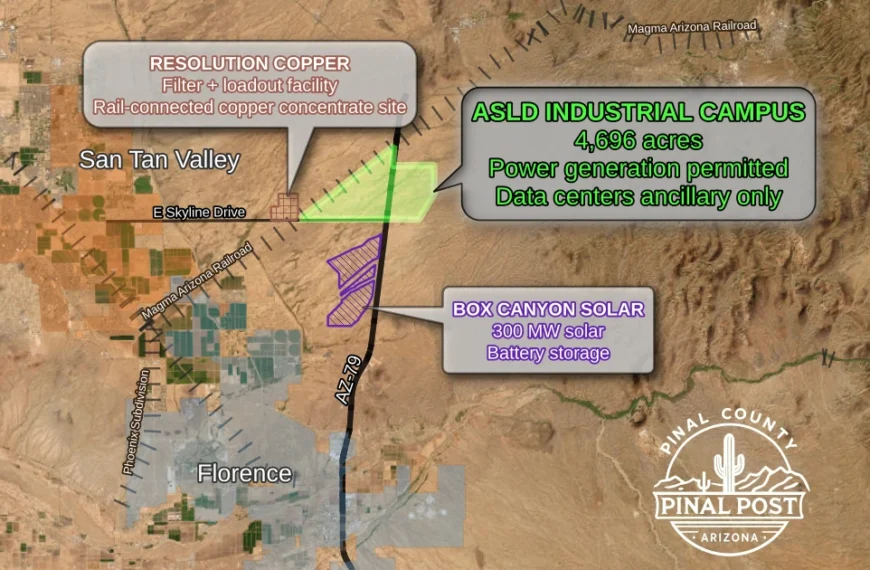
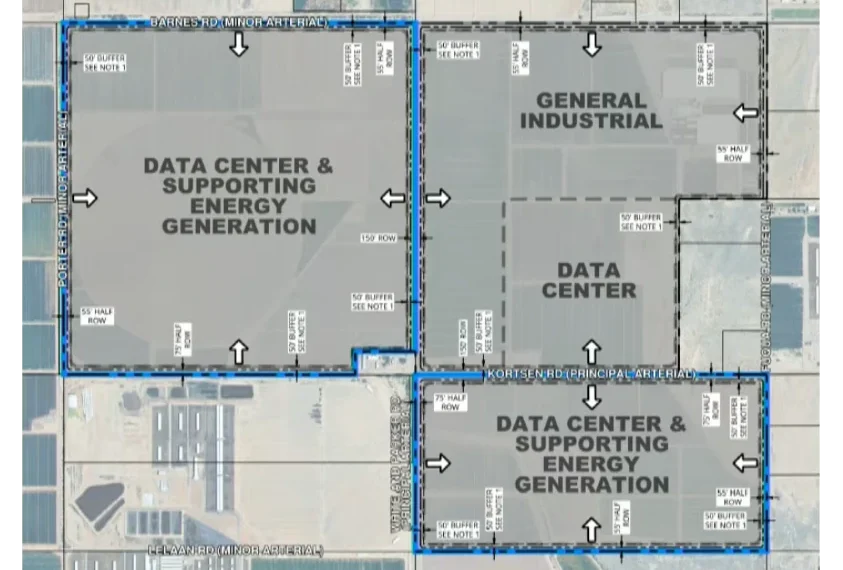
Commissioner Terrilyn Klucar said her concern is location, not the facilities themselves. Recent applicants asked to change the county’s long-range land-use plan to create new industrial areas, she said. The Goodyear sites, by contrast, needed no rezoning. “They should be placed in areas that are already zoned industrial,” she said. McClure said he agreed. However, counties, unlike cities, must deal with state trust land and private property issues, he said. “We’ll see how we can work forward on that.”
By the time Klob spoke, Ebert had left for other commitments, Lew told the board. Klob asked staff to obtain Ebert’s data so commissioners have reliable numbers to work from. The county’s success or failure with data centers “100% relates to how the county reacts,” he said. He urged codes and ordinances on power, water, noise, consumption and design before more data centers in Pinal County move forward. He also urged local jurisdictions to adopt the same code so developers could not cross a boundary to operate under different rules. A 400,000-square-foot data center brings 20 or 30 local jobs, he said. An Amazon warehouse of the same size brings hundreds. Goodman commented that the on-site job count does not capture how many workers elsewhere depend on a data center. He said officials should stay informed and keep residents informed as the process moves forward.