Update (July 20, 2026): The commission postponed both cases on July 16th. Read the full story.
Key Points
- The hearing: Pinal County commissioners take up Project Midway’s rezoning Thursday, July 16. It’s a 215-acre data center site southwest of Casa Grande, inside the city’s future planning area.
- What would be built: Five data center buildings. Backup generators beside each. A 50-acre substation and equipment area at the center of the site.
- Power: Generated on site — from natural gas engines, Bloom Energy fuel cells, or both. The substation on the site plan could allow a future grid connection.
- Water: Estimated 14,500 gallons a day. The developer pledges low-water cooling but has not said how the buildings will shed heat. Some designs use no water. Others evaporate large amounts.
- Air pollution: Gas engines release combustion pollutants. Bloom fuel cells release far fewer smog-forming pollutants but still produce CO₂. The mix will decide the impact.
- Fire service: The developer says the area has no fire-service provider. It expected to have funding details by this hearing. They are not in the filings.
- Concerns: Hidden Valley residents cite a falling water table, wells that must be drilled deeper, and generator noise.
- Bigger picture: Midway is one of several data centers under county review. In May, supervisors delayed the much larger La Osa project to August 26. Residents there asked the county to pause and write rules.
- What’s next: Thursday’s vote is a recommendation. The Board of Supervisors makes the final call later.
The proposed Project Midway data center comes before the Pinal County Planning and Zoning Commission for a public hearing on Thursday, July 16, 2026. Commissioners will consider the Project Midway rezoning request from General Rural to Industrial (I-3), paired with a Planned Area Development (PAD). Staff’s suggested approval motion carries 21 stipulations on the PAD case, plus one standard stipulation on the rezone itself. Several respond directly to concerns residents raised at earlier hearings. Those include an air-cooled or closed-loop cooling requirement for IT equipment. Others include a landscaped berm along the western property line and specific decibel limits with restricted hours for backup generator testing.
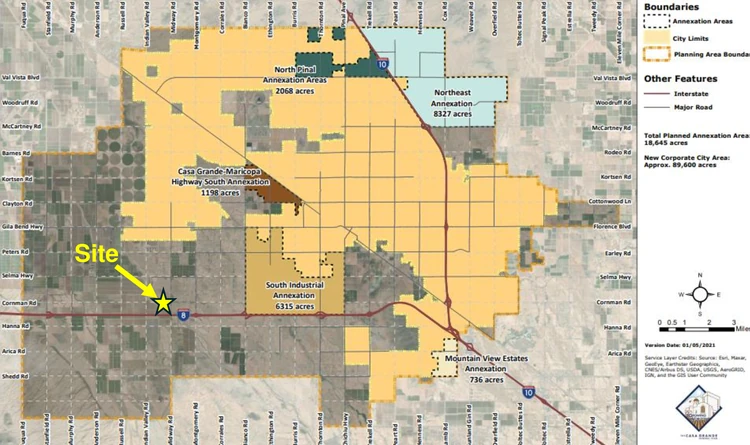
The site sits inside Casa Grande’s extended planning area, where the city has long envisioned industrial growth along Interstate 8.
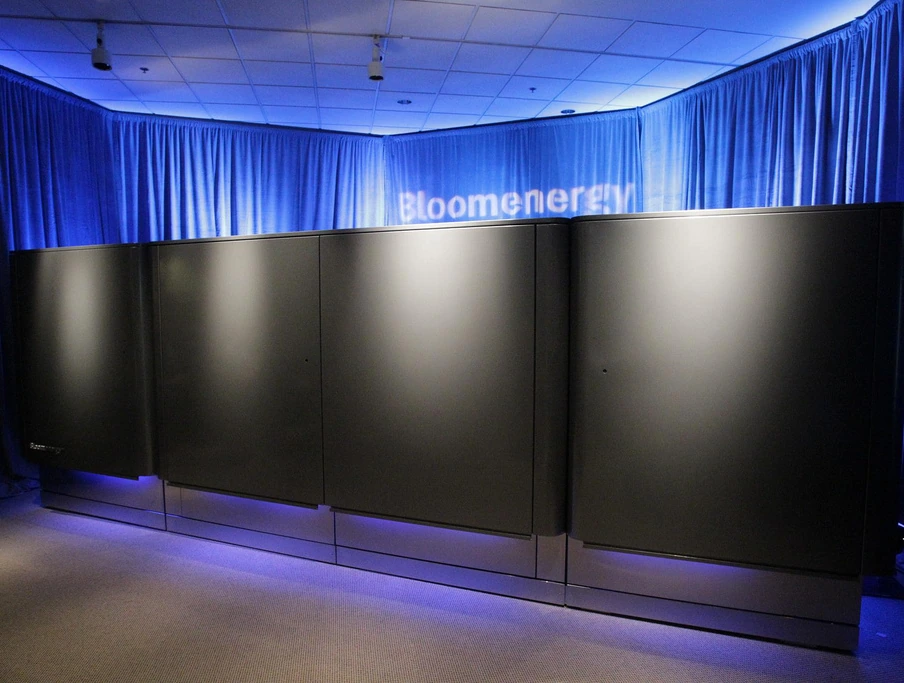
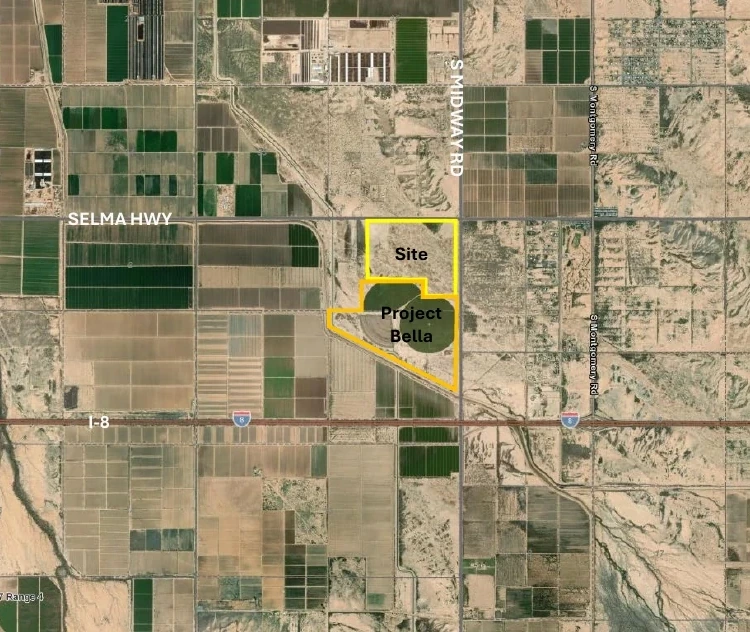
Since last fall, the power plan has changed significantly. The applicant’s earlier concept would have drawn power through the Electrical District No. 3 (ED3) grid, with about 40 percent possibly coming from Project Bella, a natural gas and battery storage plant approved directly south of the site. Under the current plan, Project Midway would generate all electricity on site. Fuel cells (Bloom Energy’s product was the one modeled in the noise study), gas engines, or a mix may supply the power. Fuel cells generate electricity through a chemical reaction rather than combustion; here they would run on natural gas. Per Bloom Energy’s datasheets, its fuel cells use no water during normal operation, run at high electrical efficiency, and produce near-zero smog-forming pollutants. Gas engines typically cost less upfront and are the longer-established choice.
This is one of the last county land-use hearings where the public can weigh in. In November 2025, supervisors approved the land-use change that made this rezone request possible. The commission’s July 16 vote will be a recommendation; the Board of Supervisors will make the final decision at a later date. If the rezone is ultimately approved, the county’s remaining reviews, such as the site plan, are administrative, though separate permits, like air quality, follow their own processes.
Thursday’s hearing comes as data center proposals in Pinal County draw heightened scrutiny. In May, supervisors continued a vote on the 3,385-acre La Osa data center south of Eloy. La Osa — more than 15 times the size of Midway’s 215 acres — drew hours of public comment, including more than a dozen speakers calling for a countywide moratorium.
What the Project Midway Rezoning Would Change on the Ground
The 215.8-acre rezone would apply a classification the county describes as suited for medium and heavy industrial development. Custom rules for the site would raise the maximum building height from 50 to 60 feet, among other modifications to standard requirements. Any approval would also carry binding conditions called stipulations.
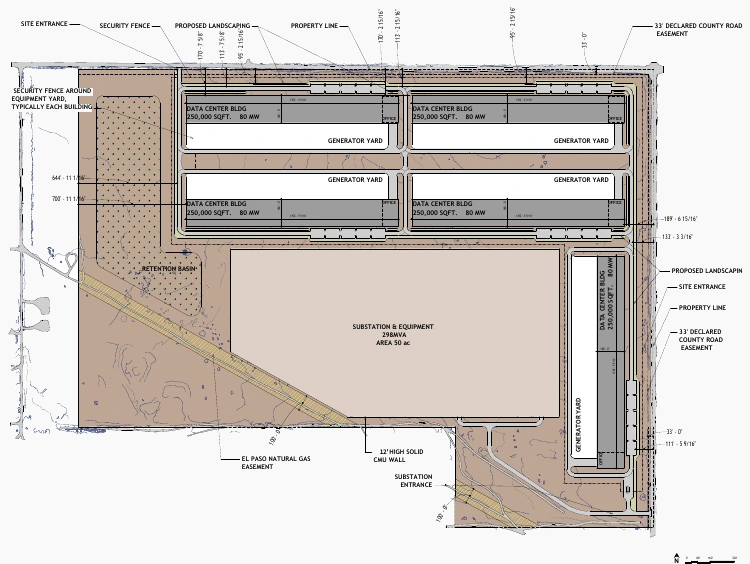
The conceptual plan divides the site into five data center buildings of about 250,000 square feet each, for a total of 1,250,000 square feet across the campus. Each building would draw about 80 megawatts of electricity, for a total campus demand of roughly 400 megawatts at full build-out. A roughly 50-acre substation and equipment area sits in the interior of the property. Backup generators sit next to each building. The rezone narrative describes about 700 feet of separation between the development and existing rural lots along the west side.
On-Site Power: Bloom Energy Fuel Cells, Gas Engines, or Both
No grid connection is proposed at this time, though a substation appears on the site plan for possible future interconnection. The substation is rated at 298 megavolt-amperes (MVA), a capacity measure roughly comparable to megawatts. For scale, that’s about three-quarters of the campus’s 400-megawatt demand. Primary fuel would be natural gas: the staff report points to the El Paso Natural Gas line that bisects the property, while the applicant’s utility table lists Southwest Gas as the provider.
The technology mix is not yet decided. The rezone narrative says on-site generation may include fuel cells and/or gas engines. The packet does not specify what share would be fuel cells and what share gas engines.
The packet does not legally bind the developer to any specific power-generation technology. The developer could deploy all gas engines, all fuel cells, or any mix. Nothing in the packet stops them from drawing power from the ED3 grid instead: the site plan shows a substation large enough to carry much of the campus load. The commission can recommend a stipulation on July 16, though only the Board of Supervisors can attach one to the final approval. Residents at the La Osa hearing called for a countywide data center ordinance and framework; the county has not adopted one.
Both technologies use natural gas as fuel, but they process it very differently:
| Gas engines | Bloom Energy fuel cells | |
|---|---|---|
| Water use | Cooling required; water use depends on cooling design | No water use during normal operation |
| Air emissions | Combustion pollutants: NOx, carbon monoxide, VOCs, particulates, and CO₂ | Very low NOx, SOx, and particulates; still produces some CO, VOCs, and CO₂ from natural gas |
| Process | Combustion | Electrochemical reaction (combustion-free) |
To check noise compliance, the applicant’s study modeled three primary-generation scenarios of about 500 megawatts each, configurations built around gas engines or Bloom Energy fuel cells, more than the roughly 400-megawatt campus demand.
At the project’s property boundary, the noise study modeled all three configurations at 53.2 to 54.9 dBA after mitigation, fuel cells and gas engines alike; at the nearest home, modeled levels drop to about 46 to 48 dBA. If the final design leans heavily on fuel cells, industrial water demand and combustion emissions at the site would be substantially lower. If it leans on gas engines, both would be higher.
Bloom Energy made its first commercial deployment at Google in 2008, and its customer list has included Apple and longtime data center operator Equinix. Fuel cells remain less common than gas engines for on-site power overall. Cost has been the primary challenge, per a 2015 U.S. Department of Energy assessment of stationary fuel cells.
The noise study also modeled a separate 400-megawatt backup system: about 90 gas engines distributed across the five buildings, a modeling assumption rather than a binding design. The study assumes backup will not run at the same time as primary generation, except during brief testing of individual units.
By November 2025, Alex Hayes, a land use attorney with Withey Morris Baugh representing property owner Selma & Midway LLC, had told supervisors that no contracts existed with any power source and that on-site generation was being studied. For a sense of electrical scale, ED3’s entire utility-wide record peak was 280 megawatts:
“On August 7th [2025], Electrical District No. 3 (ED3) set a new record for its system demand of 280 megawatts (MW) at 5:13 pm with a temperature of 115 degrees.”
Project Midway would not draw from ED3 for its normal demand under the current plan.
Stipulations Address Prior Resident Concerns
Several of the 21 PAD stipulations respond directly to concerns raised at earlier hearings:
- Air-cooled or closed-loop cooling required. Stipulation 18 makes the earlier pledge enforceable for the data center’s IT equipment.
- Noise study and limits. Stipulation 19 requires an acoustical engineer’s study, with a plan for post-construction monitoring. It caps sound at 60 dBA from 7 a.m. to 8 p.m. — roughly the volume of normal conversation — and 55 dBA from 8 p.m. to 7 a.m. Backup generator testing is limited to 9 a.m. to 5 p.m., Monday through Friday, excluding holidays.
- Landscaped berm. Stipulation 12 requires a landscaped berm for visual screening along the western property line.
- 50-foot industrial buffer. Stipulation 11 requires perimeter buffering where the site borders rural or residential zoning.
- Power generation setbacks and screening. Stipulations 13 and 14 require a 250-foot setback from rural or residential zoning districts for primary generation equipment and screening from public view by full enclosure, building placement, a minimum 12-foot masonry wall, or a combination.
- Lighting Zone 2. Stipulation 16 requires Lighting Zone 2 compliance and motion-sensored lighting, and says fixtures should be shielded to limit spillover.
- Air quality permit. Stipulation 15 requires an industrial air quality permit for the on-site generators.
Water, Wells, and the Air-Cooling Requirement
What the Water Memo Projects
A May 27, 2026 memo from Colliers Engineering & Design estimates projectwide average-day demand at 14,500 gallons, up from the 11,507 gallons shown in the applicant’s presentation at the October 2025 Planning and Zoning hearing. The revised memo also adds a maximum-day estimate of 35,200 gallons. Average demand works out to roughly 5.3 million gallons a year, or about 16 acre-feet.
The memo distinguishes two water uses. Domestic demand is described as exceedingly low given the small employee count. Industrial demand is anticipated to be largely limited to generator cooling — an estimate that assumes the IT equipment’s own cooling will draw little water. Stipulation 18 requires air-cooled or closed-loop cooling for that equipment but does not address generator cooling. Arizona Water Company would supply water to the project through a new line from a proposed water campus at Montgomery Road and Cornman Road. That is itself a change: the memo’s February version proposed an on-site production well; the May revision replaced it with Arizona Water Company service.
The Cooling Pledge and the Water Question
In one common closed-loop design, coolant circulates through pipes or plates near the IT equipment, absorbing heat as it flows past. That heat then has to go somewhere — and where it goes is the water question. Released to outside air, it uses little or no water; rejected through a cooling tower, it evaporates water continuously. Stipulation 18 constrains the cooling system type but does not specify the heat-rejection method, and neither does anything else in the packet. The memo’s 14,500-gallon average-day estimate appears inconsistent with heavy evaporative cooling, though the memo does not name the heat-rejection method — and the figure is an engineering projection submitted with the application, not a binding condition. No proposed stipulation sets a numerical limit on the project’s water use, and the packet contains no development agreement establishing one. Residents have asked for exactly such a limit. “There needs to be a cap on the water, if any water is used,” Robin Davis, a Hidden Valley resident, told supervisors in November.
The same assurance has been given in both of the county’s data center cases. At Midway’s October 2025 hearing:
Commissioner Tom Scott: “So you’re not using water to cool with, you’re gonna use something similar to what I have at my house for air conditioning?”
Alex Hayes: “That’s correct. It’s chillers… not water cooled.”
That pledge broadened to air-cooled or closed-loop and became Stipulation 18.
A month later, Court Rich, La Osa’s attorney, told the Board of Supervisors:
“This project will not be using water-cooled technology. I can’t say that loud enough. I’ve said it at several of the hearings and people still come up and say, ‘You’re gonna use too much water to cool it.’ But we’re not using water-cooling technology. We’re gonna use either air-cooling or a closed-loop system.”
At La Osa, that pledge has not yet reached the written conditions. Rich had told supervisors in November that the project would stipulate to the cooling commitment at zoning, but when the zoning case reached the board in May, none of the 33 stipulations forwarded by the Planning and Zoning Commission addressed water use. Rich again offered from the podium to stipulate and said he would return with new stipulations; the case resumes August 26.
Wells, the Aquifer, and the Opposition Letter
“He lost me at 11,500 gallons per day,” Davis said at the October 2025 Planning and Zoning hearing. She described neighbors in Hidden Valley drilling wells deeper as the aquifer declines. At the same hearing, Savannah Morrison read a statement from a Hidden Valley property owner whose 2022 well had to be drilled to 960 feet after failing to find water at the planned 850 — financed, the statement said, with a loan in the tens of thousands of dollars that she is still repaying. Maryeileen Flanagan, also from Hidden Valley, later told supervisors that one neighbor had drilled her well deeper three times in six months. “If it goes in, it needs to be stipulated that it will never draw on our water supply or aquifer,” she said. Hayes responded by offering to stipulate to air-cooled or closed-loop cooling at the zoning phase.
The July 2026 packet does not identify the source of the water Arizona Water Company would deliver or analyze effects on the aquifer. Groundwater pumping is regulated by the state through the Arizona Department of Water Resources and the Pinal Active Management Area, though the county can attach water-related conditions through zoning — as Stipulation 18 shows. So far, the only opposition letter comes from Deanna Pence, whose home is a quarter mile from the site. Filed June 30, 2026, the letter describes her well pump burning out after a nearby agricultural well was reactivated. She attributes the burnout to lowered groundwater.
Generator Noise, Sound Walls, and Rural Character
The rezone packet includes a full acoustical study by SWCA Environmental Consultants. Baseline sound levels ranged from 42.3 to 43.6 dBA, a quiet rural environment.
The study’s modeled results assume a 12-foot masonry wall around the generation area, plus acoustic enclosures and exhaust silencers on the two engine configurations (the fuel cell scenario relies on the wall alone). With those controls, sound from the project alone ranges from 53.2 to 54.9 dBA at the property boundary, below the county noise ordinance’s 55 dBA nighttime limit for residential areas. At the nearest home, about 182 feet west of the property, the project’s contribution falls to 46.3 to 47.5 dBA, roughly what the study likens to light traffic heard from about 100 feet away.
Combined with existing background noise, the study calculates 55.1 dBA at the project boundary; the ordinance measures at the neighbor’s side, not the emitter’s, and at the nearest home the combined nighttime level is 48.6 dBA — well below the 55 dBA limit.
Residents at earlier hearings raised generator testing as a specific noise concern. Resident Tena Dugan reported visiting Chandler data centers, where two neighbors she spoke with said routine operation didn’t bother them but the weekly backup-generator testing did. “It’s awful,” she recounted one saying, “and they do it every week and there’s nothing to buffer it.” Flanagan asked for berms or soundproofing. Stipulation 12’s berm along the western property line is for visual screening; noise mitigation runs through Stipulation 19’s acoustical study.
Fire Service Plan and Funding Remain Unresolved
The project area has no fire-service provider today, according to Hayes’s statements at the hearings. “We heard from a property owner nearby who pays an additional $5,000 a year in property insurance because he doesn’t have fire service,” Hayes told supervisors in November. The rezone narrative and Hayes’s statements at the hearings say the applicant is coordinating with the Pinal County Fire and Medical Authority to support fire service for the property and surrounding area. It has not committed to whether the Arizona City Fire District’s boundaries will be expanded or which funding mechanism will be used. At the November hearing, then-Chairman Stephen Miller sketched two possible approaches: expanding the fire district and funding through property taxes, or a subscription model with annual payments. Hayes said the developer could provide initial funding to get the Fire Authority off the ground, then transition to ongoing assessments. None of these arrangements has been finalized.
Supervisor Rich Vitiello had pressed for specifics in November, noting that Project Bella’s presentations had shown fire-funding numbers while Midway’s showed none. “I saw none of that here, which is very important to me,” Vitiello said. Hayes responded that Bella did not have those numbers at the same comprehensive-plan stage either, and he did not commit to dollar amounts. “By the time we’re back for you for zoning, we would have some more specificity on what that looks like and what the contributions would be,” he told the board. The July 16 hearing is that return. The figures are not in the packet.
A $6.6 Billion Project on a Changing I-8 Corridor
In November 2025, Hayes presented an economic impact study based on a 225-megawatt facility. It projected a $6.6 billion capital investment and about 225 permanent jobs averaging $93,000 a year — roughly twice the county average. Construction would bring hundreds if not thousands of temporary jobs. Over a 20-year life, the study projected $127 million in company tax revenue to the county and $91 million to schools and special districts. The current conceptual plan assigns approximately 400 megawatts across the five buildings. A separate supporting document in the packet gives a higher projection: the campus could employ up to 405 people at full operating levels. The traffic statement filed with the application recommends right-of-way dedication, half-street improvements along the site’s Midway Road and Selma Highway frontages (Selma Highway is currently unpaved), and turn lanes at the main Midway Road entrance; final requirements come through a later county-approved traffic analysis.
La Osa Delay and Calls for Countywide Data Center Rules
If commissioners recommend approval on July 16, the Midway rezoning goes next to the Board of Supervisors, the same board that on May 27, 2026 continued both zoning cases for the La Osa data center south of Eloy — what would have been the county’s first data center zoning vote — to August 26 after hours of public comment. Turnout was heavy: 71 people signed up to speak, and staff logged 66 additional comment cards from residents who did not wish to speak — 64 of them opposed the project. Vitiello cast the only no vote on the continuance after seeking a longer delay.
Other data center projects, including Midway, have cleared the earlier land-use step but none has yet won a Board of Supervisors zoning vote — the last step where the public can weigh in before remaining reviews move through administrative process.
The Entities Behind Project Midway
Three separate entities fill different roles: LPI Group as developer, Selma & Midway LLC as property owner, and Fairview Capital LLC as applicant of record. No end user has been named: at the October 2025 hearing, Hayes said the developer was negotiating with a “pool of potential users.”
How Project Midway Reached the Rezoning Stage
The proposal moved from a May 2025 neighborhood meeting through unanimous votes at the Citizens Advisory Committee (September 4, 15-0), the Planning and Zoning Commission (October 16, 9-0), and the Board of Supervisors (November 19, 5-0), which approved the change with no stipulations and re-designated the land to Employment. Pinal Post covered the July 2025 work session, the October 2025 P&Z hearing, and the November 2025 Board vote in previous reporting.
Rezone applications were filed March 4, 2026. A second neighborhood meeting followed on March 18 at the Francisco Grande Hotel in Casa Grande with about five neighbors attending.
The July 16 Hearing and What Comes Next
The Planning and Zoning Commission takes up the Project Midway rezoning Thursday, July 16, 2026. Meeting details and instructions for public comment are in the official agenda. Thursday’s vote is a recommendation; the Board of Supervisors makes the final decision at a later date, and both bodies hear public comment before deciding.