SAN TAN VALLEY, AZ — The San Tan Valley Town Council voted on June 3, 2026 to recommend approval of the Copper Basin battery storage project to the Pinal County Board of Supervisors. The vote followed earlier approval recommendations covered in the Pinal Post’s May 21 county Planning and Zoning article. Before the council vote, Councilmember Rupert Wolfert pulled the item from the consent agenda for separate discussion, citing questions he had received from residents. The 250-megawatt facility is planned for a 25-acre parcel at the southwest corner of Bella Vista Road and Attaway Road, with commercial operation targeted for 2031.
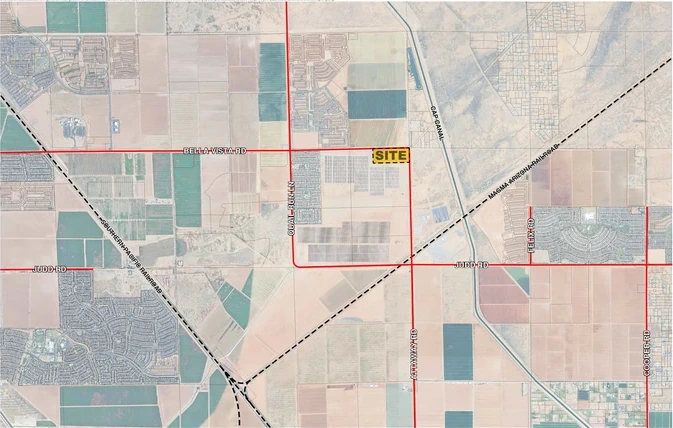
The county, not the town, holds final approval authority. The council’s vote is an endorsement that will be forwarded to the Pinal County Board of Supervisors.
Why the item came off consent
Consent agenda items are procedural matters the council does not expect to need public discussion. They are voted on together in a single motion. However, any councilmember can pull an item for separate discussion.
Councilmember Rupert Wolfert pulled the Copper Basin recommendation off consent. He said residents had sent numerous questions about the council’s planned endorsement of the battery storage project, and he wanted the project team to answer them publicly before the council voted.
“We want to be certain that we’ve had those reasons and rationale behind why we’re recommending it,” Wolfert said.
What residents will pay
Councilmember Daniel Oakes asked whether any cost to residents would show up on their SRP bill, or whether they would see a separate charge from somewhere else. Matthew Look, who represented developer Plus Power, said any cost flows through SRP. “Everything is being handled through SRP,” he said. Plus Power contracts with SRP and does not bill residents directly.
Wolfert then asked how the project would stabilize or reduce electricity costs. In response, Look compared the facility to a gas peaking plant. (Gas peakers are natural gas plants that utilities fire up only during periods of peak demand, such as hot summer evenings.) He said gas peakers typically run only about 20% of the time, but require a full investment to build. By contrast, batteries capture solar energy that would otherwise go to waste during low-demand daytime hours, when the grid has nowhere to send it.
Look said that captured energy is released back to the grid in the late afternoon and evening, when residents return home from work and turn on their air conditioners. That surge drives the highest demand of the day. Look said that, as a result, ratepayers avoid paying for a larger plant that runs only part-time. “Batteries are a much cheaper investment for ratepayers rather than providing a gas peaking plant,” he said.
Wolfert said those savings shaped his support. “That’s really what my support hinges on, is cost savings to our residents and then also safety,” he said.
Fire safety and emergency response
Vice Mayor Tyler Hudgins raised public concern about battery fires. In response, Look brought Brian Scholl of the Energy Safety Response Group to the podium. Scholl is a retired Phoenix Fire Department veteran. He also sits on the NFPA and International Fire Code committees that govern stationary batteries.
“These batteries are highly tested, highly regulated,” Scholl told the council. He said that level of regulation distinguishes them from older battery systems.
At the earlier May 21 Pinal County Planning and Zoning hearing, Plus Power told commissioners the company operates nine facilities across Texas, New England, Hawaii, and Arizona, none of which has had a fire. Scholl told that hearing that the January 2025 Moss Landing battery fire in California involved first-generation nickel-manganese-cobalt batteries, while the industry standard today is lithium iron phosphate chemistry.
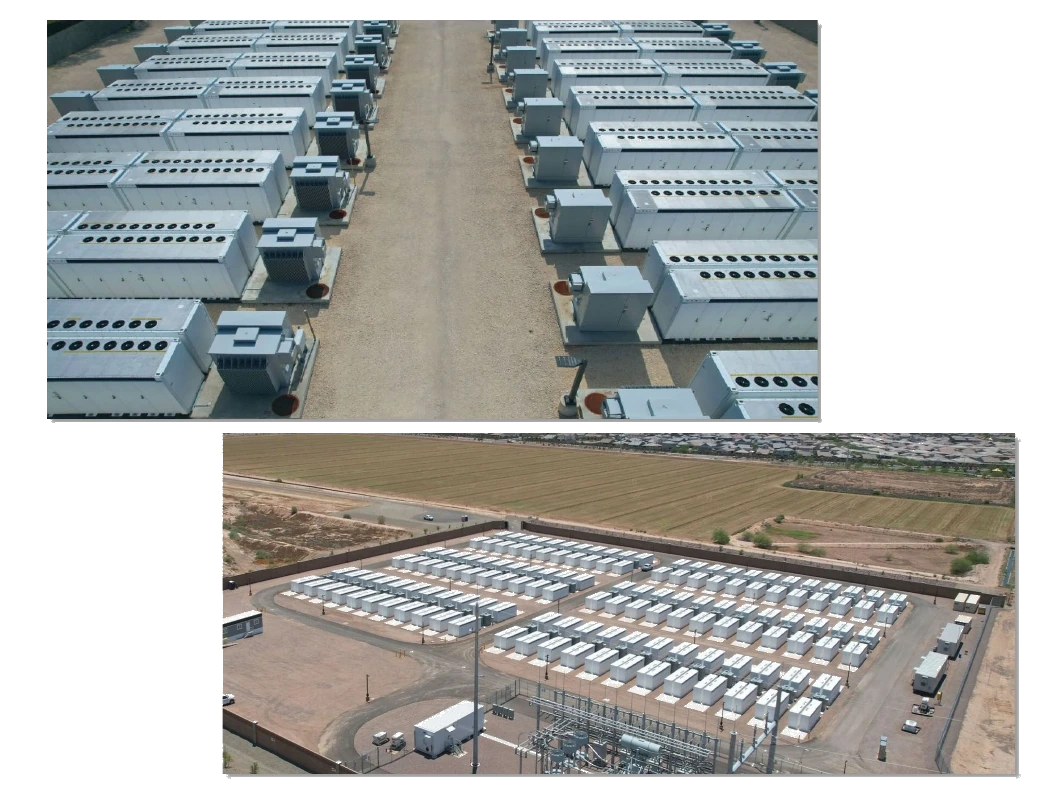
Councilmember Brian Tyler asked about emergency protocols with Rural Metro Fire Department. Scholl described the cabinets as non-occupiable appliances rather than buildings. Therefore, firefighters will not enter an enclosure during an incident. “There’s nothing to save inside that enclosure, so we’re not gonna risk our firefighters for an appliance,” he said. Scholl helps write the site’s emergency plan and said he has trained Rural Metro personnel on past projects. Look added that Plus Power continually trains the fire departments at its facilities.
Mayor Daren Schnepf asked what happens when one enclosure ignites. Scholl said large-scale fire testing shows an incident stays inside the affected enclosure and burns itself out. He said the enclosures are tested and UL-listed for that containment, so no intervention is required by design. According to Scholl, spacing is also based on that fire testing. He said the cabinets sit roughly 10 feet apart at the door ends, with their back ends butted up.
Schnepf also asked about toxic emissions. Scholl named the main byproducts: hydrogen, carbon monoxide, carbon dioxide, and a small amount of hydrogen fluoride. He said the gases are buoyant and dissipate quickly. By contrast, he said house fires are “way worse” because no one knows what’s in the smoke from burning fire-retardants, plastics, and other household materials.
Sound, sight, and heat at the property line
Wolfert raised resident concerns about noise, humming, and view obstruction. Look said a perimeter wall will screen the batteries from view. In addition, landscaping will be coordinated with the town after incorporation on July 1.
The batteries themselves are silent. However, the cooling system generates some sound. Look said the facility will comply with the Pinal County noise ordinance. At the May 21 hearing, a noise consultant retained by Plus Power projected the facility would measure approximately 51 decibels at the perimeter wall, comparable to the level of a normal conversation.
Wolfert asked how the cabinets are cooled. Scholl said the system uses liquid cooling, similar to a vehicle’s radiator. Oakes asked for clarification on water use. According to Look, the only on-site water use is for staff restrooms.
Councilmember Gia Jenkins asked whether the facility would raise temperatures on neighboring properties. Scholl said he had not heard of that happening at other sites.
Plus Power’s role at Copper Basin battery storage
Oakes asked Look about Plus Power’s role. He asked whether the company was building the facility for itself, buying power from SRP and selling it back, or just acting as the construction firm building it for SRP.
Look said Plus Power will own the facility. The company holds a contract with Salt River Project to maintain the site and deliver power. Under the arrangement, SRP “puts the power in and puts it back out,” Look said. Plus Power buys that power from SRP and sells it back at a higher rate, all under contract with SRP set ahead of time.
Oakes confirmed the property will not be an SRP-owned facility.
Why this site for a battery storage facility
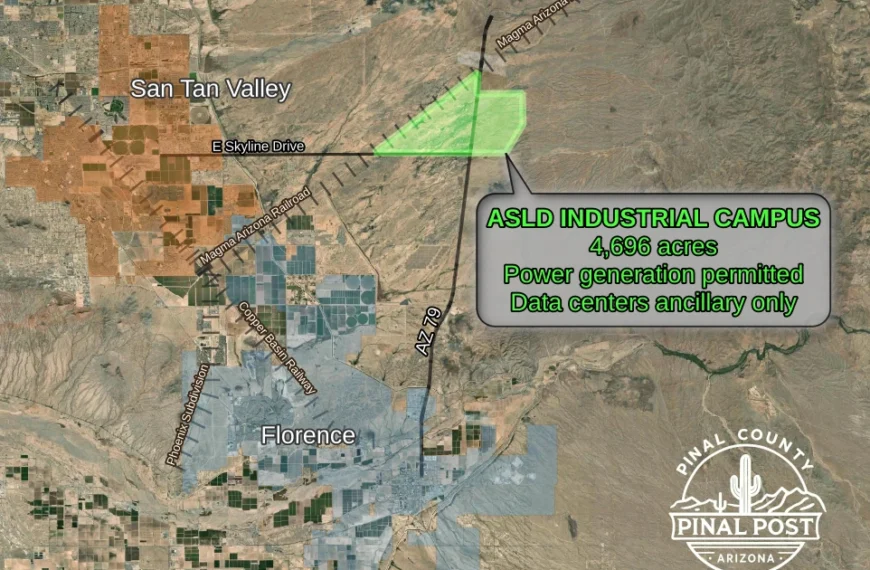
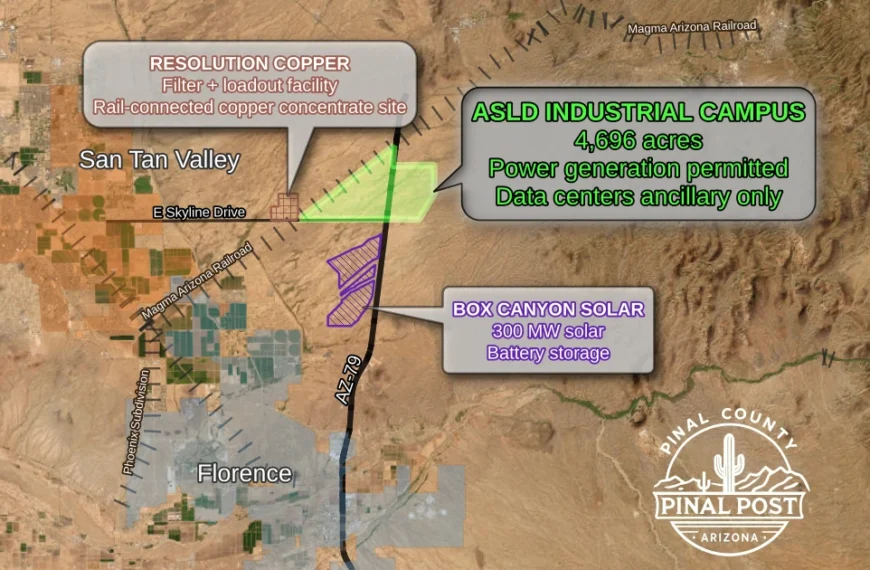
Schnepf asked Look why this parcel suits a battery energy storage system. Look pointed to the adjacent SRP Copper Crossing Energy and Research Center, which borders the property on three sides. Additionally, the SRP Abel Substation sits next to the project site. That proximity to existing transmission lines reduces interconnection costs.
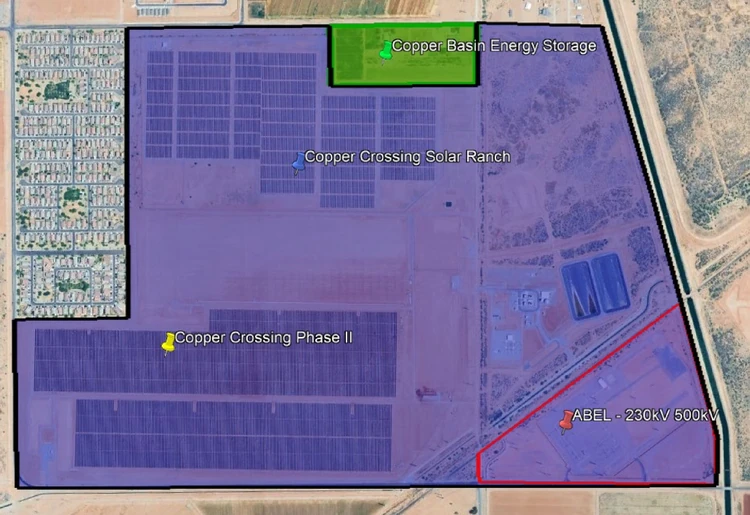
Although the sites sit side by side, Copper Basin is a separate, standalone project and not part of SRP’s Copper Crossing development. Residents who want more information about SRP’s adjacent facility can visit the SRP Copper Crossing project page.
Schnepf asked if SRP supported the project. Look said yes. Hudgins added that he had previously toured the Abel location and agreed it is the appropriate place for this kind of facility.
Jobs, taxes, and community benefit
Hudgins asked about employment and neighborhood improvements. Look said construction will support roughly 120 jobs. Plus Power’s original submission to Pinal County had projected 50 to 100 jobs over a 12- to 18-month period. After construction, Look estimated three to five full-time technicians would staff the site during normal business hours.
Furthermore, Look said the project will generate tax revenue for the town and the county.
Schnepf asked how Plus Power plans to give back to the community. Look said the company partners with local nonprofits at its other Arizona facilities, including New Leaf and Boys & Girls Club. Programs vary based on local needs.
Future capacity for a growing town
Councilmember Bryan Hunt asked whether the facility could scale to meet San Tan Valley’s long-term power needs. Look clarified that Plus Power is not a power provider. That role belongs to SRP.
Look said the site has limited room to expand. However, he said battery technology can improve, including both capacity and storage duration.
The vote and the county process
The town’s Interim Planning Advisory Committee previously voted 6-0 on April 26, 2026 to recommend approval of the three related cases. Each is a separate county decision the project requires: a comprehensive plan amendment to change the land use designation, a rezoning to industrial, and a Planned Area Development overlay setting site-specific standards like height, setbacks, and noise limits. The Pinal County Planning and Zoning Commission then voted unanimously on May 21, 2026 to recommend approval to the Board of Supervisors.
On June 3, Councilmember Brian Tyler moved to recommend approval of cases PZ-PA-003-26, PZ-002-26, and PZ-PD-002-26 to the Pinal County Board of Supervisors. Jenkins seconded the motion. The motion carried.
As Wolfert noted at the meeting, the council’s vote is an endorsement and does not impede the formal county approval process. He said any additional concerns can be taken up with Pinal County, which will ultimately approve the plan.
Where residents can learn more
Schnepf pointed residents to a Pinal County work session held on November 12, 2025. That meeting featured a battery energy storage safety presentation. The Pinal Post also covered the work session in Battery Safety Discussed at Pinal Board of Supervisors. Plus Power maintains a project website for direct community questions.
If the Pinal County Board of Supervisors approves the three cases, Plus Power expects commercial operation of the Copper Basin battery storage facility to begin in 2031.