Guest opinion column by Eirini Pajak of Pinal Unlocked, published in Pinal Post’s Opinion section. Views are the author’s own.
LA OSA DATA CENTER SERIES — PART 1
This series examines the proposed La Osa Data Center rezoning on the Pinal County Board of Supervisors’ May 27, 2026 agenda. This article examines the project’s $100 million in property taxes. Article 2 examines the power supply questions.
A $33 billion project sounds like a financial windfall for any county.
Pinal County is being asked to rezone land south of Eloy for a data center campus. The financial promises behind the request deserve careful examination before a vote.
Arizona’s property tax rules for large industrial and data center projects are notoriously intricate. The figures below reflect my reading of the statutes and Department of Revenue guidance; the aim is to raise the right questions, not deliver a final number.
What Is Actually Being Proposed: The Scale
The applicant is Vermaland, a Phoenix-based land banking company founded in 2004 by Kuldip “Ken” Verma. The company is one of Arizona’s largest private landowners with more than 25,000 acres. It is the owner and developer of the La Osa site, but not itself a data center operator; the stated plan is to sell or lease the rezoned parcels to data center tenants.
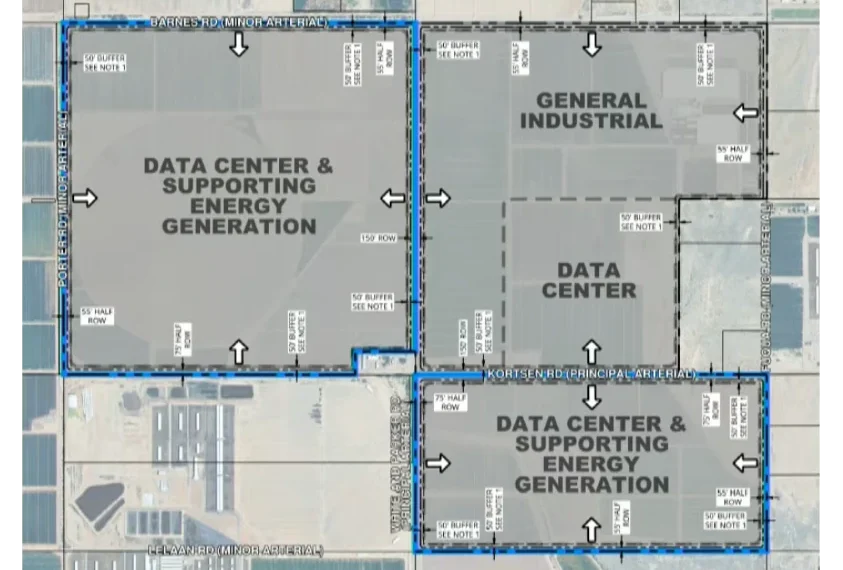
According to the La Osa application, the campus covers approximately 3,385 acres south of Eloy. The request would change 2,393 acres from General Rural to Industrial I-3 zoning, with about 992 acres designated as proposed open space, and would apply a Planned Area Development overlay to govern how the project is built out. The campus is planned across three distinct phases:
- Phase 1 (Northwest): Initial buildings and a site for a future Avra Valley Fire District station.
- Phase 2 (Central): Additional buildings and the first gas-fired power generation facility.
- Phase 3 (Southeast): Remaining buildings and a second gas-fired power plant, reaching a maximum of 59 buildings.
The maximum build-out envisions 59 data center buildings at about 400,000 square feet each, roughly 400 football fields under roof.
This is a theoretical maximum. The actual build-out depends on demand, utility capacity, and permitting outcomes for the on-site gas generation, none of which are committed in the application.
Where the $33 Billion Figure Comes From
Vermaland’s press release cited both a 3,000 megawatt capacity and a $33 billion investment figure. The figure follows JLL’s 2026 Global Data Center Market Outlook, which puts the average global data center construction cost at roughly $10 to $12 million per megawatt. At the October 16, 2025 comprehensive plan amendment hearing, however, applicant attorney Court Rich described only “hundreds of megawatts” of gas generation and did not commit to a final scale while utility studies remain pending.
The same press release also describes the project as being located in a Federal Qualified Opportunity Zone, a federal program that reduces capital gains taxes for investors in designated economically distressed areas. For an investor who holds a Qualified Opportunity Fund investment for at least 10 years, federal capital gains on appreciation can be permanently excluded, which is among the most generous tax treatments in federal law for long-hold real estate investors. The Opportunity Zone designation suggests that part of the project’s value to its backers comes from federal investor tax benefits, not just the underlying real estate or operations. That is worth holding in mind when evaluating who actually gains from the project.
The $100 Million Property Tax Figure
This is, at buildout, you know, this is on the order of $10 billion or more dollars for this project to be built. And at buildout, it is gonna be probably the largest taxpayer in the county, if not certainly one of the largest taxpayers in the county, which means 100 million-ish dollars every single year in tax revenue to the county and the special districts that are associated there. So, between the fire district and the Red Rock School District and the county, that’s a tremendous amount of opportunity for the county to keep taxes lower for others as a result of this economic development. [lightly edited for readability]
It is worth noting that at the formal hearing, Court Rich put the project cost at “$10 billion or more,” not $33 billion, and described the annual tax figure as “100 million-ish.”
Both the $33 billion investment figure and the $100 million annual tax figure describe the project at full build-out, not what would exist at the time of the vote or in the early years of operation. Full build-out depends on hurdles examined in later articles in this series, and may take decades to reach or may not be reached at all.
Not All Investment Is Taxed the Same
To evaluate the $100 million claim, it helps to understand how the project’s components are actually taxed. They are not all taxed the same way. According to a McKinsey analysis of global data center investment, a large campus typically breaks down as follows:
- IT Equipment (roughly 60%): Represents the largest cost share but receives the most aggressive tax reductions under Arizona law.
- Power Infrastructure (roughly 25%): Includes gas plants and substations. Their tax contribution depends on whether they are state-assessed by ADOR or locally assessed.
- Buildings and Site (roughly 15%): Usually the most stable source of local property tax, yet these are built incrementally over time.
How Pinal County Taxes a Data Center
The state sets the rules that determine how a data center is taxed: what’s exempt, how property is classified, how it’s valued. The county and local jurisdictions set the rates that determine how much. Here is how they work together.
IT Equipment and the Double Reduction
Under HB2822 (2022), qualifying business personal property is valued at 2.5% of acquisition cost regardless of equipment type or use. Data centers benefit disproportionately not because of any sector-specific carve-out, but because the sheer scale of their equipment purchases magnifies the effect of the reduction. Arizona then applies a Class 1 assessment ratio of 15.5% to that amount.
| How the Tax Is Calculated | Example Dollar Amount |
|---|---|
| Starting point: original acquisition cost | $10,000,000,000 |
| Step 1: HB2822 valuation factor (2.5%) sets Full Cash Value | $250,000,000 |
| Step 2: Class 1 assessment ratio (15.5% in 2026) applied to FCV | $38,750,000 Assessed Value |
| Result: estimated annual property tax generated | $2.7 million to $3.9 million |
| Effective tax rate on original acquisition cost | Approximately 0.03% |
To put that in perspective, the same $10 billion in IT equipment, taxed under the Class 1 ratio without the HB2822 reduction, would generate roughly $100 million to $150 million in annual property tax depending on the combined local rate. The HB2822 valuation factor cuts that to 2.5% of what the unreduced calculation would produce.
The 59 Buildings
Buildings do not receive the 2.5% reduction, making them the primary driver of property tax revenue. Each building, once built and assessed, would generate substantial annual property tax. The exact amount depends on construction cost, applicable rates, and assessment methodology. But all 59 arrive across three phases over many years, and each generates tax only once it is built and assessed.
Where the Property Tax Revenue Goes in Unincorporated Pinal County
Based on FY 2025 to 2026 data, tax dollars are split across many entities:
| Taxing Entity | Share of Tax Dollar | Scope of Benefit |
|---|---|---|
| School Districts | 35.5% | Primarily local, but often offset by reductions in state aid. |
| Pinal County Government | 27.0% | County-wide. Funds sheriff, courts, and regional roads. |
| Special Districts | 16.6% | Local and county-wide. Includes the Fire District (local) and Flood Control (county-wide). |
| Central Arizona College | 13.7% | County-wide. Benefits the whole county. |
Note: Cities and Towns receive approximately 7.3% of the property tax dollar countywide; this share does not apply to unincorporated areas like the La Osa site.
Public Safety note: The application includes a fire station site for the Avra Valley Fire District, but does not appear to include comparable provisions for law enforcement. The Sheriff’s budget is part of the County share (27%), spread across all of Pinal County, so any policing of the site would draw on existing county-wide resources rather than adding capacity at the location.
Who Actually Benefits and How Much?
Now we will look more closely at where the projected tax revenue actually goes, and how much of it reaches the community around the proposed data center.
The School District: The Funding Swap (about 35.5% of your bill)
A common misconception is that a surge in local property tax revenue means new money for local schools. In reality, under Arizona’s funding formula, the state sets a fixed funding level per student for basic formula funding. Local property taxes fill that bucket first. If a large industrial project increases the local qualifying-tax revenue, the state can reduce the amount of Basic State Aid it must provide. That means some of the apparent school benefit may function as a state-local funding swap rather than a direct increase in classroom resources. Bonds, overrides, transportation-related levies, and other local funding categories can work differently. This is documented in the Arizona Senate Research Staff school finance brief, which sets out the Basic State Aid formula (Equalization Base minus local Qualifying Tax Rate revenue).
The County Share (about 27% of your bill)
The county share is spread across a tax base covering all of Pinal County. While it adds to the overall pot, the county also faces increased costs for regional infrastructure and services. Any potential rate reduction would be decided by the Board of Supervisors and would be diluted across every property owner in Pinal County, making the impact on an individual’s bill very small.
The Fire District and the Half-Tax Promise
Avra Valley Fire District Chief Brian Delfs stated at the April 16, 2026 Planning and Zoning hearing that annexing the first two phases of La Osa into the district could possibly cut property tax rates in half for existing district residents.
I believe he was specifically referring to the fire district levy, which is only one component of a total property tax bill. According to the Pinal County Treasurer’s tax bill guide, each taxing authority calculates its rate independently. Based on a review of sample tax bills, the fire district levy in unincorporated Pinal County is typically a small fraction of the total bill, though the share varies by district and location. Even if that portion were cut in half, the overall bill would see only a modest reduction, not the same as cutting the total tax bill in half.
This calculation only applies to property owners within the Avra Valley Fire District, and only if the district annexes the site. Property owners outside the district pay no AVFD tax, so a half-cut would not affect their bills. And even within the district, this modest reduction depends on a chain of favorable circumstances, each of which carries its own uncertainty.
Under ARS 48-262, the project would need to be annexed into the Avra Valley Fire District for the district to receive any of its property tax revenue. A single landowner can request inclusion under § 48-262(I), and the district board can amend the boundaries by order. With annexation, the district’s tax base would expand. But under ARS 48-805.02, the board sets the budget each year, and a bigger tax base does not automatically translate to a lower rate. The board could choose to maintain rates and expand services instead.
Transaction Privilege Tax (TPT) Distribution
Property tax is not the only tax affected by this project. Arizona also levies the Transaction Privilege Tax (TPT), collected by the State and divided among the State, counties, and incorporated cities and towns. It operates as a separate system with its own implications for local revenue.
This article addresses property tax (paid annually on land, buildings, and equipment) and Transaction Privilege Tax (a sales-style tax paid by vendors). For a data center project, both are sharply reduced under current Arizona law. HB2822 collapses property tax on equipment to a fraction of its unreduced value. The state’s Computer Data Center program exempts most equipment purchases from TPT. The reductions are not separate quirks; they compound, leaving a relatively small revenue footprint from what is otherwise a very large investment.
The TPT Exemption: A Shared Loss
Arizona’s Computer Data Center program, established under ARS § 41-1519, exempts qualifying data center equipment from TPT and Use Tax at the state, county, and local levels. The statute’s scope covers server equipment, networking equipment, racks, cabling, monitoring and security systems, water conservation systems, and other tangible personal property essential to data center operations. Governor Hobbs’s own administration estimated this exemption costs Arizona $38.5 million per year in lost revenue and she called for its repeal in her January 2026 State of the State address. Because the exemption’s statutory scope covers most operational equipment a data center would purchase, one of the project’s largest categories of potential taxable spending may generate little or no TPT revenue while the exemption remains in place. That would reduce the revenue base available for state and local distribution.
There is an additional wrinkle for this specific site. A common assumption is that local TPT activity translates into local revenue: a project generates sales tax, and the surrounding community keeps the city share. That assumption does not hold here, for two reasons.
First, the “city share” of state TPT is not actually local to begin with. Cities and towns collectively receive 25 percent of the state’s shareable TPT base, but it is allocated by population across all incorporated municipalities in Arizona, not by where the activity occurred. Because La Osa is in an unincorporated area, that area does not receive a share of TPT from activity at the site. Incorporated cities and towns still receive their population-based allocation from the statewide pool, but that share is not increased by what happens at La Osa. Pinal County itself does receive its own share of state TPT, but that is a county-wide pool spread across all of Pinal County, not local to the project area.
Second, much of the TPT activity that would otherwise matter at a data center, particularly equipment purchases, is exempted in the first place under the data center program described above. So the intuitive picture of local sales tax flowing back to the immediate community does not match how the system actually works for a project like this.
Why This Matters
The county would likely see more revenue from this project. The open questions are how much, how soon, and how much the county actually keeps after state-level adjustments.
There is also a cost side to this equation that the gross revenue figures do not capture. Arizona Public Service and Tucson Electric Power are both seeking approximately 14% rate increases for residential customers in 2026, citing unprecedented data center demand and infrastructure costs as key drivers. APS is separately proposing a 45% rate increase for extra-large energy users, including data centers (ACC docket E-01345A-25-0105).
APS states that data center infrastructure costs are paid by data centers and do not shift to residential customers. That position is contested by consumer advocates and the Arizona Attorney General, who has intervened in the APS rate case.
The net public benefit of a project like La Osa includes not just what the county gains in tax revenue, but what residents in the broader service territory may absorb in utility rate increases driven by aggregate industrial demand. A credible fiscal study should account for both sides of that equation.
What a Credible Fiscal Study Would Need to Cover
In some established data-center markets, independent public agencies have evaluated whether data-center subsidies and tax exemptions actually pay for themselves. Those reviews show why Pinal County would benefit from a project-specific fiscal analysis before relying on full-buildout revenue claims. Studies like the Virginia JLARC December 2024 report examine the full range of data center impacts including economic, fiscal, energy, and community effects. The JLARC analysis found that for every $1 abated through Virginia’s data center sales tax exemption, the state gets back only 48 cents, a finding highlighted in Good Jobs First’s review.
A December 2025 audit of Georgia’s data center sales tax exemption by the Carl Vinson Institute of Government at the University of Georgia reached an even sharper conclusion: in FY 2025, data centers were projected to bring in $41 million in tax revenue while receiving $474 million in exemptions, a net state loss of $433 million. The audit’s “but-for” analysis found that 70 percent of data center projects would have located in Georgia even without the subsidy.
This is the kind of net fiscal loss that can occur when communities provide expensive infrastructure and tax breaks for projects that yield a low net return. Arizona does not appear to require an independent fiscal impact study as a standard condition of approval, which makes one especially valuable here.
A credible study could include:
Net rather than gross:
- Net fiscal impact after infrastructure and service costs, not just gross revenue
- TPT revenue loss compared to a non-exempt project, quantified as a dollar figure
- How the school equalization formula offsets apparent gains, and whether Red Rock School District revenue could be reduced by state aid adjustments
Timing and risk:
- Tax revenue at Phase 1, Phase 2 complete, and full campus completion, with sensitivity analysis for delayed phases
- What the Avra Valley Fire District would actually receive under different annexation and build-out scenarios, compared to the half-tax promise
- Federal Qualified Opportunity Zone effect on investor tax benefits, and what that means for local returns
Assessment mechanics:
- HB2822 and Class 1 assessment ratio effect on IT equipment value, modeled phase by phase
- Real property assessed value for the 59 buildings, using current construction cost methodology
- Whether the gas plants are assessed locally as industrial property or centrally by ADOR as utility property, and what that means for revenue distribution
- Whether gas plant equipment qualifies for the data center TPT exemption
An independent fiscal impact study, directed by the county and reviewed by a qualified Arizona property tax professional, built around the actual three-phase build-out timeline and Arizona’s current industrial assessment structure, should exist before decision makers vote on a permanent rezoning.
The fiscal questions in this article are only one layer of the picture. Subsequent articles in this series examine other costs and uncertainties that do not show up in county revenue projections. Each layer points the same direction: the apparent net benefit narrows the closer you look.
The vote deserves the real picture, not the best-case one.
The Pinal County Board of Supervisors public hearing on this case is scheduled for May 27, 2026 at 9:30 a.m., 135 N. Pinal Street, Florence. Agenda packet.
Update, July 2026: Since publication, Arizona enacted a three-year moratorium on its data-center sales tax exemption as part of the state budget signed in June 2026. From July 1, 2026 through June 30, 2029, the Arizona Commerce Authority cannot accept new applications for the exemption, though construction of data centers may continue. Lawmakers estimate the pause preserves about $38 million a year in state revenue, close to the figure discussed above. Governor Hobbs had originally sought to repeal the exemption outright, so the moratorium is a partial step. Whether it reaches the La Osa project depends on whether the project applied for the exemption before the pause took effect.
Professional Disclosure
This article is a personal analysis of publicly available information regarding a proposed development and Arizona tax law. It is provided for general informational purposes only and is not financial, tax, or legal advice. Due to the complexity of industrial property taxation, all figures and interpretations should be independently verified by a qualified Arizona tax professional or the appropriate public agencies.
About the Author
Eirini Pajak is a licensed real estate agent and Pinal County resident. She covers local land use and development decisions through her Pinal Unlocked page on Facebook and runs the Pinal Code Watchers community group. Her dog Peso joins her on county rounds.
Coming Next: Where the Power Comes From
This is the first in a series of articles examining the La Osa Data Center proposal. The next article looks at the power supply questions: why having a transmission line nearby is not the same as having power, what the national interconnection data shows about how often projects like this succeed, why the on-site gas plants proposed for Phases 2 and 3 face their own separate permitting and equipment challenges, and what the applicant’s own testimony at the hearings reveals about how much of the power supply picture remains unresolved.