Key Points
- City Council adopted the Effluent Allocation Strategy on May 4 with no opposition recorded
- The 20/40/40 framework divides treated effluent into a 20 percent strategic reserve, 40 percent for industrial users, and 40 percent for residential development
- The strategy applies to roughly 6,300 acre-feet of A+ quality effluent the city produces annually
- The strategy formalizes industrial and residential growth as “co-equal drivers of community prosperity,” splitting effluent equally between the two at 40 percent each
- The 40 percent residential allocation could support roughly 12,000 dwelling units at current volumes and around 14,000 by 2033
- The strategy will return to council for review every year, with annual staff reports on production, allocations, and revenue
CASA GRANDE, AZ — Casa Grande City Council adopted the Casa Grande Effluent Allocation Strategy on May 4, with no opposition. The action formalizes how the city will divide its treated wastewater, known as effluent, among aquifer reserves, industry, and housing growth.
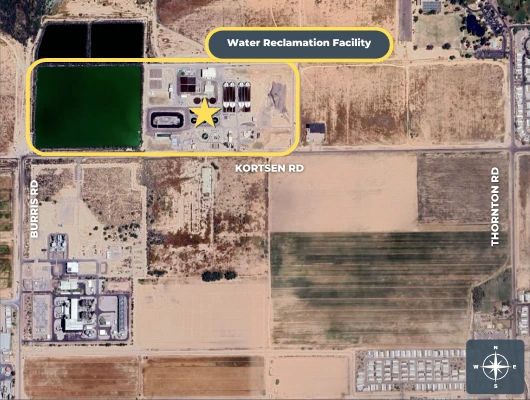
The city processes approximately 6,300 acre-feet of A+ quality effluent each year at its Water Reclamation Facility. Under the new policy, 20 percent of that supply will go to a strategic reserve through aquifer recharge, 40 percent will be allocated to industrial users, and 40 percent will be allocated to residential development. This 20/40/40 split will guide future effluent allocation decisions tied to industrial recruitment and residential growth.
The adoption follows a series of council study sessions held since December and covered in earlier reports, including the December 15 overview of current uses and credit losses, the January 5 authorization of Cactus Mine negotiations, the February 17 direction on recharge and reserves, and the March 16 review of the draft strategy.
Inside the New Effluent Policy
The adopted strategy sets out how the city’s treated wastewater supply will be allocated in the years ahead. According to the document, the framework is intended to prevent over-concentration of effluent in a single sector, protect against economic volatility, ensure housing supply aligns with employment growth, and position the city to compete for both industrial users and residential expansion.
Effluent currently supports several public and private uses. The city recharges approximately 3,034 acre-feet annually into the aquifer to generate long-term storage credits, which the city can later use to help meet water supply requirements for new development. About 540 acre-feet irrigates the municipal golf course. In addition, a contract delivers 1,181 acre-feet to industrial use at the Desert Basin Power Generating Station. Another roughly 1,352 acre-feet flows down the north branch of the Santa Cruz Wash without earning the city any storage credits, because stormwater and irrigation district discharges into the wash interrupt the credit calculation.
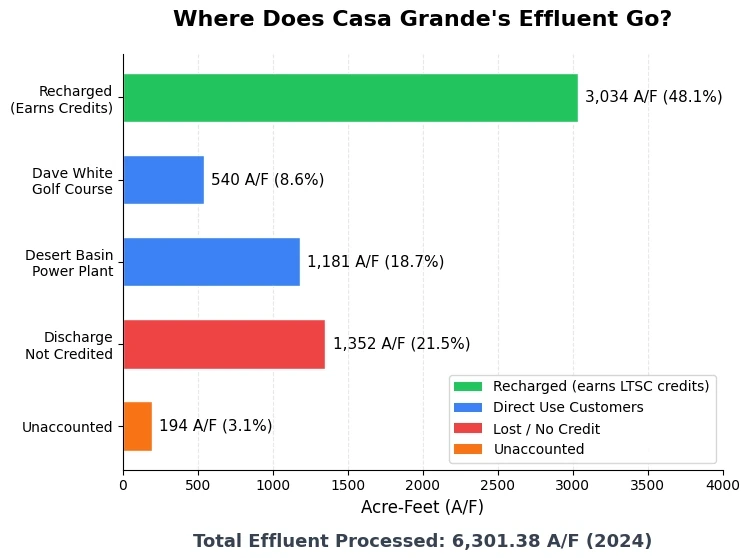
The strategy points to two goals for how it puts effluent to work. When industrial customers, golf courses, and other users take treated effluent, they do not have to pump groundwater for those same operations. The strategy describes this as offsetting groundwater use for non-potable purposes. The strategy also directs the city to limit those uncredited wash discharges, both by maximizing the share of effluent that earns storage credits and by routing more of it to direct-use customers.
Modifications and Reprioritization Before Adoption
Before adoption, City Manager Larry Rains noted the document had been refined since an earlier study session presentation. He characterized the changes as minor: “Really nothing that was added or removed, but just essentially reprioritized.” The reprioritization expands how housing is treated within the policy structure.
One documented example is the renaming of Tier 2 in the priority system, which the strategy changed from “High-Value Economic Development” to “High-Value Industrial and Residential Economic Development.” The tier lists residential uses explicitly alongside industrial ones, including subdivisions tied to the state’s alternative water supply program, recharge programs supporting housing, and master-planned communities. The rationale section describes industrial and residential growth as “co-equal drivers of community prosperity.”
The two surrounding tiers carried over largely as before. Tier 1, the highest priority, covers municipal and regulatory needs, including aquifer recharge, long-term water portfolio protection, and subdivisions inside the city’s Designation of Assured Water Supply boundary. Tier 3 covers commercial, agricultural, and landscape uses, including golf courses, large-scale irrigation, and non-potable landscape systems.
Rains framed the 20/40/40 split as a balanced starting point given uncertainty around the new Alternative Designation of Assured Water Supply (ADAWS) program. The state program lets housing developments meet Arizona’s 100-year water supply requirement by drawing on renewable sources like treated effluent, rather than relying on groundwater alone. He told the council the approach “allows the mayor and council some flexibility” as the city sees how the alternative designation program develops over the next several years.
The adopted document also splits the city’s effluent supply into two pools for accounting purposes: volumes produced before Arizona Water Company received its ADAWS designation in March 2026, and volumes produced afterward. The split lets the city distinguish effluent committed under the old regulatory landscape from new supply generated in an environment where housing developers are expected to request effluent in much larger numbers. Council members agreed to this approach at the February study session, in anticipation of the wave of ADAWS-related requests Rains has said the city expects to receive.
How the 20/40/40 Allocation Will Work
Subject to municipal priority needs, the city will allocate available effluent across three categories. The reserve portion supports recharge and long-term storage credit generation. The industrial portion supports economic development. The residential portion supports housing growth under ADAWS.
Industrial allocations from the 40 percent pool must meet one or more of several thresholds spelled out in the strategy: a minimum capital investment of $100 million, at least 200 full-time jobs, wages at or above 110 percent of the county median, a minimum five-year operational agreement, and developer-built or expanded delivery infrastructure. The adopted version also adds a new 10-year maximum term, with potential extensions, that did not appear in the March draft. At the March 16 study session, council members had discussed treating those thresholds as guiding criteria rather than rigid mandates, at least in the near term.
Residential allocations carry their own set of conditions. A project must have subdivision or master plan approval, demonstrate compliance with state assured water supply requirements, follow a build-out schedule, and pace construction to match public infrastructure completion. The strategy also requires recharge infrastructure to be developed and built for each project, though who pays for and operates that infrastructure is a question the city is still working through with developers.
Every effluent agreement carries the same baseline protections for the city. Customers who do not use the effluent they were allocated lose it back to the city. Customers must help cover the cost of the pipes and facilities that deliver the water. And in a shortage, the city’s needs come first.
The strategy also requires that all major effluent allocation agreements receive public council approval. Staff must also report annually on production, allocations, remaining capacity, revenue, and long-term commitments.
Rising Demand from Housing and Industry
The adoption comes as Arizona’s regulatory environment shifts. In March 2026, Arizona Water Company received what Pinal County described as the first Alternative Designation of Assured Water Supply in the county, a designation expected to support more than 80,000 new homes. Demand for effluent as part of housing approvals is expected to grow.
“We’re very likely going to get more requests for the use of effluent than we ever have because of the importance of effluent to the ADAWS program,” Rains told the council at the March 16 study session.
Councilmember Matt Herman recalled that “five or so years ago, we almost gave it all away to somebody,” and expressed support for the new framework as a way to keep the city in control of a resource it had nearly let go.
The city is also negotiating an effluent purchase agreement for the Cactus Mine, the former Sacaton Mine site. Council authorized those negotiations on January 5 for an agreement that would deliver up to 1,300 acre-feet annually to the project. However, the final agreement must return to council for approval.
Fiscal Impact and Long-Term Projections
Staff expect new revenue from future effluent purchase agreements.
The strategy includes a 10-year projection model based on a conservative 1.6 percent annual growth rate. Under this scenario, total effluent production grows from 6,301 acre-feet in 2024 to approximately 7,268 acre-feet by 2033.
In residential terms, the 40 percent housing allocation translates to approximately 12,000 dwelling units at current volumes. By 2033, that capacity would support roughly 14,000 units.