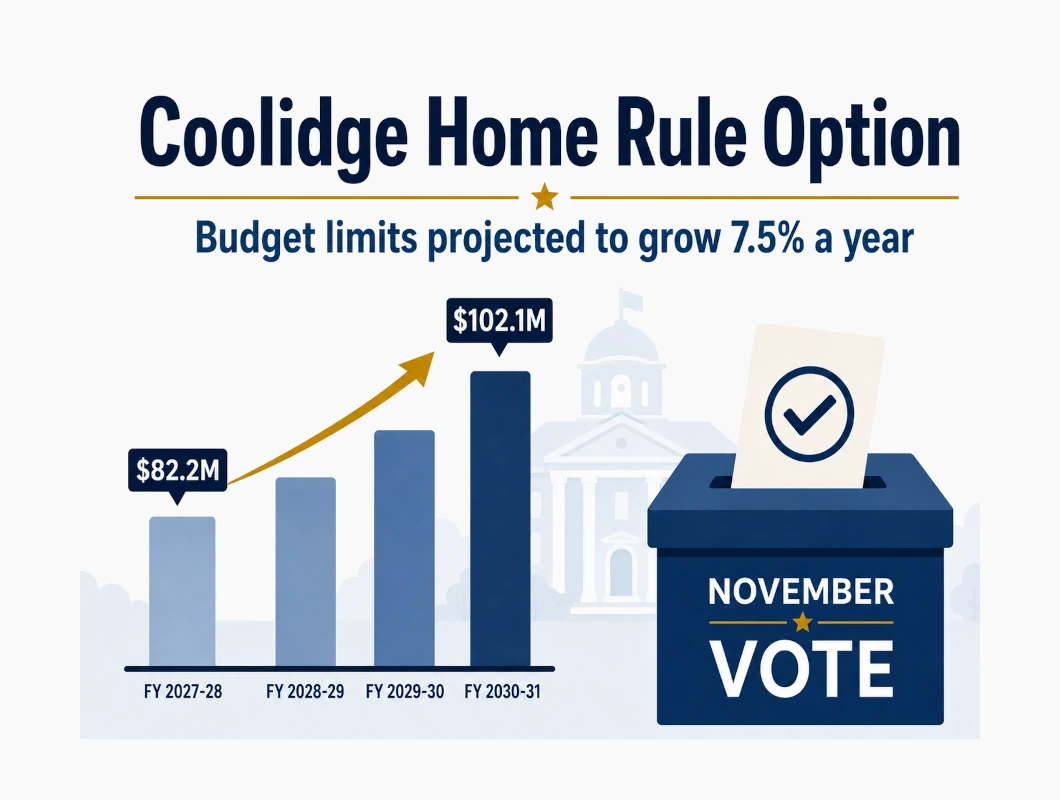
COOLIDGE, AZ — Coolidge voters will decide on November 3, 2026, whether to renew the Coolidge Home Rule Option, which would let the city set spending limits projected to grow about 7.5% a year. Under that projection, the city’s analysis shows limits rising from roughly $82.2 million in 2027-2028 to $102.1 million by 2030-2031. The measure allows the City Council to set the city’s own budget limits instead of following a state formula. As a current-year example, the agenda report says the city would have had to cut about 36% from its budgets without Home Rule. The largest cuts would have fallen on police, fire, and recreation, since those departments carry the biggest budgets and the most personnel. On June 8, the City Council held the first of two scheduled public hearings on the measure.
Why the Coolidge Home Rule Option Is on the Ballot
The Arizona State Constitution imposes a formula-based spending limit on every city and town. As an alternative, the constitution allows local voters to approve their own expenditure limit, known as the Home Rule Option. The measure affects only what the city is able to spend, Finance Director Erik Heet said.
Coolidge has operated under this option since 1982, and voters must renew it every four years. Voters have approved the Home Rule option each time it has appeared on the ballot since 1982, most recently in August 2022. Therefore, the measure returns to the ballot this fall, and approval would cover the four fiscal years beginning in 2027-2028.
Budget Projections Built on 7.5% Annual Growth
Heet told the council the city’s projections assume steady budget growth over the next four years. “We ran some calculations similar to the prior four years, looking at a rough increase of about 7.5% annually in terms of our total budget,” Heet said.
Under those projections, the spending limit would start at $82,189,226 in 2027-2028. It would then rise to $88,353,418, then $94,979,925, and finally $102,103,419 by 2030-2031. By comparison, the city’s summary analysis worksheet projects the state-imposed formula would cap spending between roughly $43.0 million and $54.5 million over the same four years. The formula produces lower figures because it starts from the city’s 1979-1980 spending base of about $1.5 million, adjusted only for population growth and inflation since then. Moreover, he noted the formula does not account for the services and programs each community actually provides. Heet stressed that these figures are ceilings, not spending commitments. The city does not have to spend those amounts; the limits simply keep budgets from going beyond them.
Most of the funding comes from local sources, such as sales taxes and local grants, Heet said. Additionally, he estimated between about $25 million and $31 million per year in combined federal and state funds. However, Heet noted those numbers would go up if the city lands any large grants, such as the RAISE grant. According to Heet and the city’s Home Rule information sheet, the measure does not increase or decrease tax rates, and the estimates rely on income sources the city already receives.
Stakes Illustrated by This Year’s Budget
Heet offered the current fiscal year as an example of what is at risk. The city’s expenditure limit under Home Rule is about $71.1 million this year, while the state formula would have allowed only $45.2 million. “If we went with the state expenditure limitation, we would have been about 25 million in the hole,” Heet said. In that scenario, he noted, many capital projects, roadwork, and other vital work the city has been doing might not happen.
A yes vote would let Coolidge continue setting spending limits locally through its normal budget process. Conversely, a no vote would impose the state formula, which the city says would reduce services in fiscal year 2027-2028. According to the city’s Home Rule information sheet, affected services would include police, fire, parks and recreation, the library, animal control, public transportation, development services, and liquid and solid waste services.
Procedural Path to the Election
During the June 8 hearing, Councilmember Steve Hudson voiced support for keeping local control, saying the city does not want the state dictating what it can and cannot do. No members of the public came forward to comment. The city posted the hearing notice on its website and published it in local papers on May 28 and June 4.
How Residents Can Weigh In Before Voting
Residents have one more chance to comment before the alternative expenditure limitation reaches the ballot. The second public hearing is set for June 22, 2026, at 7:00 p.m. in the Coolidge City Council Chambers at 911 South Arizona Blvd., where the council is also expected to pass an authorizing resolution. After that, the Coolidge Home Rule Option goes before voters at the November 3 general election.