CASA GRANDE, AZ — Three Casa Grande residents challenged the city’s use of the Casa Grande Flock cameras during public comment on Aug. 17, 2026. They raised concerns about privacy, the city’s contract terms, and reported misuse of similar systems elsewhere. Their comments came after Pinal County Sheriff Ross Teeple told supervisors on Aug. 5 that his office would not renew its Flock contract over Fourth Amendment concerns. Five days before the meeting, the Board of Supervisors voted 4-1 to end Flock’s right-of-way agreement on county infrastructure. Neither county action affects city contracts. The council did not respond. Mayor Lisa Navarro Fitzgibbons said council members could not respond to or discuss items not on the agenda, though they could direct them to staff.
Casa Grande approved a 10-year, $10 million Flock contract in September 2025, and that agreement remains in place.
Adam Power: Safety Versus Liberty
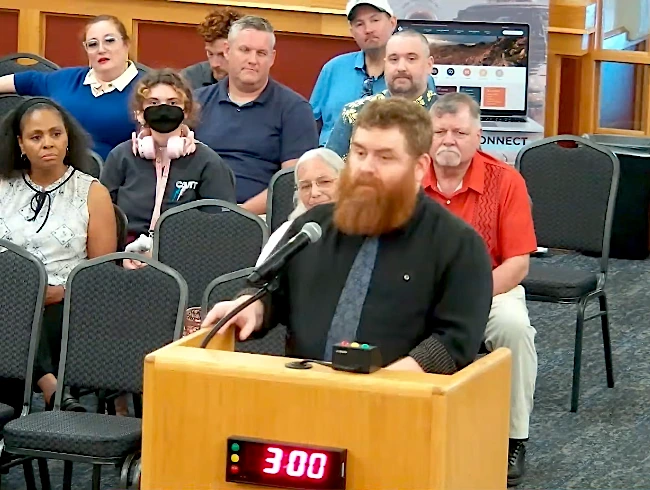
Adam Power, who teaches government and economics at Mission Heights Preparatory High School, said he spoke at his students’ request. He wants Casa Grande safe and police well equipped, he said. “The disagreement isn’t about whether we want safety. It’s about how much freedom we should surrender in pursuit of it.”
He pointed to the Fourth Amendment and to the Arizona Constitution’s right to privacy. Technology complicates those protections, he said, because there is a difference between watching a single trip in public and compiling records of a person’s movements. As authority, he cited Chatrie v. United States, which he said reaffirmed this year that Americans have a reasonable expectation of privacy in their physical movements, even when a private company holds the data.
That June ruling involved cell-phone data, not cameras, and Power acknowledged it does not make every public camera unconstitutional. “But it should make us ask a serious question,” he said. “When does observation become surveillance?”
“Every society asks us to surrender some freedom,” Power said. “That’s the social contract. So whenever government asks us to surrender another piece of liberty, we should ask what greater freedom are we receiving in return?” He also raised the cost when these systems fail, citing an Arkansas stop earlier this year in which police held an innocent couple at gunpoint after a camera misread a plate. According to KATV, that stop happened in Sherwood in February 2026 after a Flock camera misread a plate by one letter. Officers detained the driver and a passenger seated next to an infant, then released them once they realized the mistake.
Power added that a former student, now a police officer, told him the cameras are useful, and he believes him. Still, he argued that police enforce the law while citizens decide what powers to give them.
— Adam Power
He asked conservatives to imagine the system controlled by the most progressive government they can picture. Likewise, he asked liberals to imagine it controlled by the most conservative government, or by a corporation. “I don’t know who will control these systems ten years from now, but I know who will live under the decisions. My students will,” he said. He concluded that the question “is whether the amount of freedom we surrender is worth the amount of safety we gain. I don’t believe it is.”
Jacob Petrosky: The Casa Grande Flock Cameras Contract
Jacob Petrosky said he reviewed the city’s Flock contract. According to him, the city owns the imagery the Casa Grande Flock cameras collect but grants Flock a worldwide, non-exclusive, irrevocable, royalty-free license to use it, which he described as free access forever.
“Flock doesn’t have a business without the data,” Petrosky argued, saying the company needs a steady flow of imagery to build its machine-learning models. He compared the cameras to 200 people filming on street corners around the clock at minimum wage, which by his own calculation would cost about $26 million per year. “So the question is: where’s our $26 million for letting them collect all this data?”
Saying he is not a lawyer and was not giving legal advice, he cited the Arizona Constitution’s gift clause, which he said bars a city from giving valuable public assets to a private corporation for no return. Speculative benefits, such as improving Flock’s software, do not count as payment, he argued. “You’re effectively helping a private company train their AI for free with taxpayer money, and that’s illegal,” he said. Because the license is non-exclusive, he asked when his own company would get free access to the same data.
Michael Hanrion: Misuse Elsewhere and Police Presence at Home
Michael Hanrion, who said he has raised Fourth Amendment concerns with the council many times, pointed to recent cases of possible or confirmed officer misuse of Flock cameras in other Arizona cities, including Chandler and Apache Junction. AZFamily reported that Chandler discontinued its cameras on Aug. 7 after an audit flagged an anomaly involving an employee. In Apache Junction, an officer ran his wife’s plate through the department’s Flock system and located her car in Casa Grande, according to Apache Junction police chief Michael Pooley. He disclosed it while asking Casa Grande police to check on her, and Casa Grande police promptly notified his department. He resigned after an internal investigation. However, Pooley said the department will keep using the cameras.
Hanrion argued that mass surveillance targets law-abiding residents because they are easier to control than criminals, comparing what he described as more than 200 Flock cameras in Casa Grande to Sweden’s plan to electronically monitor at-risk youths and police weapons searches at some German train stations. Pinal Post reported the city’s 2025 contract added more than 220 devices, including 100 license plate readers and 100 pan-tilt-zoom cameras, on top of 14 license plate readers approved in 2022. In May, the council also approved emergency police access to elementary school cameras through a Flock gateway, matching an existing arrangement with the high schools; those cameras are owned by the school districts.
Hanrion, a teacher, said good teachers circulate rather than stand in one place. In his view, Casa Grande police movement around the city has sharply declined, possibly because officers are watching camera screens. He said he sees Pinal County sheriff’s deputies more than city police. “Is that how it’s supposed to work? Maybe. I doubt it,” he said. He closed by asking the council to “reconsider the use of this mass surveillance system in our wonderful city.”