Key points
- Apache Junction may take over Idaho Road from the state.
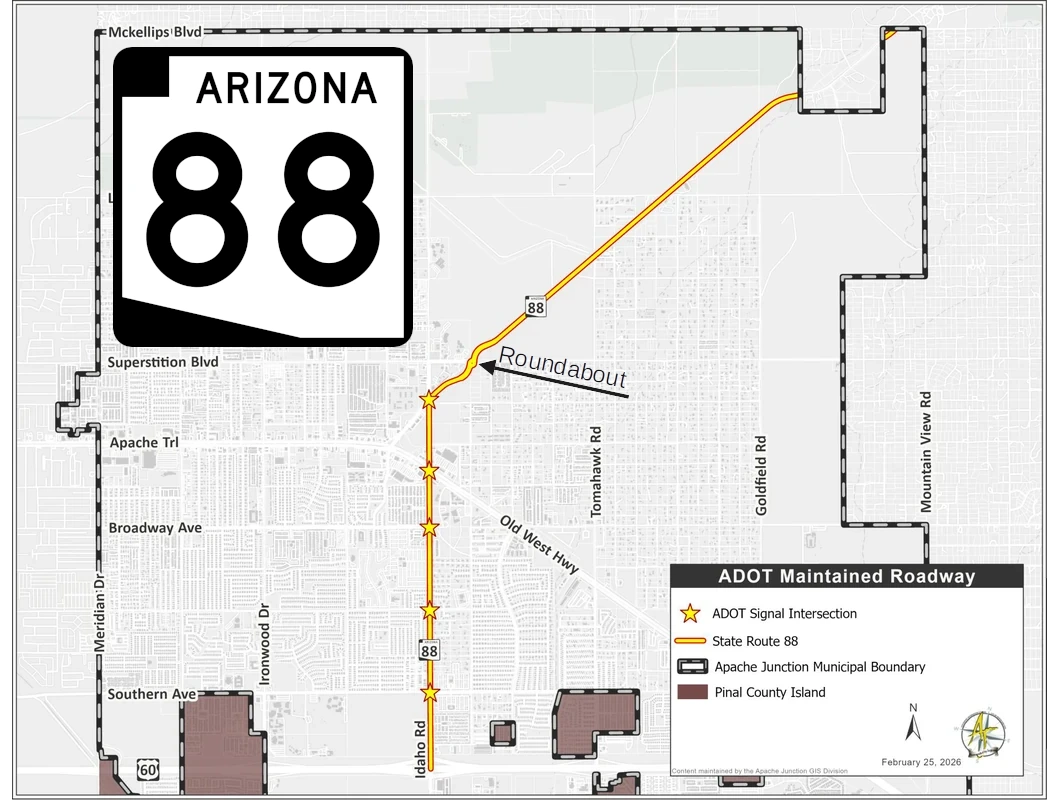
- The road is State Route 88, from US 60 to the northern city limits.
- The city would control five traffic signals and the roundabout.
- Signal changes and permits would no longer wait on ADOT.
- Repairs would run $9.1 million for the downtown leg, $14 million for the whole road.
- Annual maintenance would rise by $700,000 to $1 million.
- ADOT would hand over the road free.
- Building the route new today would cost about $43 million.
- The council can take the road in one piece or in sections.
- At least four of seven council members want the whole stretch.
- No vote was taken Sept. 14.
- Staff expect to bring agreements back within a couple of months.
APACHE JUNCTION, AZ — Apache Junction is considering taking over Idaho Road from the Arizona Department of Transportation. At least four of the seven City Council members signaled support Sept. 14 for taking the entire State Route 88 stretch through town. It runs from US 60 to the northern city limits. South of US 60, the city already controls the road. The Idaho Road transfer would give the city control of five traffic signals, the roundabout and permits along the corridor. However, it would also add roughly $700,000 to $1 million a year in maintenance costs. ADOT would hand over the road without charging the city for what it cost to build.
The work session agenda listed the item as a discussion and presentation, and the council took no vote. The other three members asked about liability, maintenance and signal timing. None spoke against the transfer.
Synchronized signals, faster permits and local crash handling
If the city owns the five traffic signals, Public Works Director Mike Loggins said, it can synchronize them. Drivers would then get green lights through town instead of stopping every mile or half mile, he said. Today, city staff can see ADOT’s signal cameras but cannot change anything.
Permits would also move faster. The city’s water district, sewer district and other city crews currently need ADOT permits to work in the road. Loggins said those permits take six to eight months. By comparison, the city’s own permit process takes about a month.
Crash response would change too. Today, city officers reach wrecks on SR 88 first, then typically turn the scene over to the highway patrol, Loggins said. Under city control, they could handle those crashes themselves. In March, Police Chief Michael Pooley told the council that waiting for state troopers could take hours.
ADOT now sets what developers must build along the road, such as turn lanes farther north. Loggins said those decisions would become the council’s, and that working with ADOT on them has been difficult. Vice Mayor Robert Schroeder also noted that any artwork on the roundabout currently needs ADOT approval. Once the city owns it, he said, the council could design that artwork the way it wants.
Idaho Road transfer options at a glance
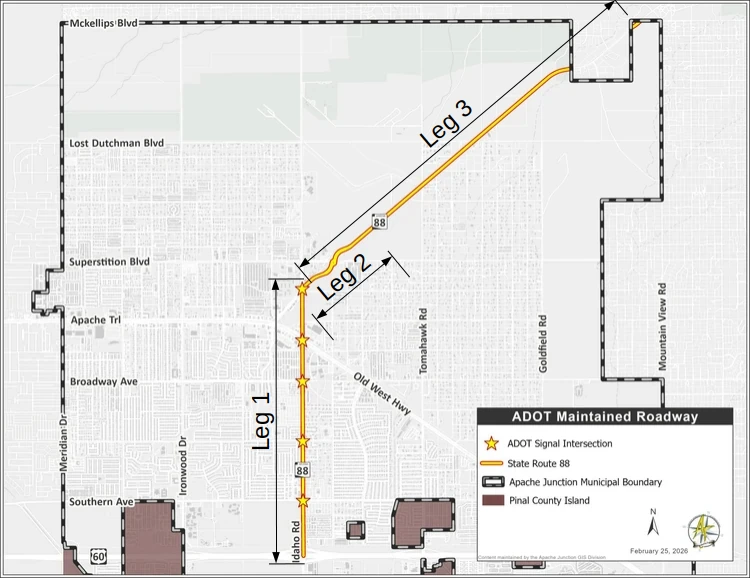
Loggins broke the road into three legs. For each, he estimated the city’s maintenance cost over the next 10 to 20 years. Those figures include the pavement, sidewalks, streetlights and traffic signals. Councilmember Peter Heck asked whether taking one leg now would rule out adding the others later. Loggins said it would not. The council can take the legs all at once, one at a time, or redraw them, and ADOT is open to any of those approaches.
| Option | What the city would take | Estimated repair cost, next 10–20 years |
Points in favor raised at the meeting | Concerns raised at the meeting |
|---|---|---|---|---|
| Leg 1 only | US 60 to the signal where SR 88 turns northeast toward the roundabout | About $9.1 million | Control of the downtown signals and the stretch between Southern Avenue and US 60, which the city manager called a huge economic corridor | Costliest section to maintain; one intersection needs repair now |
| Legs 1 and 2 | Adds the stretch from that signal to just past the roundabout | About $10.1 million | Control of the roundabout, including approval of its artwork; adds about $1 million in repairs | More road and streetlights to maintain |
| All three legs | Adds the rest of the road out to the northern city limits | About $14 million | Northern stretch recently repaved; growth expected to the north; ADOT is willing now | Highest total cost; includes a county island outside city limits; city responsible for any future safety fixes on the rural stretch |
Leg 1 is the largest piece, with about 11 lane miles and all five signals. Leg 2 adds 1.75 lane miles and the roundabout, and leg 3 adds about 6.5 lane miles. Building the entire route new today would cost about $43 million, Loggins said. The city would not pay that amount. Instead, the figure measures what ADOT already built and would turn over for free. What the city takes on is maintaining the road from then on.
Councilmember Darryl Cross asked whether legs 1 and 2 overlap. Loggins said they do, slightly, at the intersection where one ends and the other begins. Therefore, taking the two together would trim a little from his estimate, he agreed. However, the roughly $10.1 million figure for legs 1 and 2 still adds his two estimates together.
ADOT also offered two timelines for the handoff.
| Timing option | How long it would take | What it means for the city |
|---|---|---|
| Take the road as is | Two to four months after an agreement | The city gets the road in its current condition and pays for all future work |
| Ask ADOT to repair it first | Five to seven years or longer | ADOT would mill and overlay or slurry seal the road first, but that work is not in its five-year plan |
City Attorney Joel Stern raised what he called a political issue. ADOT staff are friendly toward the transfer right now, he said. However, when the city tried to do things on the road five and 10 years ago, different staff told them not to touch ADOT’s right of way. ADOT would love to hand the road off, he said, because it costs the agency a lot to maintain. That attitude could change, however. Consequently, taking leg 1 now might not guarantee the city could add legs 2 and 3 later, though he called that speculative.
Councilmember Tess Nesser asked about the stretch that runs through a county island outside city limits. She wanted to know whether ADOT would expect the city to pave it. Loggins said that stretch would be included in a full takeover. The city would maintain it and would likely ask the commercial and residential property owners there to come into the city limits.
One intersection needs repair now; other work is years away
Loggins said only one spot needs immediate work: the intersection of Old West Highway and Idaho Road. ADOT did a fog seal on leg 1 this year but did not touch that intersection, and its pavement is alligatored with holes and cracks. Meanwhile, the city is improving Old West Highway from Idaho Road to Tomahawk. As a result, the untouched intersection would stand out as the one bad section. Schroeder asked where leg 1 would rank on the city’s maintenance priorities if Apache Junction already owned it. Aside from that intersection, Loggins said, it would not fall high, since other city roads are in worse condition.
Beyond that repair, staff put the next round of work years out. Legs 1 and 2 have had minor maintenance and would need more within five to 15 years. Leg 3 received a mill and overlay from ADOT three to five years ago, so its next round falls in the 10-to-20-year range.
Councilmember Bambi Johnson said she has heard many people push for a roundabout at SR 88 and Lost Dutchman. She asked whether ADOT plans one. Loggins said ADOT has not mentioned any such plans. If safety problems arise there after the transfer, the city would have to seek the funding, including grants. ADOT used safety grants to help fund the existing roundabout, he said.
Maintenance costs and the city’s road budget
The city spends about $7 million to $8 million a year on road preservation, Loggins said. The new lane miles would add slightly less than 10 percent to the streets the city already maintains. That rough share is where his $700,000 to $1 million estimate comes from. “We’d have to have additional tax revenue because there’s more maintenance,” he told the council. He added that the city could build up money for the big projects over time and schedule them around the 10-year mark or later. The city routinely moves projects earlier or later in its schedule, he said, and would watch how development and tax revenue come in.
Of leg 1’s $9.1 million, about $1 million covers upgrading the five signals and connecting them to the city’s system, Loggins said. That work covers fiber, network and cameras. Those cameras manage traffic flow and are not license plate readers, he said. However, he said the city could ramp that work up slowly over time.
Assistant City Manager Matt Busby said general fund revenues have been good. However, road funding known as HURF is not growing. The hope, he said, is that efficiency and better technology make maintenance cheaper over time. Still, he said staff is confident the city can manage the added cost.
City manager’s recommendation on the Idaho Road takeover
Cross asked City Manager Bryant Powell whether the cost would hurt the budget. Powell said the city would have to prioritize, but he believes it can manage. “There have been many times over the years working here that I just wish we already owned it,” he said. Owning the road, he added, lets the city control its own destiny. “If you were to tell me the economy continues like it’s going right now, it’s a full strong recommendation,” he said. However, he cautioned that the city never knows what economic headwinds are coming.
Johnson had asked about taking only the downtown stretch from Broadway past the roundabout. Loggins replied that state land along Idaho Road just south of Southern Avenue could one day attract a large commercial user and tax revenue. With city ownership, that traffic decision would rest with the council instead of ADOT. Powell then strongly recommended including the half mile between Southern Avenue and US 60 in any transfer. He called it a huge economic corridor. Powell also supported taking leg 2 to gain control of the roundabout. The northern leg, he said, still feels rural and more like a state highway, so the city could come back for it. However, he added that there could be reasons to start now, citing the city attorney’s warning that ADOT’s cooperation could change. He also said he thinks Loggins leans toward now being the time.
Liability shifts to the city once the road changes hands
Heck asked who would be liable for road defects after the transfer. Stern said the city would be liable for accidents or defects once ADOT fully transfers the road. He added that the city already carries some risk today because its officers respond to crashes on SR 88. Arizona case law has held cities responsible for hazards on state routes their police patrol, he said.
Council members signal support for the entire route
Councilmember Bryan Soller said the city should take the whole road. Growth is coming to the north, he said, and owning the road lets the city make changes. Johnson had earlier raised the possibility of waiting on leg 3. By the end of the discussion, however, she said she would like to see the city take it all. “It’s mood of the day and clerk of the moment, and you just never know when the tide of cooperation can change,” she said of ADOT. Cross agreed and said the city should go for the whole thing. Nesser added, “We need to just own it.”
How the Idaho Road transfer reached the council
Apache Junction has never controlled the road. On March 3, the council voted 7-0 to direct staff to open talks with ADOT. That effort began after Cross waited through four light cycles at Old West Highway and Idaho Road. He then learned ADOT needed two to three weeks to respond. ADOT later held a public listening session, and Loggins said the agency came away hearing the city was ready, willing and able to take over the road. Subsequently, ADOT reached out to staff with the options presented Monday.
Agreements could return within a couple of months
Loggins said he has enough direction to go to ADOT, tell the agency what the city is looking for and see what agreements they can reach. He expects to bring those agreements back with a recommendation, probably within the next couple of months. The council would then decide whether to approve the SR 88 transfer, which would start ADOT’s handoff process.