Key Points
- San Tan Valley Town Council voted on April 15 to seek membership in the Maricopa Association of Governments (MAG), with no votes in opposition.
- The application now goes to MAG’s Regional Council for consideration next month.
- If accepted, the town becomes MAG’s 33rd member and gains access to federal transportation funding for projects like arterial road widening.
- Membership would cost the town about $11,895 in annual dues and assessments, buying a seat at an agency that operates on a $62.8 million budget largely funded by federal dollars.
SAN TAN VALLEY, AZ — San Tan Valley Town Council voted on April 15 to seek membership in the Maricopa Association of Governments (MAG), with no votes in opposition. The application now goes to MAG’s Regional Council for consideration next month. If accepted, the town will be able to compete for federal transportation funds and take part in regional planning on roads, air quality, and growth.
What the Vote Means for Residents
If MAG accepts the application, San Tan Valley would become the agency’s 33rd member in a region covering more than 10,000 square miles.
MAG Executive Director Audra Koester Thomas told council the agency awards “many millions of dollars each and every year” through competitive programs. Those programs include arterial widening, a category Koester Thomas said would likely be “top of mind for a fast-growing community like San Tan Valley.”
What If San Tan Valley Says No?
Mayor Daren Schnepf pressed the executive director on the cost of staying out. “What, in your expertise, in your knowledge, what would be the result of us as a town not being a member of MAG?” he asked.
Koester Thomas answered with three points. First, she described the loss as “an opportunity cost.” Membership lets a town submit projects, have them scored, and “chase multi-millions of dollars of transportation dollars.” Without it, San Tan Valley cannot compete for that pool.
Second, she pointed to collaboration with the other member agencies, which include cities, towns, counties, and Native nations. “Regionalism is something we do really well,” she said. The agency, she added, works to “find solutions that are able to work for Wickenburg, Tempe, and San Tan Valley, all with different kinds of issues.”
Third, she described MAG as an advocate for its members with state agencies, working most closely with the Arizona Department of Transportation (ADOT) and the Arizona Department of Environmental Quality (ADEQ). “Because of the big voice that MAG has, covering as much as we do, I think we’re able to find opportunities to champion what you need and find solutions on your behalf,” she said.
Schnepf responded: “If there’s one thing we need is a little bit of leg up with ADOT and with transportation funds. We know that we have some challenges out here.”
What MAG Would Do for San Tan Valley
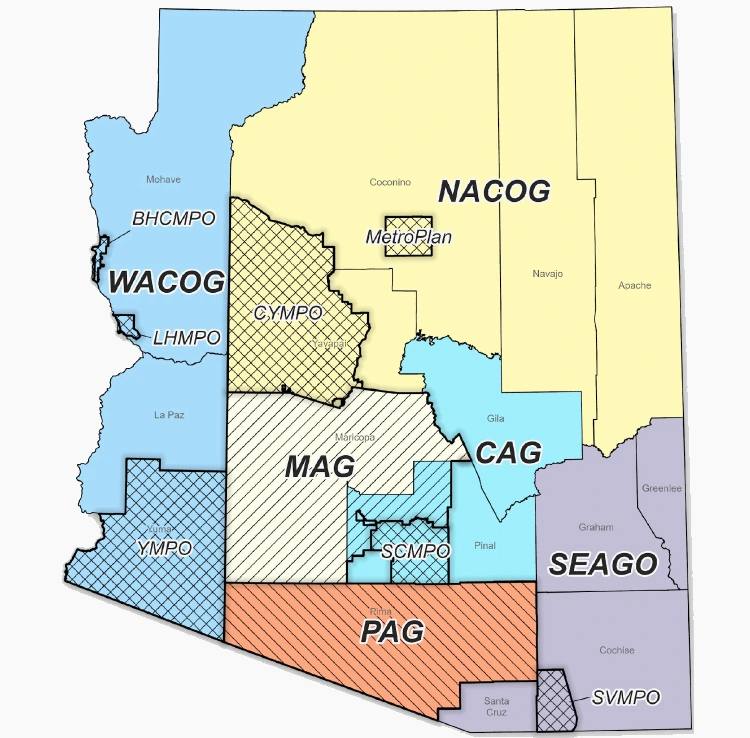
MAG was established in 1967 and now serves a region of more than 5 million residents. It covers all of Maricopa County and, after the 2010 census, expanded to include parts of northern Pinal County, picking up the Town of Florence and the City of Maricopa. As Koester Thomas explained to council, “we are both a metropolitan planning organization and a council of governments.”
Koester Thomas described MAG as two organizations rolled into one. The metropolitan planning organization (MPO) side handles federally required transportation planning. The council of governments (COG) side, she said, covers regional services like human services and community development. Maricopa County communities get both. For San Tan Valley, only the MPO side would apply. “For San Tan Valley and members in Pinal County, we’re only serving the metropolitan planning organization component,” she said. Some of the broader regional services in Pinal County, she added, are handled by a separate agency, the Central Arizona Governments.
A few MAG programs do reach Pinal County beyond transportation, Koester Thomas told council. MAG serves as the lead air quality planning agency for the region, and “that includes for areas in Pinal County,” she said. MAG also runs regional solid waste planning and, by executive order, produces population projections for the region.
According to MAG’s investment plan, Pinal County member agencies are eligible to submit projects for seven program categories: Nonmotorized Transportation, Air Quality, Arterial Rehabilitation, Arterial Widening, Intelligent Transportation Systems, Safety, and Transportation Demand Management Expansion. Two other categories, Arterial Intersection and Emerging Technology, “are solely funded by the Maricopa County sales tax and are only eligible to Maricopa County members,” Koester Thomas said.
The bottom line, in her words: “At MAG, your principal focus will largely be transportation.”
Pinal County’s Existing Seat at the Table
Pinal County is already represented at MAG. According to MAG’s roster, Supervisor Mike Goodman holds the county’s seat on the Regional Council. The Town of Florence is represented by Mayor Keith Eaton and the City of Maricopa by Mayor Nancy Smith. The town also borders the Town of Queen Creek, a current MAG member led by Mayor Julia Wheatley.
Federal Authority and the Role of MPOs
Koester Thomas told council that MAG’s authority comes from three sources: federal law, state statute, and executive order. Its principal role, she said, comes through the federal government.
“Our principal role comes through the federal government,” Koester Thomas said. “We’re the metropolitan planning organization for this region, that carries the transportation responsibilities with it. MPOs were created about 50 years ago by Congress when members of Congress were seeing that dollars coming from the Department of Transportation were being disproportionately spent in rural parts of states by state DOTs.”
The structure “empowered local elected officials to directly receive that federal funding and then make decisions that made the most sense for local communities,” Koester Thomas said. “That comes with a lot of weight, and why MPOs have some power.”
State Authority and the Half-Cent Transportation Tax
By legislative authority, Koester Thomas said, MAG implements Proposition 479 and the previous Proposition 400 and 300 transportation plans. All three are versions of the same half-cent sales tax that funds regional roads and transit. Maricopa County voters first approved the tax in 1985 with Proposition 300, renewed it in 2004 with Proposition 400, and renewed it again on November 5, 2024, with Proposition 479, extending it through 2045.
Koester Thomas said the state treats Maricopa County differently than other counties on transportation taxes. “We need to go to the state for permission in Maricopa County to have a local tax placed on a ballot for transportation,” she said. “Pinal County and the rest of the counties in the state can put something directly on the ballot for up to one cent.”
Koester Thomas also said that, by executive order, MAG produces population projections, and that the agency had already provided projection assistance to San Tan Valley before the membership question came up. The town’s recent development impact fee study uses a 2026 base-year population of about 106,600, drawing on a MAG estimate of roughly 107,000 current residents.
Transportation as Core Business
“Transportation really is our core business at MAG,” Koester Thomas said. The work runs through three planning documents: the Regional Transportation Plan, the Transportation Improvement Program (TIP), and the Regional Strategic Transportation Infrastructure Investment Plan.
“At the end of the day, ADOT cannot do any project unless it is in our TIP, and that’s the same for anyone else in the country,” Koester Thomas said. “That’s the powerful document, and demonstrates the control we have over the transportation projects within our region.”
Privately funded transportation projects must also appear in the TIP if they are regionally significant, Koester Thomas said, so the region can confirm they will not worsen air quality. The MAG region does not currently meet federal standards for three pollutants.
Air Quality, Dust, and Ozone
The MAG region is in non-attainment for three pollutants, Koester Thomas told council: ozone and two forms of particulate matter.
“Ozone’s our toughest one,” Koester Thomas said. “Most of the ozone in this region is outside of our control, yet we have to come up with a plan and find ways to reduce ozone. Only 20 percent of the ozone in our region is within our control.”
She said an ozone exceedance was possible the next day. The agency, she said, has worked with the EPA over the past two years on the issue with some success.
The other two pollutants, she said, are forms of dust. PM10 is the larger particulate, the kind kicked up by haboobs, dust storms, and especially unpaved roads. PM2.5 is much smaller and combustion-related, tied to wood burning and consumer fireworks. “That’s where we see most of our PM2.5 exceedances right around New Years each year,” Koester Thomas said.
Koester Thomas also told council that MAG serves as the regional solid waste planning agency. “Not every community has their own landfill,” she said. “We help that on a coordinated level across the region.” MAG plans to update its regional solid waste plan over the next year, she said.
Homelessness and Heat Relief
Koester Thomas said MAG’s human services work focuses on homelessness through the Maricopa Regional Continuum of Care, which is centered in Maricopa County. Pinal County, she noted, has its own continuum of care.
“So many things are intertwined with homelessness, and we’re continuing to see that to be an issue, not just in the central core but across the region,” Koester Thomas said. “Housing affordability becomes a contributing factor to this. You’ll also see heat relief — of our deaths in the summertime unfortunately, approximately 50 percent of those are from our most vulnerable, those who are unsheltered.”
Vice Mayor Tyler Hudgins said he had previously started and run a heat relief center.
“It was one of the most rewarding, powerful experiences of my life,” Hudgins said. “Every year 600 plus people die because of the summer heat, and there is zero reason why anybody should die on our streets due to the heat, with the number of buildings that are running AC that are available during the week, during the weekends.”
Hudgins asked staff to gather more information on the heat relief program and encouraged community partners with air-conditioned space to consider working with MAG. “We’ve got a summer coming up, it’s already been hot in March,” he said. “It’s a very serious issue and it’s growing every single year.”
How MAG Is Funded and What the Town Will Pay
According to MAG, the agency operates on a $62.8 million budget for fiscal year 2026. Federal revenue accounts for about 70 percent of that total. Revenue from the half-cent transportation sales tax makes up another 27 percent. Member agency dues account for about 1 percent, with the remaining roughly 2 percent coming from other sources.
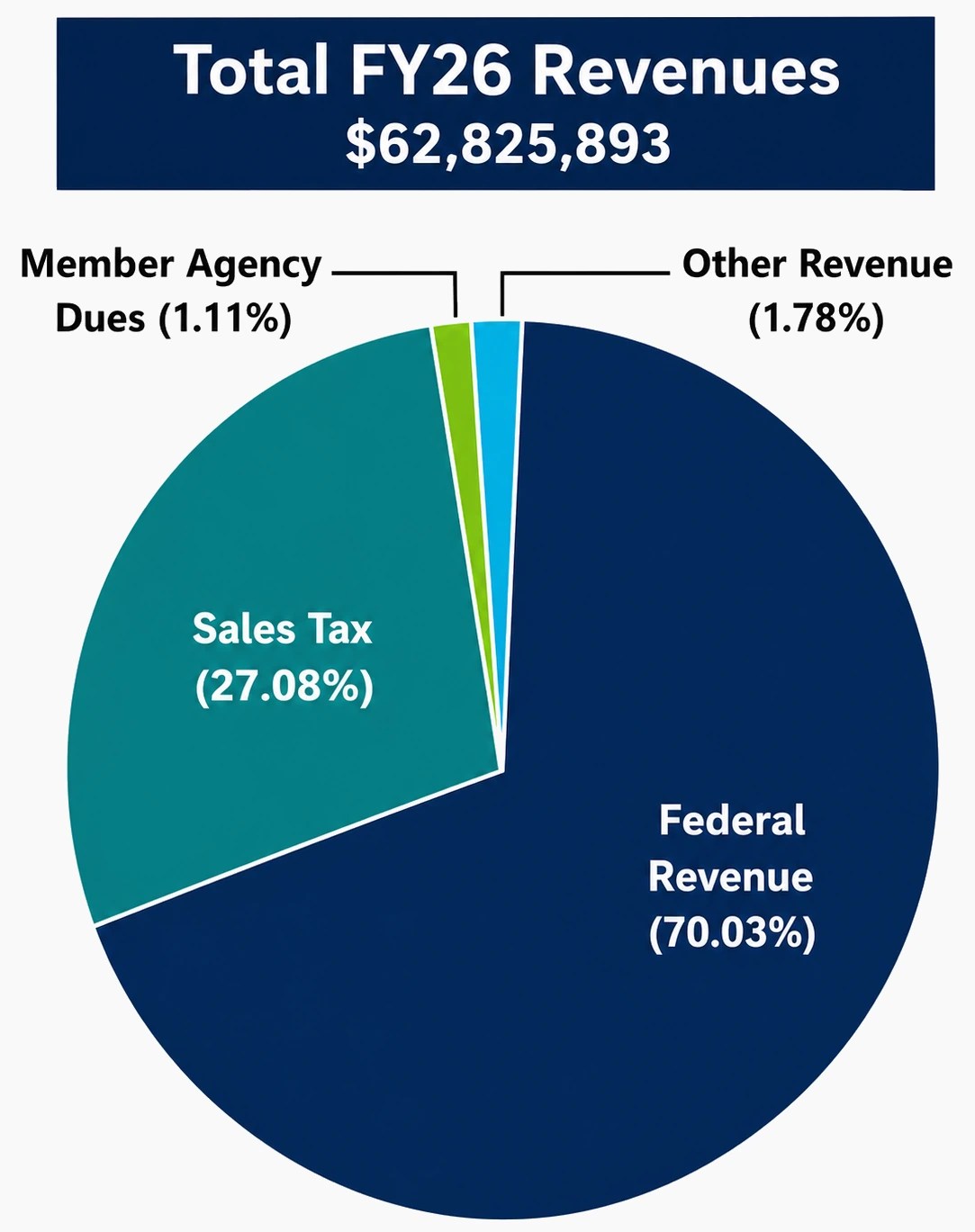
“We work really hard to keep member agency dues very minimal,” Koester Thomas said. “We try to squeeze as much value out of that federal funding as we can.”
On the spending side, transportation accounts for the majority of the agency’s work. About 55 percent of the budget goes to transportation, 30 percent to agency support such as human resources, information technology, communication, rent, insurance, and legal services, and roughly 9 percent to environmental work. The remainder is divided among contingency, community initiatives, local projects, and public works.
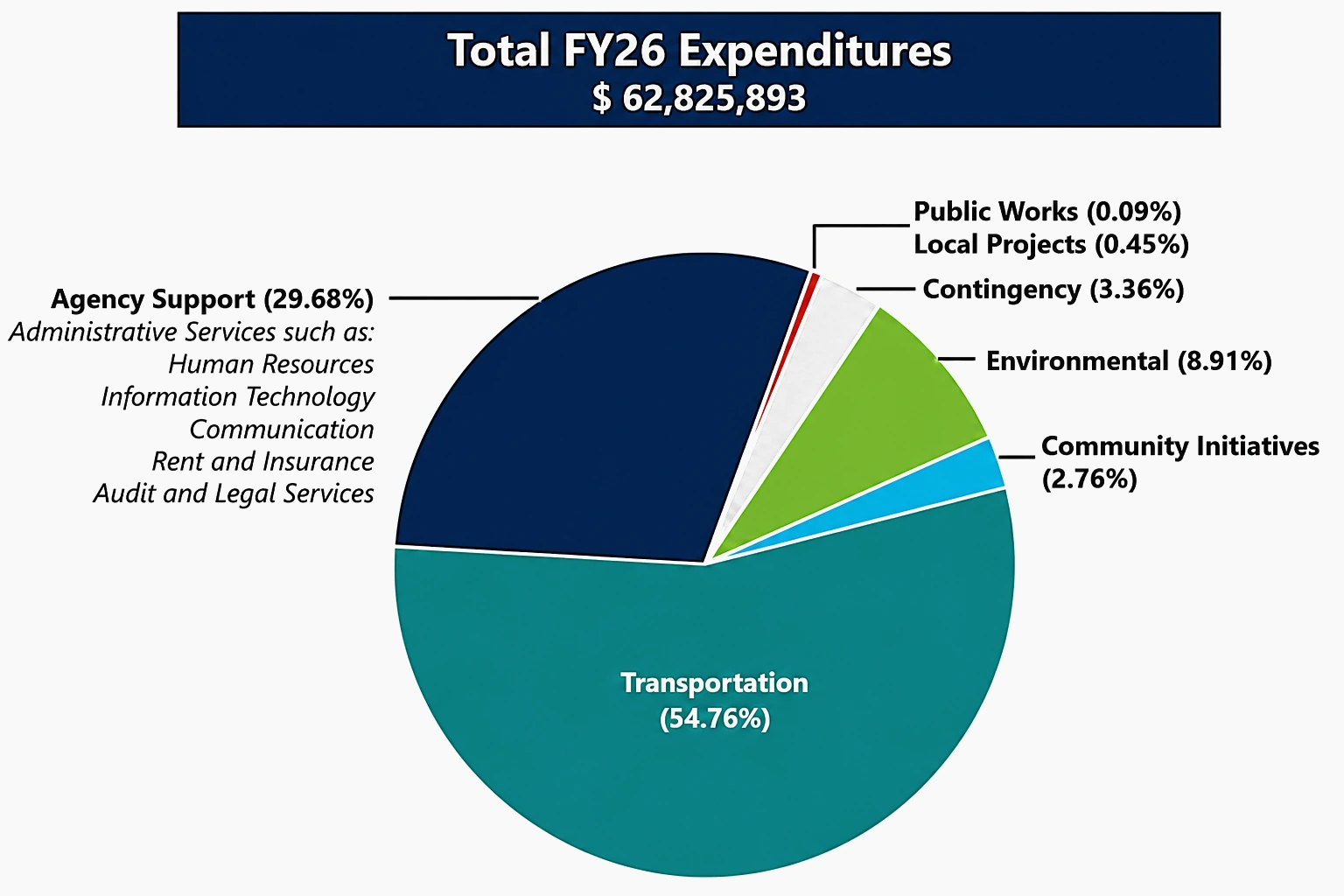
The town’s expected annual cost is $11,895, based on current population:
| Category | Amount |
|---|---|
| MAG Member Dues | $7,174 |
| Solid Waste Planning Assessment | $1,307 |
| Water Quality Planning Assessment | $0 |
| Human Services Planning Assessment | $1,707 |
| Homeless Prevention Assessment | $1,707 |
| Total FY 2027 Dues and Assessments | $11,895 |
The Water Quality Planning Assessment is $0 because Section 208 water quality planning in Pinal County is handled by the Central Arizona Governments rather than MAG.
Looking to the Regional Council Vote
The MAG Regional Council is scheduled to consider San Tan Valley’s membership next month. If approved, the town’s mayor or highest-serving elected officer would take a seat at MAG’s regional decision-making table, with a vote equal in weight to that of any other member.
Councilmember Brian Tyler summed up the council’s view of the agency after the vote: “She had me at transportation.”