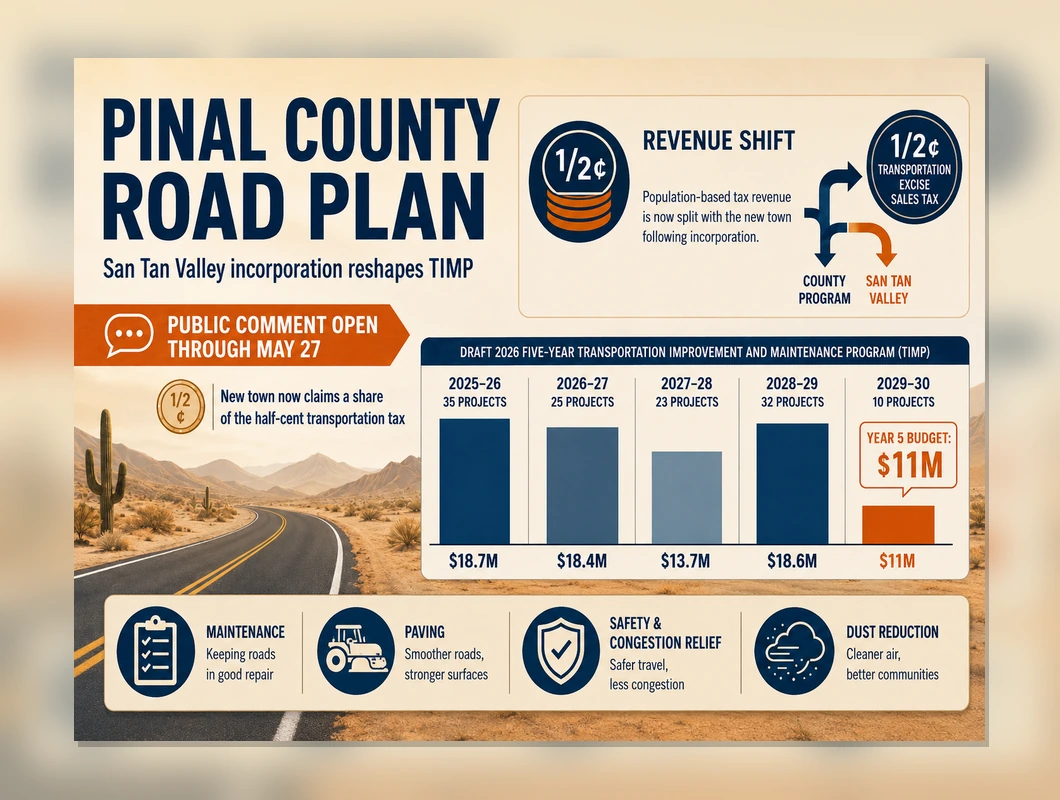
Pinal County’s public comment period on the draft 2026 Five-Year Transportation Improvement and Maintenance Program (TIMP) is now open and runs through May 27. The plan reflects a major shift in county road funding tied to the incorporation of San Tan Valley, which is cutting projected revenue and changing which projects move forward. Pinal County Senior Transportation Planner Nina Arredondo and Development Services Managing Director Joe Ortiz presented the draft to the Board of Supervisors on May 13. The Pinal County transportation plan covers Budget Years 2025-2026 through 2029-2030, and staff are scheduled to return June 17 to request Board approval.
Residents can review the draft and submit feedback at the county’s Draft TIMP Plan page or use the public comment form.
How San Tan Valley Incorporation Changes the Pinal County Transportation Plan
San Tan Valley incorporated in September 2025 and is home to roughly 107,000 residents, making it the largest community in Pinal County. The county has about 502,000 people overall, so roughly one in five county residents now lives inside the new town’s borders. Because the Half-Cent Transportation Excise Sales Tax is split partly by population, a sizable chunk of road revenue is now redistributed among the county and its municipalities, with San Tan Valley claiming a share as a new town. The town’s draft fiscal year 2026-27 budget projects about $9 million from that same half-cent tax, labeled in town documents as the Pinal County Road Tax, in its first full year. That share reduces what is available for the county’s TIMP. As a result, county staff are budgeting conservatively for the final year of the plan.
Arredondo told supervisors revenues had recently trended upward. “Historically, TIMP revenues have trended upward, reaching a little over 21.5 million in recent years,” she said. “However, with the incorporation of the Town of San Tan Valley and the resulting redistribution of population-based revenues, we are taking a conservative approach in budgeting $11 million for the fifth year of the program.” The half-cent tax is shared between Pinal County and its incorporated cities and towns based on population, so the $21.5 million figure reflects only the county’s portion.
District 2 projects inside the new town’s boundaries are also being handled differently. “Projects were received within District 2,” Arredondo noted. “However, because those projects fall within the incorporated Town of San Tan Valley, they were ranked separately, and the recommendations will be forwarded to the town for their prioritization consideration.”
Chairman Jeff McClure asked whether the county would handle road work through intergovernmental agreements until San Tan Valley stands up its own public works department. “Correct,” Ortiz replied. “We have an IGA being developed and probably be before the board here soon for the operations of maintenance of their streets.” The town is also separately pursuing membership in the Maricopa Association of Governments to compete for federal transportation dollars.
What Residents Will See in the Five-Year Pinal County Transportation Plan
The TIMP funds maintenance and improvements to the county’s existing road network rather than building new roads from scratch. That includes repaving, widening to ease congestion, safety upgrades, and paving previously unimproved dirt roads.
The five years of the plan look like this:
- Budget Year 2025-2026: 35 projects at $18.7 million
- Budget Year 2026-2027: 25 projects at $18.4 million
- Budget Year 2027-2028: 23 projects at $13.7 million
- Budget Year 2028-2029: 32 projects at $18.6 million
- Budget Year 2029-2030: 10 projects at $11 million ⬅
Budget Year 2029-2030 is where the change shows up. That year includes just 10 projects totaling $11 million. Of those, eight are new projects and two are existing projects from prior plans.
Why Pinal County Maintenance Spending Keeps Growing
Arredondo told supervisors the program’s emphasis has “increasingly shifted toward maintaining our existing paved roadways, ensuring we preserve the infrastructure we already have.”
Air quality is another driver. “We are addressing air quality requirements by increasing paved mileage, specifically targeting unimproved roads with average daily traffic counts of 150 vehicles or more,” Arredondo said. Paving these dirt roads helps reduce dust. In addition, supervisors have flagged economic development as a strategic focus, so projects that support job-creating sites are part of the scoring mix.
How Projects Get Picked for the Pinal County Road Program
Anyone can submit a project request by mail, email, or online form. Requests received by September 30 are considered for the next planning cycle; later submissions roll to the following year. Public Works staff evaluate eligible projects on criteria including safety, connectivity, and dust reduction. The 10-member Transportation Advisory Committee, appointed by the Board of Supervisors, then ranks the scored projects and recommends those that fit within the budget.
Ortiz and McClure Discuss Funding Shortfall
After the presentation, Ortiz told supervisors his team is working with San Tan Valley to “develop a transitional plan to account for some of the projected revenue that’s going to be reduced.” McClure pressed on timing, noting that San Tan Valley is “a reality now.” Ortiz agreed the impact starts sooner than the fifth-year drop suggests: “Starting next year, it’ll probably be an issue.”
Ortiz then explained how staff intend to handle the gap. “Next year, we have a list of roads that it’ll take 20 million to complete, and we know we’re not gonna get 20 million,” he said. “We’re projected probably around 11, so what we’ll probably do is prioritize those that are in that list. Whatever doesn’t make that $11 million cut, we’ll probably push to the next year, then push to the following year until we can complete all of them.” McClure followed up on whether some of those roads sit inside San Tan Valley. “I think we have a couple,” Ortiz replied, “and that’s kind of why we wanna sit down with San Tan Valley to find out what their priorities are.”
Serdy and Lew Address Flexibility in the Plan
Vice-Chairman Jeff Serdy asked County Manager Leo Lew whether the five-year plan locks the county in. “One of the strengths of Pinal County and this board is how fast we can adapt to what’s thrown our way,” Serdy said. “So let’s say some large business opportunity is coming to Steve Miller’s district, we can cater to that and build roads as needed, right? We don’t have to stick to this plan in a case like that.”
Lew agreed. “We have multiple funding sources for roads, and this is one of those, and there are also amendment processes that can occur within this TIMP program,” he said, adding that “as priorities change and partnerships change,” some projects can move ahead of others.
Serdy offered a concrete example: “For instance, if another LG-type thing wants to move right to the east, we need to get on that and prioritize it.” Ortiz confirmed the flexibility is institutional. “In our bylaws, it’s written that the director and/or county engineer has the flexibility to change as needed,” he said. “It’s built in.”
Where the Money Comes From
The program is funded entirely through the county’s Half-Cent Transportation Excise Sales Tax, also called the Pinal County Road Tax in local budget materials, not to be confused with the separate PRTA half-cent tax struck down by the Arizona Supreme Court in 2022. Pinal County voters originally approved the Half-Cent Transportation Excise Sales Tax in 1986, renewed it in 2005, and reauthorized it again in November 2024 before its scheduled expiration at the end of 2026.
Board Vote Set for June 17
Staff will compile public comments before returning to the Board of Supervisors on June 17 to request approval. Ortiz told supervisors he will return a second time after that meeting with a longer-term strategy for handling the revenue shortfall. The earlier years of the plan, he noted, were built on revenue projections of $18 to $21 million that the county now expects to fall short. “We’ll be back one more time after the June 17th to hopefully give you a strategy and game plan on how we’re going to manage that,” he said.

There are many deaths on Hwy 77 between Oracle AZ and Oracle Junction on Hwy 77. Will there ever be improvements, a third passing lane? Much, much more traffic on this roadway, re: Saddlebrook Ranch. Commuters using this roadway to get to Tucson for employment, many service people. This roadway was shut down May21, 2026 for many hours due to an accident with a fatality. This is the only way to get to and from the North to the South.