Key points
- The Pinal County Planning Commission voted 6-3 on May 21 to recommend denial of the Valley Farms Energy Center.
- The recommendation does not block the project. The Pinal County Board of Supervisors will make the final decision and can still approve it.
- The proposed 400-megawatt battery storage project would occupy 68.77 acres southeast of Coolidge.
- This is NextEra’s second attempt at the site; an earlier version with solar was denied in April 2025.
- Opposition came from the City of Coolidge, which cited a conflict with its general plan, and from neighbors raising fire safety and water contamination concerns.
- Supporters pointed to grid reliability, rising energy demand, and the Wuertz family’s right to sell their farmland.
The Pinal County Planning and Zoning Commission voted 6-3 on May 21 to recommend denial of the Valley Farms Energy Center, a 400-megawatt standalone battery storage project proposed southeast of Coolidge by NextEra Energy Resources. The recommendation now goes to the Pinal County Board of Supervisors, which will vote to approve or deny the project at an upcoming meeting. Supervisors are not bound by the commission’s recommendation and can still approve the project.
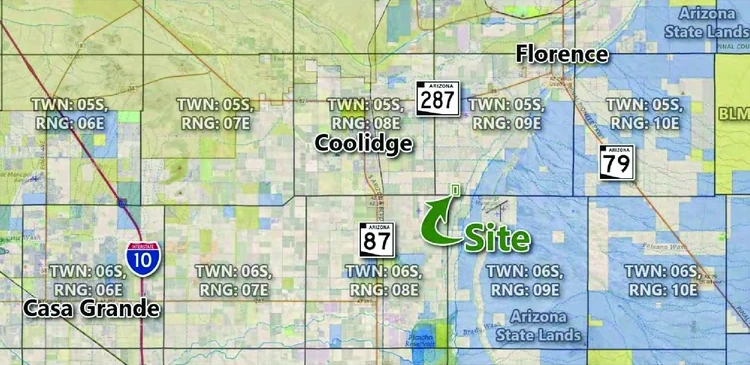
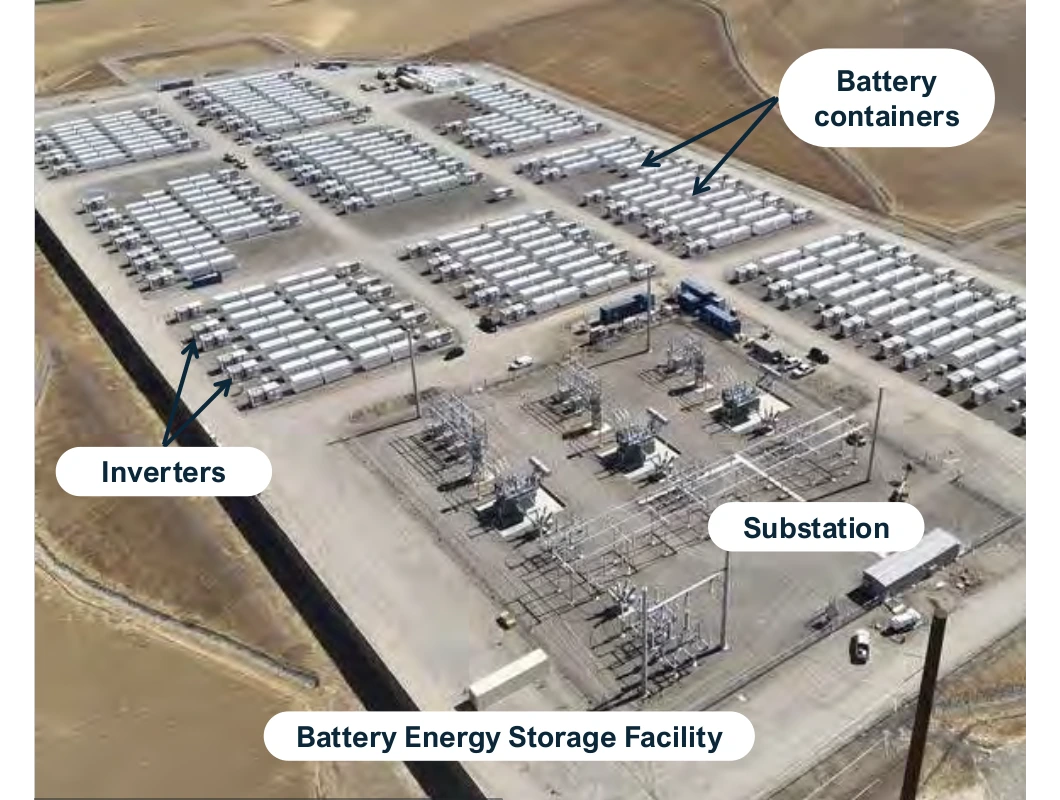
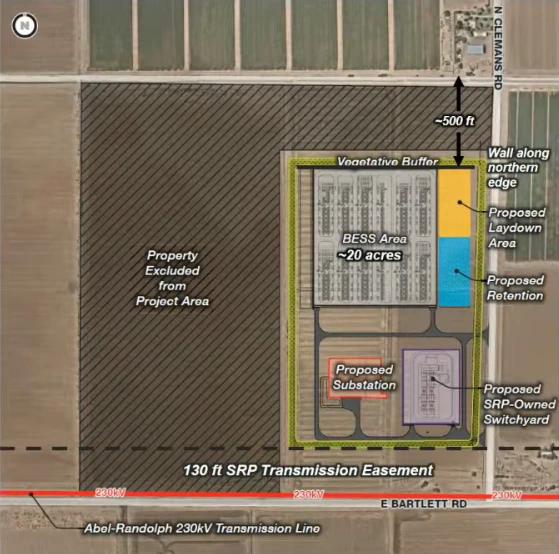
The project would place approximately 20 acres of containerized lithium-ion batteries on a 68.77-acre portion of a 160-acre parcel owned by the Wuertz family. Construction is planned to take about 14 months once all approvals are in place.
A second attempt at the same site
The Valley Farms Energy Center has come before the commission before. Pew & Lake attorney Sean Lake, representing NextEra, began the applicant presentation by calling the situation “an interesting scenario.” He explained that the property is general planned for green energy production, “and then when we brought forward a green energy production project, it was denied. So now we’re back re-tooling, and having to re-change the general plan, because the county said no to a green energy production facility.”
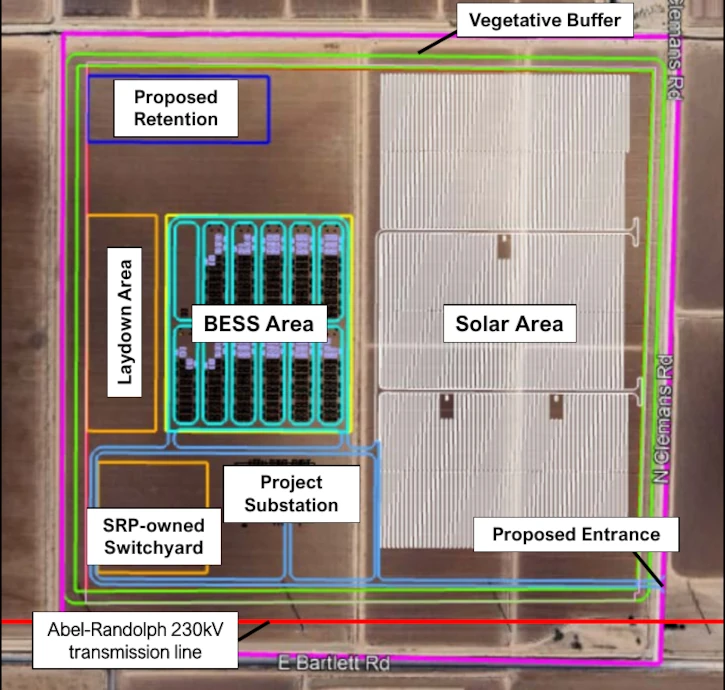
The first iteration covered 160 acres and combined 80 acres of solar panels with 80 acres of battery storage. In February 2025, the planning commission recommended denial. Commissioners raised concerns about battery fire safety and the planned North-South freeway corridor. Several Coolidge officials, including Councilmember Tom Bagnall and Senior Planner Phil Garthright, also spoke against the project. They cited conflicts with the city’s voter-approved general plan. Then on April 30, 2025, the project failed to pass at the Pinal County Board of Supervisors. Mike Goodman and Stephen Miller voted in favor; Rich Vitiello, Jeff McClure, and Jeff Serdy voted against. A supermajority was required because at least 20% of property owners within 300 feet of the site had filed formal objections. At that hearing, Councilmember Tom Bagnall, Senior Planner Phil Garthright, and Coolidge Planning and Zoning Vice Chairman Tom Scott spoke against the project. Scott told supervisors that approximately 40,000 acres of Pinal County had already been approved for solar development.
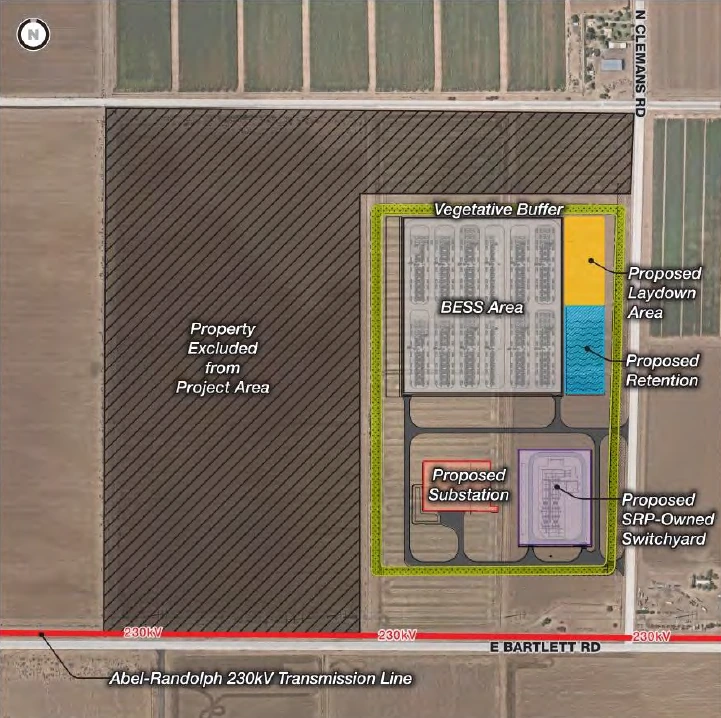
NextEra returned with a revised proposal, holding a neighborhood meeting on November 18, 2025. The company removed solar entirely, reduced the footprint, set the boundary back from neighboring property, and added a wall along the north side. “We heard the county. We heard they were concerned about the solar, we removed the solar,” Lake told commissioners. Project Manager Ashley Johnson added that the redesign “completely removes it from the ADOT North South Freeway study corridor, and also sets back the project area approximately 500 feet from that northern road.”
Background coverage of the earlier cases is available in reports on the 2025 planning commission rejection and the April 30, 2025 Board of Supervisors split vote.
What changed between Valley Farms 1.0 and 2.0
The applicant presented a side-by-side comparison of the two versions.
| Valley Farms 1.0 | Valley Farms 2.0 |
|---|---|
| 160 acres | 68.77 acres |
| 80 acres of solar arrays | No solar arrays |
| Project boundary along Malorie Road | Over 500 feet away from Malorie Road |
| 80 acres of battery storage | Approximately 20 acres of battery storage |
| In North/South Corridor area | Outside of North/South Corridor area |
| No boundary wall | Boundary wall on north side of development |
What was proposed
The application asked the county to change the property’s land-use designation, rezone it for industrial use, and adopt a Planned Area Development overlay limiting permitted uses to power plants.
According to NextEra’s decommissioning plan submitted with the application, the facility would have a storage capacity of approximately 1,600 megawatt-hours, allowing it to deliver 400 megawatts for about four hours.
The facility would include the batteries, a substation, retention ponds, internal access roads, a 50-foot landscape buffer, and a seven-foot chain link fence with barbed wire around the entire site. A wall would line the northern boundary, and the batteries would sit at least 100 feet back from the project boundary and 500 feet from the northern neighbor’s property.
Why NextEra chose the Valley Farms Energy Center site
Johnson and Lake described the site selection as driven by proximity to existing transmission infrastructure. An existing 230-kilovolt Abel-to-Randolph line runs along Bartlett Road on the southern boundary. In addition, Salt River Project plans a new switchyard on the southeast corner of the parcel, expected to be in service by 2027.
“We’re pretty much smack dab in the middle as the crow flies between two integral nodes in the regional grid system,” Johnson said, referring to the Pinal and Abel substations. Moving the facility further away, she added, “is going to jeopardize reliability.”
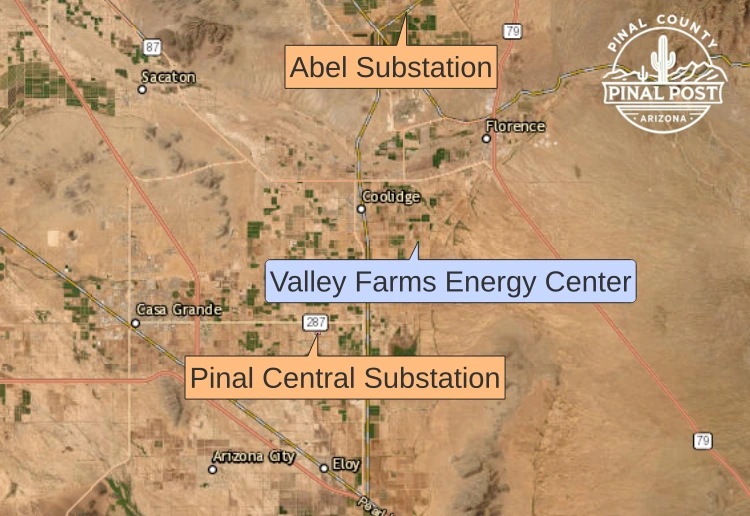
Lake offered a water-system analogy. “When you serve a community with water, you don’t consolidate all of your wells in one location,” he said. “Electricity is very similar.” Spreading battery facilities across the grid, he said, helps maintain stable voltage.
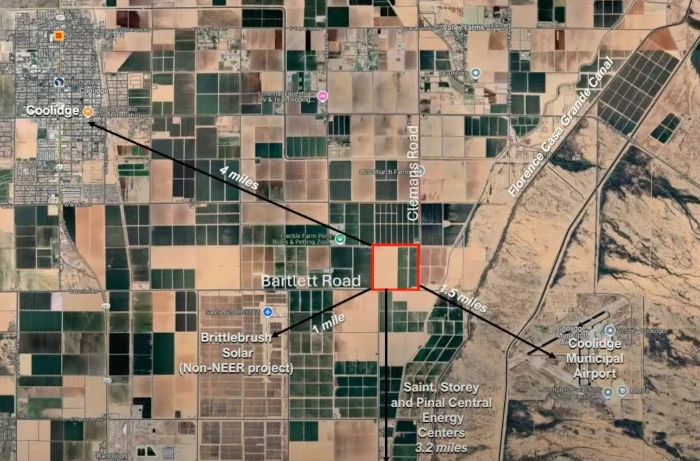
The site borders Coolidge city limits on multiple sides but sits in unincorporated Pinal County. Other utility-scale solar and battery projects already operate in the surrounding area.
About NextEra Energy Resources
Johnson described NextEra as the largest energy infrastructure developer in the United States. “We not only develop these facilities, but we own and operate them,” Johnson said, citing the company’s recent purchase of an industrial site in Coolidge for an operations and maintenance facility. According to materials submitted by the applicant, NextEra operates wind, solar, and battery facilities across Arizona and paid approximately $5.3 million in Arizona property taxes in 2024.
Community contributions cited
Johnson said NextEra has contributed approximately $390,000 to Pinal County organizations since 2021, including local fire departments, schools, and community resources. Commissioner Tom Scott asked the company about the relationship between those donations and project support.
“So, the volunteer fire department, that’s the one that you donated $80,000 to for a firetruck, hoses, and other things to help them along?” Scott asked. Johnson confirmed the $80,000 donation went to the South Florence Fire Department in 2022.
“That’s probably why they wrote that nice letter supporting this project,” Scott said. He added that he had spoken separately with the fire chief, who confirmed the equipment information.
SRP growth projections cited
Linda Brady, Local Government Affairs Manager at Salt River Project, told commissioners that SRP expects approximately 12% annual energy growth in Pinal County over the next decade.
The applicant’s presentation showed SRP peak demand rising from 8,542 megawatts in 2025 to a forecast 8,869 megawatts in 2026, an increase the applicant characterized as roughly 400 megawatts in a single year — matching the Valley Farms facility’s 400-megawatt capacity. NextEra said the storage is needed for summer 2028 demand.
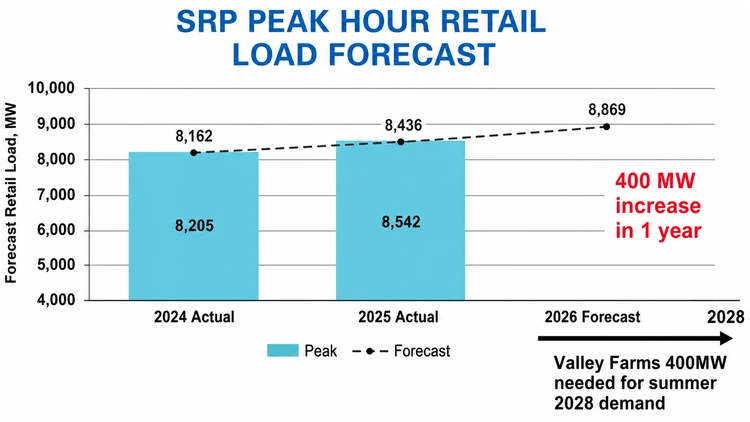
Brady noted that SRP has already signed an energy storage agreement tied to the project. “Battery storage is a practical solution that utilities can deploy quickly, much faster than other technologies. And it’s critical as demand continues to arise,” she said.
The 489-battery question
Scott asked the applicant about the scale of the installation. Working from the decommissioning plan, he calculated 489 battery containers spread across the roughly 20-acre battery storage footprint.
Project Engineer David Weeks clarified that the initial site design includes just under 400 containers. “As the site operates over time, the batteries degrade slightly and we have to add batteries from time to time to keep the capacity of the site,” Weeks said. Over 20 years, the count could approach 450 to 480.
Container spacing is based on large-scale fire testing standards, Weeks said, with about 10 feet between individual containers and 20 to 30 feet between groups of batteries.
Safety and emergency response
NextEra fire safety engineer Fallon Adair told the commission that current systems comply with the latest industry fire-safety standards. She described large-scale fire tests in which a center container is intentionally ignited to measure heat transfer to adjacent units.
“No water will be sprayed on the systems or the neighboring systems,” Adair said. She said NextEra trains local fire departments in advance, and during any incident fire crews would remain outside the site boundary while the containers burn out on their own. Vents on top of each container open to release any pressure that builds up inside.
Johnson said the closest fire department to the site is Coolidge Fire Station 1, with the Regional Fire and Rescue Department as a planned backup membership. The company also supports the South Florence Volunteer Fire Department, according to its community investment materials. Adair told the commission the company’s Renewable Operation Control Center in Florida would monitor the site remotely 24 hours a day, with an operations and maintenance crew on site during working hours and within commuting distance otherwise.
Vice Chair Karen Mooney asked about toxic smoke. Adair said NextEra conducts plume studies during forced battery fire tests, measuring chemical emissions at different wind speeds and distances. She said EPA studies have measured air, soil, and water within about a mile of past lithium iron phosphate battery fires. “Outside of the immediate vicinity of the site, there have been no levels that are toxic to human health,” Adair said.
Vegetative control
Lake told the commission that licensed contractors would use pre-emergent and post-emergent herbicides to maintain the 50-foot landscape buffer surrounding the facility. According to NextEra’s presentation materials submitted with the application, the project plans to use Direx as the pre-emergent and TerraVue as the post-emergent, and the herbicide plan requires written approval from an environmental specialist.
Noise level comparable to a classroom
Commissioner Bryan Hartman asked about decibel levels. Johnson said the facility would operate within the county ordinance, with expected sound levels of 60 to 65 decibels at the property line. She described that as comparable to classroom chatter. Hartman asked whether the noise could be a problem for landowners who might decide to sell and build homes in the area. Johnson said no, the project would stay within the county ordinance.
Coolidge benefit question
Several exchanges addressed whether local residents would benefit from regional energy projects or whether power would simply leave the county. Brady said SRP has signed an energy storage agreement for the Valley Farms Energy Center, and the project is designed to support Arizona customers, not California. Even so, she added, the grid moves power across boundaries. “The electric grid is shared infrastructure. It’s like roads and highways,” Brady said. Just as cars cross boundaries, electricity does the same — Pinal County both receives power from other counties and contributes to the broader system.
Construction water use
Construction is expected to require 30 to 50 acre-feet of water, primarily for dust control. Scott calculated that as 9.7 to 16.3 million gallons, or roughly 1,630 to 2,720 semi-truck loads at about 6,000 gallons each, from a well located down the road. “We are in a drought,” Scott said. He cited aquifer depletion and damage to rural roads as his concerns.
Lake responded that construction water is required for any development in the county. Johnson said the company plans to chip seal along the project route but had not addressed road damage during the construction period, and she offered to work with the county on it.
Speakers in favor
Cesar Corral of Sheet Metal Workers Local 359 spoke first in support, citing skilled trades opportunities. Mark Cardenas of Casa Grande followed. “Projects like this help ensure Arizona has the energy capacity needed to support new housing, manufacturing and economic development while maintaining grid reliability during extreme summer demand,” Cardenas said. Cepand Alizadeh of the Arizona Technology Council called the project well-sited and spoke in support of NextEra’s community engagement.
Dylan Lewis, a Florence-based sustainability business owner, supported the project and disclosed a 12-year working relationship with NextEra. He said that years ago, NextEra had funded renewable energy projects he was developing for local schools, churches, and non-profits when banks would not.
Kirk McCarville, the broker representing the Wuertz family, said water scarcity makes farming unsustainable. “There’s 250,000 acres of farmland. There’s enough water for about 50,000 acres,” he said.
Bobby Wuertz spoke on behalf of his parents, describing four generations of family farming in Coolidge beginning in 1929. “We are not just your fly-by investor. We are very ingrained in the community,” he said. The sale represents a retirement liquidity event, he said, adding that the family will retain ownership of the remaining acreage. His brother lives near solar and battery facilities at 11-Mile Corner, he noted, and has no plans to move.
Richie Kennedy, who handles vegetation management at NextEra sites and lives in the area, also spoke in support.
Before the meeting, staff reported 31 support letters submitted by the applicant and one letter of opposition. During the meeting, one additional support letter and one additional opposition letter were also received. Chairman Robert Klob entered into the record a 39-name list from Arizonans for Clean Economy that he received during a break and described as “almost like a petition” in support of the project.
Speakers in opposition
City of Coolidge Senior Planner Phil Garthright told the commission that although the project is in unincorporated Pinal County, it sits “within our planning boundary of the City of Coolidge.” The city’s general plan designates that location for business and commerce, he said, while industrial projects like this one would require an industrial and manufacturing designation. “We would not support this in our plan,” he said.
Coolidge Councilmember Tom Bagnall, who lives near other NextEra solar facilities, called the wall and landscaping “lipstick on a pig.” “After they built Pinal Central [Energy Center], they had an inverter fire on that project,” Bagnall said. “Then over at Storey Solar, they had a fire underneath the panels because they didn’t take care of the weeds.” He also pointed to language in the application stating “no potential for smoke, fumes, dust, or glare from this project,” and asked how that aligned with the day’s fire discussion.
When Commissioner Scott asked whether NextEra had lived up to its claim to be a good neighbor, Bagnall said his experience was “not good.” He claimed NextEra had bought out a neighboring property to run a transmission line and was now operating what he called “a commercial enterprise” from a parcel he said is zoned general rural. He described constant truck traffic on Sunshine Boulevard serving the company’s solar facilities at Saint, Storey, and Selma, and said his complaints went unaddressed until he pushed for a sign to stop misdirected deliveries reaching his home. “They’re rule breakers. That’s all they are,” Bagnall said.
Bagnall also said he had taken down 200 pecan trees on his property, attributing the decline to a combination of water scarcity and increased heat he believes is caused by concentrated solar facilities nearby. Planning Manager Harvey Krauss then asked the commission to keep discussion on topic with the matter before it.
Misty Brown spoke on behalf of her father Jim Wallace, the adjacent property owner to the north, raising concerns about water safety and property values. “One of our greatest concerns is water safety,” Brown said. “Every home and farm in this area relies on private wells.” She warned that contamination from a battery fire, chemical leak, or runoff could spread directly into nearby homes and farms. Brown also referenced the 2025 Moss Landing battery fire in California and said NextEra had never made her father any offers to purchase his property.
Coolidge resident Tom Brown read an excerpt about the May 2024 lithium-ion battery fire at the Gateway facility in Otay Mesa, California. Farmer Sean Keeling asked whether smoke from any fire could contaminate nearby crops bound for dairies, sharing a story about his uncle’s vineyard. “The wine was ruined because of the taste that was within the bottles that happened from that fire. And that was over 20 miles away,” Keeling said.
How each commissioner voted
The motion to recommend denial of all three cases carried 6-3.
Voting yes (to recommend denial): Chairman Robert Klob, Vice Chair Karen Mooney, Bryan Hartman, Wallace Keller, Tom Scott, and Timothy Hansen.
Voting no (to recommend approval): Daren Schnepf, Gary Pranzo, and Terrilyn Klucar.
Scott explained his motion by citing several factors. He pointed to the City of Coolidge’s opposition and to the future North-South freeway corridor, noting that off-ramps typically draw commercial development that a battery facility at this site “would deter.” Scott also said the Coolidge mayor had stated he did not want any battery storage or solar facilities north of Bartlett Road. He further cited the small share of local addresses among supporting letters. Of the 39 names on the petition delivered during the meeting, he said, only four listed Coolidge addresses. “These people don’t even live there,” Scott said.
Path forward to the Board of Supervisors
The recommendation now moves to the Pinal County Board of Supervisors, which will vote on whether to approve the project. NextEra has said it will hold another neighborhood meeting before that hearing. Residents will have another opportunity to weigh in on the Valley Farms Energy Center at the Board meeting. The Board has the authority to overrule the commission’s recommendation.