Key Points
- The draft budget totals $79.1 million, the maximum the state will let the town spend.
- Police services dominate departmental spending at $17.3 million.
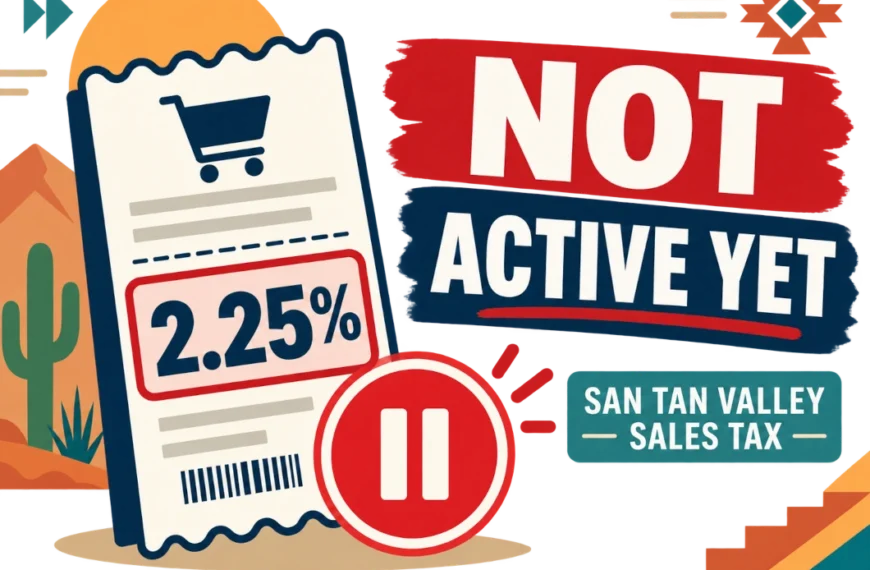
- A local sales tax (Transaction Privilege Tax) will appear on receipts starting late summer or early fall 2026.
- Voters will be asked to approve a permanent base adjustment, which would raise the town’s annual spending cap.
- Finance Director Gabe Garcia said the state-imposed cap is not enough to run the town; neighboring Queen Creek operates with an $800 million spending ceiling after passing a similar adjustment.
- The Census Bureau’s population figure of 91,000 is roughly 16,000 below regional estimates, suppressing the cap.
- The town will pay off its roughly $1.9 million debt to Queen Creek before July 1.
- Tentative budget adoption is set for June 3, with final adoption on June 20.
SAN TAN VALLEY, AZ —San Tan Valley’s first full-year spending plan is taking shape, and staff are preparing to ask voters to weigh in on the town’s long-term spending ceiling through an upcoming ballot measure. On May 6, 2026, Finance Director Gabe Garcia presented the San Tan Valley draft budget for fiscal year 2026-27 to the Town Council. The plan totals $79,146,448, the maximum the state will allow the new town to spend.
Garcia stressed the numbers are not final. “All of these things are subject to change. We’re working on them internally every day,” he told the council. The presentation was for discussion only; no votes were taken.
Two upcoming items will directly affect residents: a future election on a permanent base adjustment, which would let voters raise the base figure used to calculate the town’s future spending limits, and the arrival of a local Transaction Privilege Tax (TPT), the town’s first local sales tax.
State cap, police costs, and an incoming local sales tax
The $79.1 million ceiling is set by the state, not the town. Garcia called this the “state expenditure limitation,” and explained the town has no flexibility above it. “We could collect $500 million next year, but we can only spend the state-imposed amount,” he said. The Economic Estimates Commission publishes expenditure limits for every Arizona city and town.
Within that ceiling, police services dominate departmental spending at $17.3 million through agreements with Pinal County. The next two largest departments are far smaller: Community Development at $2.4 million and Legal at $2.2 million. Beyond what departments will actually spend, the town also plans to set aside roughly $28.9 million as a contingency and reserve, slightly more than the town’s combined personnel and operations spending. Vice-Mayor Tyler Hudgins called the reserve essential, citing past downturns: “There’s situations where I think us, as a council, don’t want to be boxed in like a 2008 situation.”
Residents should also expect a local sales tax to begin appearing on receipts. That tax will be set through the Model City Tax Code, the standardized framework Arizona cities and towns use to set local sales tax rates. Adoption is already underway. Garcia said the town sent letters to businesses notifying them of the code around April 27, starting the 60-day window state law requires before a municipality can approve a new business tax. After that window, the code returns to council for a formal vote. If approved, it becomes effective 60 days later, when businesses would begin collecting the local sales tax from customers. The town will not see that money right away. “If I’m a business and I’m paying transaction privilege tax for the month of August, it’s not due till September 15th,” Garcia said. “So by the time ADOR takes that money, distributes it out, it’s most likely October before you get August numbers. So you’re always trailing about two months.” Garcia estimated the town would not start collecting that money until around January 2027.
How much the new tax will generate is uncertain. Billingsley laid out a comparison range for neighboring cities: Queen Creek collects about $80 million in local TPT annually, Casa Grande about $50 million, Maricopa about $44 million, and Apache Junction about $24 million. “We think that we’re gonna be a whole lot closer to Apache Junction than Queen Creek,” he said.
Key dates ahead for the FY 2026-27 budget
Several public milestones remain before the new fiscal year begins:
| Event | Date |
|---|---|
| Tentative Budget Adoption | June 3, 2026 |
| Final Budget Adoption | June 20, 2026 |
| New Fiscal Year Begins | July 1, 2026 |
The June 3 tentative adoption sets the upper spending limit. After that, the figure can drop but cannot rise. Final adoption follows on June 20.
Permanent base adjustment and the upcoming vote
Staff plan to ask voters to approve a permanent base adjustment, a ballot measure that would raise the starting figure the state uses to calculate San Tan Valley’s annual cap. “We’re gonna have that election later on,” Garcia said. The vote does not raise taxes or fees. “That doesn’t change the amount of money we bring in. It doesn’t lower taxes if you don’t pass it. It just means you’re asking for the maximum amount you can spend,” he said.
Arizona’s constitution gives towns three ways to spend beyond the state cap:
- One-time override: Voters authorize a specific dollar amount above the cap for a single year.
- Home Rule: A locally set ceiling that lasts four years before voters must revisit it.
- Permanent base adjustment: Permanently raises the starting figure used to calculate the cap each year.
Of the three, only Home Rule has a mandatory four-year renewal cycle. The override applies to one year and ends; the base adjustment carries forward unless voters later approve another.
For San Tan Valley, staff and council members said the population number used to calculate the cap is low. Garcia previously told the council that the Arizona Economic Estimates Commission calculated the town’s starting figure using a population of 91,000. According to a Maricopa Association of Governments estimate cited in the town’s recent impact fee study, the current population is closer to 107,000. Mayor Daren Schnepf told the council the figure is low, specifically as it affects state-shared revenues: “The number that we were given by the Census Bureau is low based on our state-shared revenues.” The undercount has two effects. It suppresses the state-calculated spending cap, since the cap formula multiplies a per-resident figure by population. And because state distributions to cities and towns are also calculated using population, it cuts monthly state-shared revenue. Billingsley said the town hopes a new census-designated place classification will produce a more accurate count next year. “We’re hoping we have a more accurate number and it’s recognized by the state demographer’s office for next year’s budget,” he said.
The formula behind that starting figure dates back nearly half a century. State law directs the Commission to set a new town’s starting figure by taking the average per-resident local revenue that Pinal County cities and towns collected in 1979-80 and multiplying it by the new town’s population. The Commission then layers on annual adjustments for population and cost-of-living changes.
Town Manager Brent Billingsley pointed to neighboring Queen Creek, whose permanent base adjustment is about $800 million, but Garcia declined to commit to a figure for San Tan Valley. He said it would be “a big number.”
Where the money comes from
Because San Tan Valley incorporated less than a year ago, most revenue lines are estimates. The town has no historical baseline. “We have no idea what it costs to run San Tan Valley because it never existed,” Garcia said. He pointed to a future when that changes: “If five years from now we’ll say, over the last four years, we averaged this amount in this line item, my job becomes really easy at that point.” The largest revenue lines, state-shared revenues like the income tax and state sales tax, are based on projections the League of Arizona Cities and Towns sends to finance directors and town managers across the state.
Projected revenues for FY 2026-27 break down as follows:
| Source | Amount |
|---|---|
| State Income Tax (Urban Revenue Share) | $21,025,276 |
| State Sales Tax | $15,016,314 |
| Local Taxes (TPT, estimated) | $11,752,036 |
| Vehicle License Tax | $5,818,761 |
| Licenses & Permits | $1,900,000 |
| Interest | $725,800 |
| Fines and Forfeits | $300,000 |
| Big Beautiful Bill Adjustment (loss) | -$1,280,000 |
| General Fund Total | $55,258,187 |
The largest line, $21 million in state income tax, is brand new for the town. This is the first fiscal year in which San Tan Valley is eligible for urban revenue sharing, which new municipalities can begin receiving on July 1 of their first full fiscal year after incorporation. Local taxes, permit revenue, capital sales tax, and development impact fees are all estimates because the town has not collected them before. The local Transaction Privilege Tax line reflects the town’s in-progress adoption of the Model City Tax Code. Interest income assumes a 1.5% return on balances, a figure Garcia said could rise as the town moves funds into higher-yield accounts.
The $55.3 million general fund pays for day-to-day operations like police, courts, community development, and administration. Money here is unrestricted and can be spent on any municipal purpose. Separately, the town expects $13.8 million in capital projects revenue, made up of $9.1 million from the Pinal County Road Tax, $4.2 million in capital sales tax, and $508,000 in development impact fees (one-time charges builders pay to help offset the cost of new infrastructure), all including interest. These funds are budgeted for one-time capital uses such as roads, vehicles, and equipment, rather than ongoing general-fund operations. The town also expects $8 million in Highway User Revenue Fund (HURF) dollars, which can only be spent on roads.
Losses to ADOR and the Big Beautiful Bill
Billingsley identified two outside forces pulling money away from the town. The first is the federal Big Beautiful Bill (BBB), which he said was signed by the president about three months ago and which requires Arizona to align portions of its tax code with new federal rules. “What they sent us is a draft number of $1.28 million that we would lose in state shared revenue just due to the state tax code and changes due to the federal bill,” he said.
A separate hit comes from the Arizona Department of Revenue (ADOR). Billingsley said the state legislature may again divert a portion of state-shared revenue away from cities and towns to fund ADOR itself, a practice that ended last year but is back in the proposed state budget. “The Arizona Department of Revenue, essentially got the legislature to take a portion of the state shared revenues to fund the Department of Revenue. Last year, that ended. It’s been reinstated in the proposed budget, and the number I was provided was about $78,000.” He added: “If the budget gets approved and that item is in there, that’s just an example of $78,000 that we won’t get in state shared revenues.”
Paying off Queen Creek and entering the new year clean
Before July 1, the town intends to settle its debt to Queen Creek, which has been lending San Tan Valley money to cover startup costs since incorporation. The arrangement began with a $250,000 monthly cap before the council raised the limit to $450,000 in March. Garcia laid out the plan: “We’re basically, at June 30th, we’re gonna write a check. We’re gonna write a check to our friends over at Queen Creek to pay off the balance that we owe. So that way, we’re going into the new year as close to zero as we can.”
He estimated the payoff at about $1.9 million. When Mayor Schnepf asked if that figure was principal and interest combined, Garcia confirmed: “Principal and interest, correct.” Queen Creek has been charging 4% interest. After the payoff, the town projects $11.7 million in general fund carryover and $4.7 million in HURF carryover heading into the new fiscal year.
Garcia noted the town has not yet been able to spend any of its current $14.7 million interim budget. Implementation of Tyler Technologies, the town’s new financial software, is still underway. “We can’t write our own checks yet, so we’ve spent zero,” he said.
General fund expenditures grow year over year
General fund spending grows sharply from the interim budget’s $10 million general fund portion to the full 12-month plan at $55.3 million. Garcia attributed the increase to the longer period and to staff having a better sense of what spending will look like.
The largest general fund line items for FY 2026-27 are:
| Department | Amount |
|---|---|
| Police (Pinal County agreements) | $17,300,000 |
| Contingency & Reserve | $28,893,720 |
| Community Development | $2,363,777 |
| Legal | $2,200,000 |
| Administration | $1,018,569 |
| Public Works | $740,392 |
| Finance | $669,977 |
| Parks & Recreation | $459,881 |
| Town Clerk | $452,456 |
| Information Technology | $360,697 |
| Court | $300,000 |
| Human Resources | $274,668 |
| Council | $204,050 |
Reserve fund targets one year of general fund operations
The town is targeting a reserve equal to roughly a year of actual department operating costs. Of the $55.3 million general fund, about $26.4 million covers personnel and operations across all departments, while $28.9 million is set aside as a contingency and reserve. “We’re looking to have at least 100% of general fund operations set aside for that rainy day,” Garcia said. The cushion currently sits slightly above the target.
He explained why a larger cushion makes sense for a new town. “At some point, we’re gonna have to buy land for parks, we’re gonna have to buy land for town hall, we’re gonna have to buy land for public works departments.”
Capital improvement projects planned for the year
The draft includes about $3.5 million in capital projects, focused on roads, vehicles, and office equipment. Major items include $1.8 million for pavement preservation, $350,000 for the Hunt Highway and Bella Vista median, $300,000 each for turn lanes on Schnepf Road at Rolling Ridge and Hash Knife Draw, and $175,000 for the Gantzel and Pecan Radii Reconstruction (rebuilding the curved corners where the two roads meet). The town also budgeted $270,000 for vehicles, $250,000 for furniture and equipment, and $31,500 as a local match toward a street sweeper grant.
Staffing growth: from 9 to 14
The town plans to grow from 9 employees to 14 in FY 2026-27. The additions include one new finance position, two in Community Development, and 2.5 in HURF-funded street operations. Public Works will drop by 0.5 because one position is being split between Public Works and the HURF-funded street operations, not eliminated.
Garcia softened the figure, noting it could shift. “Could that be more? Could we come to council and maybe ask for more? Probably. It just depends on how many people are lining up for permits.” Mayor Schnepf observed that Community Development will hold the most staff: “There’s gonna be a lot to do there.”
Top financial risks identified by staff
Councilmember Gia Jenkins asked staff to name the top three risks facing the town. Garcia listed uncertainty as the largest. “We don’t know what those numbers are gonna be.”
Billingsley pointed to legislative threats. “Some of these bills in the legislature are a gigantic risk to us,” he said. He cited a state ballot referral, HCR 2052, which would freeze municipal and county tax, fee, and utility rate increases from July 1, 2026 through June 30, 2030 if passed by the legislature and approved by voters this November. “We need to be mindful that it may be in a situation where we’re frozen for four years. So we better get it right the first time,” he said, referencing the town’s ongoing fee study and Model City Tax Code work.
He also singled out the food tax, which was discussed later that evening in executive session. “It’s a huge funding source for cities and towns.” Billingsley said implementing the Model City Tax Code without knowing what it will generate is a significant concern. Garcia echoed the worry, noting that paper goods taxation faced similar threats a few years earlier. “If they start to not tax paper goods or they’re coming after food tax, like, what else is left?” he said.
Coming up on the budget calendar
Tentative adoption is scheduled for June 3, with final adoption set for June 20. Residents can attend the upcoming meetings and contact the town with feedback before final adoption. The new fiscal year begins July 1, 2026.