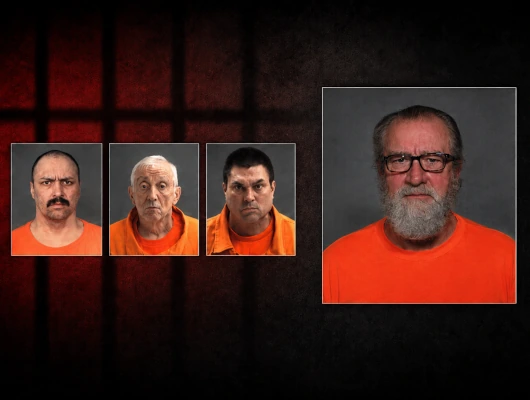
Pinal County Attorney Brad Miller announced on May 11, 2026 that his office has filed a Notice of Intent to seek the death penalty against Ricky Wassenaar in connection with the killings of three inmates at the Arizona State Prison Complex-Tucson (ASPC-Tucson). The prosecution stems from an April 4, 2025 attack inside the Cimarron Unit of the Tucson prison complex that left Donald Lashley, Thorne Harnage, and Saul Alvarez dead.
The April 2025 Attack at ASPC-Tucson
The emergency response inside the Cimarron Unit ran from 7:15 a.m. to 7:50 a.m. that morning. At 7:15, an Incident Command System alert was called after Donald Lashley was assaulted outside the unit’s dining hall. Thorne Harnage was also assaulted during the same incident. Both men were pronounced dead within minutes of each other, Lashley at 7:36 a.m. and Harnage at 7:37 a.m.
Sixteen minutes after the first alarm, a second emergency call went out. This time, officers found Saul Alvarez unresponsive in his assigned cell within the Cimarron Unit. He was pronounced dead at 7:50 a.m.
By the end of the day, ADCRR had identified Ricky Wassenaar as the sole suspect. Preliminary reports indicated he acted with intent to harm all three men.
Capital Charges Filed Against Wassenaar
Wassenaar is charged with three counts of First Degree Murder, along with Aggravated Assault. Miller said the filing followed a thorough review of the facts, evidence, and applicable laws, with input from experienced prosecutors in his office.
“I believe the death penalty is the appropriate sentence given the defendant’s extensive history of violence,” Miller said in the announcement.
Additionally, the County Attorney’s Office alleges the case meets the statutory aggravating factors necessary to impose the death penalty under Arizona law.
The case is being prosecuted in Pinal County rather than Pima County, where the killings occurred, because the Pima County Attorney’s Office declared a conflict of interest. Pima County Attorney Laura Conover told the Arizona Mirror that her prosecutors had placed at least two of the victims in prison. “Some of the next of kin did not support some convictions, but we went forward — and shortly after, they were killed,” Conover said. She told the outlet she believed an independent county was better positioned to provide “a neutral, independent view of what happened within the prison walls.”
Wassenaar publicly confessed to the killings weeks after the attack. In an April 2025 telephone interview with the Arizona Mirror, he said he targeted the men because they were child sex offenders. “Child molesters: I wanted to kill them all,” he told the outlet. “The taxpayers no longer have to pay for them. I’m paying my debt to society.”
A History of Violence: 15 Days, Two Hostages, One Lewis Prison Tower
The 2004 Lewis Prison Standoff
For Wassenaar, violence inside Arizona prisons is nothing new. By January 2004, he was serving a 28-year sentence at ASPC-Lewis on Pima County convictions for aggravated assault and armed robbery. At about 3:15 a.m. on January 18, 2004, he and an accomplice, Steven Coy, attempted to escape from the Morey Unit at the Lewis Prison Complex near Buckeye, Arizona. Both men were armed with improvised knives known as “shanks.” In the kitchen office, Wassenaar approached Correctional Officer Kenneth Martin and a female civilian kitchen worker, told Martin “this is an escape” and “I’ve got nothing to lose,” and ordered him to remove his uniform shirt and boots. Wassenaar then handcuffed Martin to a toolroom cage. Coy bound the female kitchen worker’s hands and feet with electrical wire and later sexually assaulted her in the kitchen area. Wassenaar shaved his beard with an electric razor, put on Martin’s uniform, and tricked his way into a guard tower by appearing as a corrections officer on the security monitor. Once inside, he struck the first officer in the face with a metal kitchen stirring paddle, fracturing his orbital bone. He then struck a second officer in the face with his knee and subdued her. He handcuffed both and took control of the tower. Meanwhile, as Coy made his way from the kitchen to join him, he slashed another guard’s face with a shank in the dining hall. When other personnel tried to stop Coy from reaching the tower, Wassenaar opened fire on them with a rifle taken from inside, firing approximately 14 rounds during the early stage of the incident. What followed became a 15-day standoff, the longest prison hostage situation in U.S. history. During the standoff, Coy sexually assaulted the female officer. Wassenaar was separately convicted of one count of sexual assault tied to the same incident, a charge he denied at trial but the jury upheld. The standoff ended on February 1, 2004, when Wassenaar and Coy surrendered.
Trial, Conviction, and Wassenaar’s Own Words
A jury convicted him in 2005 on 19 counts, including ten counts of dangerous or deadly assault by a prisoner, five counts of kidnapping, and single counts of promoting prison contraband, first-degree escape, sexual assault, and aggravated assault. The court sentenced him to 16 consecutive life sentences, plus additional terms totaling nearly 38 years. He represented himself at trial. During a pretrial hearing on the use of his prior felony convictions, he told the court, “I can be a violent man when provoked, Your Honor.” In his opening statement, he told the jury, “Given the same circumstances today as that, I would take that tower again today,” and “I do not regret taking that tower.”
A Quiet Stretch and a 2024 Warning
For roughly 21 years, Wassenaar’s record had been comparatively quiet. ADCRR told lawmakers that, before the April 2025 incident, his most recent documented threat or predatory behavior dated back to 2004, the same year as the Lewis Prison standoff. While he had logged other minor disciplinary infractions since, most recently False Reporting in February 2021, none involved violence or predatory conduct, according to the department. However, the department’s response to Senator Kevin Payne also disclosed an earlier exchange. In November 2024, ADCRR received an email from Donna Hamm, founder and Executive Director of Middle Ground Prison Reform. The organization is an Arizona prison reform nonprofit. According to that disclosure, Wassenaar had claimed to have killed another inmate, Mr. Desisto, and was insisting that the department was covering it up. ADCRR responded that the Desisto death had been thoroughly investigated by both its Criminal Investigations Unit and the County Medical Examiner, with no indication of anything but a natural death. Hamm had requested that Wassenaar be single-celled due to his comment to her.
Staffing at the Cimarron Unit
Legislative inquiries followed quickly after the killings. ADCRR told Representative Quang Nguyen that 16 officers plus supervisors supported the Cimarron Unit on April 4, levels the department called consistent with typical operational needs. In its response to Senator Kevin Payne, the department reported that the unit overall was operating with 47.38 vacancies out of 155.88 authorized full-time positions, roughly 30% vacant. The day and swing shifts were the hardest hit, with vacancy rates of 36% and 39% respectively.
Prosecution Path Forward
With the death penalty notice now filed, the Pinal County Attorney’s Office said the case remains an active prosecution and that no further details will be released at this time.