Key Points
- No vote: The Sept. 8 study session ended without action; Flock cameras stay in place.
- Under review: Shorter data retention, an outside auditor, and visits by the Attorney General’s Office (scheduled for Sept. 9), two state representatives and, if it accepts, the governor’s office.
- Police case: Reported crime fell 42% from Jan. 1 to Sept. 1 versus 2025; the chief says the cameras do not use facial recognition, continuously track vehicles or sell data, and no court has ruled them unconstitutional.
- Critics’ case: The contract’s location-history lookup, 58 photos of one car, search logs residents say contradict policy, a Flock patent on matching faces across cameras, security flaws, and retention a forensic analyst says favors prosecutors because records expire before defendants can use them.
- Council: Four members backed keeping it; two raised questions on retention, penalties and upgrades.
- Cost: Payments reach $1.365 million a year from year five, about $10 million over 10 years; police say funds on hand cover nearly four years.
CASA GRANDE, AZ — Casa Grande Flock cameras will keep operating while police study whether to shorten how long they keep license plate data. The City Council took no vote at its Sept. 8 study session on the Safe City Initiative, the 10-year Flock Safety contract it approved a year ago. Between the presentation, council questions and public comment, the discussion ran about two hours. Police Chief Mark McCrory said the 30-day window could shrink and the department wants an outside auditor.
Of 18 speakers at the regular meeting that followed, 16 addressed the Safe City program. Thirteen opposed or criticized the program, while three supported it. One critic also asked for a public vote. The mayor said the law bars the council from responding to comments on items not on the meeting agenda, so the police statements quoted throughout this article came from the study session, before residents spoke. The council also received letters from Larry Reed, a resident who also spoke, and Timothy Warner; a speaker at the dais said two more written comments would go into the minutes.
Where each council member stands
- Mayor Lisa Navarro Fitzgibbons: Did not state a position. Said the city is not locked into the 10-year contract and that talks on shorter storage, possible ordinances and firmer guardrails should continue.
- Mayor Pro Tem Brent BeDillon: Did not state a position. Pressed for an update on the retention review, policy language on future upgrades, and answers on whether out-of-state agencies could reach city data.
- Councilmember Matt Herman: Did not state a position. Asked whether the money would be better spent on officers, raised Queen Creek’s misuse-penalty ordinance and called an outside audit a good tool.
- Councilmember Bob Huddleston: Supports continuing. A 33-year veteran of the Casa Grande Police Department who served as chief from 1999 to 2013, according to his city biography, he said abandoning the program would be “premature and a knee-jerk reaction,” while pledging oversight and backing a statute if needed.
- Councilmember Sean Dugan: Supports continuing. Said he agreed with Huddleston completely.
- Councilmember Anthony Edwards: Supports continuing. Said the program grew out of town halls where residents named safety their top concern, and agreed with Huddleston.
- Councilmember Rebecca Romo: Supports continuing. Cited public and officer safety and said the council must stay aware and adjust as needed.
Crime is down 42%, police say; resident points to national decline
Reported crime in Casa Grande fell 42.33% from Jan. 1 through Sept. 1 versus the same period in 2025, from 2,008 reports to 1,158, McCrory said, citing state Department of Public Safety figures. The share of reported crimes the department closed rose from 57.62% to 62.87%.
The numbers cover part of a year, McCrory noted, but he predicted only a catastrophe would prevent a high double-digit drop for the full year. “I don’t know if this system can solely take credit for that,” he added. Over the same period, police credit the cameras and sensors with 71 cleared cases, 39 arrests, 20 recovered stolen vehicles and three missing people located. Drones, in service since February, typically reach a scene in about 80 seconds and beat the first officer there more often than not when the police monitoring center is staffed.
Resident Benjamin Hanrion questioned the cause, citing a Council on Criminal Justice analysis showing substantial crime declines in a sample of U.S. cities since 2019 and arguing that the drops occurred in places with and without surveillance. “Crime probably would have dropped by forty percent here anyway,” he said.
Reed, a retired officer, said the Flock system identified a vehicle used to flee a tavern homicide, leading to an arrest in another state. Hamza Al Baroudi, a former Flock employee who also spoke at Apache Junction’s Sept. 1 hearing, recounted a case he said was described at a Prescott council meeting, in which a stolen car used in a Phoenix child kidnapping passed cameras that Flagstaff and Sedona had shut off before a still-running camera in Cottonwood triggered the alert that led to an arrest and the child’s recovery.
What the Casa Grande Flock cameras do, and what police say they cannot
Mayor Lisa Navarro Fitzgibbons said the session was meant in part to clear up confusion about what each device does, and Deputy Police Chief Brian Ramirez walked the council through the equipment: 100 license plate readers and 100 pan-tilt-zoom cameras, most already installed, plus 10 community cameras, 31 gunshot sensors, four drones and access to school district cameras. Expand the box for his rundown of what each does and doesn’t do.
What’s installed—and what each device does and doesn’t do (click to expand)
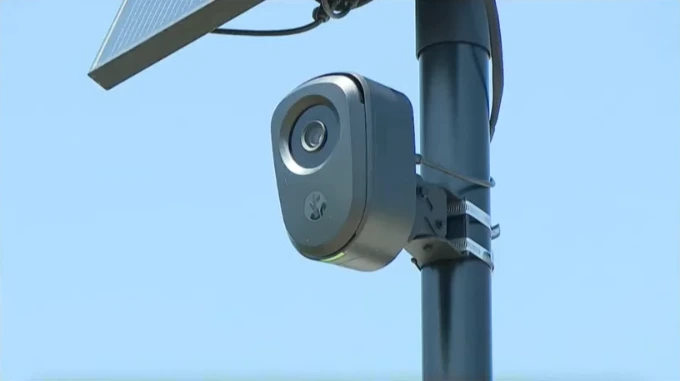
License plate readers (ALPR): 93 of 100 are installed; the rest sit on ADOT right-of-way and await ADOT permits. Each captures the plate, a vehicle image, vehicle characteristics and the date, time and location.
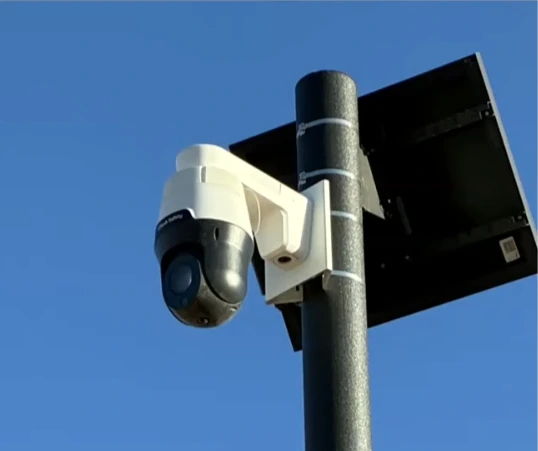
Pan-tilt-zoom (PTZ) cameras: 89 of 100 are installed, with the rest also awaiting ADOT permits; the contract also includes one portable unit. They provide live video at intersections, main roads, parks and event areas.
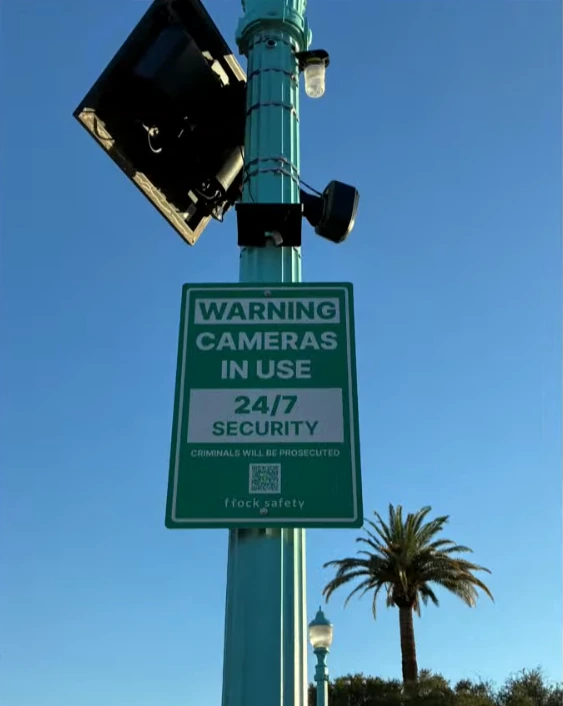
Community cameras: 10 solar-powered video cameras. Five sit at city facilities, two at City Hall and one each at the airport, the Northern Operations Center and the recreation center parking lot, and five were offered free to local businesses to fill coverage gaps. Like the PTZ cameras, they provide live video during calls for service and retain recorded footage for 30 days. They share a housing with the plate readers and look like them, Ramirez said, but they do not read plates. A green warning sign and a light that blinks at night mark each one.
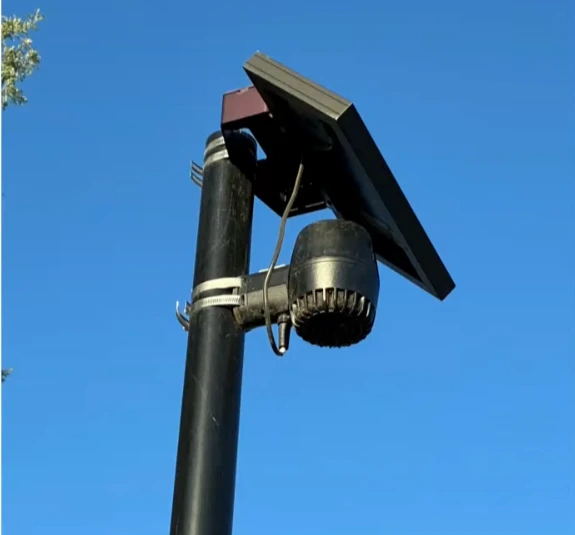
Gunshot sensors: 31 sensors, placed using a year of shots-fired calls, run southeast from Pinal and Cottonwood to near Jimmy Kerr Boulevard and locate gunfire within about 90 feet.

Drones: Four drones launch from the rooftops of the city’s municipal court building and the city’s community recreation center and respond only to calls for service. “We’re not launching [drones] and flying over the city and randomly patrolling, looking for crime,” Ramirez said.
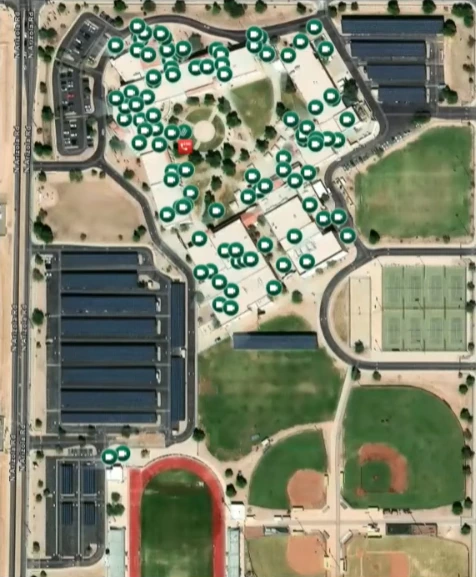
School cameras: Police can access the high school district’s existing, non-Flock cameras under an approved agreement and are integrating the elementary district’s under a separate one. Each district decides which cameras police see, access is limited to public safety events, and every viewing is logged. “Nobody else that we share our camera system with in the state of Arizona can access those cameras whatsoever,” McCrory said.
(Device images: Casa Grande Police Department presentation to the City Council, Sept. 8, 2026.)
One officer staffs the Real-Time Information Center, the monitoring room, 40 hours weekly.
Ramirez also listed what plate readers do not do:
The PTZ, community and drone cameras record no audio, he said, and the gunshot sensors do not record conversations.
“We couldn’t use facial recognition on Flock if we wanted to because they don’t possess that technology on the equipment that we have,” McCrory added. Mayor Pro Tem Brent BeDillon asked what happens if Flock adds unwanted features. “I know we’re never gonna go to facial recognition,” McCrory replied, adding that new functions would get internal review. “As I went through the city’s policy, I didn’t see anything in regards to technological advances. So if we can get something in there, I’d appreciate that,” BeDillon said.
Resident Jacob Petrosky cited a Flock patent that he said describes matching faces across cameras. “What they tell you they can do and what you get access to are two totally different things,” he said. He also argued the gunshot sensors must record audio to work. Erick Fowler, chair of the Maricopa County Libertarian Party, said, “It started with twenty-two cameras looking for stolen cars. Tonight, it is two hundred and forty-four devices, spy microphones, and an AI search that didn’t exist back then.”
Are drivers being tracked? Police say no; one resident brought his photos
McCrory said a plate reader takes a point-in-time image at a fixed location and does not follow a vehicle. Court rulings residents cite involve continuous cell phone or GPS tracking, he said. “We can’t fill in the gaps as to where you were. There is no tracking, so to speak, on that,” he said.
Fowler said the city’s contract lists a “license plate location history” lookup. He also cited a June 24 Cave Creek email pitching a Flock upgrade, LPR Pro, built for “connecting activity across locations.” “That’s how you fill in the gaps,” he said.
Resident Marco Cruz, who opposed the contract a year ago, said he then requested 30 days of images of his own vehicle and, with about 20 cameras up, got 58 photographs. “They’re not just photographs of my license plate,” he said. “There are photographs of me and my passengers in these photos.” The records can be mapped to show his direction of travel, he said, showing a stack of photos. “I come here to the city council meeting. There’s a drone overhead. There’s a pan-tilt-zoom camera watching us. This has a chilling effect,” he said.
Al Baroudi, the former Flock employee who spoke earlier in the comment period, took the opposite view: “There is no record being built on anybody if a search is not done.”
Searches, audits and what happens to officers who misuse the system
McCrory said every search needs a specific investigation and a written reason, and logs pass through several layers of review:
The department has also reached out, without a reply yet, to the company that audits its body-worn cameras about serving as an outside auditor. “That’d be a third-party audit that would be non-law enforcement,” McCrory said, meant “to alleviate some of the police policing themselves.”
Casa Grande was the first Arizona agency to use Flock’s Audit Assistant, a tool that McCrory said flags five patterns:
- Searches for data older than 30 days
- One plate tied to multiple investigations
- One user repeatedly searching the same plate
- Users who search only other agencies’ data
- Repeated searches using unusually narrow time windows
A flag prompts a review, not a finding of misconduct; it goes to a supervisor and, if needed, up to the chief. An officer who makes a mistake, such as trying to search on the 31st day, will be counseled, McCrory said, but intentional misuse means termination, “and we’re gonna do our best to remove them from law enforcement as a career.” The department has had one citizen complaint of misuse, and its investigation exonerated the officer, he said.
Councilmember Matt Herman asked about Queen Creek’s new ordinance penalizing officers who misuse Flock. “It’s exactly up to you,” McCrory said. “Do I think that somebody should be punished for misusing this outside of just losing their job? Absolutely.” Councilmember Bob Huddleston noted that unauthorized release of state criminal justice system information is already a Class 6 felony. “If we need to put a policy or a statute in place to make sure that’s the case, I’m all for it,” he said.
BeDillon raised the Apache Junction case. A former officer there used Flock cameras to find his wife’s vehicle in Casa Grande. BeDillon asked how that search was caught. Ramirez said the department keeps a log of searches by outside agencies. It shows the agency, the time and the stated reason. However, it does not show which officer ran the search or which investigation it was for. “We would have to contact them like we did with AJ,” he said. “One of my concerns is that another agency could use our data in an unauthorized way that we may or may not catch,” BeDillon replied.
Petrosky said older logs contain searches with blank case numbers and asked who would be punished for those. He also said a February 2025 log entry shows information sent to ICE’s Enforcement and Removal Operations, which he said contradicts the department’s FAQ statement that it does not share data with federal agencies, including ICE.
Benjamin Hanrion said the department’s free-form search feature logged 86 concerning searches from October 2025 to January 2026. In one, an officer typed “Native female wearing gray hoodie with gray lettering, black pants.” Flock blocked it, and 13 seconds later the officer re-ran it without the word Native, he said. Another officer’s search for a Hispanic male was blocked, and a third officer ran the same description without the word Hispanic that day. “This is racial profiling,” he said. The department’s FAQ states that users cannot search by gender or ethnicity. Fowler added that a deputy chief in January listed “monitoring a student protest at City Hall” as a search reason, calling it a First Amendment violation.
On the risk of acting on a wrong plate match, McCrory said officers must confirm a hit before acting. “We’ve all heard the horror stories of a family being pulled out at gunpoint based on a Flock hit. Well, that’s fault in the officer,” he said. “Ours needs human verification before we take action.” Resident Michael Hanrion argued that plate readers misread some plates and that on a busy road such as Peart Road, even a small error rate would add up to many wrong readings a day. “Innocent people may be associated with crimes they do not commit,” he said.
When officers in other cities have been caught misusing Flock, McCrory said, it was the system itself that exposed them. “It’s not a system flaw at all. It’s a human flaw,” he said. “I can’t ever promise anybody that’s never gonna happen ’cause we’re still hiring humans.” The policy has changed at least three times and will keep evolving, he said.
How long data stays, who can see it, and whether Flock sells it
Casa Grande license plate reader and PTZ camera data is kept 30 days unless preserved as evidence or otherwise required or permitted by law or policy. McCrory said Flock has announced a seven-day limit for new customers, adding, “Personally, I don’t think seven days is long enough.” Casa Grande and six other Pinal County agencies using Flock agreed last week to study the question together, starting with how soon after a crime searches happen. “If it’s within a week, then we’ll drop it to a week. If it’s in fourteen days, we’ll drop it to fourteen days,” he said. “It may not be thirty.”
Jonathan Dellmar, a digital forensic analyst and resident, said he has worked three cases where prosecutors presented plate reader evidence. “One of my large concerns is, due to the quick expiration date of the information, it can only be used by the prosecution,” he said.
He said the implementation is flawed.
Dellmar also said the data sits on Flock’s servers, not the city’s. “You don’t have care, custody, and control,” he said, adding that a federal warrant would override any local sharing agreement. Resident Leah Kiser said the president could have federal agents subpoena the data, putting immigrant neighbors, “even those who are here legally,” and political organizers at risk. Austin Harmon of Arizona City said published security flaws in Flock’s system let a user take over a camera and watch its live stream, and urged third-party security audits.
Ramirez said the department shares plate data with 60 Arizona agencies and no out-of-state or federal agencies. BeDillon asked whether a New Mexico agency could reach Casa Grande data through Queen Creek, which has access; Ramirez said it would have to persuade a Queen Creek employee to run the plate. “So they technically could,” BeDillon said. The mayor asked whether Casa Grande shares with any city that dropped Flock over Fourth Amendment concerns and said she was told no. She noted that all Pinal County cities have stayed with Flock so they can keep working together and using each other’s data, even as other Arizona cities have left.
McCrory said Flock does not sell customer data and challenged anyone to name a buyer he could verify. Fowler said that in March a Flock account executive offered Sheboygan, Wisconsin, five years of traffic analytics from its own cameras, and that Casa Grande’s contract bars Flock from selling anonymized data even though a traffic analytics package appears on the city’s order form. Al Baroudi responded that traffic analytics is a common product and Flock does not sell data.
Fourth Amendment questions and the warrant debate
McCrory said no state supreme court or federal court has found plate readers violate the Fourth Amendment. “Doesn’t mean there won’t be, but as we sit here today, and as we use this technology, there is no court case,” he said. Asked by Herman whether a warrant is practical, McCrory said, “Right now, I don’t think a judge would give us a warrant because they would laugh at us and say, ‘You don’t need a warrant. It’s legal.'” The department would change its policy if courts require it, he added. Councilmember Huddleston, the former police chief whose city biography also lists him as a judge pro tem in the Pinal County Justice Courts, agreed. “If you can stand on the corner and take a picture, that’s an observation in the public, and people do not have an expectation of privacy,” he said.
Fowler said the chief was wrong to dismiss those rulings as cell phone cases. The courts ruled on records of where people have been, he argued, and “it does not matter that a third-party company has handed them over.” He cited an Aug. 5 ruling in which a federal judge in Mississippi refused to authorize “tower dump” warrants, which seek records of every phone connected to cell towers near crime scenes, and held that such warrants are unconstitutional general warrants. The judge wrote that the government cannot have “access to an entire haystack because it may contain a needle.” Fowler applied the metaphor to Casa Grande: “Two hundred cameras on every main road is the haystack of data,” he said. “That’s not a very good policy. It’s a liability plan.” Petrosky quoted the Supreme Court’s Carpenter decision: “A person does not surrender all Fourth Amendment protection by venturing into the public sphere.” Another speaker, Jack La Commare, asked how much surveillance power government should hold over people not suspected of a crime. A man who declined to give his name pointed to China’s surveillance of its own citizens, saying it has benefited those in charge but not the people being watched, and urged the council to reverse course.
Chief asks critics to learn the system; critics ask for a debate and a vote
“We recognize and we respect that people have a right to differ from our opinion on the value of this system. All we ask is that people take the time to get educated on it,” McCrory said, rather than “rely solely on social media and self-proposed experts.” The city has held eight public meetings on Safe City or camera integration since its first study session in August 2025, Ramirez said, but people who disagree with the department have turned down invitations to tour the monitoring room, McCrory said.
“I’ve noticed a lot of sort of dismissive language … towards people that are skeptical of this technology,” resident Adam Power said, calling it unfair to dismiss critics as social media spin. He praised Petrosky’s research and challenged officials to a public debate, saying he prefers debate to presentations because either side could be proved wrong. Harmon asked for an official vote, saying most residents never chose for or against them. Cruz said respect for residents begins with their consent. Resident John Bremner, who said he spent 16 years in web security, said residents are angry about the system’s invasiveness. Grover Ramsey, a resident, said the cameras make him feel safe and likened them to residents’ own doorbell and garage cameras. “The silent majority wants safety,” he said, pointing to the city’s survey results.
How the cameras arrived and what they cost
A 2022 double homicide, solved with help from other cities’ plate readers, led the department to buy about 18 cameras as a pilot in January 2023 using RICO funds, McCrory said. The council approved the broader Safe City contract on Sept. 15, 2025. Fitzgibbons said the city “is not locked into that contract for ten years if we determine that program is not meeting our expectations or our community’s needs.” Police showed this payment schedule on Sept. 8:
| Period | Annual cost |
|---|---|
| Year 1 | $250,280 |
| Year 2 | $353,112 |
| Year 3 | $353,112 |
| Year 4 | $961,316 |
| Years 5–10 | $1,365,000 |
| 10-year total | $10,107,820 |
The slide figures for the first four years differ from the 2025 contract’s pre-tax schedule, which totaled $10,011,962. The presentation did not say whether its figures include tax.
The identified funding totals about $1.2 million: $544,000 in city camera allocations from the police, parks and city manager budgets, $300,000 from the state through Reps. Chris Lopez and Teresa Martinez, a $252,000 state grant, and $111,000 from the Gila River and Tohono O’odham communities. That money, plus funds rolled over from earlier budgets, covers nearly the first four years without pulling from other projects, McCrory said. The presentation identified no funding source for the later years, when payments reach $1.365 million a year, and McCrory said the department treated the first four years as a test. “If we could not prove the value of this system in the first four years, then maybe we had to reconsider,” he said. “So far, our expectations have been exceeded.”
Herman noted the contract’s annual cost climbs sharply in later years, said the council had asked repeatedly before signing whether it could exit, and asked if the money would be better spent on officers. McCrory replied that money alone would not add officers quickly: the department is budgeted for 91 and has 88, and even with funding for 100 it would still have 88 tomorrow, because hiring takes time. He also answered in terms of lives. “The three missing people that we found, what’s the value of a life? And I know if it was your wife and we found her, she’d be worth three hundred thousand dollars, right?” he said. Continuing is the council’s decision, he added. “We have to show through practices and policies and guardrails that we’re worthy of that responsibility to have that type of technology in this city,” he said. Resident Morgan Drennan urged the council to reject the system, saying its recurring subscription costs divert tax dollars from youth programs, roads and mental health support.
State visits, a budget-cycle review and how to weigh in
The Arizona Attorney General’s Office, which announced a Flock investigation, was scheduled to tour the monitoring center on Sept. 9. Reps. Lopez and Martinez plan to visit later this month; the governor’s office has been invited. Fitzgibbons said the ideas raised on shorter storage, possible ordinances and firmer guardrails need more discussion. McCrory said the Casa Grande Flock cameras will be revisited each budget cycle. Residents can submit questions through Engage Casa Grande, read the FAQ and policy on the Safe City page, or view the transparency portal.