SAN TAN VALLEY, AZ — Youth sports teams could get practice space through school partnerships before the town builds its first park. On Wednesday, Sept. 2, the San Tan Valley Town Council informally directed Town Manager Brent Billingsley to keep pursuing partnership talks. No vote was taken on the discussion item, which covered possible partnerships with two school districts and a Boys & Girls Club serving Pinal County. His presentation on San Tan Valley parks gave residents an early public look at the town’s approach.
However, Billingsley cautioned that the town cannot yet pay for facilities of its own. The town began providing services on July 1. Meanwhile, it does not expect its first sales tax revenue until December or January. Seven draft park sites, most of them flood basins, would come later and depend on funding the town does not yet have.
Practice fields come first through school partnerships
Three partnerships are in play:
- Florence Unified School District: Staff are in negotiations for potential field space at a San Tan Valley school, with a maintenance agreement as the concept. FUSD would control and maintain the fields.
- J.O. Combs Unified School District: Staff are pursuing a lease of district property. The town would schedule and manage the space for practices — baseball, soccer, flag football and cheerleading among them.
- Boys & Girls Club: A club Billingsley called the Boys & Girls Club of Pinal County wants to bring its programs here. Billingsley noted the name may carry bad memories locally, but said this is a different club from the East Valley one that ran the earlier programs. Both belong to the same national organization.
No locations were named, and staff are setting up a joint meeting with both districts and the club. Councilmembers Rupert Wolfert and Brian Tyler and Vice Mayor Tyler Hudgins each backed the approach, and Mayor Daren Schnepf told Billingsley to proceed. Wolfert called it a dual track: partnerships first, town-owned parks later.
Splash pad and parks director depend on revenue
Hudgins raised the splash pad in the adopted budget. “While we can’t afford a huge regional park or a big community park today, we have budgeted a million dollars for a splash pad as something that we can get as a quick win for the community,” he said. However, Billingsley clarified: “We don’t have a million dollars for a splash pad. That’s based on projected revenues.” Capital spending waits until revenue covers administrative costs. “We have zero dollars,” he added.
The same caution applies to a parks and recreation director. The council included the position in this year’s budget, but Billingsley said staff will take another look at it after six months of revenue and spending data. He also recommended a parks and trails master plan. Such a plan would set priorities and the money needed to design, build, maintain and staff facilities.
Why the council took up San Tan Valley parks now
Residents have asked about parks and programs at recent meetings. “This town, when it was created, has exactly zero square feet of parks, zero square feet of facilities, and we own no land,” Billingsley said. The population, he noted, is above 100,000. His slides set the goal of ending forced reliance on restricted facilities in neighboring towns.
Councilmembers tied the issue to incorporation and safety. Tyler said parks ranked among the top reasons voters incorporated. Meanwhile, Hudgins said the sheriff called juvenile crime the area’s distinguishing problem because kids have nothing to do.
What the town has and what parks cost
Billingsley tied the timeline for San Tan Valley parks to the town’s finances. “The town of San Tan Valley is projected to receive $37 million in unrestricted general fund revenue through state-shared revenues this year. Our general fund budget is $55 million. Queen Creek’s budget is $650 million, and we’re larger than Queen Creek,” he said.
The council approved a local sales tax and model city tax code on July 1, but collections have not started. Staff hope collections begin in October, and payments to the town lag two to three months. However, none of that revenue is set aside for parks. Billingsley said the town must first cover its administrative costs before it looks at capital projects, and staff have no way to project what the local sales tax will actually bring in.
Councilmember Gia Jenkins added that the construction estimates leave out operations and maintenance. Those ongoing costs add a whole other layer, she said.
| Item | Estimated cost |
|---|---|
| Raw land | $120,000–$150,000 per acre |
| Unlighted neighborhood park | $150,000–$250,000 per acre |
| Lighted sports complex or community park | $350,000–$550,000 per acre |
| Turnkey splash pad | $500,000–$750,000 each |
| Lighted baseball or softball field | $600,000–$850,000 per field |
| Lighted soccer or multi-use field | $400,000–$600,000 per field |
| Community center | $20 million–$50 million |
| Aquatic center | $20 million–$60 million |
Billingsley said the community center and aquatic center estimates come from real Arizona projects of the past few years. Queen Creek’s new aquatic center cost $65 million. The land figure reflects what San Tan Valley property is selling for now.
Dual-use flood basins could become practice fields
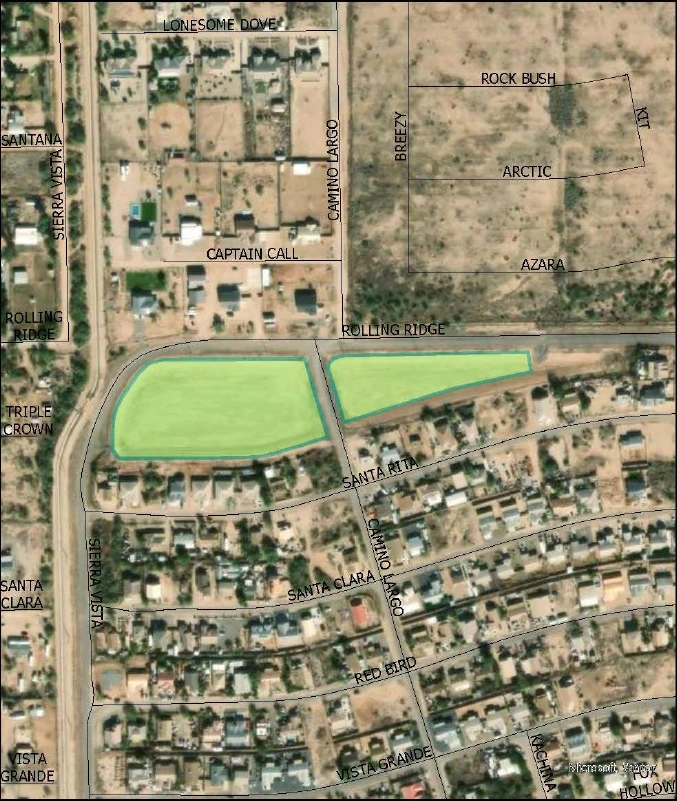
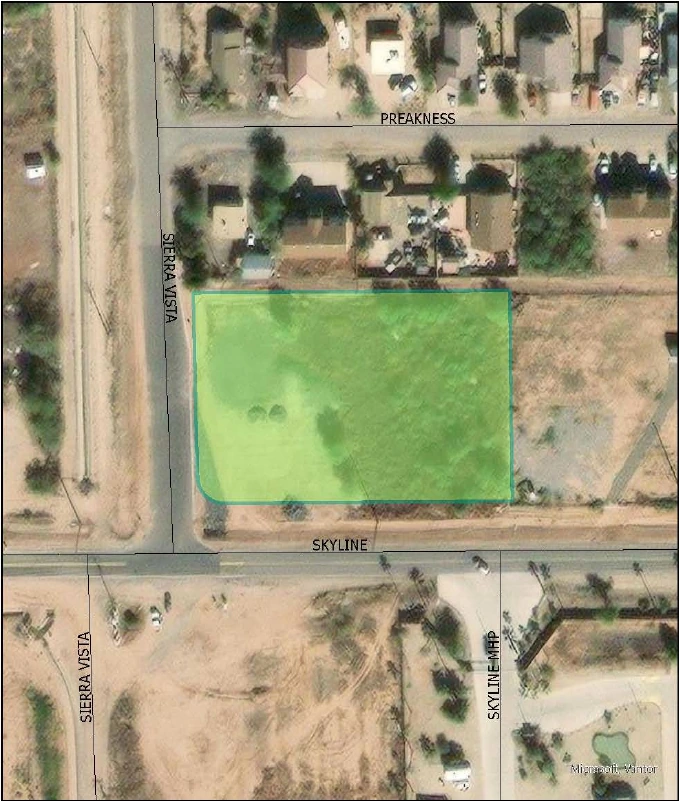
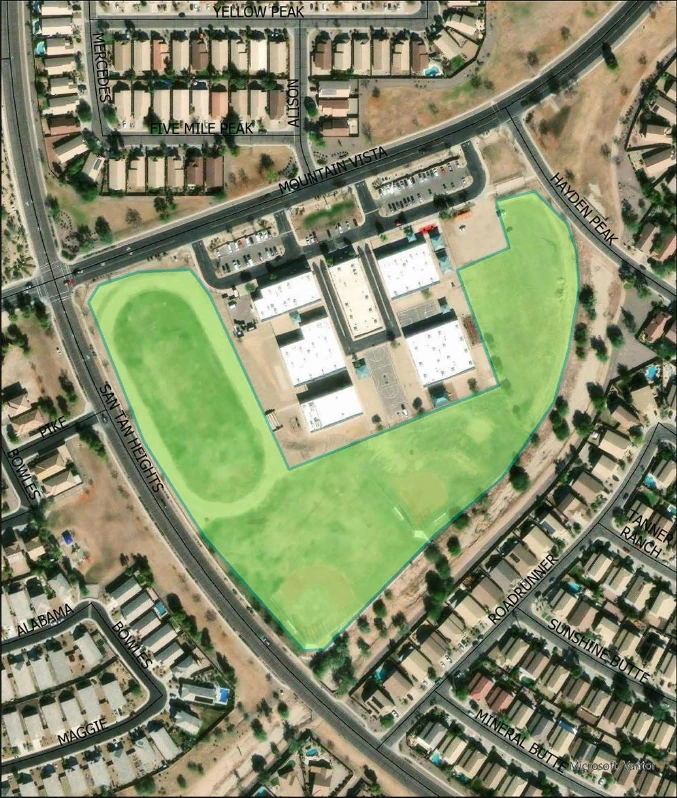
Dual-use infrastructure means putting land that already serves one purpose to a second use. Here, staff want to turn flood control basins into practice fields and small parks. Those basins belong to HOAs, Pinal County or its flood control district. The advantage, Billingsley said, is land: because the town would not buy property, construction costs drop. However, maintenance costs match a traditional park, and basins fill with water and carry liability. Nothing can be built in a floodway, the main channel that carries major flows. Billingsley said an analysis by Public Works Director Chris Wanamaker identified basins that might work while ruling out wash bottoms like the Queen Creek Wash, even though the ground looks dry most of the year. In addition, each basin site would need an intergovernmental agreement with the Pinal County Flood Control District, or a private agreement with the HOA that controls it.
Billingsley cited two examples from Maricopa, where he previously worked on parks. Pacana Park, that city’s first, came from an agreement among a master developer, a home builder and the city. Its fishing lake held effluent that irrigated the park, making the site dual-use itself. Copper Sky, its large regional park, is a detention basin that took more than 300 homes out of the floodplain. However, he said Maricopa also erred, investing in features that later failed or had to be torn out. He said that past experience is behind his master plan recommendation.
Tyler observed that only one site on the list has places to park. The rest sit beside roads or in open desert. Billingsley agreed and said parking costs more to build than the field itself. He then made a direct appeal: “If any of you is a member of an HOA, and you happen to have some HOA property that maybe has grass on it — there’s one right across the street over here, that’s a flood basin — and you’re willing to talk to the town about an opportunity for a dual-use facility, please give me a ring or send me an email.”
Seven draft sites shown for discussion only
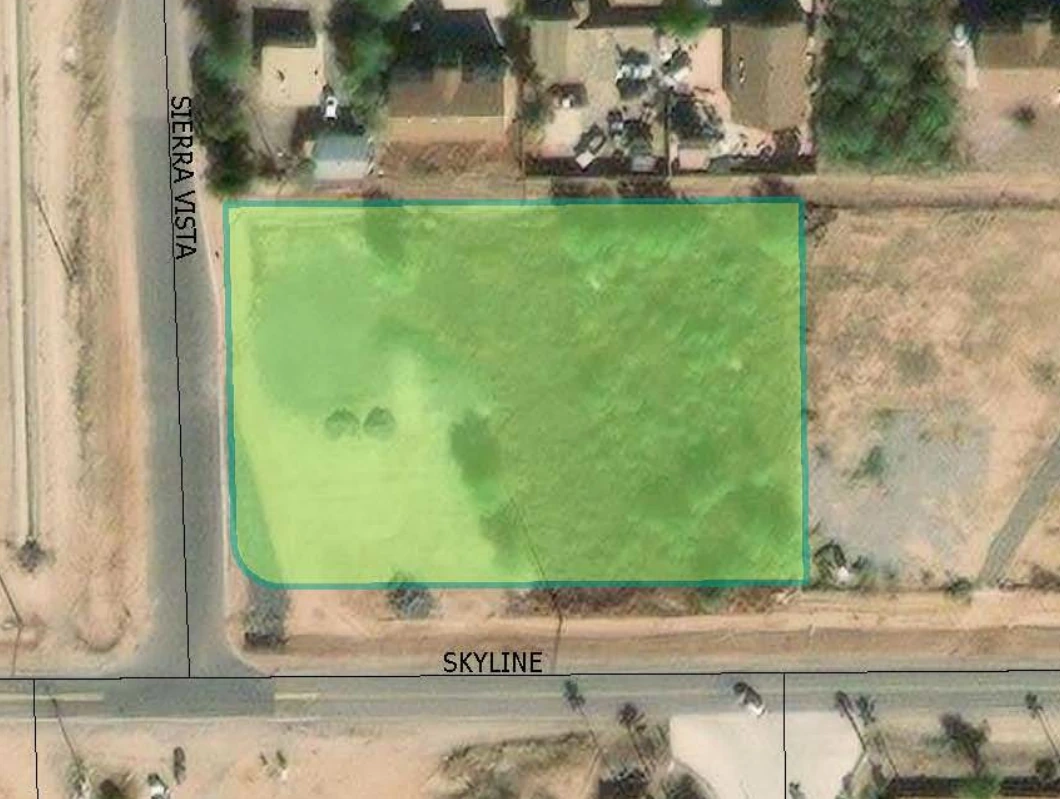
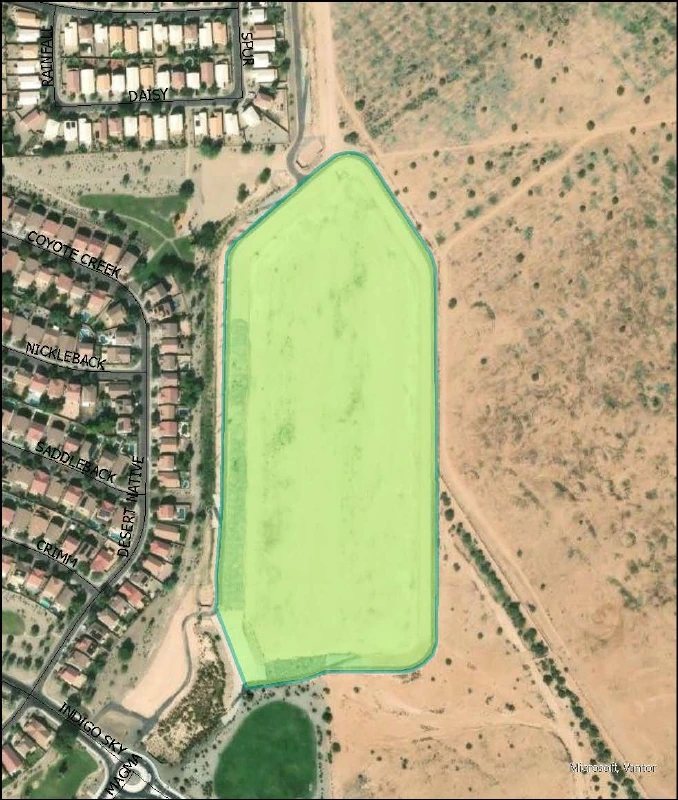
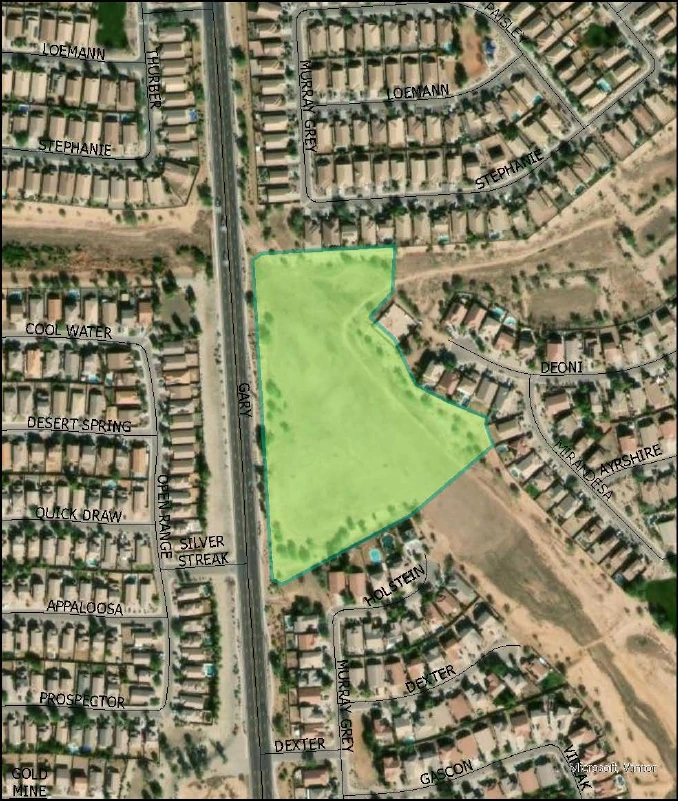
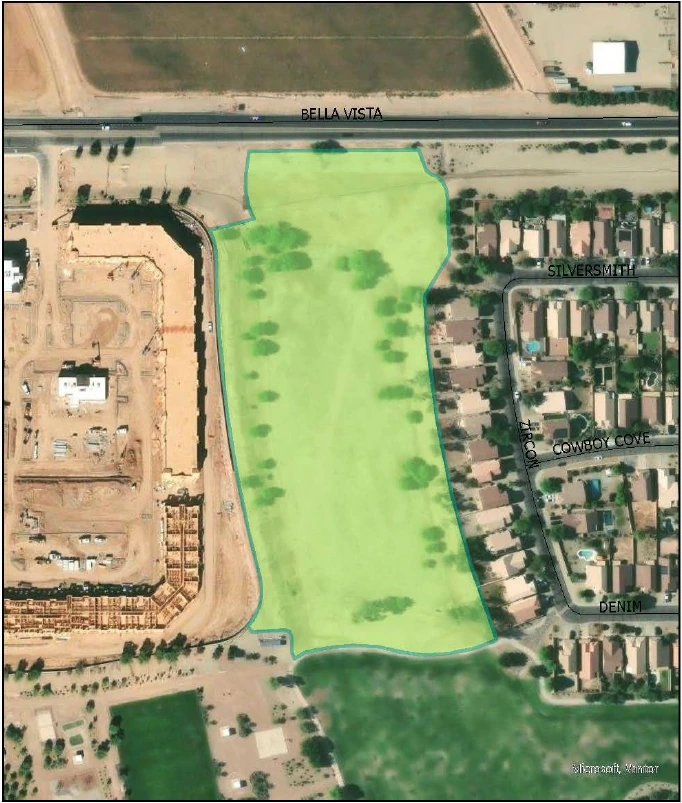
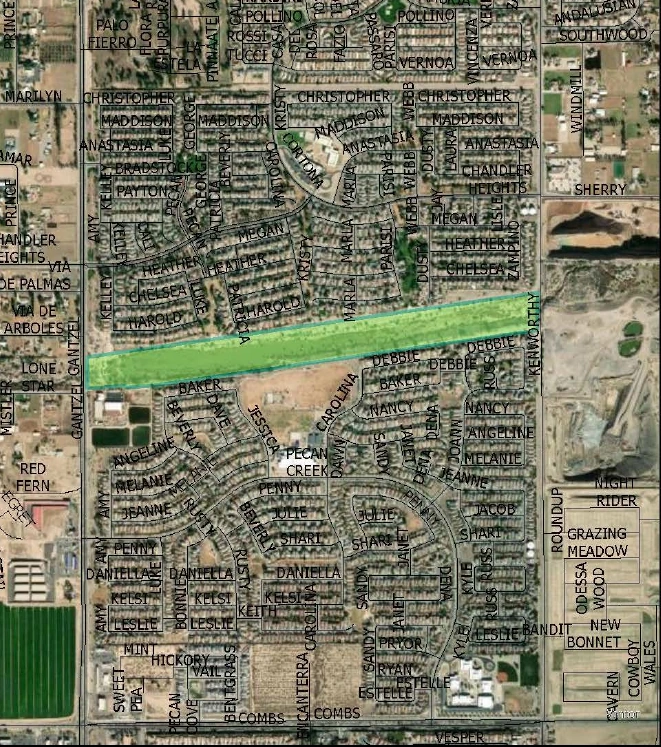
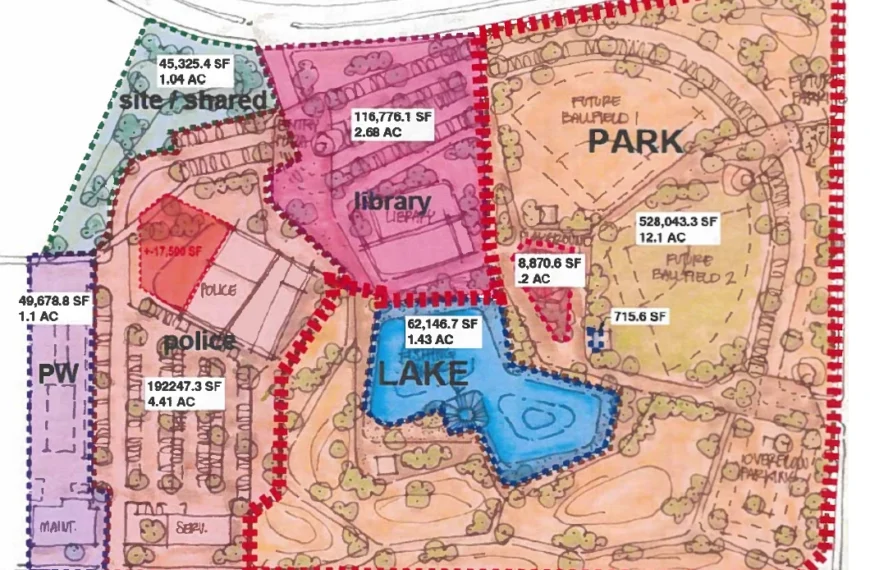
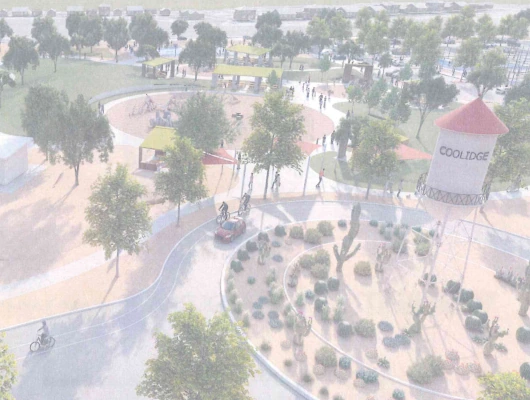
Answering that question, Billingsley pulled up slides he had not planned to show. The packet labels them “Conceptual/Draft — For Discussion Purposes Only,” and no site has been selected, funded or approved. The concept images appear below.
Impact fees, SAIDs and other San Tan Valley municipal parks funding tools
Billingsley walked through the remaining funding sources and their limits.
Development impact fees. These one-time charges on new development typically pay for parks. However, Billingsley called the topic “a big grr.” In June, he told the council that HB 2946 blocks the town’s first impact fees for 24 months on development Pinal County already approved, which he estimated at 6,000 to 7,000 single-family lots. The town’s draft fee study proposed about $6,200 per new home, and he estimated the loss could top $20 million.
Construction sales tax. The town adopted a 5% sales tax rate on construction and designated that money for building infrastructure once it starts arriving.
Parks and recreation fees. User fees would offset staffing and maintenance once facilities exist.
General fund. Unlike gas tax money that can only go to roads, general fund dollars are not tied to one purpose. They can pay for parks if available and budgeted. However, the current budget covers about 18 employees and no buildings or similar structures.
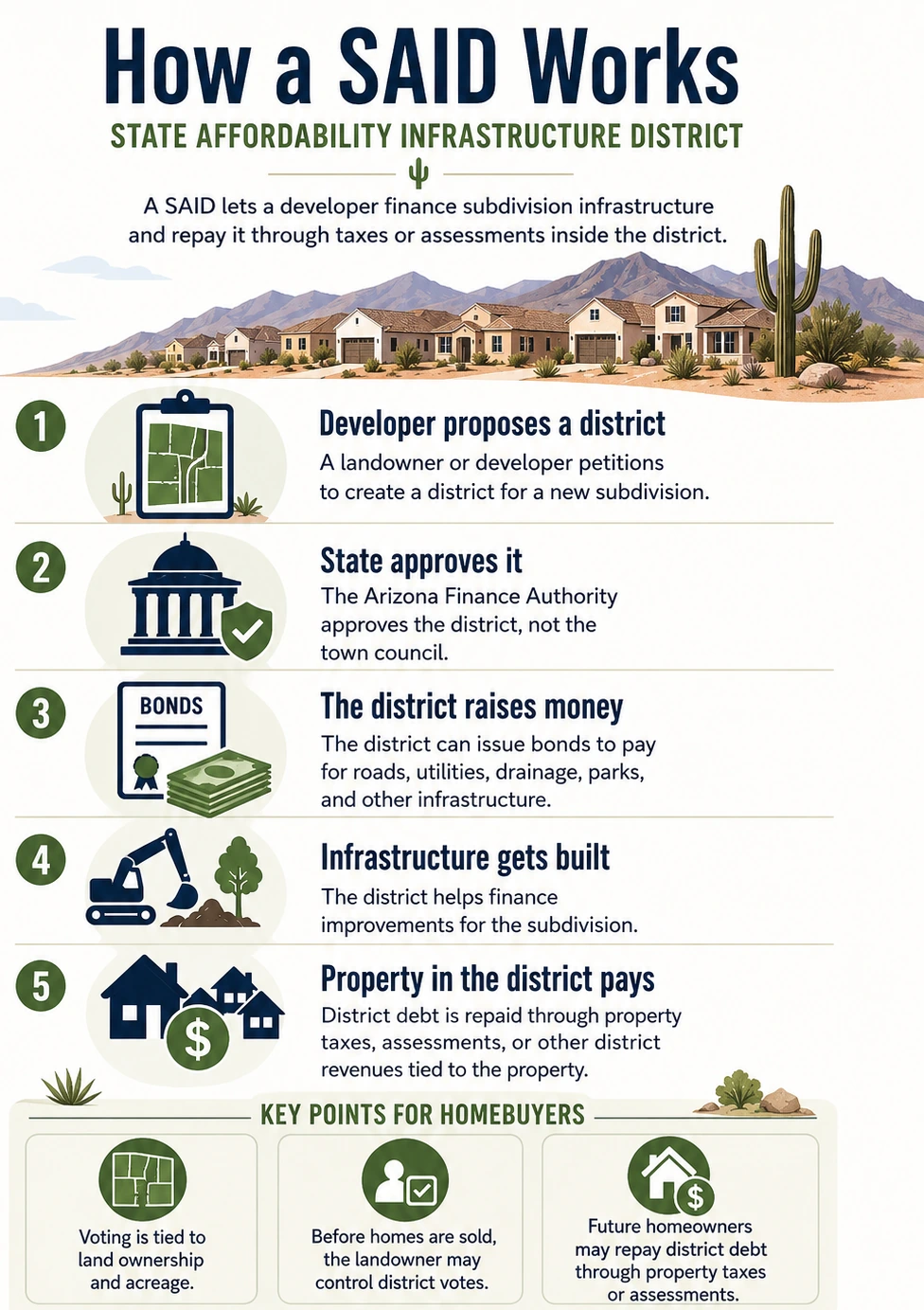
State Affordability Infrastructure Districts. HB 2999 created SAIDs this year. A developer petitions the state, not the town, to form one, and the district sells bonds for parks and other infrastructure. Property inside it repays that debt, an obligation homebuyers take on when they purchase, as Billingsley explained in June. A three-member board of property owners governs each district. Billingsley stressed that the council would not oversee such a district. Its applicability, he said, is still undetermined.
Large-scale developer partners. Billingsley also urged working with developers building hundreds or thousands of acres, whose projects could include amenities the town cannot fund alone.
No credit, no bond rating: what must happen before the town can borrow
Jenkins asked Billingsley to walk through what it takes to reach a bond. She said she knows it is years away, because the town has no revenue projections yet. He answered that the town has no bonding capacity, no bond rating and no credit. For example, its own bank required a $1 million deposit and three months just to issue purchasing cards. Before borrowing becomes realistic, he said, the town must show positive cash flow and build credit by borrowing and quickly repaying. It also needs a full year of financials with a clean audit. Therefore, an auditor will review the books after the fiscal year ends June 30, 2027, likely starting that fall. Billingsley said federal grants require a separate single audit as well. “It really is like a kid graduating from high school and going to college and trying to figure out how they build up their financial capability to buy their first car,” he said.
Trails could come before ball fields
Councilmember Daniel Oakes asked who owns the Queen Creek Wash, the 45- to 50-acre site shown in the draft concept slides above. Billingsley and Wanamaker said ownership is split among private mining operations, Queen Creek, and the Wales Ranch and Pecan Creek communities. Any park use there would depend on partnership agreements with those owners. Separately, Oakes urged staff to think first about pathways and trails, since linear projects need less land than fields and buildings.
Little League leaders describe the field shortage
Five residents spoke about parks during Call to the Public, some among other topics. Ali Day, president of San Tan Valley Little League, said fall registration hit 388 players, up 30% from last fall. About 500 are expected in spring. The league helps maintain the school and community fields it uses, she said, and is on its own at the Skyline Ranch fields, which have no water. “I’m not going to put these kids on a dangerous field,” Day said.
Abby Munger, a league board member, said families quit when practice locations change week to week. She urged the town to look at Empire Park, an HOA property with four baseball fields. The HOA will not maintain them, she said, and it turned down the league’s offers to pay rent and do the work itself. Karen Mooney asked whether the town would oversee or have any authority over maintaining the grounds if campuses close. Those sites could become parks, she said, but the field near her home is overrun with gophers because neither Paladin nor the district does pest control. Jeanne Stockton asked whether the town had looked into negotiating with FUSD to buy one of those schools for use as an administrative building. Additionally, Karen Oliver said residents compiled their own list of dual-use sites for the town.
After public comment, Schnepf told residents, “Stay tuned. We hear you.”
Six-month revenue review sets the pace for parks
Billingsley expects to report back to the council on the partnerships. Beyond that, San Tan Valley parks decisions track the town’s money. The director position, the splash pad, dual-use construction and any borrowing all wait on the revenue and audit milestones he outlined.

If we get the land then maybe diamondbacks would help with little league fields. I have seen several areas in state they gave donated but believe would need land first