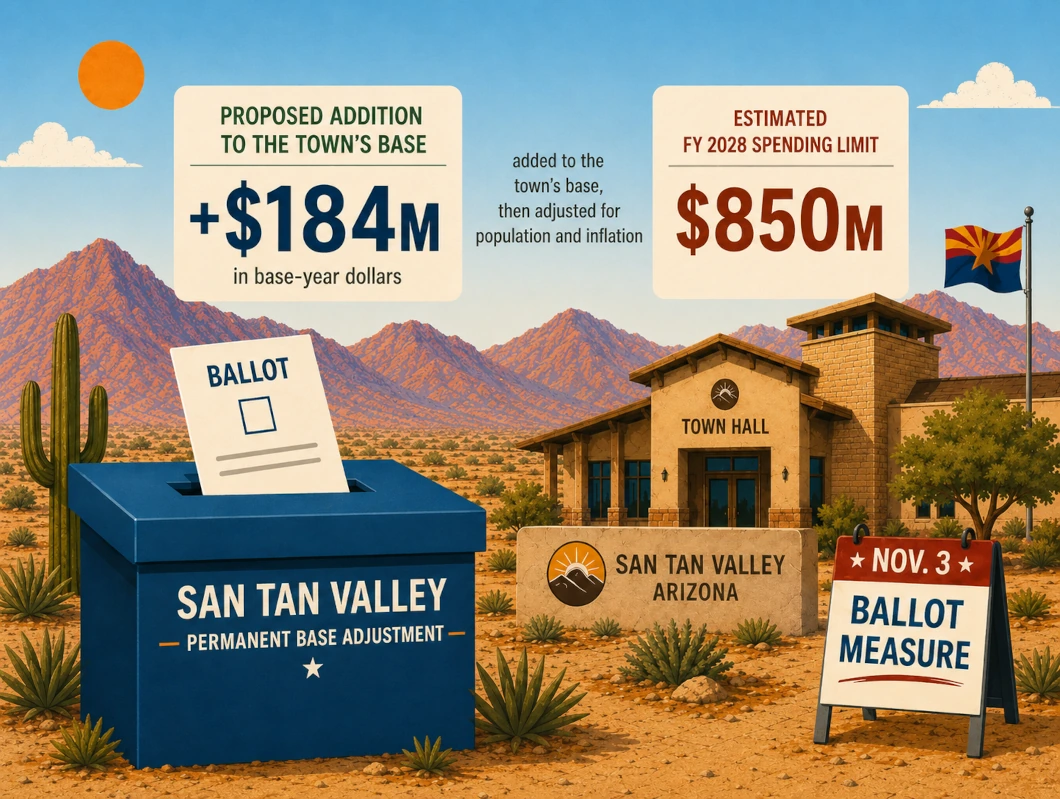
SAN TAN VALLEY, AZ — San Tan Valley voters will see updated language when they decide the town’s permanent base adjustment on Nov. 3. On Friday, Aug. 7, the Town Council voted unanimously at a special meeting to restate the proposed adjustment as $183,997,957 in 1979-80 base-year dollars. An earlier resolution had put the number at $758,923,652 after accounting for population growth and inflation. The Arizona Auditor General’s Office asked for the figure in 1979-80 dollars, before the population and inflation adjustments are applied. However, the revision does not change what voters are deciding. Both figures express the same proposed increase to the town’s spending base — the 1979-80 starting figure the state uses to set the annual limit each year. With that increase, the town’s total limit for fiscal year 2028 is estimated at $850 million.
The measure does not change property taxes or sales taxes.
Why the Permanent Base Adjustment Is on the Ballot
Arizona’s Constitution limits how much of its revenue each city and town can spend each year, using a formula tied to fiscal year 1979-80 and adjusted for population and inflation. Not every dollar counts against the cap — federal grants, for example, are excluded — but the state-shared revenues the town relies on generally do.
San Tan Valley did not exist as a municipality in 1979-80. Finance Director Gabe Garcia told the council earlier this year that the Economic Estimates Commission used a population of 91,000 as the basis for calculating the town’s limit. However, town officials have said that census-based count is low. An estimate from the Maricopa Association of Governments, cited in the town’s recent impact fee study, puts the population closer to 107,000. Because the cap formula multiplies a per-resident figure by population, the undercount holds the limit down.
The state’s limit for the town’s first full budget year stood at $79.1 million in May and has since been recalculated to about $91 million after updated population estimates. If voters approve the adjustment, the town estimates that ceiling at $850 million for fiscal year 2028. By comparison, Garcia pointed to neighboring Queen Creek at the April meeting where it adopted the interim budget. The state’s current table lists that town’s limitation at $852.3 million — a ceiling, not actual spending.
Auditor General Flagged the Figure
State law required the town to submit the ballot measure to the Auditor General’s Office for review before ballot materials could be prepared. Staff told the council that the office’s feedback has arrived piecemeal — the council had corrected a fiscal-year error in the same resolution just two days earlier, on Aug. 5. According to staff, the office has indicated this is the final revision. Because of election deadlines and ballot printing, the town scheduled the special meeting rather than waiting.
Yes or No on the $850 Million Limit
A “yes” vote permanently adjusts the town’s 1979-80 base by $183,997,957 in base-year dollars, beginning in fiscal year 2028. After the state applies its population and inflation adjustments to that larger base, the town estimates the resulting limit at $850 million for that first year. The cap would then keep growing annually on the same basis.
A “no” vote leaves the town under the existing state-imposed limit, which stands at about $91 million for fiscal year 2026-27 and is recalculated annually. In that case, the resolution states, the town may be legally prohibited from spending revenue it receives, even when budgeted.
Corrected Language Heads to the Printer
The council approved Resolution No. 2026-51 unanimously, with two of its seven members absent. With that vote, the corrected language moves into the publicity pamphlet and ballot for the Nov. 3 general election. The final decision on the permanent base adjustment now rests with San Tan Valley voters this fall.