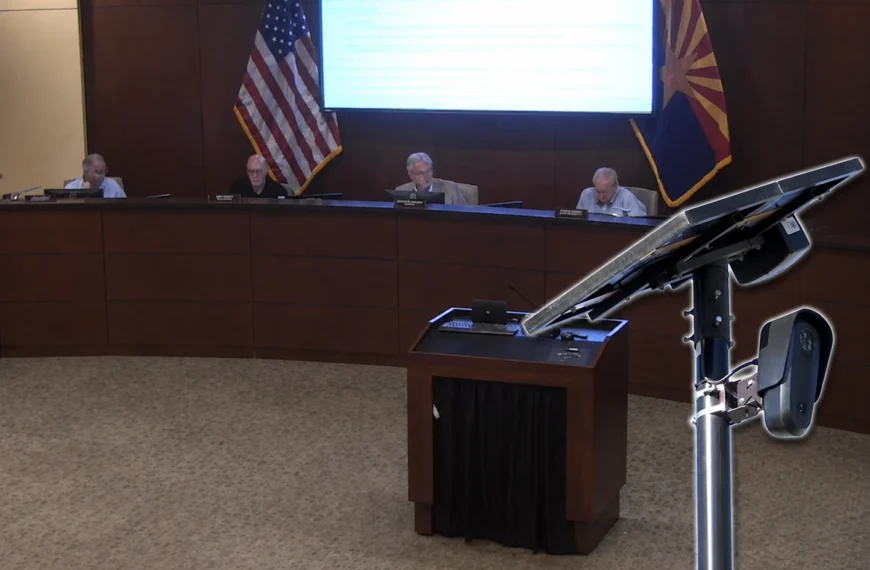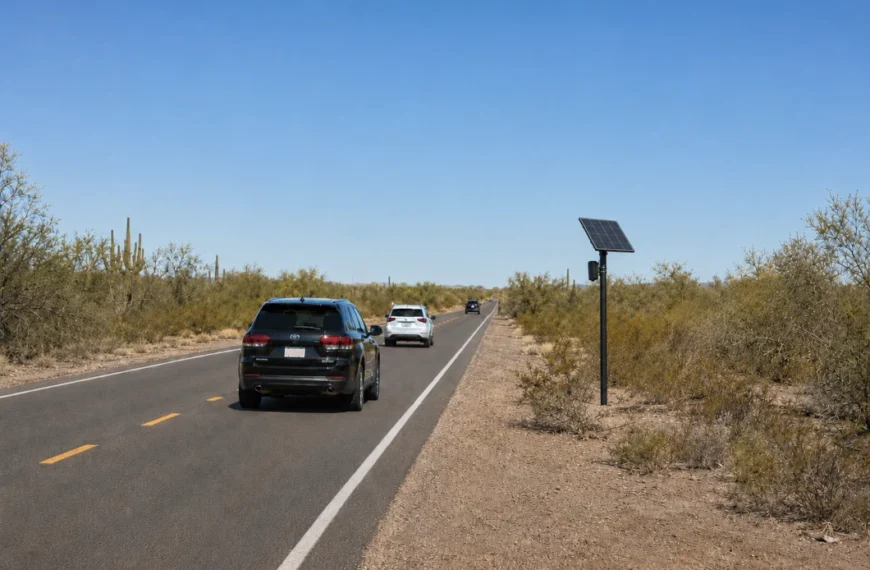
PINAL COUNTY, AZ — Sheriff Ross Teeple has ordered the cancellation of the Pinal County Flock cameras contract. On Aug. 5, he told the Board of Supervisors that he gave his staff the instruction last month. His concerns center on the system’s AI pattern recognition and facial recognition capabilities. “These concerns are enough that I instructed my staff to cancel the contract that the sheriff’s office has,” he said, adding, “we’re not going forward.”
Cancellation Covers Unincorporated Areas Only, Teeple Says
Teeple stressed that his decision covers only the cameras his office controls while serving unincorporated Pinal County. However, he said cities remain free to make their own choice. “The cities, if they decide that they want to continue on with this technology, God bless them. They are free to do that,” he said. For example, Casa Grande approved a 10-year, $10 million Flock Safety contract in September 2025, as Pinal Post reported.
Nearly Half of Pinal County Flock Cameras Sit in San Tan Valley
A large share of the network stands in and around San Tan Valley. According to Pinal Post’s earlier coverage of a July 15 San Tan Valley Town Council briefing, 22 of the 45 Flock cameras run by the sheriff’s office sit inside town limits. Two more stand in Queen Creek and three in Eloy, while the rest occupy county right-of-way. The Aug. 5 discussion did not address whether the cameras inside these municipal limits fall under the cancellation instruction. At the July 15 Town Council briefing, officials said images delete after 30 days unless saved to a case file. Additionally, the office shares its scans with 124 law enforcement agencies. The county holds two Flock Safety agreements — an operational contract and a right-of-way agreement — and the operational contract had been set to renew this month, August 2026, officials told the council at that briefing.
Why the Sheriff Sees a Fourth Amendment Problem
Teeple noted the agenda described the cameras as automated license plate readers. If that description were technically accurate, he argued, no Fourth Amendment concern would exist. He told the board it is settled law that a license plate on a public road carries no expectation of privacy, because the DMV technically owns the plate. For example, he cited an 8-1 ruling from 2020 confirming an officer can run a plate on the roadway. Even the lone dissenter in that case, Justice Sotomayor, objected only to the officer’s actions after running the plate, Teeple said, adding that he agreed with her reasoning. So the entire court agreed there is no expectation of privacy in the plate itself, he said.
However, he pointed to a separate Supreme Court ruling that found putting a GPS tracker on a vehicle to follow a person’s movements too intrusive. The camera system now raises the same problem, he said. “Now we have a camera system that can do facial recognition technology, pattern recognition technology, and can start building a data set on what our citizens are doing on a day-to-day basis,” he said. That capability, “in my training and experience and talking to my fellow law enforcement, is a huge Fourth Amendment violation.” The Fourth Amendment protects people from unreasonable searches and seizures.
Data Breach Questions and a Departed Vendor Rep
Teeple briefly mentioned data breach issues that have been circulating around Flock’s technology. His IT staff confirmed some of them happened, he said. He also described his attempt to get answers from the vendor’s local representative. The rep promised to respond, Teeple said. Instead, “the next time I saw him, he explained to me that he had been let go from our vendor. So I thought that was very telling.”
‘Tired Arguments’: Serdy Pushes Back on Camera Defenses
Vice Chairman Jeff Serdy said national and local outrage surrounds the devices. People “are taking it upon themselves to take these things down all over the country,” he said. Moreover, he argued the board lacked key information when it first approved the cameras, including “what they would turn into.” He compared the systems to monitoring in China and the United Kingdom — “just like the novel 1984” — and said the cameras also photograph people who simply walk past them.
Serdy then confronted what he called tired arguments. To the claim that people with nothing to hide have nothing to fear, he responded, “Why not just chip everybody right now and track everybody?” To the point that cellphones already track people, he answered, “Well, then why do we need them?” Furthermore, he warned that newer models will add facial recognition and read whose cellphone rides inside a vehicle. He pointed to Mesa’s real-time cameras, which he said track people “as if you were in China,” and to cameras placed inside infrastructure such as cacti.
Serdy also questioned who oversees the system. Monitoring falls to company hires rather than elected officials or sworn officers, he said, and those workers can access the data. He cited a case in which a police chief tracked an ex’s movements. Meanwhile, he said Rep. Tim Burchett of Tennessee plans a bill to ban the devices nationwide. Serdy closed by quoting Ben Franklin: “Those who would give up essential liberty to purchase temporary safety deserve neither.” He added, “If you’re being monitored, you don’t have liberty, you don’t have freedom.”
Teeple Says State Law Sets the 30-Day Retention Clock
Serdy also questioned the data itself. He asserted Flock keeps recorded information in perpetuity and asked why plate records must be held for 30 days. In his view, five minutes should be enough to check a plate in a kidnapping, much like an instant firearm background check. In response, Teeple pointed to state law. The Arizona Law and Libraries Retention Act sets how long law enforcement must keep records, he said, so that statute would have to change first. For example, every document a sworn peace officer creates must be kept until five years after the officer’s last day of employment, he said.
Plate-Only Cameras Already Serve the Anti-Smuggling Unit
Supervisor Rich Vitiello asked whether a simpler system could track plates alone and alert other cities or counties during a kidnapping or murder. Teeple said such cameras exist. According to his IT staff’s research, several vendors offer different levels of technology, including cameras that take only still photos of a rear license plate. In fact, his anti-smuggling unit uses those cameras now, and he relied on similar still-photo cameras as a lieutenant over aviation and search and rescue. His concern began, he said, when he learned the Flock cameras in Pinal County are capable of streaming live video, recording video and running AI pattern recognition.
Supervisors React
Supervisor Mike Goodman thanked Teeple for the briefing. “With technology evolving to where it’s going, it’s good that we’re being informed and brought to speed on a lot of these things,” he said, adding that Serdy’s points resonated with him. Similarly, Supervisor Stephen Miller called the presentation “great information” and thanked the sheriff. Chairman Jeff McClure, who had briefly paused the presentation for an executive session, also thanked Teeple for the update.
Right-of-Way Vote on Pinal County Flock Cameras Could Come Next
The Aug. 5 item, requested by Teeple, was listed as information only, so the board took no formal action. Afterward, Serdy asked whether a future agenda item would be needed “to literally vote these things away.” A county attorney said the board could place the existing 2024 right-of-way license agreement on a future agenda, though the contractual matters are separate because of how they were procured. McClure agreed the right-of-way agreement “would be the item.” For now, the sheriff’s cancellation order stands, and any vote on the Pinal County Flock cameras’ right-of-way agreement would come at a future meeting. See Pinal Post’s ongoing Flock coverage.