Part 8 of a Series | Case No. PZ-003-26 and PZ-PD-003-26
Guest opinion column by Pinal Unlocked, published in Pinal Post’s Opinion section. Views are the author’s own.
Robert Ricci is a research professor in the Kahlert School of Computing at the University of Utah and a director of its Flux Research Group. Pinal Unlocked arranged an interview with Ricci about the La Osa data center project proposed near Eloy, Arizona, with Pinal Post joining the discussion. For more than two decades, he has built and studied large-scale computing testbeds, including CloudLab, a facility funded by the National Science Foundation and used by researchers across the country to experiment on real cloud infrastructure. He is not a data-center construction engineer, he noted, but his work gives him hands-on experience with the computing systems and cloud infrastructure inside them and what they run. He walked us through what he has learned watching similar projects unfold in Utah. His central argument was blunt: from what he has observed, developers are planning far more data center capacity than the market is likely to need.
Developers are scrambling to the front of the line to build before the money runs out, he explained, while the people who live nearby try to get to the back.
Not every “data center” means the same thing
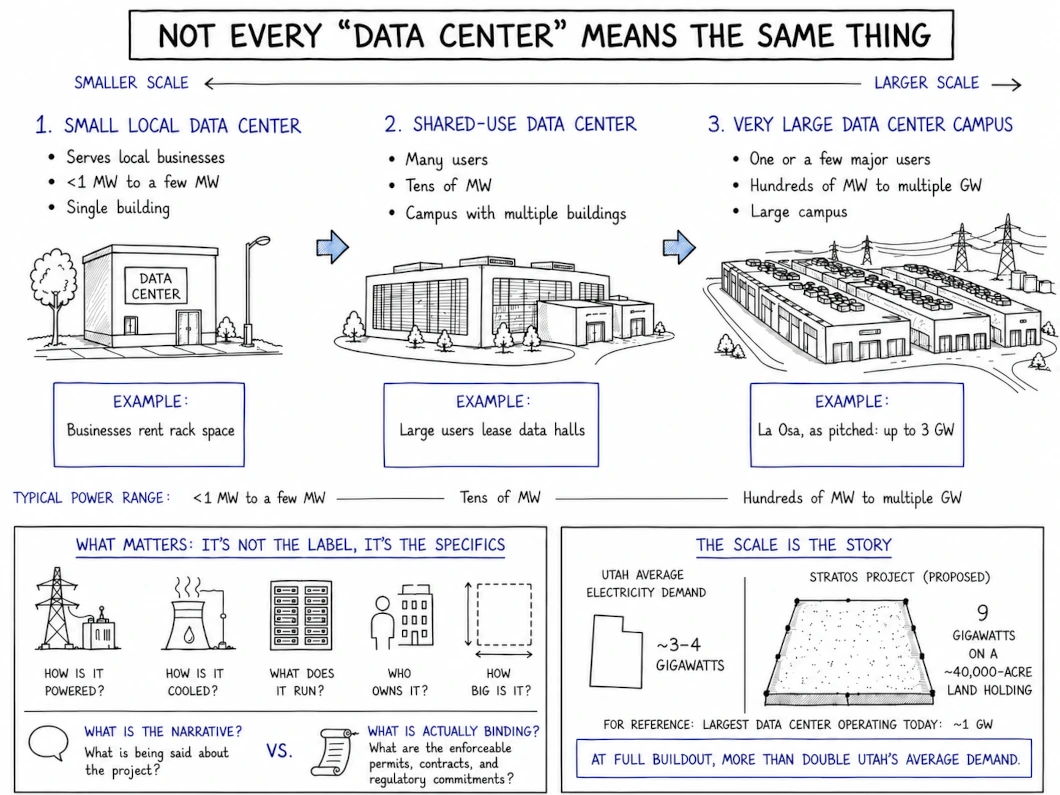
A data center can be almost anything, Ricci said, and in a photo essay he published in May documenting northern Utah’s data centers, he laid out the range. At the small end are colocation sites, where nearby businesses rent space for servers they would rather not run themselves (like the one across the street from his grocery store in downtown Salt Lake City). Also at the small end are data centers that serve as interconnection points, where internet carriers hand traffic to one another. A step up are buildings where racks are leased to multiple companies, sometimes adding up to tens to hundreds of megawatts across a campus. The projects driving recent concern sit at the far end: build-to-suit AI facilities, often for a single undisclosed tenant, designed to run at enormous scale. What matters, he argues, is not the “data center” label but the specifics of a given site, how it is powered, how it is cooled, what it runs, who owns it, and how big it is.
The sheer scale became the crux of the conversation. The project proposed for Box Elder County in northern Utah, known as the Stratos Project and backed by “Shark Tank” investor Kevin O’Leary, was pitched at 9 gigawatts of power on a city-sized land holding of roughly 40,000 acres, for what Utah State University physicist Robert Davies estimates would be the largest data center on the planet. Utah’s average electricity demand is roughly 3 to 4 gigawatts. At full buildout, the campus’s planned 9-gigawatt load would be more than double that.
The numbers may be the marketing
Ricci suspects the sheer size of many proposed projects serves a purpose beyond engineering. The size itself helps raise money. A record-breaking announcement attracts investors and capital in a way an ordinary project cannot, even if the demand to fill it may never materialize. At the same time, the major AI and tech companies are telling a story of essentially limitless demand. He pointed to SpaceX’s public offering filing, which put its total addressable market at 28.5 trillion dollars, a figure close to the whole of U.S. GDP, most of it tied to artificial intelligence. Ricci called that kind of claim incredibly unlikely.
In Ricci’s view, this amounts to a rush to cash in. Developers and data center operators build enormous facilities and then charge rent to the AI companies. Whether real demand ever shows up to fill them is a separate question, and one he thinks will be answered badly for many of these projects.
Promises the developers do not have to keep
A recurring theme in Ricci’s remarks was the gap between what developers say and what they are actually bound to do. They often promise closed-loop cooling with dry or air-based heat rejection, which uses little water. They promise low-water or air-cooled gas turbines. Very little forces them to follow through.
The technology is real, Ricci said: dry cooling systems and low-water turbines exist. But the caveats matter. Closed-loop systems still need an initial fill and may need maintenance or top-offs, and the larger question is how the system sheds its heat. And as he understands it, the low-water ones burn more fuel in exchange for using less water, and their global supply is limited, so not every developer promising to use them will be able to buy them. These systems are also fairly new at this scale, and Ricci expects operators to learn as they go. If cooling falls short on the hottest days, the cheapest fix is to add evaporative coolers, which means adding water. Facing pressure to protect the investment, Ricci believes many operators could end up adding evaporative cooling if they need it.
There is a built-in trade-off Ricci is careful to explain. A data center uses electricity for two things: running its computers and cooling them. Operators try to spend as little electricity as possible on cooling, since none of it does any actual computing. But the cheapest way to cut it is evaporative cooling, which uses water to do some of the cooling instead. So the more electricity a data center saves, the more water it can end up using, a trade-off the industry now tracks on both sides.
In that same essay, Ricci made the water math concrete. The backers, he said, had claimed access to roughly 13,000 acre-feet a year, about 4 billion gallons, while insisting they will use only a small fraction of it. By his reading of Utah’s water-rights rules, which run on a use-it-or-lose-it basis, the safe assumption is the reverse of the developers’ reassurance: plan as though every gallon they have claimed will eventually be drawn, since unused rights can be forfeited. He also pointed to a nearby precedent. QTS, which is building a hyperscale campus in Utah County and advertises cooling that consumes no water once operational, is the same company whose Georgia campus drew about 29 million gallons of unmetered water while under construction, after nearby residents noticed their pressure dropping.
Without those, he said, the public should not take developers at their word.
Who is it actually for?
One question Ricci thinks deserves far more attention is who will use these facilities. Many are built to suit for undisclosed tenants, with corporate structures designed to keep the client hidden. The end user could be Google, Meta, Palantir, or the NSA, and residents usually have no way to find out. Yet the same building might mean targeted advertising and chatbots, or it might mean surveillance. Communities are being asked to absorb the impact of these data centers without knowing whose interests they serve.
Ricci argued that the people training these models and profiting from them will mostly be in the Bay Area, not in an Arizona valley, while the environmental harm lands in residents’ backyards. He described rural areas being treated as sacrifice zones, a term from industrial geography for places where the burdens of heavy development get concentrated, chosen here for cheap land, existing gas pipelines, and distance from the eyes of most voters and state officials. In Box Elder County, that pipeline access was an explicit draw for the site. The deal also came with steep tax relief, which Ricci put at roughly 90 percent on energy, 85 percent on the real estate, and 100 percent on the equipment inside the buildings, concentrating the public costs locally while the profits flow elsewhere.
Doubts on the industry’s own terms
There are reasons to question the projects even by the industry’s own logic. As Ricci describes it, Nvidia designs meaningfully better chips roughly every 18 months, manufacturing is limited and mostly done in Taiwan even as new fabs open in the U.S., including one in Arizona, and the queue runs long enough that a newer chip is announced before the last one arrives. He questions whether enough chips are even being made to fill every proposed facility. The squeeze extends past fabrication: the advanced packaging that finishes these chips is still done almost entirely in Taiwan, which currently takes even the chips fabricated at TSMC’s Arizona plant. Ricci said the industry tends to plan around a four- or five-year hardware lifecycle. The building is the harder question. A data center is essentially a warehouse built to a fixed power density, able to bring in only so much electricity per square foot and shed only so much heat. Today’s AI facilities need far higher density than older ones, so an existing building cannot simply be refilled with the next generation of hardware. Ricci says there is no clear answer yet to whether AI’s power density has reached a plateau that will hold for decades or will keep climbing, leaving buildings finished today outdated within a couple of years. The chips inside have a roughly known lifespan. The useful life of the building itself does not.
Many of these projects also lean on private equity financing. Ricci’s worry is the risk that funding dries up before construction is complete, a danger he thinks private equity only sharpens.
What it means for Pinal County
Ricci was describing Utah, but the same questions apply everywhere. Large data center proposals across the Southwest, including La Osa in Pinal County, raise the same unknowns: how much electricity a project will ultimately draw, whether its cooling and water promises are enforceable, who the tenant actually is, and whether the forecast demand will ever justify the scale being built.
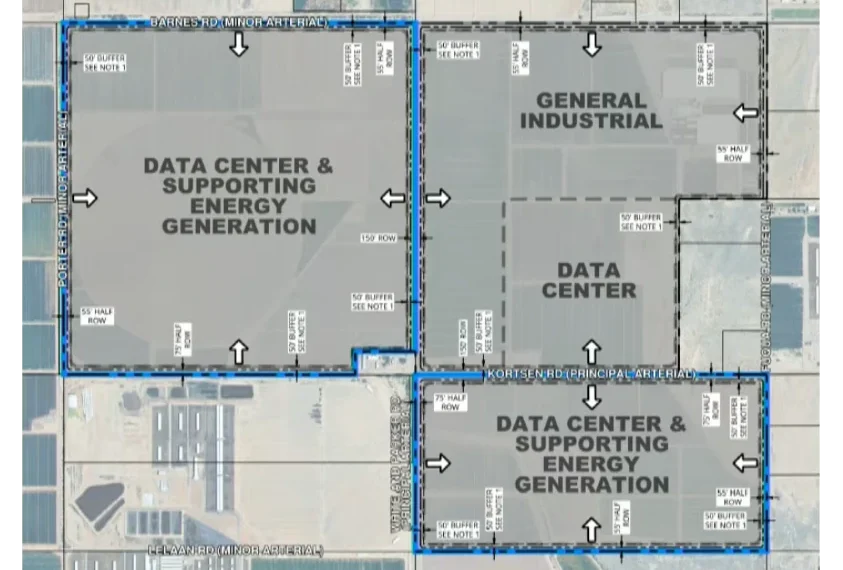
La Osa shows how closely those questions fit. As pitched by its developer, Vermaland, the campus south of Eloy would have spanned more than 3,000 acres with up to 59 data center buildings, two on-site gas-fired power plants, and battery storage, a project intended for an unnamed end user or tenant. After a packed May 27 Board of Supervisors hearing with overwhelming opposition in the comment cards, the developer said it would cut the number of buildings by about 80 percent, from 59 to 11, and cap the project at 1 gigawatt, down from roughly 3, though the reduction is so far a public statement, not a binding condition.
Those details track Ricci’s warnings closely. The developer’s representatives promised closed-loop cooling that avoids evaporative, water-consuming systems, the same kind of assurance he treats with caution. The planning commission’s chairman, Robert Klob, challenged the job numbers, saying he was seeing roughly five to ten people per building across the country rather than the hundreds the developer’s attorney projected. And the developer’s retreat under pressure echoes his argument that organized opposition can move a project.
Delay, he suggested, may accomplish more than any single argument. If shovels stay out of the ground long enough for the overbuilding to become plain, the economics that justify these projects may simply stop working.
Ricci also noted the political fallout in Utah. In the June primaries, Senate President Stuart Adams, who as head of the Military Installation Development Authority, or MIDA, helped fast-track the Stratos project, lost his primary after more than two decades in the Legislature, and two Box Elder County commissioners who approved it were also voted out.
Whether Ricci proves right about the coming wave of overbuilding remains to be seen. His core doubt is that demand may never justify the buildout. And a developer may not even intend to operate a data center, a possibility raised in our conversation about La Osa, where Vermaland has listed the land and says it has no end user yet. A project that stalls or changes hands can leave the industrial zoning, and any water rights a developer has locked up, in place with nothing built.
The land-use risk, by our reading, reaches further than any single hearing weighs. Unless an approval sets a deadline to break ground, an industrial rezoning does not lapse on its own if the data center never arrives; the entitlement stays with the land, sometimes called a zombie entitlement. And because each project is approved on its own, a county that grants several over several years, as Pinal County already has, can see them all switch on at once, hitting the water table and the grid with a combined demand that no single hearing ever evaluated. Once the land is rezoned, the water rights committed, and any power plant built, those choices are hard to undo.
La Osa Returns to the Board
Whether it goes forward, and on what terms, is for the Pinal County Board of Supervisors, who take it up again on August 26. The board hears the case that day at 9:30 a.m. at 135 North Pinal Street in Florence, and the hearing is open to the public. Written comments can be submitted to the clerk of the board at [email protected], referencing case numbers PZ-003-26 and PZ-PD-003-26. Comments sent to the clerk are shared with the full board and become part of the official record.
Eirini Pajak is a licensed real estate agent, freelance photographer, journalist, and Pinal County resident. She covers local land use and development decisions through her Pinal Unlocked page on Facebook and runs the Pinal Code Watchers community group. Her chiweenie Peso joins her on county rounds and features in the photo series accompanying this work.