
Guest opinion column by Eirini Pajak of Pinal Unlocked, published in Pinal Post’s Opinion section. Views are the author’s own.
LA OSA DATA SERIES
In 2021, the Arizona Department of Water Resources (ADWR) modeling showed more than 8 million acre-feet of unmet groundwater demand over 100 years in the Pinal Active Management Area (AMA). ADWR subsequently stated it would not approve new Assured Water Supply applications, the state certifications that guarantee homebuyers a 100-year groundwater supply, that rely on groundwater within the existing Pinal model domain.
The Assured Water Supply program is meant to prevent subdivision lots in AMAs from being sold without a demonstrated 100-year water supply. It does not apply to industrial developments in the same way.
In 2026, the county’s Planning and Zoning (P&Z) Commission voted 7-2 on April 16 to recommend approval of a $33 billion hyperscale data center in that same basin.
Quick Look
The applicant submitted two water analyses: an original memo on page 264 of the April 16 application packet, and an addendum filed after the P&Z vote. Both were prepared by EPS Group. The bullets below summarize what each contains and what is missing.
- The water source and water rights pathway are both unresolved. Global Water is described only as a “potential” supplier. The record does not say how the project would legally secure the groundwater it needs.
- The original water figure treated data center and gas plant cooling as interchangeable with any other industrial use. EPS applied a single generic industrial rate uniformly across the site rather than a technology-specific calculation.
- The addendum’s gas plant estimate benchmarks against a plant designed to run only during peak demand periods, while La Osa would run continuously. It compares plant size rather than actual generation, does not disclose expected operating hours, and is neither verified nor binding.
- The closed-loop claim applies only to the data center buildings and is not a binding condition. Neither are any other technology specifications that would impact water usage.
- The addendum leaned on Microsoft’s “zero water” marketing. City records for an actual Microsoft campus running that design show up to 702,000 gallons per day.
- The site plans show evaporation ponds at both gas plant locations. The addendum does not address whether the 280 to 600 acre-feet per year figures incorporate their evaporative loss.
- The 2.55 million gallons per day wastewater estimate was calculated with a generic flat rate rather than a technology-specific one, and the addendum left it unrevised.
- Construction water is unquantified. The record does not identify which wells, what volumes, or under what conditions, and a project this size could take a decade to build.
- Once approved, the entitlement runs with the land, and the Board does not vote on this project again. No current stipulation requires anyone to slow down or course-correct if actual water use exceeds projections.
Context: Water in the Desert
The Pinal AMA was established under Arizona’s 1980 Groundwater Management Act specifically because the basin had developed a heavy reliance on groundwater.
The Pinal AMA’s management framework is designed to slow the decline, not stop it. Every new withdrawal that is not replenished accelerates the decline. Even redirected demand that converts flexible agricultural withdrawals to fixed industrial ones permanently removes the adaptability the basin relies on during drought years.
The Central Arizona Project (CAP) is the canal system that delivers Colorado River water to central and southern Arizona. According to the Arizona Republic, Pinal County farmers’ direct CAP allocations ended across wide areas of the county in 2023, though some districts retain access through stored credits or individual agreements, and farmers are pumping more groundwater to compensate. Noah Hiscox, a supervisor with the San Carlos Irrigation and Drainage District in the Coolidge area, describes what that pressure looks like on the ground. His district lost its CAP allocation, and for 2026 received a water allotment of 0.21 acre-feet per acre. Growing one acre of cotton requires 4 to 5 acre-feet, meaning a farmer needs the water rights from roughly 20 to 25 acres to irrigate a single acre this year. According to Hiscox, the district’s reservoir is expected to run dry before the end of May, the same month the Board votes. As surface water disappears, pressure on the Pinal AMA groundwater basin increases. La Osa would add large-scale industrial demand to that same basin.
The question this article examines is how much water a $33 billion industrial campus would actually draw from the same basin, whether the figures in the application tell the full story, and what the record does not yet contain.
The Scale of What Is Being Proposed
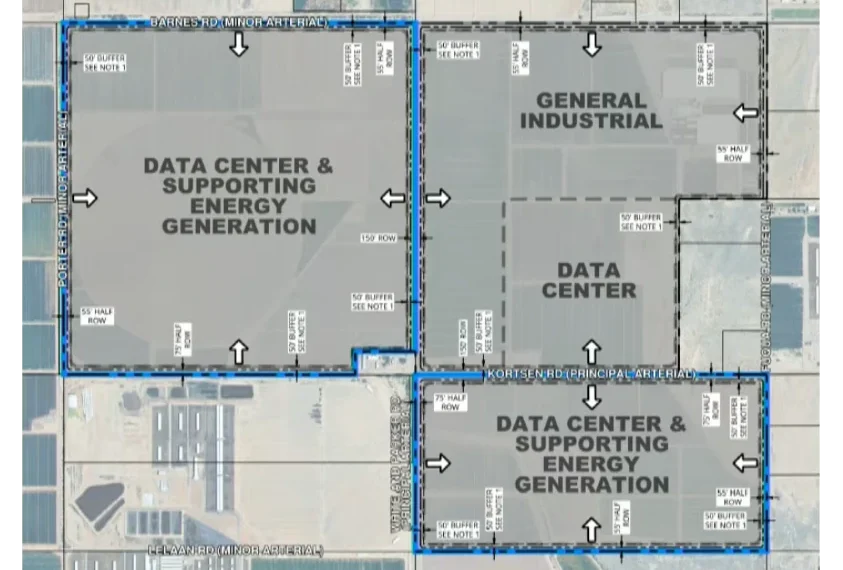
The applicant is Vermaland, a Phoenix-based land banking company. Land banking firms acquire land, secure zoning approvals and development rights (entitlements), and sell or develop those parcels later. The approved zoning is the product, and the entitlements run with the land regardless of whether Vermaland or a subsequent owner builds the project. The La Osa project plans for up to 59 data center buildings, roughly 23.6 million square feet, the equivalent of more than 400 football fields under roof. A hyperscale data center is a facility, often a multi-building campus, built for the largest cloud and technology companies. It houses anywhere from thousands to hundreds of thousands of servers and typically draws 40 megawatts or more of power. It differs from a conventional enterprise data center primarily in sheer scale, with floor area, server count, and power draw that can be orders of magnitude larger. The project is planned across three phases, with gas generation beginning in Phase 2 and a second power plant added in Phase 3. Earlier articles in this series examined the financial promises and the power supply questions; this article focuses on water.
According to Vermaland’s own press release, the 3,300-acre complex would support up to 3 gigawatts of power capacity at a projected cost of up to $33 billion.
From Placeholder to Addendum
The applicant’s water analysis was prepared by EPS Group, a Phoenix-based engineering and planning firm retained by Vermaland. Their report, found on page 264 of the April 16 Planning and Zoning application packet, estimates average daily site water demand at approximately 3.8 million gallons using a flat industrial rate of 1,800 gallons per day per acre applied uniformly across 2,127 acres, treating data center cooling, gas plant cooling, and every other use as interchangeable.
The same engineering firm subsequently provided a Water Memo Addendum after the P&Z vote, breaking out gas plant and data center cooling separately. The addendum explains the original memo used a flat rate because they “do not have documented demand factors for either power generation data center land uses and more specifically the cooling systems associated with data centers.”
Data Center Cooling
Data centers generate enormous heat and must remove it continuously. The traditional method uses evaporative cooling towers, which consume large volumes of water. Closed-loop systems recirculate the same fluid internally, using far less water. Once a closed loop has picked up heat from the servers, something still has to get that heat out of the building. A dry cooler is one option: it sends the warm fluid through finned coils outside and uses fans to blow the heat away into the air, without evaporating any water. Each approach uses dramatically different amounts of water, which is why the choice of cooling technology is central to any water accounting.
The addendum’s data center cooling estimate rests on three vendor sources: Microsoft’s corporate blog, Meta’s newsroom, and a Stream Data Centers article published eight days after the vote. Vendor self-certification can be treated as a starting point for independent verification, not as the verification itself, as water law researchers have documented. The addendum’s own engineer acknowledged the research behind those claims “has not been verified by the writer of this memo.”
The addendum supports its near-zero claim by quoting Microsoft’s general statement that its August 2024 design “consumes zero water for cooling.” That design is being piloted at two sites, Phoenix and Microsoft’s Mount Pleasant campus in Wisconsin. In a September 2025 blog post, Microsoft writes that “over 90% of our datacenter capacity uses this system, requiring water only once during construction and continually reusing it with no evaporation losses,” with the remaining 10 percent of traditional servers using outdoor air cooling that switches to water on the hottest days. The Mount Pleasant campus offers a real-world test of that claim. “Near-zero” is the addendum’s characterization; Microsoft’s own phrase is “zero water for cooling,” measured against older evaporative cooling systems. But Racine city records obtained by Wisconsin Public Radio show the campus at a peak of 234,000 gallons per day in Phase 1, rising to a peak of 702,000 gallons per day, or roughly 8.4 million gallons a year, at full buildout. In absolute terms, that is not near-zero.
Dry coolers lose efficiency as outside temperatures rise. According to the U.S. Department of Energy’s Best Practices Guide for Energy-Efficient Data Center Design, “the heat rejection effectiveness of outdoor drycoolers depends on the ambient dry bulb temperature.” In Arizona where summers regularly exceed 110°F, this degradation occurs precisely during the months when cooling demand peaks. The addendum cites installations in cooler climates and makes no adjustment for Pinal County’s summer heat.
The Microsoft campus matters here not as a size match but as a documented example. Microsoft writes that “over 90% of [its] datacenter capacity” uses a closed-loop, dry-cooler design, with the remainder using air cooling that draws water on the hottest days. La Osa likewise proposes a closed-loop system for its data center buildings, which the addendum describes as using “near-zero” water. Yet the Racine records still put the Microsoft campus at up to 702,000 gallons per day at full buildout. The comparison does not establish La Osa’s future demand, as campus configurations, compute density, and operating profiles vary too much for direct extrapolation, and the Mount Pleasant figures reflect surface water drawn from Lake Michigan rather than groundwater pumped from a stressed desert aquifer. But it demonstrates that even advanced closed-loop systems marketed as “near-zero” can consume substantial absolute volumes at scale. La Osa is planned at 3 gigawatts of capacity across up to 59 buildings, which is why “near-zero per building” and a near-zero total are not the same claim.
The closed-loop system captures heat from the servers, but that heat still has to leave the building somehow, and the addendum does not specify how. If cooling towers handle that second stage, they consume water two ways: some evaporates as the towers shed heat into the air, and because only pure water leaves as vapor, the minerals left behind grow more concentrated with each cycle. Eventually that water would scale or corrode the equipment, so a portion is drained on a regular schedule and replaced with fresh water, a second draw known as blowdown. Until the addendum specifies how the captured heat is released to the outside, there is no way to know whether or how much blowdown this campus would require.
The Closed-Loop Claim and What It Does Not Cover
The applicant’s most prominent water argument at the April 16 hearing was that the data center buildings would use a sealed, closed-loop cooling system. The applicant’s attorney, Court Rich of the Rose Law Group, was direct: “We’re not one of those data centers that uses water for cooling anymore.”
Closed-loop systems do use substantially less water than evaporative cooling. But the claim applies to the data center buildings only. It does not cover the gas-fired power plants, which use a different cooling process entirely.
Before the vote, official correspondence to the Board from the Mayor of Eloy and the Arizona Commerce Authority characterized the closed-loop system as confirmation that water resources would be protected. However, the Water Memo Addendum, submitted after the vote, acknowledged that the scientific research behind those claims “has not been verified by the writer of this memo.”
At the hearing, the applicant’s attorney stated La Osa “won’t be using” cooling towers. Rich was explicit about why the closed-loop commitment should be trusted: “We will have a closed-loop system, and that’s in the zoning, and so that’s, that’s it. That’s the end of that story.” But “in the zoning” means in the application narrative, not in the 33 binding stipulations the Board would actually enforce.
Rich had described a cooling stipulation in similar terms at the November 2025 Board of Supervisors meeting, telling the Board: “When the zoning hearing comes, you will hear us and see us stipulate to that use. That means that we have to do that. And that then has the force of law. There is no option to have a stipulation that says you will do closed-loop cooling system and then do something else.” When Supervisor Vitiello asked directly what guarantees the Board would have in writing, Rich said: “When we come in for zoning, we would expect your staff to propose, but if they don’t, we will, a stipulation that says that we will not utilize water cooled system and that we will utilize a closed loop system for cooling. And when that stipulation then goes into place on the approved zoning, that’s the law for this project.” Asked about the current stipulation list before the May 27 vote, Rich confirmed by email that no new stipulations had been added. In the same email, Rich described the closed-loop system in more detail:
A review of all 33 stipulations finds no mention of closed-loop cooling, water use, cooling technology, or any water-related requirement. Stipulation 28, the closest thing to a technology requirement, addresses sound mitigation only.
The Board of Supervisors vote is scheduled for May 27. A cooling stipulation could still be added then.
Gas Plant Cooling
According to the April 16 hearing, the applicant confirmed the gas plants would operate “to some degree, a lot,” with some capacity planned to run 24 hours a day.
When Pinal County Planning and Zoning Commissioner Tom Scott asked directly how the gas plants would work, the applicant’s attorney said the specific technology would “get worked out as we complete these studies with the utilities,” according to the April 16 hearing. The commission voted without a cooling technology specification in the staff report or water memo.
The addendum, submitted after the hearing, specifies air cooling systems paired with spray intercooling. EPS reviewed two comparable projects, Project Baccara near Luke Air Force Base and the Salt River Project (SRP) Coolidge Generating Station expansion, and derived a water consumption estimate of 280 to 600 acre-feet per year at 2,000 megawatts (MW) of generation. Both benchmarks use simple cycle combustion turbines, which generate electricity directly from burning gas without capturing waste heat. At the hearing, Rich stated the project would “probably be utilizing a combination of simple cycle and then combined cycle.” If the project ultimately uses combined-cycle technology, which captures waste heat to generate additional electricity but requires more cooling as a result, the addendum’s simple cycle benchmarks would not apply. Actual water consumption could differ substantially from the addendum’s current estimates depending on which technology is ultimately deployed.
The benchmark comparison has a more fundamental problem: it compares how big the plants are, not how much they actually run. A plant that runs occasionally uses far less water than one that runs continuously, even if both are the same size.
The addendum compares plant size in megawatts, not actual electricity generation. According to SRP’s FAQ, SRP Coolidge is a peaking plant, designed to run only during high-demand periods, and is expected to run only a few hundred hours per year. La Osa’s gas plants would serve a data center running around the clock. The memo does not disclose expected operating hours or capacity factor, the percentage of time the plant would run at full output. It also compares against a plant drawing from stored CAP water; La Osa would draw from Pinal AMA groundwater.
Construction Water
Construction water has no estimate anywhere in the application materials. Concrete production, concrete curing, and dust suppression all require sustained water use across years of active grading. None of that is captured in the EPS demand figure, which addresses operations only.
According to the April 16 hearing, the project plans to use existing agricultural wells on the property. The hearing record does not identify which wells would be used, what volumes would be drawn, or under what oversight.
Wastewater
The EPS wastewater memo projects approximately 2.55 million gallons per day using a flat-rate methodology. No revised figure appears in the addendum. For context, city water demand data obtained by WPR found that Microsoft’s Wisconsin campus would discharge around 81,000 gallons of wastewater daily in its first phase, rising to 243,000 gallons per day in later phases.
During initial phases wastewater would go into septic systems on site; Red Rock has no municipal sewer system. Large-scale septic loading at this density raises immediate concerns about nitrate contamination and localized soil saturation, risks that are well documented by U.S. Environmental Protection Agency (EPA) guidance on septic systems and groundwater quality and are not addressed anywhere in the application materials. The EPS memo notes coordination with a utility provider such as Global Water would occur when a treatment facility “becomes necessary,” but does not define what makes it necessary, when that threshold would be reached, or what happens if it is not met. The groundwater quality implications of septic loading, cooling system discharge, and the disposal of drained cooling water, and how additional unreplenished withdrawals contribute cumulatively to long-term subsidence pressures, are examined in Article 4 of this series.
Flexible Demand vs. Hard Demand
In a stressed basin, volume matters but flexibility matters too. Farmers can fallow fields, rotate crops, or leave land unplanted when water is scarce. A data center campus running continuously cannot.
How La Osa would actually secure water rights is not specified in the hearing record. There are several legal pathways available: purchasing existing agricultural rights, applying for an industrial use permit, or being served through Global Water. Each has different implications for whether groundwater withdrawals would be replenished or permanently unreplenished. A General Industrial Use permit, for example, requires the holder to use water efficiently but does not cap the total volume it can pump, regardless of basin conditions, as described in ADWR’s overview of groundwater conveyances. Without knowing which pathway applies, the Board cannot meaningfully evaluate whether the project’s groundwater demand would be replenished, transferable, or permanently unreplenished.
A common argument from data center developers is that their facilities use less water than golf courses or apartment complexes. The La Osa site is zoned General Rural, so apartments are not an alternative on this land. The golf course volume comparison is commonly cited in data center development discussions. Both golf courses and large-scale cooling facilities in Arizona are regulated under ADWR’s Industrial Conservation Program. Unlike turf-related facilities such as golf courses, which receive annual allotments based on turf, landscape, and lake acreage as described in ADWR’s commercial and industrial conservation guidance, large-scale cooling facilities and power plants are regulated more by how efficiently they use water than by a fixed cap on how much they can pump.
The Global Water Transition
The project plans to eventually transition to Global Water Resources as its utility provider. Global Water is described in the formal record only as a “potential” supplier and the will-serve letter the attorney confirmed at the hearing does not appear in the application packet. At the hearing, Rich described the arrangement as Global Water coming to “create the service territory for the project,” according to the April 16 hearing, language that implies a service area extension has not yet occurred.
According to Arizona Department of Environmental Quality (ADEQ) drinking water system records, Global Water’s Red Rock service area draws from groundwater. The water source does not change. The operator does.
If La Osa falls outside Global Water’s current licensed service area, the service area question would need to be resolved through the Arizona Corporation Commission (ACC) regulatory process for private water utilities.
The 33 stipulations contain no binding timeline for the water transition, no confirmation that Global Water’s service area covers La Osa, and no phase gate preventing later construction until the water supply is confirmed.
Who Bears the Risk
Developers and county staff will note that unresolved engineering questions are normal at the conceptual rezoning stage. That is true for most projects. What makes La Osa different, from a water accounting standpoint, is the sheer scale of what is being proposed combined with unverified demand figures, an unspecified water source, and technology claims that are not binding conditions of approval.
The project’s water plan rests on assumptions: that existing wells will be adequate during construction, that Global Water will transition to service on an unspecified timeline, that gas plant consumption will fall in the 280 to 600 acre-feet range, and that data center cooling will use significantly less water than conventional systems at La Osa’s scale.
Under Arizona law, once a rezoning is approved and a Planned Area Development is recorded, the entitlement runs with the land. While later permits and approvals may still be required, the project would no longer be subject to a vote.
The fact that ADWR might legally grant an industrial use permit does not obligate the Board to approve the rezoning. The Board retains full discretion to weigh whether new unreplenished groundwater use in this basin is consistent with the county’s land use interests.
Before Approving This Project, the Board Could Seek Answers to the Following
- A single integrated water balance covering all three phases: data center cooling, gas plant cooling with evaporation pond losses, construction, domestic uses, and any supplemental cooling for peak summer heat. The addendum addresses fragments. No combined figure exists in the record.
- A capacity factor disclosure for the gas plants: how many hours per year are they expected to run, and how many megawatt-hours will they generate? Do the evaporation pond losses appear in the 280 to 600 acre-feet per year estimate?
- A specification of how the data center’s captured heat is released to the outside: what type of equipment, how it performs in Arizona’s summer heat, and whether any supplemental cooling would be needed during peak months.
- A construction water estimate by phase: which wells, what volumes, and under what oversight.
- A definition of when wastewater treatment becomes required: what triggers it, what mechanism prevents later phases from proceeding without it.
- Confirmation from Global Water that the La Osa site falls within its current service area, or a timeline for ACC approval of a service area extension if it does not.
- A disclosure of which water rights pathway the project intends to use, and confirmation from ADWR that the proposed use is consistent with the Pinal AMA management plan.
Each of these is a reasonable request for a project of this scale in a groundwater-stressed basin. The Board’s discretion includes the authority to require them as conditions of approval, regardless of whether ADWR would separately grant an industrial use permit at some later date.
If the Board intends to approve this project, the water accounting should come first. The figures should be technology-specific, based on the actual systems that will be installed rather than generic vendor marketing. They should be Arizona-specific, accounting for the climate conditions where the project will operate rather than benchmarks from cooler locations. They should be binding, written into stipulations so the project is legally committed to the technology and approach that generated the estimates. And they should be reviewable, with a mechanism to revisit if actual consumption significantly exceeds projections. An estimate built on dry coolers should commit the project to dry coolers. An estimate built on simple cycle gas plants should commit the project to simple cycle. Without that linkage, the figures and the conditions are disconnected.
The water question in this basin is not new. ADWR’s effective halt on new groundwater-based residential development shows the situation is dire. On May 27, we will see how the Board decides.
The Pinal County Board of Supervisors public hearing on this case is scheduled for May 27, 2026 at 9:30 a.m., 135 N. Pinal Street, Florence. Agenda packet.
Article 4 examines the geology beneath the site: what earth fissures and land subsidence tell us about the Picacho Basin, why the 0.92 correlation between pumping and subsidence matters, and why the physical consequences of overdrafting this aquifer are permanent.
Correction, May 22, 2026: An earlier version of this article described Microsoft’s Mount Pleasant campus as using a closed-loop, no-evaporative-tower design. Microsoft’s September 18, 2025 blog post states that “over 90% of [its] datacenter capacity” uses that closed-loop design, with the remaining roughly 10 percent using outdoor air cooling that draws water on the hottest days. The article has been updated to reflect the post’s characterization.
Disclosure
This article is based on publicly available documents cited throughout. It is not legal, financial, or water rights advice. Figures should be independently verified before being relied upon for any official purpose.
About the Author
Eirini Pajak is a licensed real estate agent and Pinal County resident. She covers local land use and development decisions through her Pinal Unlocked page on Facebook and runs the Pinal Code Watchers community group. Her dog Peso joins her on county rounds.
Erini Pajack’s series on the La Osa are a must read. They are incredibly well-researched and documented and ask CRITICAL QUESTIONS that deserve answers BEFORE this monster data center, right in the middle of the Greene Wash, a tributary of the Santa Cruz Rive and critical habitat and corridors for so many at risk species is approved. Thank You Eirini!!!