Key Points
- The Pinal County Planning and Zoning Commission voted 7-2 on April 16 to recommend the La Osa Energy and Data Center rezoning.
- The project covers 3,385 acres south of Eloy, along the Greene Canal of the Santa Cruz Wash.
- Plans show up to 59 data center buildings around 400,000 square feet each, two on-site gas-fired power plants, and battery energy storage.
- About 992 acres would remain as open space.
- The data centers will use a sealed, recirculating cooling system rather than water-intensive evaporative cooling, significantly reducing the project’s water demand.
- The applicant estimated construction cost on the order of $10 billion or more, with roughly $100 million in annual tax revenue at buildout.
- The Avra Valley Fire District plans to serve the project after annexation, which the chief said could cut existing residents’ property tax rates by half or more.
- Staff reported at least 11 letters of support and one email of opposition, with the Mayor of Eloy, Sandra Watson of the Arizona Commerce Authority, and the Arizona Technology Council among the supporters.
- Adjacent landowner Ronella White and the Bennings spoke in support.
- Eirini Pajak raised concerns about the undisclosed size of the two gas plants and their water demand, which she noted is separate from the data center cooling system and could reach the scale of 10 million gallons per day at full buildout. She urged the commission to require phased approvals and independent oversight.
- Chairman Robert Klob and Commissioner Tom Scott voted no, citing unresolved technical questions.
- Both cases now head to the Board of Supervisors for final action.
The Pinal County Planning and Zoning Commission voted 7-2 on April 16 to recommend approval of the rezoning for the La Osa Energy Center, a combined data center and power generation project spanning 3,385 acres south of Eloy. The recommendation now moves to the Board of Supervisors.
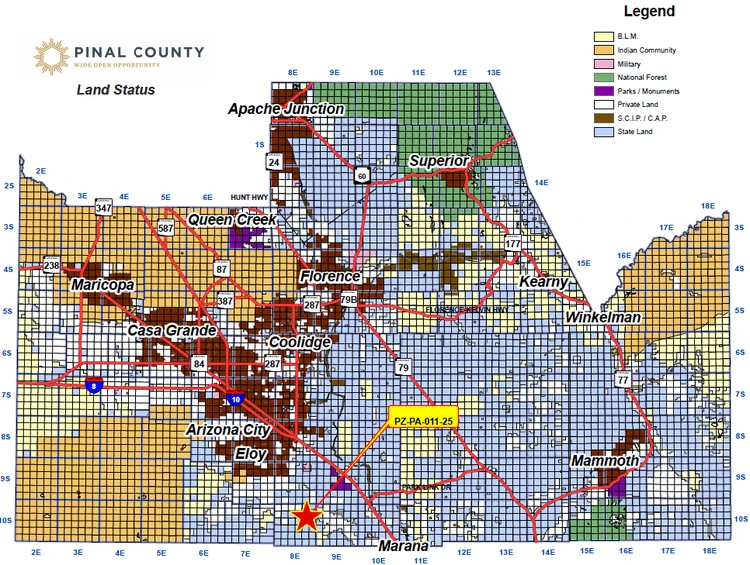
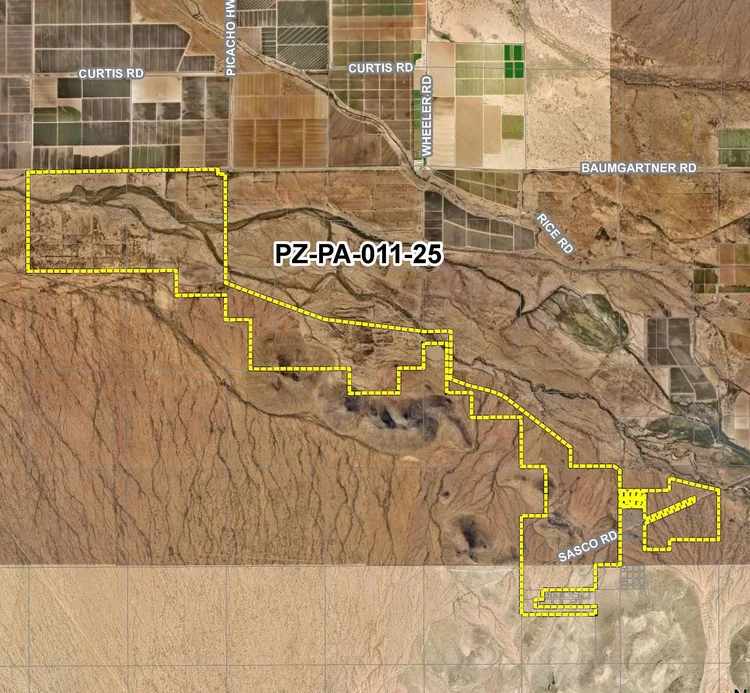
The recommendation covers Case PZ-003-26, which rezones the land from General Rural (GR) to 2,393 acres of Industrial (I-3) zoning with 992 acres of proposed open space. A companion Planned Area Development overlay, Case PZ-PD-003-26, applies 33 stipulations across the full acreage.
Part of a Growing Pinal County Data Center Pattern
La Osa is the latest and largest in a series of data center and energy campuses moving through Pinal County’s approval process. In November 2025, the Board of Supervisors approved the Project Midway Data Center, a 215-acre comprehensive plan amendment near Casa Grande. That same month, supervisors approved a 495-acre data center, gas plant and battery storage campus near Maricopa, which cleared its comprehensive plan amendment stage. Both projects still require rezoning approval before construction can move forward.
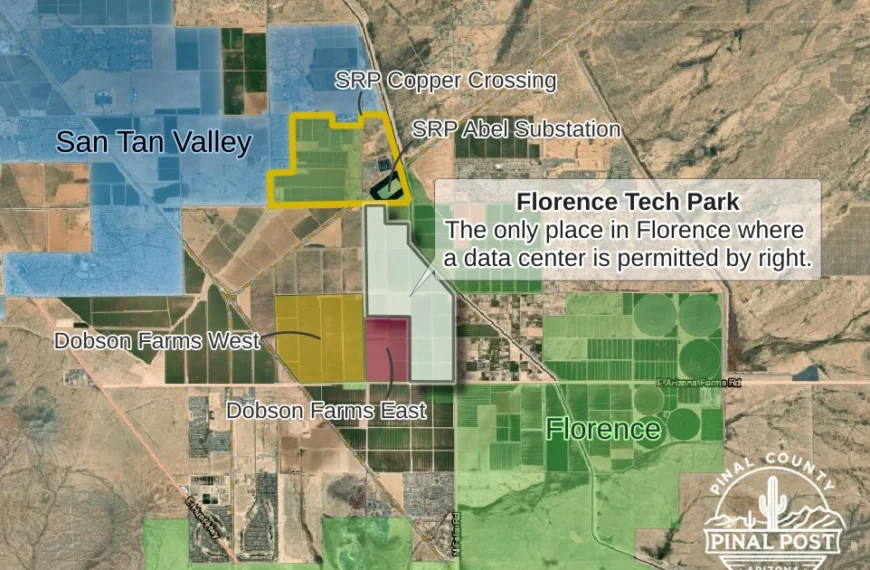
Activity is not limited to unincorporated parts of the county. In October 2025, the Town of Florence approved rezoning for 1,619 acres of data center and industrial development at Dobson Farms, covering three projects projected to generate about 800 jobs and $10 million in annual tax revenue at full buildout.
At 3,385 acres, La Osa is substantially larger than any of those projects. It is also further along procedurally than the other unincorporated-county projects, as the Board of Supervisors approved its comprehensive plan amendment in 2025, and this week’s commission vote advances the rezoning to the Board of Supervisors for final action. Applicant attorney Court Rich of Rose Law Group told commissioners he believed La Osa was the first data center project the commission had reviewed at the zoning stage.
Site, Phases and Scale
The site sits along the Greene Canal of the Santa Cruz Wash, south of Baumgartner Road and east of Eleven Mile Corner Road. According to Planning Supervisor Sangeeta Deokar, the property lies within the extended planning area of the City of Eloy and is west of Red Rock. It is remote, rural and currently undeveloped, with no houses immediately surrounding the parcels.
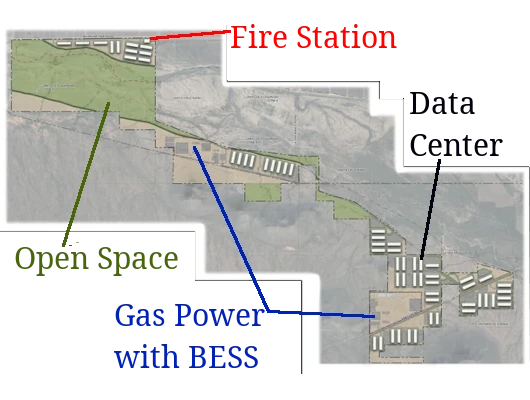
Vermaland LLC, represented by Rich, plans to build in three phases. The northwest phase will include data center buildings along with a site the applicant has offered to designate and donate to the Avra Valley Fire District for a future fire station, if the district determines one is necessary. The central phase adds a gas-fired power plant and additional data center buildings. Finally, the southeast phase will feature more data center buildings alongside a second gas-fired power generation plant.
At full buildout, the conceptual site plan depicts up to 59 data center buildings across more than 2,000 acres, plus two gas-fired power plants. “We anticipate the buildings to be around 400,000 square feet each,” Rich told commissioners. “That’s with the floors stacked on top of each other. They are big buildings.”
Approximately 29% of the site, about 992 acres, would be set aside as open space. Deokar said the open space layout is intended to keep regional open space connectivity intact, protect drainage flows, and avoid disrupting riparian habitat and wildlife corridors. She described the project as an example where “natural infrastructure with new urban infrastructure would co-exist if all the stipulations are followed.”
Jobs and Economic Impact of the La Osa Data Center Project
Rich estimated the total construction cost on the order of $10 billion or more. “At buildout, it is gonna be probably the largest taxpayer in the county, if not certainly one of the largest taxpayers in the county,” he said. He estimated roughly $100 million in annual tax revenue to the county, the Red Rock School District and special districts, arguing that the revenue could create downward pressure on the taxes paid by other residents and businesses.
Rich estimated 100 to 500 full-time jobs per data center building, telling commissioners the figure would depend on the specifics of each building, including structure and the type of data center operation. He said the low end of that range was only a rough estimate and that the actual count could be a little less. The power plants, he estimated, would add approximately 70 permanent positions.
Chairman Robert Klob challenged those numbers. “This becomes the largest employer in the county at that point, I would believe,” he said. “And I’m just not seeing that same data across the country. I’m seeing, like, 5 or 10 people per building, not 100 to 500.”
Klob said the project could be oversold. “If the reality turns out it’s 500 for the entire site, well, we got sold a bill of goods,” he said. Rich responded that different types of data centers generate different levels of employment, which was why he gave a range. He also distanced himself from any specific headline number. “I’m not here selling, telling you that you should do this for the jobs,” he said. Rich pushed back on the 30,000-employee figure Klob had referenced: “I don’t stand here telling you that this is gonna be 30,000 jobs. I don’t want you to believe that. I don’t think that’s the case.” Even so, he said he believed the project would still create “thousands of jobs” based on the various metrics he had seen.
Vice Chairman Karen Mooney asked about workforce housing. Rich said nearby landowners were “excited about the opportunities that this could create for business and additional housing needs” in the area, suggesting the project could help spur that kind of activity among surrounding property owners.
Mooney also asked whether the project would receive state or federal tax incentives. Rich acknowledged a “rather well-publicized state sales tax that’s available for the components of the data centers.” He added, “there’s a move to withdraw that. There’s some legislation that’s been adopted that would make that go away.” He described any incentive as “a very small part of the taxes that this would generate.”
Water and Cooling at the La Osa Energy Center
Rich said the project will use a closed-loop cooling system. “There is an initial filling of the system with water, and the water is mixed with glycol, which is a cooling fluid, much like you’d have, I think, in a radiator or something like that,” he explained. “Then that’s sealed, and that runs throughout wherever they need to cool and there’s a heat transfer where that fluid absorbs the heat, and then as it goes through some area away from the heat, it releases that heat and then comes back through and just repeats that system over and over.”
Mooney and Commissioner Tom Scott both pressed on whether the cooling fluid would need to be replaced, raising concerns about potential toxins and particulate buildup. Rich said he did not believe it needed to be changed but acknowledged the question went beyond his zoning preparation. He committed to researching further and reporting back at the next hearing.
Rich confirmed the project has received a will-serve letter from Global Water, which plans to create a service territory for the project. According to the applicant’s preliminary water submittal, private wells and septic systems will serve initial phases until demand grows large enough to require a larger water treatment facility. At that point, the project would coordinate with Global Water on either retrofitting existing agricultural wells into domestic facilities or constructing new domestic well sites.
An evaporative pond associated with the gas-fired power plant drew questions about potential pollutants leaching into soil. Rich said he believed the pond would be lined. “My understanding from other projects like this I’ve worked on is that it would be lined, so I think that’s a safe assumption,” he said.
Scott also pressed for a definitive answer on turbine design. “If you’re gonna use the exhaust to turn the turbine or you’re gonna use steam? I’d like to have a clear answer on that one,” he said. Rich did not provide a definitive answer at the hearing and indicated that part of the design would be worked out as the project completes its utility studies.
Power Generation and Electricity Rates
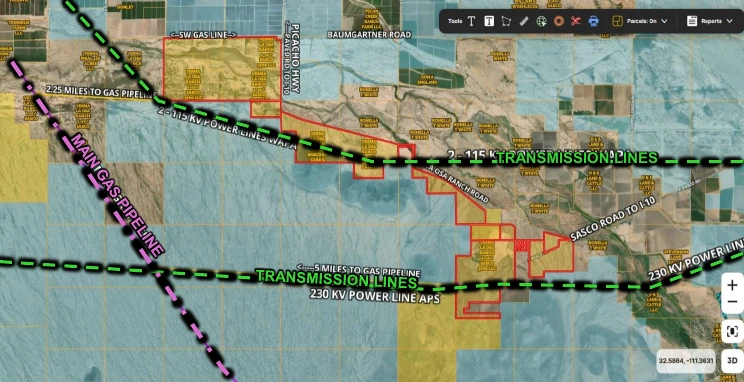
Rich explained that the developer plans to generate its own power rather than rely on the grid. “What this developer is doing is bringing their own power to serve and to be the source of the generation for the project,” he said.
The generation mix combines internal and external sources. “Their plan is to have battery energy storage as part of this,” Rich said, “and they think that will help them to bring a better product forward, keep the prices lower and better balanced and be able to use, frankly, use more clean energy that they can absorb from the grid as well.” He added that “their plan is to utilize these two gas-fired power plants, the battery energy storage, and also contract with nearby clean energy sources.”
Responding to Commissioner Bryan Hartman, Rich said the on-site gas plants will supply early phases, with additional demand met by contracts with nearby solar projects.
Rich also described what the industry calls a “wires-to-wires interconnection” with APS. This arrangement would allow the project to use APS’s grid to draw energy from other sources, and to push excess generation back onto the grid when available. A similar process is underway with Electrical District No. 4.
Mooney asked whether the project would affect electricity rates for other customers. “Our hope is no,” Rich responded. He said the project is building its own infrastructure and connecting to the grid, rather than operating “behind the meter.” “These types of projects can help lower costs for everybody by using energy at a steady amount, which then kind of has downward pressure on all the rates for everyone,” he said.
On generator operating hours, Rich told commissioners the facility will run constantly. “We have to go through that full study program with the utilities,” he said. “Some of them will be for base load generation. So some of the capacity will be running 24/7.”
Natural Gas Supply for the La Osa Rezoning Project
Natural gas sourcing came up through questions from Hartman. Rich said the developer has been in “deep, deep discussions” with gas providers but cannot sign contracts until zoning is secured. Rich said the developer believes some initial gas supply will be available for the project’s early phases, with additional capacity expected from pipelines that are proposed or being built to come into Arizona from Texas and New Mexico.
Hartman specifically asked about the TransWestern pipeline. “I think as they grow, they certainly will need that or there are others,” Rich answered. “There are several others that are proposed and coming into the state.”
He continued: “The whole state of Arizona is relying on additional gas pipelines to be built to come in to help fuel our growth and not just for data centers.” Rich noted that energy usage is rising broadly, including from increased electrification.
Fire Service Through the Avra Valley Fire District
Avra Valley Fire District Chief Brian Delfs confirmed that the district will serve the La Osa project upon completion of a pending annexation. According to a March 30 letter from the district, the project has offered to designate and donate a site for a future fire station if the district determines one is necessary. The district already operates a nearby station from which initial service can be provided.
Delfs said the annexation benefits existing district residents. “The annexation of the project will result in the district being able to lower our property tax rates, possibly cut them in half or even more for everyone that lives in the fire district just based off of the first two phases of this project,” he said. The expansion will also help the district provide additional service to Red Rock, the Picacho Peak area and communities along Missile Base Road community.
Funding will come from property taxes generated after annexation, combined with financial contributions negotiated with the developer before building permits are issued. “Fees and contributions will be determined at a later date before the building permit is filed, once a buyer or lessee is identified,” the district’s letter states.
Support and Opposition to the La Osa Energy Center Rezoning
Staff reported at least 11 letters of support and one email of opposition, with additional support letters arriving in the days before and during the hearing. The Mayor of the City of Eloy submitted a letter of support during the meeting break. Sandra Watson, head of the Arizona Commerce Authority, also submitted a support letter. The Arizona Technology Council filed a letter in support, as did adjacent landowners including Pecan Ranch Farm, the Benning family, and Louis and Mary Wagner. Ronella White and the Bennings also spoke in support at the hearing.
Rich pointed to the support from surrounding property owners. “It’s there in the first place because of that key infrastructure,” he said. “And then, gosh, the people there not only are indifferent, but they actually want it there.”
Ronella White, whose family has farmed, ranched and lived in Red Rock for well over 100 years, spoke in support during public comment. Prior Pinal Post reporting indicated White owns approximately 4,000 acres adjacent to the project. “This will bring some much needed infrastructure and economic growth to Red Rock,” she said. She cited the first-time availability of fire service as a particular benefit. “The 51 years that I have personally lived there, we haven’t belonged to a fire district.” White also said the project would benefit the Red Rock School District through increased tax revenue.
Public Comment Raises Scale and Oversight Concerns
Eirini Pajak raised concerns about the water demand of the project’s gas plants. Separate from the closed-loop cooling planned for the data centers, she pressed commissioners to ask the applicant about the two gas plants’ cooling needs. Pajak suggested the facility could require up to 4,000 megawatts, with gas plant water use at full buildout potentially reaching 10 million gallons per day.
Pajak submitted a handout of proposed stipulations for the commission’s consideration. She acknowledged the work staff and the applicant had already done but argued for stronger accountability measures. Her recommendations included phasing the project in 500-acre increments, requiring county verification of water use and infrastructure impacts before each phase proceeds, and building in enforcement tools that would pause construction if flooding impacts or other violations occur. She also called for independent third-party monitoring and coordination with the Arizona Game and Fish Department to protect habitat and wash corridors.
Pajak said her proposed stipulations were aimed at ensuring that if the project moves forward, it would be held to accountability measures that function in practice rather than on paper alone.
Heat, Noise and Environmental Concerns
Commissioner Tom Scott raised concerns about heat island effects from the facility. He cited a March 30, 2026 CNN article reporting that temperatures near a data center can rise by 16 degrees, with the effect tapering to 3.6 degrees at 6.2 miles out. Scott said this could affect the surrounding riparian area, animals and regional weather patterns.
Rich said he was not aware of peer-reviewed studies supporting those conclusions. “There hasn’t been any peer reviewed study that I’m aware of that has come to any of those conclusions,” he said. Rich told commissioners the data center industry was working to review the studies behind the article and said he was not familiar with nearby residents reporting localized heating near existing facilities.
Klob raised the issue of the constant humming sound that residents near other data centers have reported. “It’s almost like a high transmission line, electric line and you hear that buzzing, that hum,” Klob said. “That constant hum, kind of buzzing, like a mosquito in your ear. How do you stop a hum?” Rich pointed to stipulation 28, which requires the facility to “employ the best available technology pertinent to sound mitigation.” He added that, based on a Board of Supervisors presentation he had heard the day before, data center noise is often associated with cooling towers at water-cooled facilities, and the closed-loop system the project plans to use would avoid that equipment.
Why Rezoning Comes Before Utility Contracts
The sequencing of utility commitments also came up. Rich walked commissioners through the sequential development process: major comprehensive plan, rezoning, utility interconnection studies, deposits and energy service agreements, and finally building permits.
“You have to sign contracts that come with really steep penalties and guarantees,” Rich said. “They have been in close discussions with gas providers, energy providers, like, everybody, deep, deep discussions. But they can’t sign those contracts until they have a project.”
He continued that locking up power at this scale requires hundreds of millions or billions of dollars in commitments, and those agreements cannot be signed until the project has cleared what Rich called “the discretionary permitting process.” If a developer signed energy contracts and the project were then denied, he said, they would be “on the hook for billions of dollars of energy.”
Projected Water and Wastewater Demand
The applicant’s preliminary water and wastewater memos, prepared by EPS Group, project substantial utility demand once the project is fully built out. Industrial water demand is projected at 3,828,780 gallons per day on average, with a max day demand of 7,657,560 gallons and peak-hour demand of 6,508,926 gallons. Industrial wastewater demand is projected at 2,552,520 gallons per day on average, with a max day demand of 5,105,040 gallons. Global Water’s nearest existing water facility is about 10 miles away in Red Rock, and private wells and septic systems will serve initial phases.
Archaeological Records Review
The Arizona State Museum reviewed archaeological records within a one-mile radius of the project area. Of 110 archaeological sites identified in that radius, 28 intersect portions of the project area. The museum recommended, but did not require, that a qualified archaeological contractor be consulted before any ground-disturbing activity begins. The recommendation covers both portions of the project area that have never been surveyed and previously surveyed portions, where prior work is now 16 to 46 years old. ASM noted that standard archaeological practice calls for re-survey when previous survey work is 10 or more years old.
Project Background and Prior Coverage
The La Osa project has moved through a multi-stage approval process over the past year. The Planning and Zoning Commission first reviewed the project in a July 2025 work session, where commissioners raised serious concerns about flood risk. A large portion of the site falls within FEMA Zone A, a high-risk flood designation with a 1% annual chance of flooding. County mapping showed the property receives approximately 10,000 cubic feet per second of offsite flow from the Casa Grande-Eloy Watershed, and portions of the project area also experience land subsidence, with earth fissures mapped in the broader vicinity. All facilities would need to be elevated above the 100-year flood level and comply with floodplain use permits.
In October 2025, the commission voted 7-3 to recommend approval of the comprehensive plan amendment. Public participation at that stage was substantially larger than at this week’s rezoning hearing. Staff received 27 letters in opposition and nine letters of support, and environmental groups raised concerns about impacts to the Ironwood Forest National Monument, Greene Wash pollution, and the Sonoran Desert wildlife corridor. A desert ecologist described the corridor as “an artery” moving water, soil, genetics, seeds and wildlife across the region.
Rich has cited several different figures at different stages of the approval process. At the October comprehensive plan hearing, he described the total investment as “tens of billions of dollars” and projected over a billion dollars in tax revenue over 25 years. The Board of Supervisors unanimously approved the comprehensive plan amendment on November 19, 2025. The Arizona Technology Council told supervisors that every data center job is estimated to create six additional jobs in the local economy, with entry-level positions paying about $70,000 annually with full benefits. La Osa was one of four energy and data center projects that cleared the Board of Supervisors at that same meeting.
The Vote and the Path to the Board of Supervisors
Scott first moved to continue the public hearing to May 21 to obtain more definitive answers on the cooling fluid, the turbine design and other technical questions. Mooney seconded the motion for the limited purpose of opening it up for discussion and later explained that without a specific list of follow-up questions being provided to the applicant, she could not support actually continuing the case. She ultimately voted against the continuance. The motion to continue failed 7-2, with only Scott and Klob voting yes.
Mooney then moved to recommend approval of PZ-003-26 with the single staff stipulation. The motion passed 7-2, with Scott and Klob voting no. The companion PAD case carries 33 stipulations covering drainage, traffic, setbacks, buffering, landscaping, noise mitigation and decommissioning.
Both cases now advance to the Pinal County Board of Supervisors for final action. If approved there, the applicant will continue utility interconnection studies already underway, pursue energy service agreements, and seek Arizona Corporation Commission approval for the gas-fired power plants before moving into building permitting.